

Which models are in stock is the first question a new channel partner asks, and it deserves a straight answer rather than a reassurance. This site publishes no stock position, no production schedule, no allocation and no lead time for any of the twenty-eight entries in our catalogue, so nothing on these pages should be read as a statement that a given line can be shipped this week. What a catalogue can carry is more durable than that: the structure of the range, the published rows that tell you whether a line is worth opening a conversation about, and the precise wording that turns a vague availability question into one a supplier can answer in writing and you can put in front of a planner.
The reason the answer matters commercially is that the question hides three different facts, and a supplier who answers only one of them has not answered it. Is the model still in production? Is the configuration you intend to sell — the colour, the variant, the case that ships with it — currently assembled and packed? Are the components behind that configuration available to the factory at all? A factory can truthfully say yes to the first, no to the second and no to the third. A buyer who asked a single question receives a single answer and then builds a plan on top of it.
Read the way a procurement team reads it, the practical consequence is that availability is a negotiation term rather than a catalogue attribute. It cannot be read off a spec row, it changes month to month, and it is the term most likely to be agreed verbally and least likely to be honoured without a written rule. The rest of this page is built around three things: the published rows that narrow the question before you send it, the open items in our own records that slow the reply down, and the checklist to put to a supplier so that what comes back is usable.
Our catalogue covers twenty-eight entries across five families: eleven camera models, eight audio models, three sport models, three children's entries and three models published without a formal SKU — the AR model, the electrochromic model and the bone-conduction model. Twenty of the twenty-eight entries carry an AI function line. Two of the camera models, the V06 and the S7, carry an IP54 marking recorded as an annotation without a third-party test report number. One entry, the MT6, publishes a weight at all: 158 grams for the glasses body, excluding its folding charging case. Everything else in the range is described by its battery row, its runtime row, its charge time, its charging method and, where it applies, its camera resolution class or its acoustic feature line.
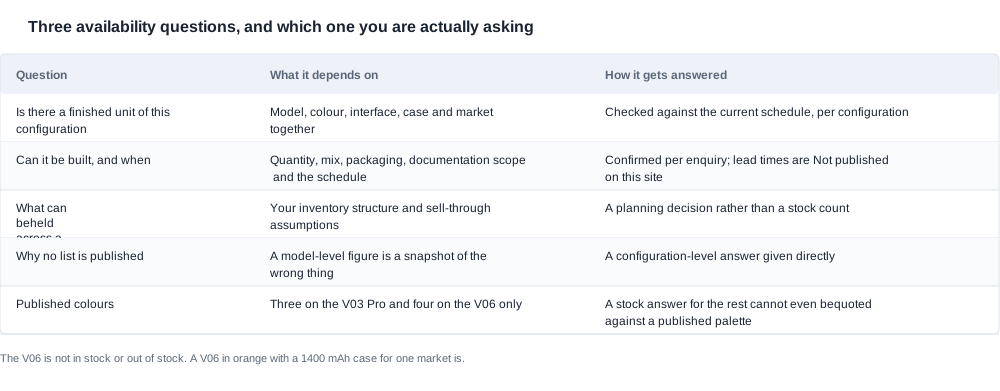
which models are in stock: three questions that have to be asked separately
Question one is production status. Is the line being built this quarter, is it a maintained line that only runs against demand, or has it been scheduled to close? The answer decides whether the conversation is about a purchase or about an end-of-life window. A maintained line that runs to order can still be a perfectly good sourcing choice; what it cannot be is planned on as though a container arriving in week six was something the plan anticipated. This is a question about the supplier's build plan and it has to be answered in writing, because it is the question that determines whether a range plan built around a model survives a quarter.
Question two is configuration, and it is the one most often missed. Our published range contains models where colour is published and models where it is not. The V03 Pro publishes three colours — orange, off-white and black — and the V06 publishes four: orange, ice-blue, white and black. Every other entry in the range publishes no colour row at all, which makes colour for those entries a question rather than a fact. The L2 Utral publishes two variant names and two case capacities, 900 and 1400 milliamp hours, without publishing which capacity goes with which variant. Those rows are the clearest published illustration of why a model-level answer is not an answer: the catalogue itself treats the L2 Utral as more than one thing without saying which combination exists.
Question three sits upstream of the other two and is the one that usually explains a surprise. A configuration can be listed and unavailable at the same time because a component is short. Our catalogue does not publish component origins and it carries no per-model certification row — the export certification page in the catalogue is an image page holding ten patent certificates, eight appearance designs and two utility models, and the catalogue text contains no reference to CE, FCC or RoHS. A buyer therefore cannot derive component risk from our published rows, and cannot derive it from a certification claim either, because there is no certification claim to read. It has to be asked, and it has to be asked as a component question rather than as a documentation question.
The three questions also have three different owners inside a supplier organisation, which is why a single reply is often incomplete. Production status sits with the build planning function. Configuration availability sits with the product or programme function, because only that function knows which colour is on which bill of material. Component availability sits with the sourcing function, and it is the one most likely to be answered optimistically and then corrected. A buyer who knows this can address each question to the right place, and a supplier who knows this can tell you which of the three answers is firm and which is provisional.
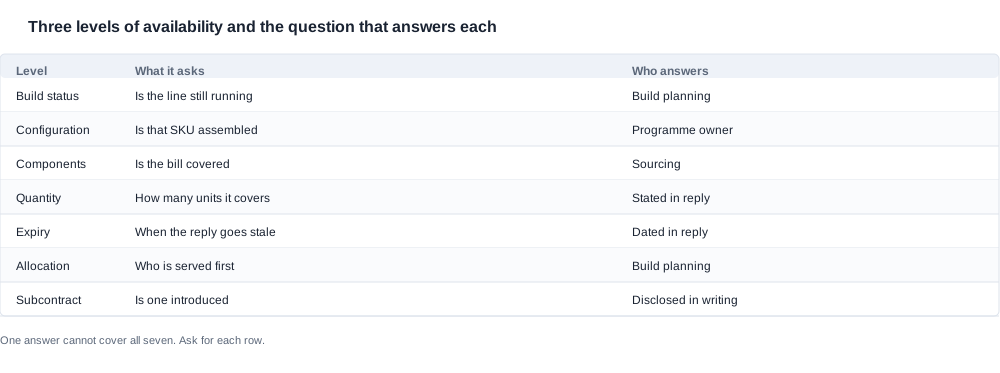

The published rows that tell you whether a line is worth asking about
Before an availability question is worth sending there is a cheaper filter: the published rows. If the row that matters to your application is blank, the availability reply will not help, because the unit that arrives will not solve the problem you had. Two examples make the point. The eleven camera models publish a resolution class — eight megapixels on the MT6 and the MT5, the V06 and the V03 Pro, and the CY03 and the V03, and the KY06 and the CY05, and thirteen megapixels on the L2 Utral and the S7, and the L1 Pro — but they publish nothing further about the camera: no sensor model, no field of view, no frame rate, no video format, no stabilisation and no low-light performance. An availability answer that says the camera line can be built does not tell you whether the image quality you need exists, and that has to be established from a sample rather than from a specification.
The charging method row separates the range into three groups, and it is a useful filter because a missing row points at a question rather than at a feature. Seventeen entries publish magnetic charging. Seven publish Type-C, which for the camera models means the V03 Pro and the L2 Utral specifically, and for the audio and sport models the D11, the D12, the D17, the ZH12 and the bone-conduction model. Four camera models publish no charging method row at all — the L1 Pro and the CY05, and the MT6 and the CY03. Those four do publish a charging-case capacity of 1400 milliamp hours, or 1200 in the MT6's folding case, so a buyer reading "no charging method" should not read "no case".
The charging-case picture is worth setting out in full because it is a three-state distribution and not two. Five camera models publish a case capacity: 1400 milliamp hours on the L1 Pro and the CY05, and the CY03, 900 and 1400 on the L2 Utral, and 1200 in the MT6's folding case. Two more, the KY06 and the MT5, show a charging case without publishing a capacity. The remaining four camera models — the V03, the S7 and the V03 Pro, and the V06 — publish no charging-case row at all. That is a silence in the document rather than a statement that no case exists, and it is exactly the kind of row that a buyer should have answered before a first order rather than after a first shipment.
The same discipline applies to the audio and sport families. All eight audio models publish a Bluetooth version — V5.3 on the K01 and the K02, V5.4 on the other six — and every one of the eleven camera models publishes none. The eight audio models publish cell configurations of 90 milliamp hours times two, 100 milliamp hours, or 55 milliamp hours times two, and their runtime figures sit at roughly eight hours, roughly seven hours or roughly six hours, with the G07 and the YK12 in the shortest of those bands. The three sport models publish 70 milliamp hours times two, 115 milliamp hours and 100 milliamp hours, and the D17 and the ZH12 are the only two entries in the whole range that publish a charge time of about one hour rather than two hours or less.
The children's entries are the thinnest rows in the catalogue and the ones where an availability question is most likely to be answered with enthusiasm rather than with information. The A05 and the A06 publish identical parameters and our own product record marks the difference between them as unconfirmed. The A07 publishes a different cell at 70 milliamp hours against the A05's and A06's 40 milliamp hours. Our product record lists the certification position for the children's category as not provided at all, and marks the app and firmware customisation capability for that category as still to be verified. Anyone shortlisting a children's line needs those four points resolved before an availability conversation is worth having at all.
Two published rows have a direct bearing on the channel rather than on the product. The ingress marking exists on two camera models only, so a channel whose application involves rain or spray has exactly two entries to work with and must not extend that marking to a sibling model. The published weight exists on one entry only, the MT6 at 158 grams for the glasses body excluding its folding case, which means a channel that has built a logistics plan around a weight assumption can only build it for that entry and must request the figure for others. In both cases the availability answer and the claim answer are the same conversation, and it is cheaper to have them together.
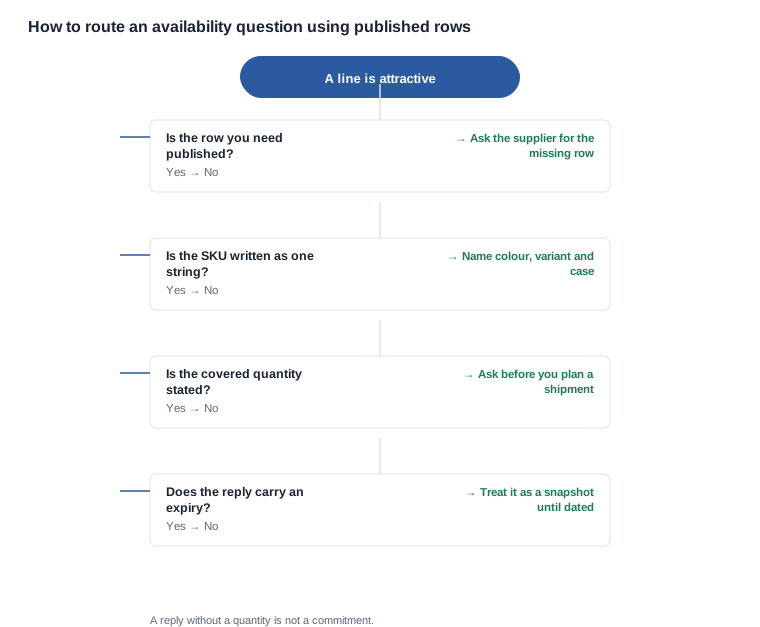
Why "in stock" has to be answered per configuration, not per model
A model-level answer is convenient in exactly the way a unit-level answer is convenient when a fault is involved: it moves the problem to the buyer without resolving it. Four configuration questions settle most of the disagreement, and they are cheap to ask.
- Which SKU is being quoted — model, colour and case combination written as one string, rather than a model name on its own.
- Which of the published variants is the base build, and whether the other one is made to order or assembled from stock.
- Whether the quoted configuration includes the case, and if so which of the published capacities applies.
- Whether the price and the availability refer to the base build or to the configuration the buyer actually intends to ship.
Those four questions exist because of what our own catalogue does and does not publish. The L2 Utral publishes two variant names and two case capacities without stating the correspondence between them. The V03 Pro and the V06 publish colour rows while the rest of the camera range publishes none. Four camera models publish a case capacity but no charging method, and four camera models publish no case row at all. A supplier who quotes "the L2 Utral" has quoted a page rather than a product, and the difference between those two things is the difference between a procurement decision and a guess.
There is a second reason configuration matters commercially, and it is about allocation rather than about the catalogue. When a component is short, allocation is applied to configurations and not to models: a factory with a constrained sensor will ship the colour that clears the schedule first and hold the other. The buyer who asked about a model learns about this as a delay on a colour they never thought to ask about. The buyer who asked about a configuration learns about it as a choice between two dates. That difference is worth one extra line in the enquiry, and it costs nothing to obtain.
Configuration granularity also determines what a range plan can safely assume. A plan built on "the MT5 will be available" is different from a plan built on "the MT5 in the base configuration with its published case will be available", and the two diverge the first time a colour becomes scarce. The same applies to the camera models with no published charging-case row: a plan that assumes a case ships with the unit is a plan built on an assumption rather than on a published row, and a plan built on assumptions is where stock-outs come from.
Open items in our own records that make an availability answer slower
There is a reason our reply to an availability question is a method rather than a list, and it is that our own records contain open items. We would rather a buyer knew about them at the start of a sourcing conversation than at the point where a purchase order is being written.
- Three entries are published without a formal SKU — the AR model, the electrochromic model and the bone-conduction model. A request that names a part number for these has to name a configuration instead, which adds a round of questions.
- The A05 and the A06 publish identical parameters, and our product record marks the difference between the two as unconfirmed.
- The L2 Utral carries a variant spelling whose intended form is not stated, together with a second variant name whose meaning is not stated.
- The MT5's catalogue page reference and its product classification are both marked as doubtful in our records, so the family it belongs to is itself an open question rather than a settled one.
- The V06 and the S7 carry a page reference that does not agree with the document layout, which matters for anyone citing a specific page during a review.
- None of the twenty-eight entries comes with photography, video or test-report evidence in the product record, so a visual, dimensional or performance confirmation has to come from a sample rather than from a file.
Each of those items is small on its own. Together they mean that an availability question sent as "is model X available" tends to produce an answer that is either a guess or a hedge, and that a question which lists the configuration, the case question, the certification question and the documentation question in one message gets a usable reply — because each of them can be answered from a build plan rather than from an opinion. The certification checklist sets out which documents exist as a category and which are the buyer's to obtain, and it is worth reading before an availability enquiry because a documentation gap discovered after the order is a schedule problem rather than a paperwork problem.
There is one more record-level gap worth naming because it is the one most often assumed rather than checked. Our catalogue publishes no per-model certification row, and the export certification page is an image page of ten patent certificates. That means an availability answer cannot be read as a compliance answer, and a compliance claim cannot be read as an availability answer. They are separate conversations about the same model, and a buyer who assumes one implies the other is taking on risk that no document on this site covers. The supplier verification and audit route is where the part of the conversation that has to happen in person belongs.

What to put to a supplier so the reply survives a planning meeting
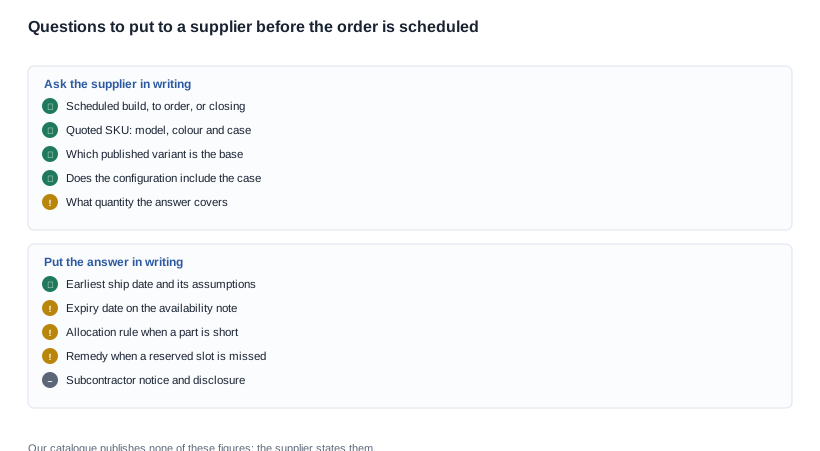
The question itself is simple; the value is in the fields. Nine items turn an availability reply into something a planner can use, and each one is a question to put to the supplier rather than a figure we can supply.
- Is the line a scheduled build, a build to order, or scheduled to close — and on what evidence?
- Which SKU are you quoting: model, colour, and case combination in one string?
- Which published variant is the base build, and which are assembled to order?
- Does the quoted configuration include the charging case, and which published capacity applies?
- What is the earliest date a unit can ship, and what does that date assume about allocation?
- What quantity is the answer valid for — one unit, one order quantity, or a quarterly build volume?
- On what date does the answer expire, and what happens to a build slot that is missed?
- If a component is short, how is allocation applied, and what notice period do we receive?
- Is a subcontractor ever introduced without notice, and how is that disclosed?
Five of those nine turn a snapshot into a commitment, and the five are the ones a buyer usually forgets: the quantity the answer covers, the expiry date, the missed-slot remedy, the allocation notice period and the subcontractor disclosure. Without the quantity and the expiry, an availability statement is not a commitment at all — it is a snapshot that goes stale in a way nobody notices until the container does not arrive.
Availability is also the term most often left out of the agreement and most often relied upon. Four clauses belong in it, and each is a term rather than a number because our catalogue publishes no delivery commitment of any kind. First, how allocation works when a component is short and what notice period applies. Second, what happens to a reserved build slot that is missed. Third, a last-time-buy notice period and a date on which the line stops being built — the date that determines how long a brand can continue to sell the model without running out. Fourth, whether a subcontractor can be introduced without notice and how the introduction is communicated. The contract terms reference covers where these clauses sit relative to the rest of an agreement, and minimum order quantity is the related term that a volume plan and an availability answer have to agree with each other.
A second and separate answer sits with the channel rather than with the factory, and the two are confused constantly. A distributor's own stock is not factory availability, and a factory's build slot is not distributor cover. The OEM-ready platform inventory planning note covers how the two sides of that equation are usually modelled, and stock and lead time for distributors and retailers covers the channel-side variables that are decided separately from a factory build plan. If the question is "can I reorder in March", the answer lives with the distributor; if it is "can you still build this in March", it lives with the factory. A buyer who has asked only one of the two questions will plan on the wrong number.
Two more questions close the loop, and both are about evidence rather than about dates. What evidence will the supplier retain against a supply commitment — a build record, a serial range, a batch date — so that a short shipment can be traced rather than argued about? And what happens to the range plan if the model is discontinued: how much finished stock is owed, over what period, and does that obligation survive the end of the build schedule? Neither question is unusual and both are routinely left unanswered until the moment they matter.
A sample request is also an availability request in disguise, and it is the cheapest way to convert a guess into a fact. How to order a sample sets out what a request should state, and a request that names the configuration and the purpose gets a faster answer than one that names a model. The same applies to colour: standard OEM colour options is worth reading before availability is raised, because a request for a colour the programme does not carry adds a week of questions before it adds an answer.
What we publish on availability and what we deliberately do not
On availability we hold a narrow line. We do not publish a stock list, a lead time, a minimum order quantity, a price, a warranty term or a production schedule for any of the twenty-eight entries, because none of those is published on this site and inventing them would be worse than the silence. We will publish the rows a buyer needs in order to judge whether a line deserves a conversation — cell capacity, runtime, charge time, charging method, camera resolution class, charging-case capacity, colour, ingress marking and, for one entry, weight — and we will tell you exactly which of those rows are blank for the model you are looking at. We will also tell you when a row is blank because the document does not carry it rather than because the product lacks it, and the four camera models with no charging-case row are exactly that case.
What we will not do is convert a specification page into an availability promise. The reason is practical as much as editorial. An availability statement we cannot honour becomes a chargeback, a delayed launch and a support queue dealing with a promise that nobody in the chain intended to make, and the cost of that lands on the brand rather than on the supplier. The useful substitute is the structure above: narrow the question with the published rows, put the configuration into the enquiry, and make the answer a written term with a quantity and an expiry date attached to it. If you send us the model and the configuration you intend to ship, we will tell you which published rows bear on it, which of them are blank, and what has to be answered by the supplier before a plan can be built on it.
Related reading
- Channel-side cover and factory-side availability — stock and lead time for distributors and retailers
- Planning the two sides of the equation — OEM-ready platforms and inventory planning and wholesale stock availability
- Getting the first unit — how to order a sample
- Colour before availability — standard OEM colour options
- The documents a programme has to produce — certification checklist
Tell us the model and the configuration you intend to ship, and we will say which published rows bear on it, which rows are blank, and what a supplier has to confirm before the order can be scheduled.


