

The S7 smart glasses suit a buyer who needs three things at once — a higher-resolution camera, a protection claim, and a size system — and they are expensive for a buyer who needs only one of those three. The published configuration is 13 megapixels, a 260 mAh cell, magnetic charging, a rated endurance range of 5 to 8 hours, an ergonomic frame, a removable inner frame and an IP54 marking.
That bundle is the whole argument. Any one of the three claims on its own can be had from a different model in the same group, at a different price, with a different merchandising position. The buyer who should buy the S7 is the buyer for whom all three land on the same product page, and the buyer who should not is the one who only needs the resolution.
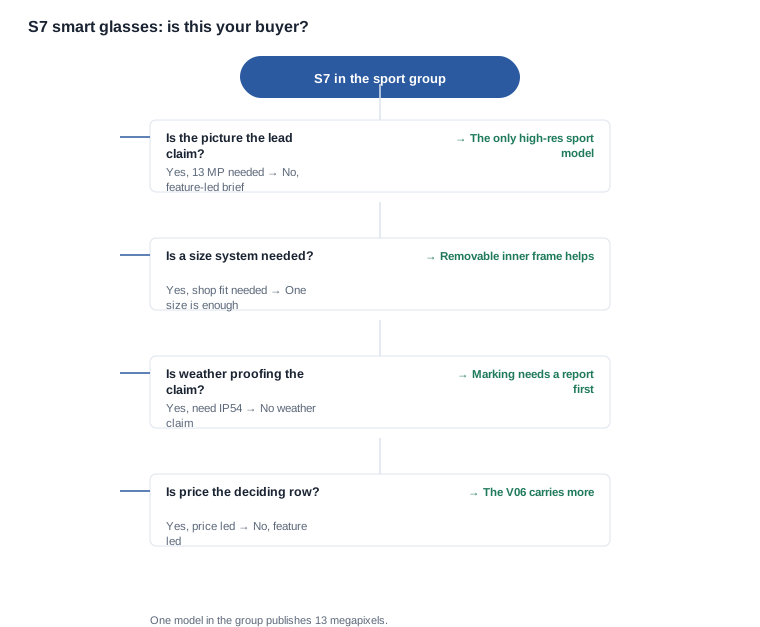
S7 smart glasses and the three claims that only come as one bundle
13 megapixels, and nothing else published about the camera. This is the only high-resolution camera model in the sport group. The V06 is the same platform at 8 megapixels, so the resolution is the entire difference between them — not the cell, not the charging method, not the endurance behaviour, and not the protection marking. That makes the decision unusually clean in one direction and unusually exposed in the other. Clean, because a shortlist of two is easy to build. Exposed, because a megapixel figure with no sensor model and no field of view behind it cannot be shown to produce a better image.
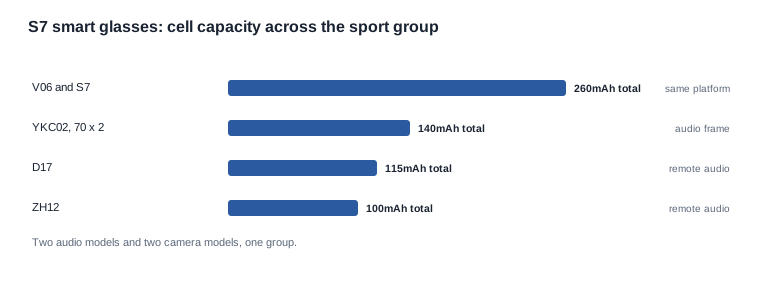
A 260 mAh cell with a rated endurance range of 5 to 8 hours. The range is a better disclosure than a point figure, because it says more than one condition was measured. It is also an admission that the result depends heavily on what the camera is doing, and no test condition is published for any model in this group. A buyer planning around the top of the range is planning around a measurement profile nobody has described. Plan around the bottom of it.
Magnetic charging, and a charging method that must be confirmed per configuration. This is a small point with a large consequence. Charging rows in this group are frequently carried across between neighbouring models in a comparison chart, and a listing that promises the wrong charging method produces a customer who cannot charge the product. Ask which interface the configuration you are ordering actually uses, and get the answer against that model name rather than against the platform.
An IP54 marking with no test report number behind it. The marking is published for this model and for the V06 in the same group. No report number, standard reference or covered batch is published for either. A marking is not evidence, and the second digit covers protection against splashing water rather than immersion or full rain exposure. If your channel plans to claim sweat resistance, rain tolerance or outdoor durability, the marking is not enough. Our IP rating guidance sets out the difference, and the sport water resistance analysis covers what the marking means where it actually applies.
A removable inner frame whose sizes are not published. This is the least discussed row on the model and arguably the most commercially valuable one. On a product taken through movement, the ability to adjust or swap the inner frame reduces returns more reliably than almost any other single feature. But the sizes available are not published, and neither is the spares route — whether replacement inner frames are sold to the channel separately, and at what minimum order quantity. Until both are answered, the feature is a word rather than a mechanism.
Sizing is the feature that decides the return rate
A camera specification decides whether a listing gets clicks. A size system decides whether the customer keeps what they bought. Those are different commercial questions, and the S7 sits unusually well on the second and unremarkably on the first.
The mechanism, stated plainly. One outer frame, one removable inner frame. The outer frame carries the electronics, the battery and the structure; the inner frame carries the adjustment that lets the same outer frame serve a range of head sizes. That is what turns a single SKU into a serviceable retail range, and it is why the S7 and the V06 both carry the feature in a group where the audio-led models generally do not.
Why it matters more in a shop than online. A customer fitting a frame in a physical store returns it immediately if it does not sit correctly, which is cheap for the channel. A customer ordering online discovers the problem on arrival, and the return travels in the opposite direction at the channel's expense. A size system only works if the channel can execute it — which means stocking more than one inner size, publishing a size guide on the listing, and giving shop staff a selection procedure rather than a guess.
The three questions that make the feature real. Which inner frame sizes are produced, and whether they are supplied in the box or sold as a spare. Whether replacement inner frames are available to the channel, at what minimum order quantity and at what unit price. And whether a damaged inner frame is a customer-replaceable item or a factory-only repair. User-replaceable versus factory-only is worth more to a service cost model than the unit price of the frame, and it is the question most often left unanswered in a due diligence file.
The measurement that is missing everywhere. Frame weight is not published for this model, and temple length and lens dimensions are not published either. Those are the numbers a sample gives you in an afternoon, and they are the numbers a shop needs to put a customer into the right size without guessing. A brand that measures them on samples and publishes its own figures gains something no catalogue page in this category currently offers.

Which buyer profile closes on the S7, and which one walks away
A content or retail brand competing on picture quality. The customer's creator publishes first-person footage and is judged on it. In this category 13 megapixels is the only published argument available at this resolution tier, and it is an argument a shopper can read without a demonstration. This buyer needs the camera specification closed once — sensor model, field of view, video resolution, frame rate — and then needs a fixed-scene sample test to convert the figure into an outcome. Without the first, the second cannot be interpreted.
A brand serving a wide size range through physical retail. The removable inner frame is the mechanism, and it is worth real money in a channel that has to fit a customer in a shop across a head-size distribution rather than to ship a single size and hope. The cost of that mechanism is inventory and a size guide, and a buyer should evaluate the inventory against the returned-unit saving rather than against the feature's marketing value.
A distributor building a premium shelf in a sport category. The S7 is the highest-resolution sport product available and it anchors a price ladder against the V06 below it. The merchandising structure is cheap to build because the two models share a platform, a cell, an endurance behaviour and a protection marking. What the distributor is buying is the top rung of a two-rung shelf, and the criteria should be whether the top rung is legible to a shopper — which it is, at 13 megapixels — rather than whether it is defensible under scrutiny, which is a separate question.
A brand whose application is genuinely outdoors. If the use case involves rain, spray or heavy sweat, this is one of only two models in the group that can carry a protection marking at all. That is a genuine qualification, and it is also the point at which the missing test report stops being a documentation gap and becomes a commercial blocker.
Where the model beside it beats it
A reseller selling on price. The V06 is the same platform at 8 megapixels, and it carries a longer published colour list. If your margin structure depends on the lowest landed cost in the group, the S7's premium buys you a resolution figure and a size system you would otherwise have to source separately. That is a real but narrow return, and it is worth pricing honestly before the range plan is signed.
A buyer whose proposition is built on documented colours. Four published colourways on the V06 against none published for the S7 means a retail range built on colour is better served by the model below. If your channel plan is a colour ladder on a shelf, the S7 cannot support it on today's documentation.
A buyer who needs a fast charge. The one-hour charge figure published in this group belongs to specific models, and a buyer planning a shared charging routine across a range needs each model's interface confirmed individually. Do not infer the S7's charge time from a neighbouring model in the same family — that inference is the most frequent error in sport-range comparison charts, and it is the one that produces a listing which describes a product the customer does not have.
A buyer who only needs one of the three claims. This is the plainest case and the most common. The S7's premium buys the three together. The V06 buys two of them at a lower price, and the sport group's audio-led models buy the protection marking at a lower price still. When a buyer can name which single claim is doing the work in the range plan, the S7 is usually the more expensive way to buy it.
The total cost version of the same question. When a buyer compares two models on price alone, the S7 loses, because the premium is real and visible. When a buyer compares them on total cost per retained unit, the picture changes: the sizing system is only worth what the channel's ability to execute it is worth, and the resolution step is only worth what the listing is allowed to claim about it. A premium that cannot be printed on the product page cannot be recovered at the shelf, which is why the boundary between published and unpublished rows is a commercial variable and not a documentation detail. Buyers who run that variable through a total cost model before committing usually find that the premium is defensible only if the three claims all reach the copy.
A buyer needing a documented colour, a documented weight or a certified durability result today. None of those is available for this model on the published documentation. That is not disqualifying — they are closeable — but it changes the schedule, because a certificate position is a lead-time item rather than a copy item.

Verification steps and the criteria for the first order
The S7's open rows are ordinary and closeable, and the order in which you close them saves more time than the order itself. The camera specification governs the listing, the sizing governs the inventory, and the durability evidence governs the schedule. Get them in that order.
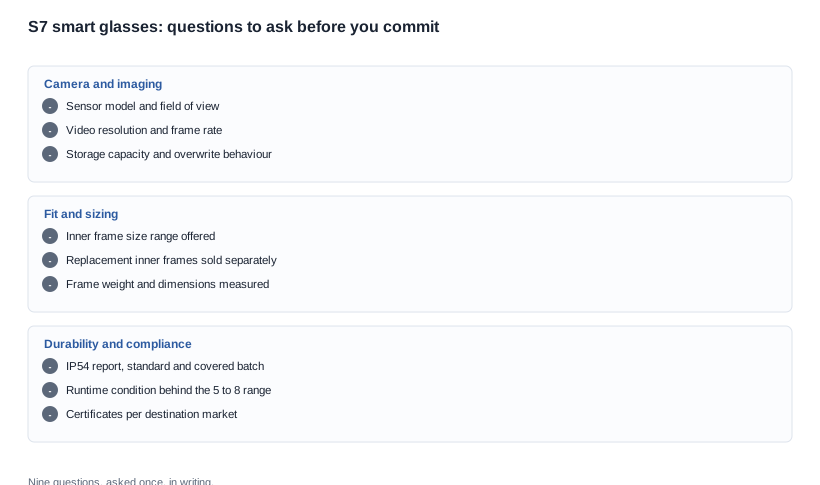
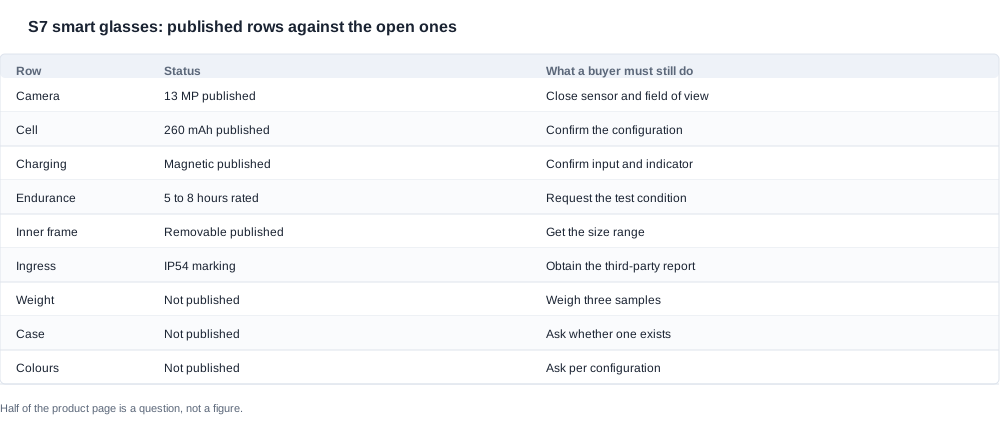
Send one written request covering all nine open rows. The camera specification, closed once for the sport platform rather than per model, so that the S7 and the V06 cannot end up with contradictory figures in two different listings. The ingress evidence, with the standard, the laboratory and the sample batch covered by the report. The inner frame size range and the spares route. The conditions the endurance range was measured under. The frame weight and the measurements, taken from samples. And the documents that name this model, market by market.
Weigh three samples, and record all three rather than the average. The same production spread question applies here as on any model, and on a product sold through a shop where the customer can try it on, the weight determines the fit conversation the staff has to have.
Hold a sample and shoot one fixed scene against the V06. Same light, same framing, same subject. This is the only test that tells you whether the resolution step is visible in the delivered footage or whether you are paying for a specification. On an 8-to-13 megapixel step the answer is usually yes in good light and frequently no indoors, and knowing which is true before the copy is written is worth the afternoon.
Confirm the charging interface against the model name, in writing. Ask for it as part of the same request and record the answer in your technical file for this SKU. The interface is a packaging line, an instruction-sheet line and a certification line, and it is the row most often carried across from a neighbouring model.
Decide the listing boundary before the copy exists. Published rows you may print: the resolution, the cell capacity, the charging method, the endurance range as a range, the removable inner frame, the ergonomic frame description and the IP54 marking as a marking. Open rows you may not: the sensor, the field of view, the video specification, the weight, the frame dimensions, the colour list, the case, the runtime condition and the certificate coverage.
Terms, red flags and the position we take on the S7
What the S7's position is worth. A three-claim bundle on a shared platform, at the top of a two-rung shelf, in a category where the number of models is small enough that a buyer can hold the whole range in mind. That is a decent position. It is also a position that depends entirely on three published rows staying accurate, which is a supplier relationship question rather than a product question.
Open to negotiation, and worth the time. Unit price and volume tiers across a bulk order; the spare inner frames and their minimum order quantity, which is usually the line item that decides whether the sizing feature can be executed; packaging specification; delivery splitting so a first tranche can be validated; payment terms with nodes against inspection; the warranty period with a stated response time; return terms for defective units; and the terms of a pilot order. The spare-parts minimum order quantity is the trade-off most worth negotiating, because a channel that cannot reorder the inner frame cannot deliver the fit promise it published.
The schedule is the negotiable half of this cost stack. Certification cost and lead time are fixed by the schedule and by whoever runs the test and cannot be moved by a conversation. Tooling behaves differently, because it is frequently amortised across a first order while certification cost attaches to a product family — so when a single quotation bundles the two, ask which one you are being quoted, because the answer decides whether the second order carries a tooling charge.
Red flags worth naming at the quotation stage. A supplier who quotes an endurance point figure where the range is published. A supplier who prints the IP54 marking as a tested rating without a report number. A supplier who describes the removable inner frame without being able to name the sizes. A supplier who extends a certificate across a group rather than to a model schedule. Each of those is cheap to raise before the purchase order and expensive to raise after the first shipment, and each of them is a question to ask rather than an accusation to make.
Where we stand. Our position is that the S7 is the right answer for a narrow and valuable brief and the wrong one for a broad brief, and that a brand listing it before the camera, the ingress evidence and the size range are established is selling a promise rather than a product. We will not present 13 megapixels as an image quality claim without a sensor model, we will not print the IP54 marking as a tested rating, we will not present the 5-to-8-hour range as a working day, and we will not quote a weight, a size range, a case capacity or a certificate number that the documentation does not contain.
And the practical consequence. A buyer who chooses the S7 for all three claims and closes them before the copy is written gets a product page that is defensible on every line. A buyer who chooses it for the resolution alone inherits nine open rows and a premium they cannot explain in a listing. The published S7 specification list is the honest baseline, and the S7 buyer review checklist turns the nine open rows into a sample-stage list.
Clauses for the agreement. The published rows for the configuration ordered; the camera specification once closed; the ingress report or the explicit position that none exists; the inner frame size range and the spares route with their minimum order quantity; the measured weight and dimensions; the warranty period with a stated response; and the certification position per market. Clauses to leave out entirely: any weather claim without a report, any image quality claim not tested on a fixed-scene sample, any weight not measured, and any single-figure runtime drawn from a range.
The practical test before you commit. Take the three claims in the order a shopper reads a product page — resolution, protection, sizing — and ask for each one to be pointed at a line you can print. If all three point at a published row, shortlist the model. If two point at an open row, the premium is buying a roadmap rather than a product, and the model beside it is the cheaper way to hold the position until the evidence exists.
Related reading
- This model's published rows — S7 smart glasses specifications and features
- The tier below it — V06 smart glasses value for money
- The commercial logic — S7 smart glasses value for money
Send us the channel, the target price band and the markets, and we will tell you whether the S7's premium survives the first week in a customer's hand.


