
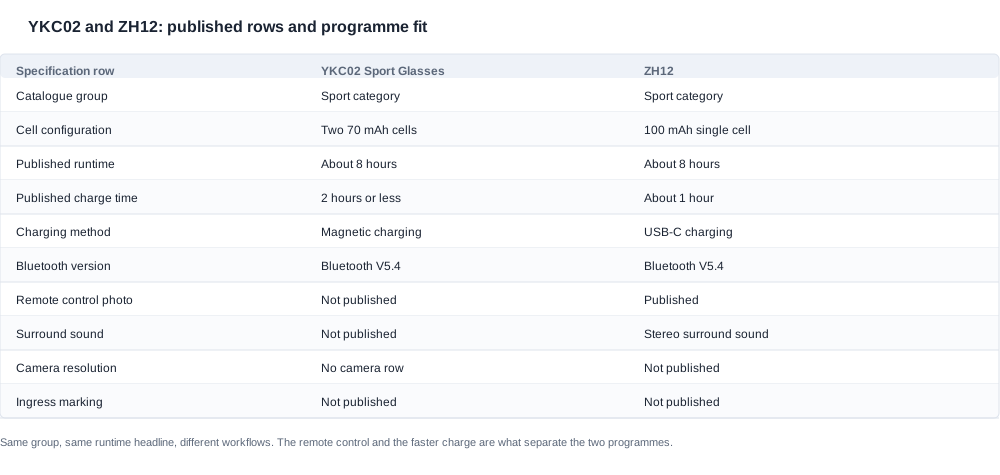
Two models can share a category, publish similar runtime figures, and still serve completely different programmes. The YKC02 and the ZH12 are the clearest example of that in the sport category: both publish about 8 hours of runtime and both publish Bluetooth V5.4, yet one of them publishes a remote control shutter and an approximately one-hour charge time while the other publishes neither.
The mistake we see most often is treating that gap as a list of features to rank. It is not a ranking problem. A remote control shutter and an approximately one-hour charge time are not features to rank; they are workflow answers to specific operating conditions. This guide maps each model to the programme conditions it fits, using only published catalogue rows, and it tells you what to ask the supplier to close the remaining gaps before a purchase order.
What the YKC02 and the ZH12 publish
Both models sit in the same catalogue group. The sport category contains exactly three models: the YKC02, the D17 and the ZH12. That shared classification is what makes this a clean comparison, because the catalogue publishes rows across the group rather than treating each model as an isolated entry.
| Specification row | YKC02 Sport Glasses | ZH12 |
|---|---|---|
| Catalogue group | Sport category | Sport category |
| Cell configuration | Two 70 mAh cells | 100 mAh single cell |
| Published runtime | About 8 hours | About 8 hours |
| Published charge time | 2 hours or less | About 1 hour |
| Charging method | Magnetic charging | USB-C charging |
| Bluetooth version | Bluetooth V5.4 | Bluetooth V5.4 |
| Remote control photo | Not published | Published |
| Surround sound | Published | Stereo surround sound |
| Camera resolution | No camera row published | Not published |
| Ingress marking | Not published | Not published |
| Weight, dimensions, colours | Not published | Not published |
| Price, MOQ, lead time, warranty | Not published | Not published |
Three rows carry most of the decision.
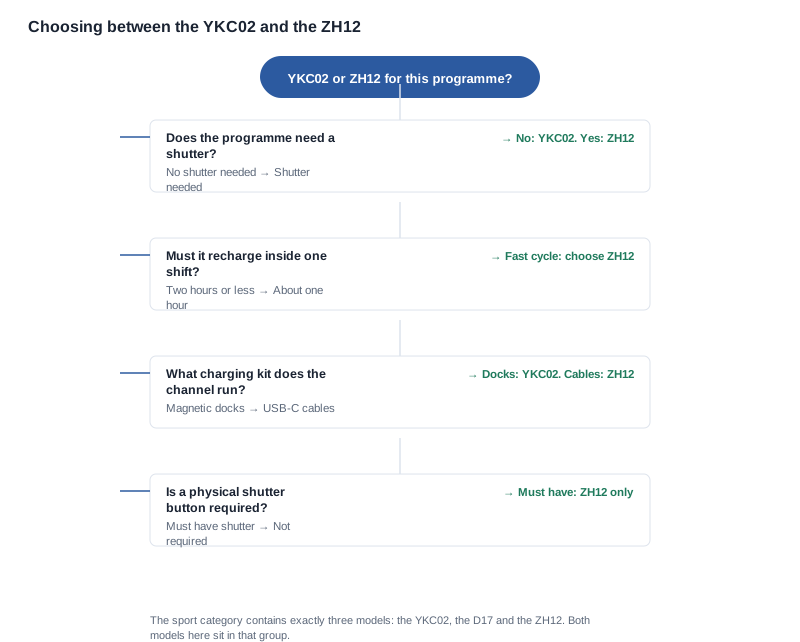
The remote control shutter is published only on the D17 and the ZH12. The YKC02 publishes none, so there is no shutter workflow to design around on that model. If your programme depends on the wearer triggering capture without touching the temple, the YKC02 cannot deliver that as published, and the question to ask the supplier is whether an alternative trigger exists on this model rather than whether a remote can be added.
The charge time differs by a full band, and both figures are published. The YKC02 publishes a ceiling of 2 hours or less. The ZH12 publishes an approximately one-hour figure. Across the whole catalogue, 26 of the 28 models sit at the 2-hour-or-less ceiling, and only the D17 and the ZH12 publish the approximately one-hour figure. So the ZH12 belongs to a two-model minority on charge time, and that minority position is the single clearest operational difference between these two models.
Both publish about 8 hours of runtime, but with different cell arrangements. The YKC02 runs on two 70 mAh cells; the ZH12 runs on a single 100 mAh cell. The identical runtime headline comes from two different physical designs, which is worth noting before anyone concludes that the two models are interchangeable from a battery standpoint. The YKC02's two-cell arrangement is the one to interrogate on docking and packaging; the ZH12's single cell and USB-C charging is the simpler case for a channel that already distributes USB-C cables.
The published rows for both models are collected in the YKC02 best-for use case article and the ZH12 specifications and features reference, and the wider shortlist logic sits in our guide to choosing between the sport-category models.
Two absences apply to both models and are worth stating up front. Neither publishes a camera resolution, so neither can be positioned on stills quality, and neither publishes an ingress marking, so neither can carry a weather-resistance claim from published data. Neither publishes frame weight, dimensions, lens material, colour options, price, MOQ, lead time, sample policy, warranty or certification status.
Certification evidence deserves the same treatment it gets across this range. The certification strings a buyer would normally look for do not appear in the catalogue body, so we will not claim certification status for either model. Ask the supplier for certification evidence as a written deliverable, with its own document reference, and treat it as separate from the specification sheet.
One more shared limitation deserves naming, because it shapes the whole exercise. Neither model publishes a capacitive touch row and neither publishes a translation row, so no control scheme beyond what is explicitly published can be assumed for either of them. Control behaviour is exactly the area where a channel partner's expectations are usually widest, and it is precisely the area the published data leaves open.
Where the YKC02 fits a programme
The YKC02 is the sport-category model for programmes that run on magnetic charging and do not need a shutter. That is a narrower brief than it first sounds, and it is worth stating precisely, because the published rows point at a specific kind of use.
The strongest fit is a programme built around shared, high-turnover charging infrastructure. Magnetic charging means the device seats onto a dock rather than requiring a cable, and the YKC02 publishes no USB-C charging row of any kind. If your retail programme, gym partner network or event kit is already built around a magnetic dock, the YKC02 fits that infrastructure directly and you avoid the cable-management problem entirely.
The second fit is a programme where the YKC02 is the "audio and control" unit in a range rather than the hero unit. Because the YKC02 publishes no camera row, it is straightforward to position it as a hands-free audio and control device. A brand can place it next to camera models without creating a false expectation about image capture. The trade-off is that it also cannot be sold on a shutter workflow, and it cannot carry a weather-resistance story from published data.
The third fit is a gift-with-purchase or attach item in a bundle, where the buyer cares about unit economics and charge logistics rather than headline features. For that use, two 70 mAh cells plus magnetic charging plus a published about 8 hours of runtime is a workable proposition, provided you have the answers to the packaging and weight questions before you commit to a display.
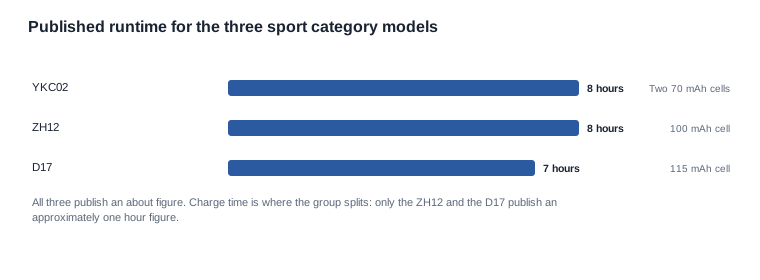
The third sport model matters here. The D17 specifications reference shows the middle position in the group: a 115 mAh single cell, about 7 hours of runtime, an approximately one-hour charge time, USB-C charging, Bluetooth V5.4, and the published remote control photo and surround sound. So the D17 shares the ZH12's fast-charge and remote-control characteristics while giving up roughly an hour of runtime relative to both the ZH12 and the YKC02.
Two published rows sit against the YKC02: it publishes no remote control and no ingress marking, and its charge ceiling of two hours or less is the slower figure shared by most of the catalogue. Two published rows sit in its favour: the two-cell arrangement with magnetic charging, and a stated Bluetooth version where the camera-group models publish none.
We will be direct about the limit of this fit, and we will say the same thing to the supplier. A buyer choosing the YKC02 is choosing a model whose published rows are clean but sparse, so the commercial case has to be built on operational simplicity rather than on a feature comparison against a rival. Get the unpublished rows in writing early, because a sparse published row set means a larger share of your risk sits in the questions you have not yet asked.
There is one cost to the magnetic-charging fit that channel teams tend to underestimate, and it belongs in the commercial model rather than in the specification sheet. A magnetic dock is not a free accessory. It has to be bought, stocked, kept at counter positions, and replaced when it fails, and a dock failure at a counter in front of a customer is a service incident rather than a returns parcel. We will therefore ask the supplier for the dock separately in the quotation: unit price, minimum order quantity, lead time, whether spare docks are available at a lower volume, and whether the dock is included in the box or sold as a channel accessory. If your programme already owns a dock fleet, the YKC02 is cheap to adopt. If it does not, that fleet is the real line item, and it needs to be in the pilot order budget from day one.
Where the ZH12 covers the other programme
The ZH12 fits programmes where capture happens without touching the frame, where the unit has to be re-charged inside a normal working day, and where the device arrives in a channel that already handles USB-C cables.
Start with the remote control, because it changes the demo script before it changes anything else. A published remote control photo means the wearer can trigger capture without reaching for the temple, which turns a static product demo into an active one. In store, that is the difference between a customer watching a product sit on a display head and a customer watching a capture happen while they walk. In an event or field-sales setting, it is the difference between a usable demonstration and one that constantly fails because the person touched the wrong part of the frame.
The remote control also creates a second thing the buyer has to manage, which is a second object in the box. A shutter workflow has an accessory attached to it, and accessories have their own questions. We will ask the supplier whether the remote ships in the box, whether it is available as a spare, whether the remote needs its own pairing step, what the remote's own battery or power source is, and how warranty is handled when the remote fails while the glasses are fine. A brand that has not asked that question usually finds out at the returns counter.
Now take the approximately one-hour charge time, which is the row most likely to change a channel programme. On paper, one hour versus two hours is a modest difference. Operationally it is a different day.
- In-store demo. A staff member can take a unit off the shelf, charge it, and have it ready inside a shift. On a two-hour ceiling, a unit brought back from the charge drawer may still be below a demoable state when the customer asks, and the demo becomes a promise about tomorrow.
- Returns handling. A returned unit at partial charge can be restored to a saleable state inside a service window. That is the difference between a unit that goes back onto the shelf and a unit that goes into a quarantine bin until somebody finds time to charge it.
- Reverse logistics turnaround. Shorter restoration time compresses the whole returns cycle, which shows up as fewer aged units and less working capital tied up in returned stock.
- Field and demo-team kits. A kit that can be recharged between appointments changes how many units a small team needs, because units are not sitting in a drawer waiting.
- Event and demo-day handling. On a multi-day event, a unit that recharges in an hour can be rotated through a full day of demonstrations; a unit on a two-hour ceiling cannot.
Add the published stereo surround sound, and the ZH12 also has a demonstrable audio character: its catalogue row names stereo surround, where the YKC02's row names surround sound. That gives the store team something to talk about that is not a specification number, which matters more in that setting than most buyers expect.
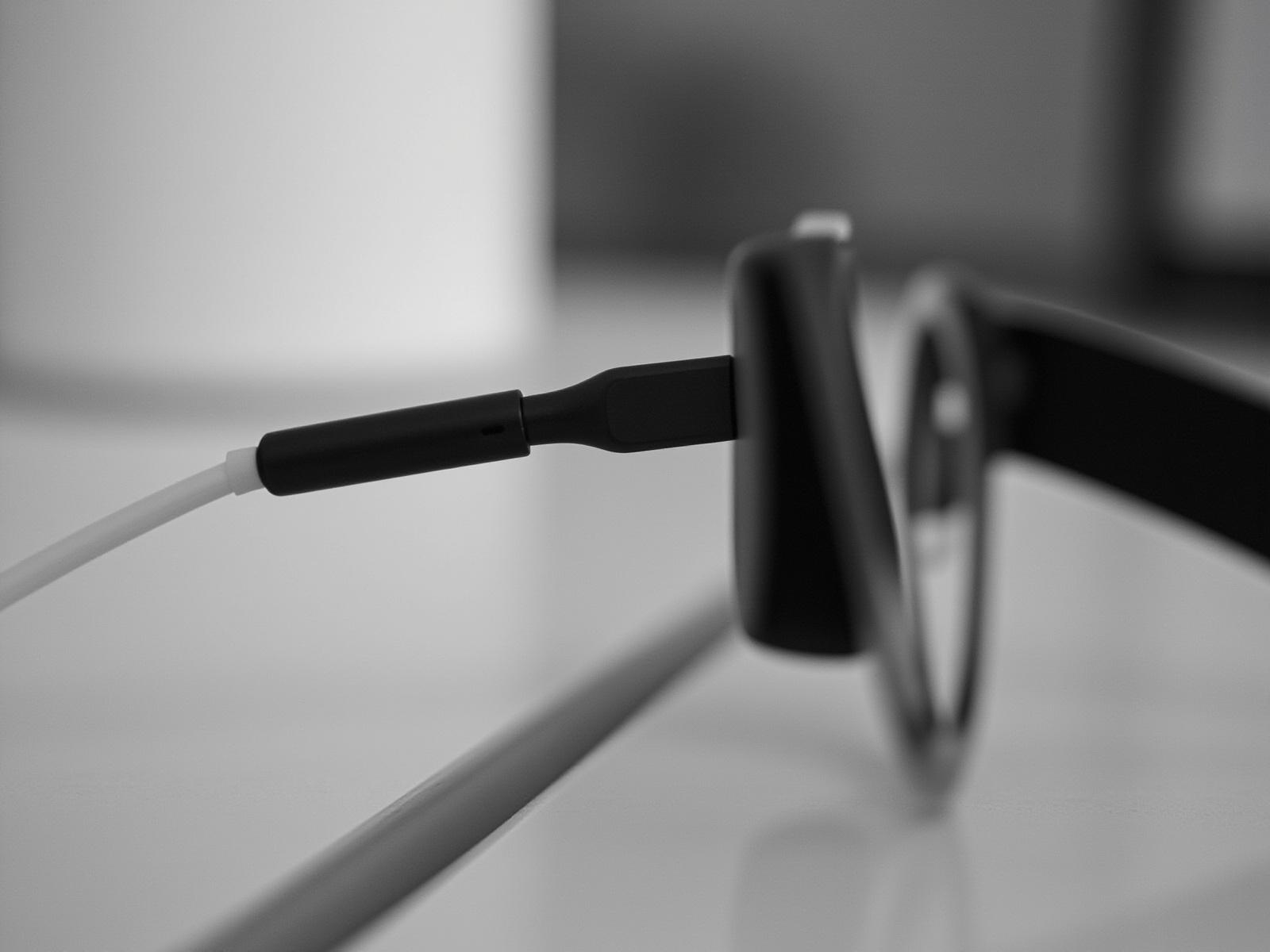
The USB-C charging row is easy to underrate. It means the device charges with the same cables the channel already buys, holds and loses. There is no dedicated dock to stock, no dock to spare and no dock to lose, which is the exact opposite of the YKC02's magnetic arrangement. For a distributor shipping to hundreds of retail accounts, that is a meaningful reduction in handling and in freight.
The trade-off is the opposite of the YKC02's. The ZH12 carries a single 100 mAh cell rather than a two-cell arrangement, and the published runtime is a single about 8 hours figure rather than a range. It publishes no camera resolution and no ingress marking, so it cannot be positioned on those axes. And it is the smaller of the two published cell configurations, which is exactly the kind of detail that should be raised with the supplier rather than resolved by inference.
The picture changes again when the programme is a demo-led retail sale rather than a device sale. The published stereo surround sound gives store staff something to demonstrate that does not require a technical explanation, and the published remote control photo gives them an action to perform. We will therefore separate two things that buyers often merge: what the device can do, and what staff can show a customer in under a minute. The ZH12 publishes enough to support the second, which is why it often works as the counter product even where the YKC02 carries rows the ZH12 does not. For the broader view of this model in use, our ZH12 best-for use case article covers the programmes it fits.
The D17 belongs in the same conversation because it shares the fast-charge and remote-control rows. Its published runtime is about 7 hours against the ZH12's about 8, its cell is 115 mAh against the ZH12's 100 mAh, and it publishes surround sound rather than the ZH12's stereo surround sound. On published rows alone, the two models differ in cell configuration and runtime rather than in the fast-charge row they share, and the D17 is the alternative if the supplier can offer a different commercial structure.
What to ask before choosing YKC02 or ZH12
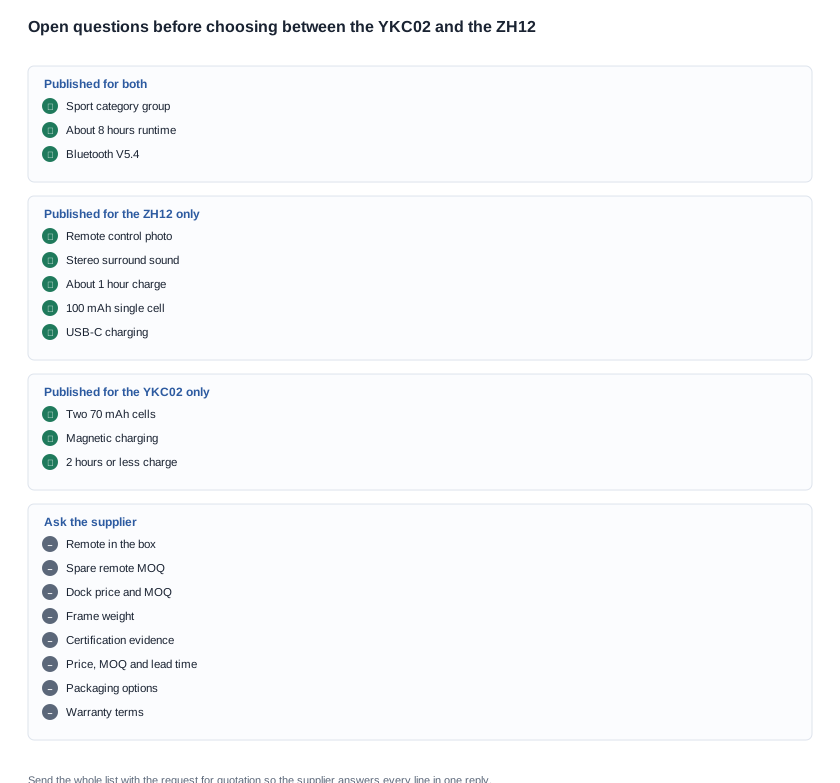
The two models publish different row sets, so the questions split cleanly. Here is the working list, written as questions rather than as blank headings, because a phrased question gets a complete answer and a heading gets a partial one.
On the YKC02 side:
- What is the frame weight in grams, and what are the frame dimensions?
- What are the lens material and the available colour options?
- Is there any ingress or IP rating for this model, and what test evidence supports it?
- How are the two 70 mAh cells arranged, and do they charge together or independently on the magnetic dock?
- Is the magnetic dock included in the box, and what is its separate price, minimum order quantity and lead time?
- Are spare docks available at a lower minimum order quantity, and what is the warranty position on the dock?
- What trigger or control method is available on this model, given that no remote control is published for it?
On the ZH12 side:
- Does the remote control ship in the box with every unit, or is it a separately ordered item?
- What is the spare-remote minimum order quantity, lead time and unit price, and what is the warranty position on the remote?
- How is the remote associated with the glasses, and does that association persist for the buyer or the end user?
- What power source does the remote itself use, and how is that handled in returns?
- What is the frame weight in grams, dimensions, lens material and colour options?
- Is there any ingress or IP rating, and what test evidence supports it?
Common to both, and to be raised in writing with the request for quotation:
- What test profile does the published runtime figure assume, and what does the runtime measure under continuous use?
- Is the published charge time measured from a fully discharged battery, and at what ambient temperature?
- What certification evidence can you provide, with document references and scope?
- What is the price, minimum order quantity, lead time, incoterms and sample policy?
- What packaging formats are available, and what tooling or artwork lead time does a branded pack require?
- What spares do you hold for this model, and what is the warranty period and the warranty claim route?
- Can you confirm the cell capacity in the shipped configuration, and whether it changes by colour or pack option?
Here is how we will sequence this in a real programme. Before the pilot order, request the quotation with the whole list attached and ask for a written answer per line. During the pilot order, place samples of the shortlisted model and test the two workflows that matter: for the ZH12, the capture-by-remote workflow under movement, and the full charge cycle timed; for the YKC02, the magnetic dock cycle and the total handling time for a customer to pick up, seat and charge. After the pilot order, fold the confirmed answers into the comparison sheet so the next channel conversation starts from a record.
The trade-off to negotiate is straightforward once the rows are in front of you. The ZH12 buys you a shutter workflow, an approximately one-hour charge time, stereo surround sound and standard USB-C handling, at the cost of a smaller published cell configuration and a second accessory to manage. The YKC02 buys you magnetic docking and a two-cell arrangement, at the cost of a slower charge ceiling, no published remote control, and no camera row to differentiate against. Neither is a better product. They are answers to different operating conditions, and the right one is the one that matches the programme you are actually running.
If you are still shortlisting rather than deciding, the sport smart glasses category page lists the full sport range, and our guide to picking between the sport models walks through the decision sequence across all three sport-category models. Once you have made the call, take the remaining questions to the supplier as a single written request, and negotiate the pilot order, samples, MOQ, lead time, incoterms, packaging, spares, warranty and certification evidence from a single shared document rather than from two separate sets of marketing claims.
One last piece of advice for the channel side of the business. Record which of these rows were confirmed in writing and which were inferred, and keep the two apart. We will not publish an inferred row as if it were a published one, and the same rule should apply to the specification sheet you hand to a retail partner, because a partner who discovers that a figure was inferred will discount every other figure on the sheet. The rows that stay labelled as open questions are also the ones you can use to negotiate: a trade-off on MOQ, lead time or incoterms is much easier to frame as a specific open specification item than as a generic request for a better price. That is the practical payoff of reading the catalogue as a set of published rows and absences rather than as a list of features, and it is why the gap list is the artefact worth keeping, long after the comparison itself has been filed.


