
Most product pages about a model like the ZH12 are written to remove doubt. They list what the device does, they confirm that it fits the use case you had in mind, and they leave the buyer with a clean impression of a finished product. That is exactly what a seller wants you to feel, and it is exactly why the same page can cost you a season of channel trouble.
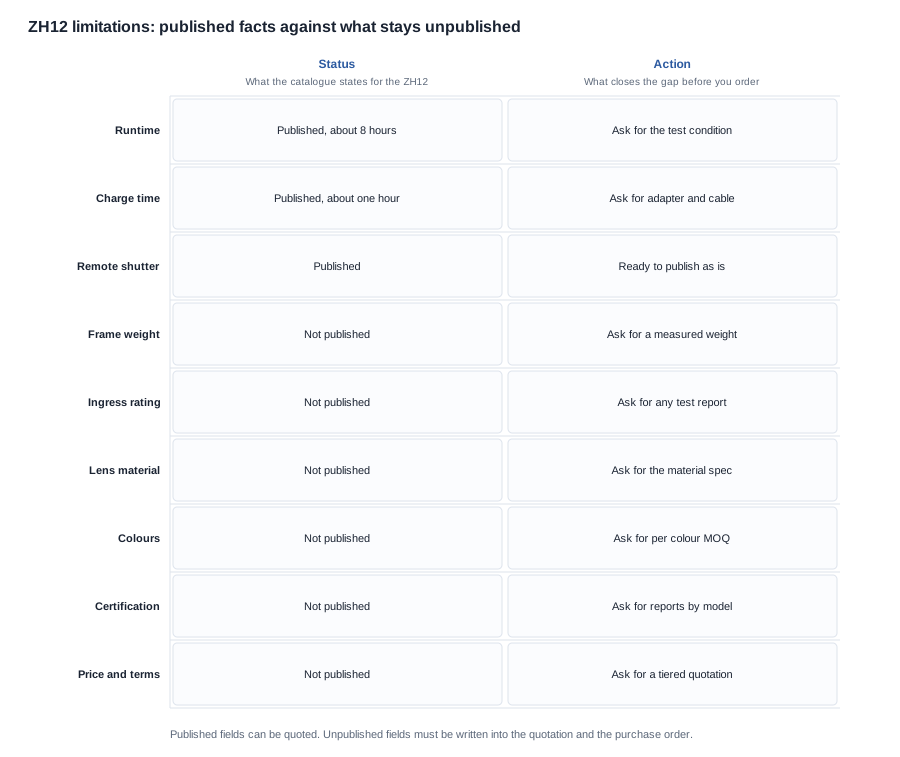
We will take the opposite route here. The ZH12 has real strengths, and the published specification is genuinely good in two places: the charge time and the remote shutter. It also has a specific set of limitations, and they are not evenly distributed. Some are structural and you cannot negotiate them away. Some are simply unpublished, and those are not limitations of the product at all — they are gaps in the data that you close by asking the right questions before you sign. Telling the two apart is the entire point of this article, because a buyer who treats an unpublished number as a product weakness will walk away from a workable supplier, and a buyer who treats a real structural limit as a data gap will discover it at inspection stage.
What the ZH12 specification sheet actually says
The published ZH12 row is short, and buyers routinely treat short rows as complete ones. It is worth reproducing it in full, because most of the mistakes in this category come from what is missing rather than from what is written.
- Category: sport
- Battery: 100 mAh, single cell
- Runtime: about 8 hours
- Charge time: about 1 hour
- Charging interface: USB-C
- Bluetooth: V5.4
- Features: remote control photo, stereo surround sound
Everything a buyer needs for a fast decision is on that list. Everything a buyer needs for a safe order is missing from it, and the two sets do not overlap much.
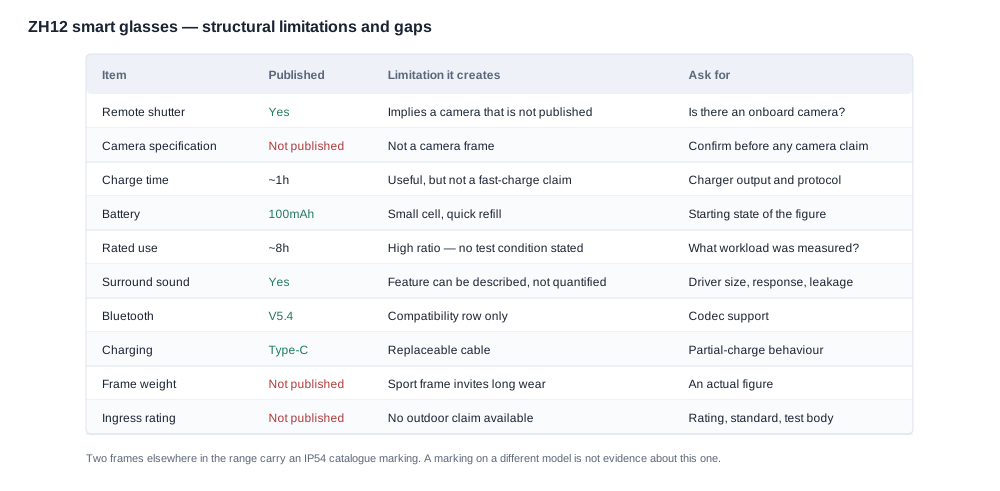
There is a second structural fact about the row itself that changes how you read it. This model publishes no camera specification. The catalogue does publish camera resolutions elsewhere — 8 MP on eight models, 13 MP on three models — but the ZH12 has no camera row at all, and it sits in the sport category with the YKC02 and the D17 rather than in the camera group. That means the ZH12 is a sport-category audio model with a physical remote shutter, and the correct move is to sell it on that basis. The trade-off is that you lose the camera feature as a conversion hook, and you gain a device that does not carry the expectation of image capture in the first place. For a channel that has been burned by camera modules that underdeliver, that is often the better position.
Before going further, two corrections that are commonly mis-stated in reseller listings, because each one creates a claim the supplier has not made.
First, the remote shutter is not a general catalogue feature. Remote control photo is published on exactly two models in the whole range: the D17 and the ZH12. If a supplier pitches a remote shutter and a "one hour charge" together, they are describing this model or its closest sibling, and the pairing is a useful authenticity check against listings that have been assembled from generic copy.
Second, the charge time is not shared. Twenty-six of the 28 models publish "2 hours or less", which is a ceiling rather than a measurement. The D17 and the ZH12 publish about one hour, and nobody else does. We will keep saying this in a different way because it is the single most repeated error in this product category: a ceiling is not a measurement, and comparing your model against a competitor's ceiling is not a comparison you would want to defend in a channel dispute.
The other correction is about what this model is not. The ZH12 has no camera specification published, no capacitive-touch entry, and no translation entry. It is a sport-category audio model with a physical remote shutter. We will not treat a camera as part of the product, and we will not treat a feature as present merely because a neighbouring model in the catalogue has it. Those two habits are the source of most of the complaints that come back to suppliers, and the fix costs nothing but discipline at the specification stage.
The full published row is also collected at ZH12 smart glasses specifications and features, and the category context sits on the Sport Smart Glasses page.

What the catalogue does not publish about the ZH12
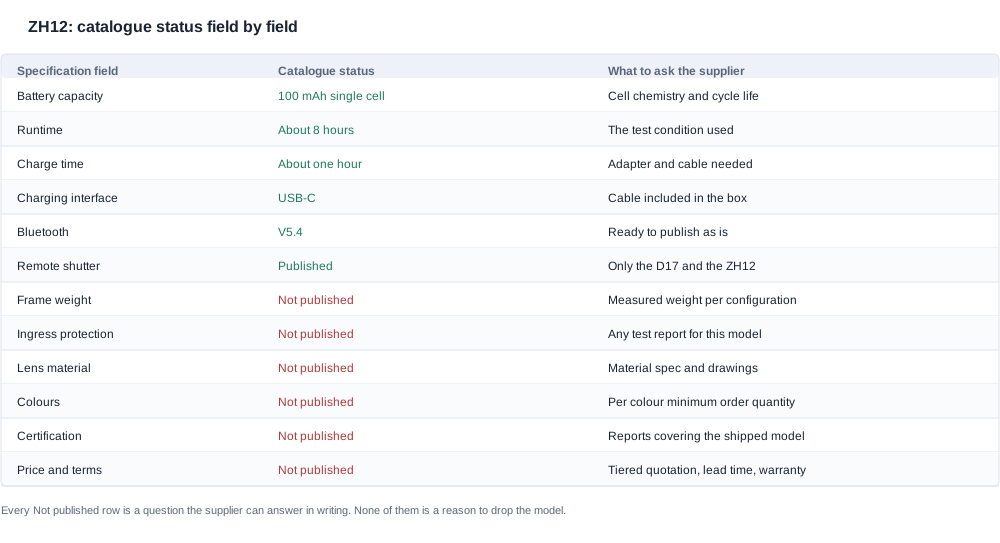
This is the section that decides orders, so we will go field by field and be blunt about which gaps are closable and which are structural.
Frame weight. The catalogue publishes a weight for exactly one model in its entire range: the MT6, at 158 g for the glasses body, excluding its 1200 mAh folding case. For the ZH12 there is no weight at all. Any claim about how light these are is currently unbacked, and the single published figure in the catalogue belongs to a different product with a different architecture. If your program depends on a weight claim, that number has to come from a measured sample, and the measuring convention has to be written down — body only or body with the case and packaging, since a buyer who measures one and a customer who assumes the other will dispute it.
Ingress protection. IP54 is published for only two models in the catalogue, the V06 and the S7. The ZH12 has no ingress rating published. For a sport-category model that will be used outdoors, this is the most consequential single gap in the published row, and it is structural rather than clerical: nobody has published a rating for this configuration, so there is no test report behind it to request.
Frame dimensions and lens material. Neither is published for the ZH12. These are routine fields on a wholesale spec sheet, and their absence tells you something about how much of the catalogue was compiled from a marketing-facing summary rather than from engineering data. Get both in writing, because lens material drives your care and cleaning instructions, your drop-test expectation, and your customer service script.
Colours. No colour options are published for the ZH12. Colour drives the minimum order quantity in almost every wearable programme, so this is not a cosmetic gap. If the supplier offers four colours and one of them has a MOQ of 500 while another has 2,000, your whole inventory plan changes. Ask for a colour-by-colour MOQ matrix, not a single MOQ number.
Certification. This one requires care, because it is where the most confident false claims are made. CE, FCC, RoHS, RED, and EN 18031 do not appear anywhere in the catalogue body for any model, including the ZH12. The export material in the catalogue is an image page showing ten patent certificates, eight design patents and two utility models, which is intellectual property evidence rather than a regulatory certification for a shipped configuration. Neither a patent portfolio nor a category-level statement about a factory's approvals will satisfy a retailer who needs test reports covering the ZH12 as it will actually be shipped. The coverage question is handled in detail at OEM-ready platforms and certification coverage, and the practical answer is to require the reports by model and by configuration, named, dated, and matching the exact SKU in your purchase order.
Price, MOQ, lead time, samples, warranty, and tooling. None of these are published for any model in the catalogue, including the ZH12. That is normal for a manufacturer-facing catalogue, and it is not a mark against the product. It does mean these terms live entirely in the quotation and the purchase order, and a buyer who treats the catalogue as a commercial document will end up with a purchase order full of implicit assumptions. We will come back to each of them in the final section, because the difference between a published number and an assumed one is the difference between a defensible margin and a margin that disappears in transit.
Battery cell detail beyond capacity. The 100 mAh figure and the single-cell architecture are published. Chemistry, cycle life, cell supplier, replaceability, charging current, and the charger inclusion are not. Capacity alone does not tell you the degradation curve, the end-of-life behaviour, or whether a returned unit is a repair or a write-off. This one is worth extra attention because it interacts with the headline runtime claim: a published eight hours with no cycle life and no test condition is a marketing number, and it should never reach a retail listing unqualified.
Charging case. Not published for the ZH12. Five models in the catalogue publish a case capacity, two have a case without a capacity figure, three rows state no case, and the V03 Pro explicitly states none. Because the sport category uses different approaches model by model, the case status of the ZH12 cannot be inferred from its siblings and must be confirmed.
Bluetooth coverage. V5.4 is published for 14 models and is not published for the eleven camera models, the A05, the A06, or the bone conduction entry. The ZH12 is in the published group, so you can state the radio version on a product page with confidence.
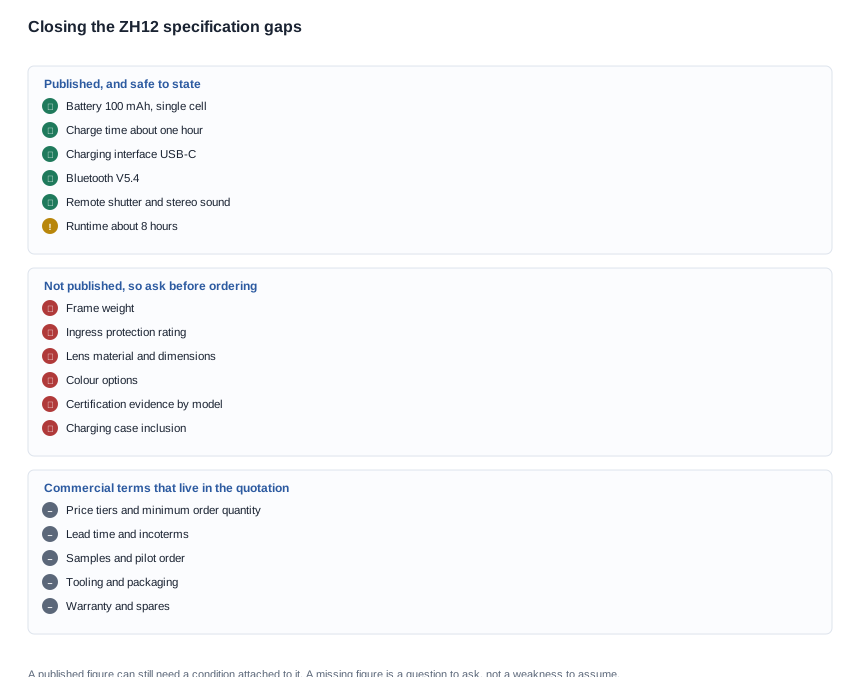
The honest summary is this: the ZH12's published row is strong on the two numbers that matter most to a retail listing — runtime and charge time — and empty on nearly everything that matters to a landed-cost model. Those gaps are closable through a well-written enquiry, and closing them is what separates a supplier you can order confidently from one you can only order hopefully.
Where the ZH12 sits in the sport category
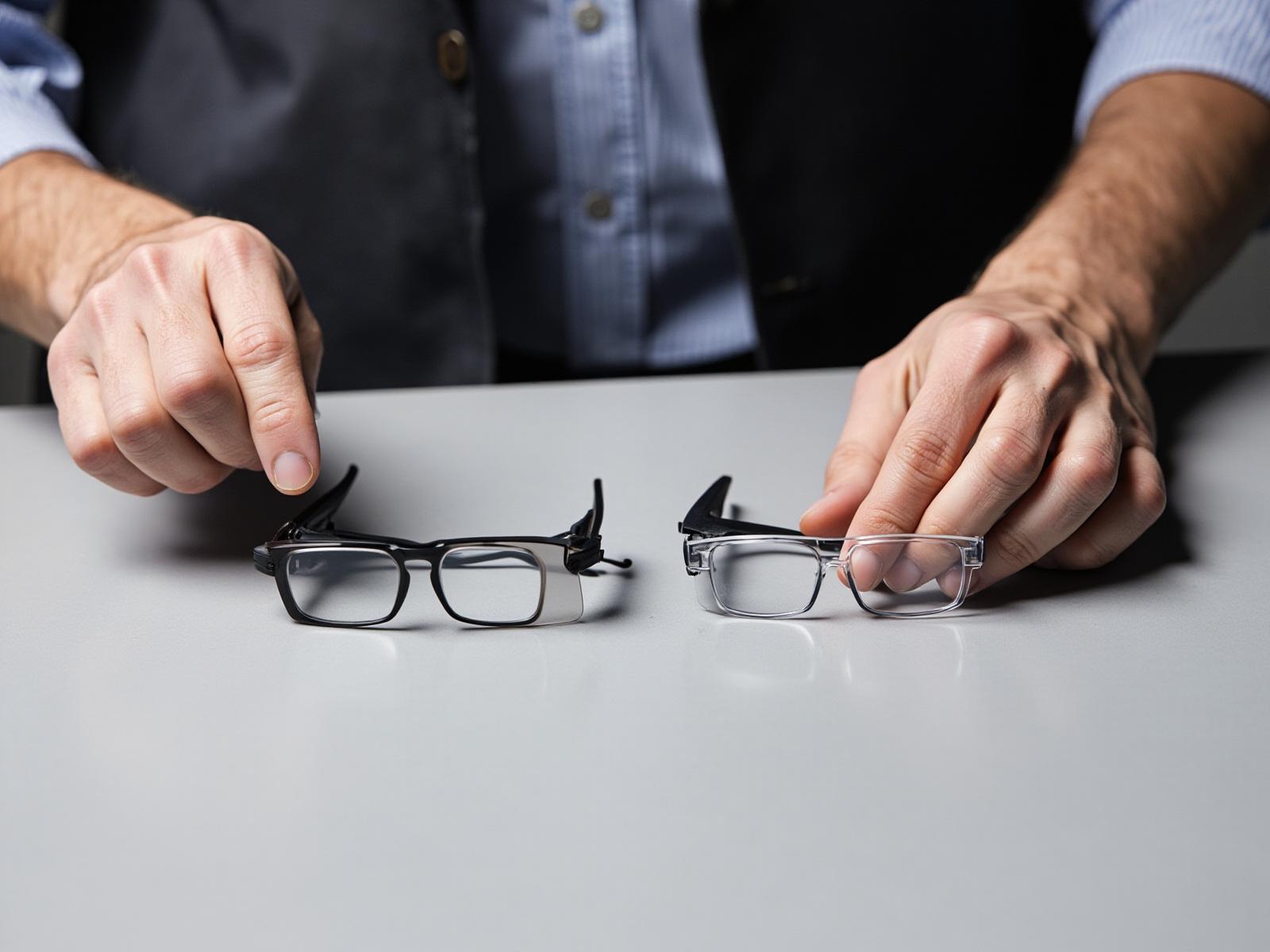
The sport category has exactly three members: the YKC02, the D17, and the ZH12. That is a small enough group that a buyer can hold all three in their head, and a large enough trap to walk into without comparing them side by side.
The YKC02 runs two 70 mAh cells, publishes about eight hours of runtime, publishes a charge time of two hours or less, and uses magnetic charging. The D17 runs a single 115 mAh cell, publishes about seven hours of runtime, publishes about one hour of charge time, and uses USB-C, with a remote shutter. The ZH12 runs a single 100 mAh cell, publishes about eight hours of runtime, publishes about one hour of charge time, uses USB-C, and carries the remote shutter.
Two conclusions follow immediately, and both cut against the assumption that a bigger cell means a better product. The D17 has the larger cell but the shorter published runtime, and the YKC02 matches the ZH12 on runtime while charging more slowly. So the cell figures do not predict the runtime figures, and a buyer who ranks these three models by mAh will rank them wrongly. Run time depends on the audio stage's draw, the driver configuration, and what the radio is doing, none of which are published per model.
Second, the ZH12's real identity in this category is a specific combination: one hour charge time, remote shutter, USB-C, and about eight hours of runtime. The D17 shares the first three and gives up an hour of runtime. The YKC02 shares only the runtime and brings magnetic charging instead of the fast turnaround. If your channel needs a sport model with a fast turnaround on a shelf, the ZH12 and the D17 are the only two candidates, and the choice between them is essentially the runtime figure and the cell.
That is also where the boundary of the category lies. If your channel actually wants a camera model, the ZH12 is the wrong product and no amount of negotiation changes that. The camera comparison is set out at S7 smart glasses vs ZH12 use case fit, where the S7 is the camera-side comparison point: it publishes 13 MP, a 260 mAh cell, five to eight hours of runtime, a charge time of two hours or less, magnetic charging, and IP54 ingress protection. Read the two side by side and the decision becomes obvious for anyone whose priority is capture rather than turnaround. The same logic applies on the ingress-protection side, where the V06 comparison at V06 smart glasses vs ZH12 use case fit sets out what the ZH12 does not have: the V06 is one of only two models in the catalogue with a published IP54 rating, and it carries a 3000 mAh capacity charging case, which makes it a fundamentally different product from a single-cell USB-C sport model.
We are not suggesting the ZH12 is a compromised choice. It is a focused one. A single-cell device that recharges in about an hour, sounds in stereo surround, and has a remote shutter is a coherent product for a specific customer: someone who wants audio on the move and wants the device ready again quickly. What it is not is an all-purpose model, and a buying error happens when a catalogue row with six fields gets matched against a requirement list with twenty.
There is a planning consequence to the category split that is worth stating separately, because it decides whether you need one supplier or two. The three sport models do not share a charging ecosystem. The YKC02 and the D17 and the ZH12 use different charging approaches from each other, so if your channel runs more than one sport model, your warehouse needs to stock two different cable types and your training material needs to cover two different charging instructions. Concentrating volume on the ZH12 alone collapses that into a single cable type, and for a channel that ships directly to consumers that simplification is often worth more than the extra hour the YKC02 saves you. That is a real trade-off, and it is one you can negotiate: ask the supplier for a blended price on a mixed sport order, and see whether the price of convenience is cheaper than the price of two cable types in the box.
The second consequence is that a sport program cannot borrow the proof points from the camera group. There is no published ingress rating on any sport model, and IP54 appears only on the V06 and the S7. There is also no published weight anywhere except the MT6, at 158 g for the glasses body excluding its 1200 mAh folding case. So a buyer moving from a camera model to this category loses the two figures that make retail copy easy, and has to build the copy on runtime, charge time, and the remote shutter instead. That is a legitimate position, but it is a different position, and the retail listing should be written for the sport category rather than copied across from a camera listing.
What to ask a supplier before ordering the ZH12
The point of this article is that the limitations are mostly closable, and closing them is a specific and finite exercise. Below is the enquiry we would send, grouped the way a supplier will actually answer it. We will lead with the hard technical items, because those determine whether the product can be sold at all, and finish with the commercial terms, because those are the ones that determine whether the order is worth placing.
Technical and specification items:
- What is the measured frame weight, and in what configuration? Body only, and separately body with case and retail packaging if a case is included.
- What lens material and frame dimensions apply to the ZH12? Ask for drawings or a dimensioned outline, not a range.
- What colours are available, and what is the MOQ per colour? A per-colour MOQ matrix, not a single number.
- Is there any ingress protection test report for this model? If not, ask directly what the expected water and dust exposure is, so your own retail copy can be written honestly.
- What are the cell chemistry, cycle life, and charging current? Ask whether the cell is user-replaceable and, if so, how.
- What test condition produces the published eight hour runtime? And separately, what condition produces the one hour charge time, including the adapter and cable required.
- Is a charging case part of the configuration, and if so what is its capacity? The catalogue does not publish a case for this model, so treat the default answer as no.
- What is the retail box configuration and does it include a charger? Ask for the exact contents list, the cable specification, and the guide language count.
- What certification evidence covers the ZH12 as shipped? Named reports, dated, matched to your SKU. Patents and factory-level statements do not answer this question.
- What is the quality control process for cells and audio, and what is the acceptable incoming rejection rate?
Commercial items:
- What is the MOQ, and what is the price at each volume tier? Get a ladder showing where each tier begins, so you can negotiate against it rather than guess.
- What is the lead time from purchase order to shipment, and how does it change by season? Separate the production lead time from the transit time, and confirm the incoterms being quoted.
- What is the sample policy and cost, and how does it relate to a pilot order? Ask whether sample cost is credited against the first production order, and how long samples take.
- What are the tooling charges, and who owns the tooling? Get the number in the quotation and the amortisation terms in the purchase order.
- What is the packaging situation? Ask about the retail box structure, the insert, the printing process for your artwork, and the minimum quantity per print run, because packaging setup is a hidden cost that appears on the first order and never again.
- What is the warranty period, who covers the freight on a battery-fault return, and what does the return process look like?
- What spares do you commit to after the last production run, and for how long? Cell, cable, and case, in writing.
For a fuller version of this in checklist form, the ZH12 smart glasses buyer review checklist collects the same items in a format you can paste into an enquiry, and the Sport Smart Glasses page remains the category anchor.
One last point on how to run the negotiation itself. Almost every unpublished field on this model is a term you can trade rather than a gap you have to accept. A supplier that cannot name the ingress rating may be able to commit to a tighter incoming inspection regime. A supplier that has no certification evidence for this configuration can sometimes offer the testing cost, or name the laboratory and the timeline. A supplier with a high minimum order quantity can often move it when you commit to a pilot order with a shorter lead time. What you cannot trade is a field the factory genuinely does not know, and you find that out by asking rather than by bargaining. So separate the two lists before you open the negotiation: the fields that are commercial levers, and the fields that are data requests. We will put the data requests first, because the answer to any of them may change how much the commercial levers are worth.
Here is the honest position after all of that. The ZH12's limitations are not disqualifying. A one hour charge time and a remote shutter are unusual in this catalogue and genuinely useful in a sport program. What the model does not have is a published frame weight, an ingress rating, lens and dimension data, colour options, or any commercial term — and those absences are exactly the things that turn a good product into an unprofitable order if you leave them implicit. Write them down, get them quoted, and the model becomes orderable on evidence rather than on impression.


