
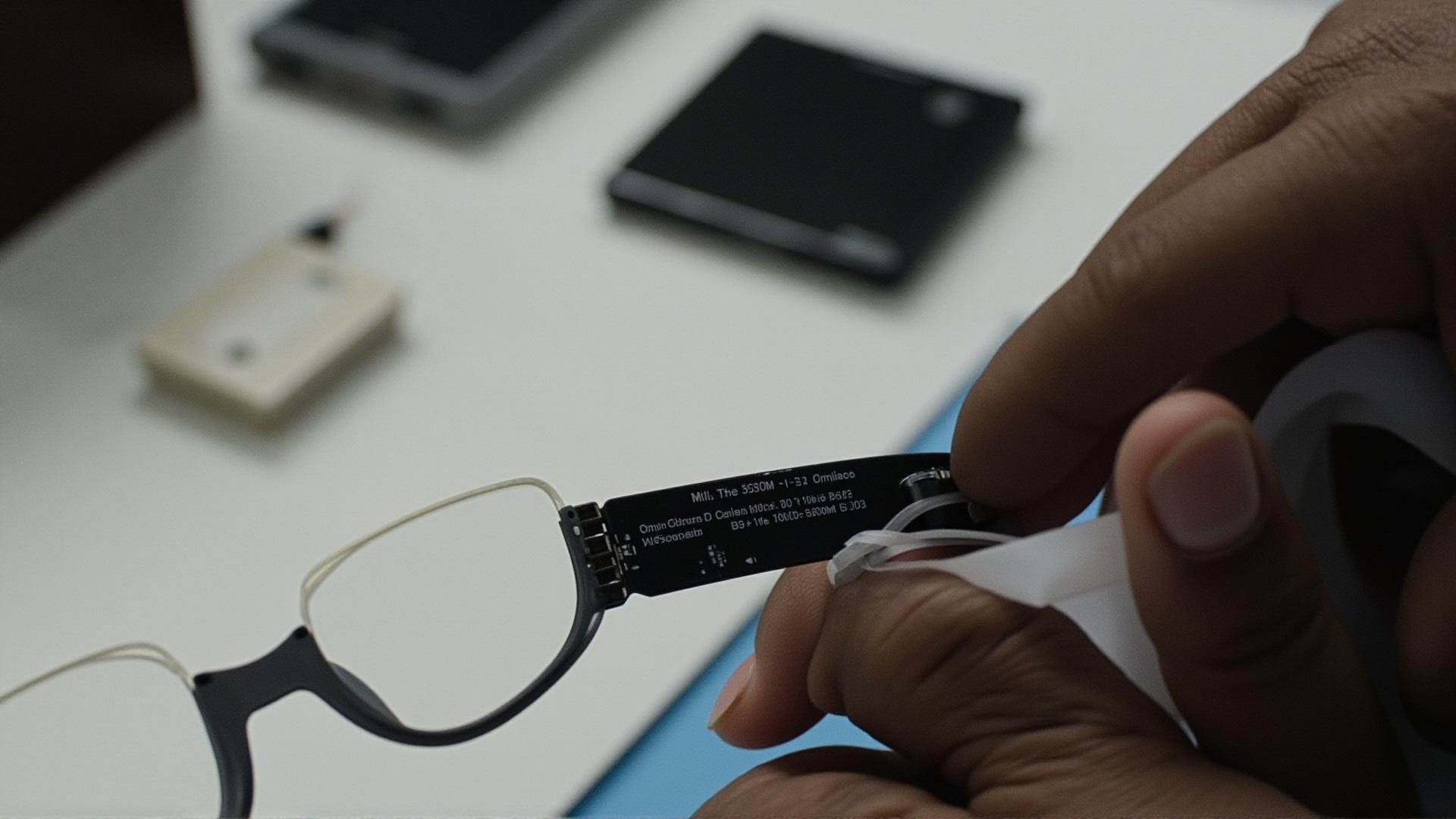
The relationship between the V06 and the ZH12 resolves on a single requirement — whether the end user records first-person video. The V06 carries an 8 MP camera, a 260 mAh battery rated 5 to 8 hours, an IP54 marking and four published colours. The ZH12 has no camera at all, a 100 mAh battery rated about 8 hours, and a roughly one-hour Type-C charge. Pick the camera model if recording is in the brief, the audio model if it is not, and nothing else in the data should drive the decision.
That is the short version of a v06 smart glasses vs zh12 use case question, and it is short because the two rows do not overlap. Both models are Bluetooth V5.4. Everything else our documentation records about them points in different directions, and the differences are not increments on a shared platform — they are two different products.
V06 smart glasses vs ZH12: the use case question, stated precisely
Most use case comparisons fail because the word "use" is never made specific. "Sport" and "outdoor" and "content creation" are categories, not use cases, and a category can contain two requirements that resolve in opposite directions. The way to make this comparison usable is to name who triggers the capture and from where — because that one sentence separates the two models more sharply than any specification row.
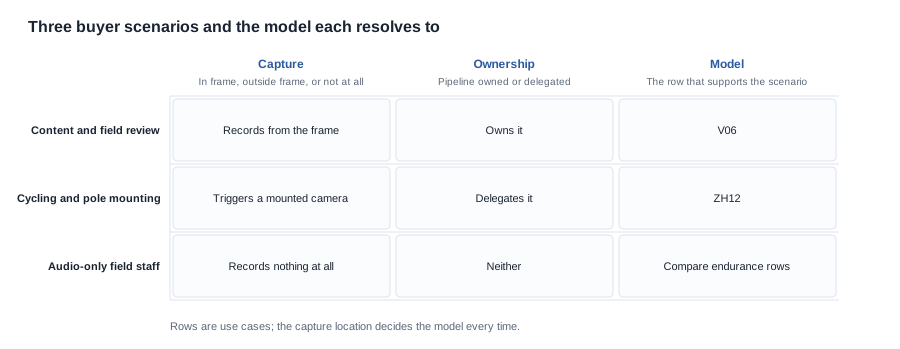
So the three scenarios resolve as follows, and the resolution is mechanical rather than a matter of taste.
- A channel whose customer records from the glasses. A content creator, a field reviewer, someone documenting a site walk-through. The V06, because the capture happens in the frame and needs no second device.
- A channel whose customer triggers capture from somewhere else. A cyclist with a camera mounted on a handlebar or a pole, with the glasses acting as the control, the speaker and the microphone. The ZH12, because that is exactly the configuration its remote shutter row describes.
- A channel whose customer records nothing. Field staff who want audio hands-free through a shift. Either model, and the choice should then be made on the endurance row and the charge time, not on any imaging feature.
In-frame capture resolves to the V06 and stops. Out-of-frame capture resolves to the ZH12 and stops. No capture at all resolves to a comparison of the endurance and charge rows, which is a much smaller decision than the one buyers usually arrive expecting to make.
The second scenario is the one most buyers misread. A remote shutter sounds like a camera feature, and buyers routinely assume the ZH12 records. There is no camera in the ZH12 frame. What the published configuration supports is the glasses acting as a control and an audio device for a capture device mounted elsewhere, and a listing that implies in-frame recording is a listing that describes a different product.
If you are still undecided after working through those three, the most useful next step is not another specification comparison. It is to ask two of your customers — or two of your channel partners — where their recording actually happens today. That answer costs nothing and it settles more than any additional row in our documentation would.
So the question to put in the brief is not "do they record" but "where does the recording happen". If the answer is in the frame, the comparison ends. If the answer is outside the frame, the comparison also ends. Only if the answer is "we have not decided yet" does this comparison need to be re-run, and it should be re-run before the shortlist rather than after the sample.
There is a commercial reason to force that answer early. A buyer who arrives at the shortlist without it will default to the model with the larger published number, and the larger published number is not connected to any requirement they have stated. That default is how brands end up with a camera platform they cannot complete a technical file for, and an audio platform they should have chosen sitting unused in the same shortlist. The cost of the default is not the model; it is the documentation, the review scope and the sample stage that follow from the wrong choice.
And a second reason, which is about the customer rather than the product. If the capture happens outside the frame, then your customer already owns a camera, already charges it and already has an app for it. They are buying your product to improve the experience around a device they have chosen. That is a perfectly good business, but it is a different positioning job from selling a self-contained capture device, and the two positions need different product pages.
Where the capture happens changes the product
This is the analytical core of the comparison, so it is worth stating as a mechanism rather than an assertion.
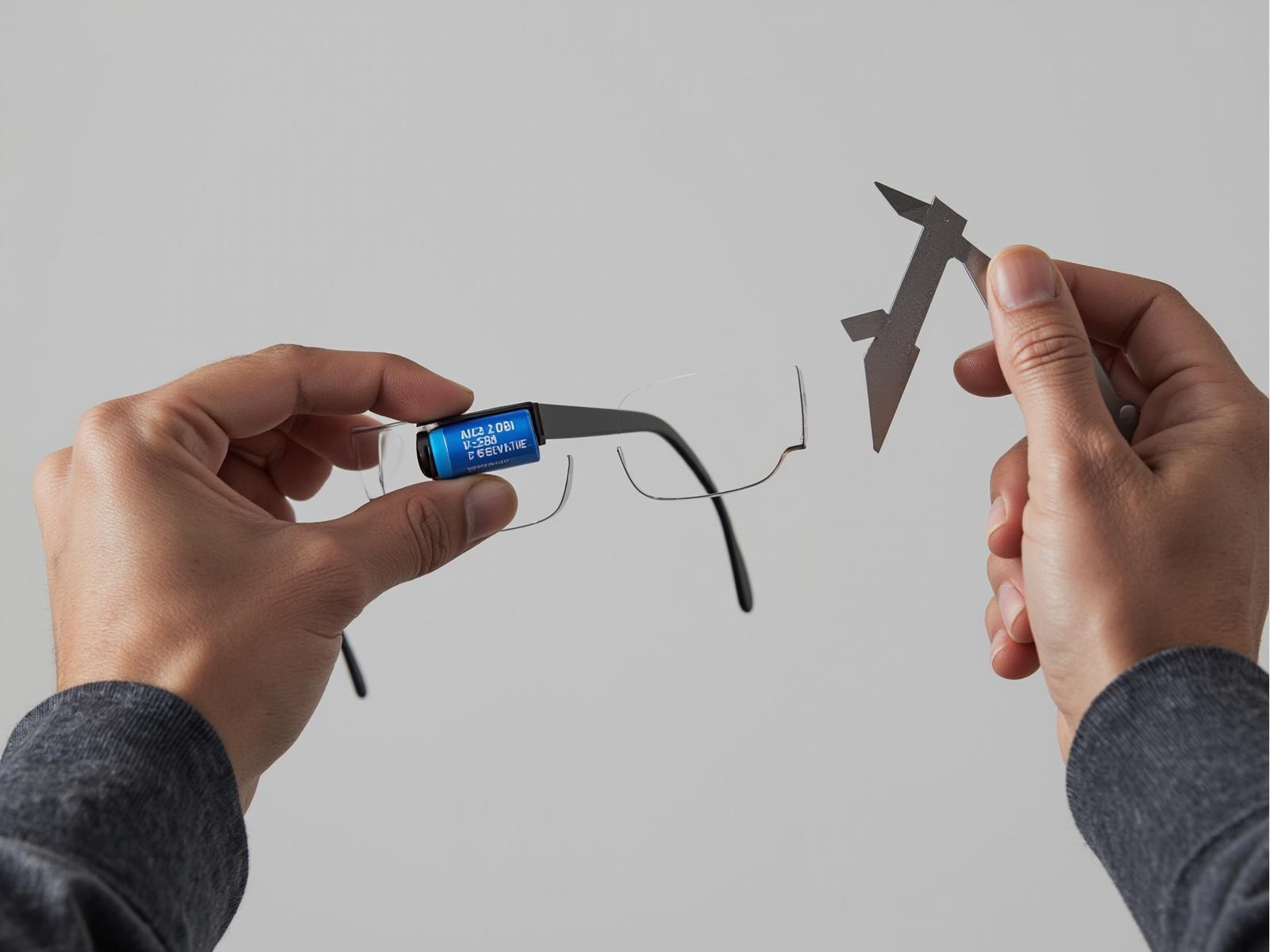
An in-frame camera and a remote shutter solve the same user problem with different hardware and different failure modes. The camera version stores and encodes on the device, which means storage behaviour, file format, transfer route and encoding quality all become part of the product. The remote version delegates capture to another device entirely, which means the glasses only need a control channel and audio — and that is why the ZH12 can publish a 100 mAh cell and still hold a published runtime of approximately eight hours.
The trade a buyer makes is between owning the capture pipeline and delegating it. Owning it gives one device, one purchase order, one packaging unit and one support story. Delegating it gives a much smaller device, a much cheaper bill of materials and a dependency on a second device that your customer has to own, mount and keep charged.
That dependency is not a small thing, and it is the reason the ZH12 scenario is narrower than it first appears. If your customer's mounted camera is a phone on a pole, then the battery of that phone, the app on it and the way it holds a mount are all outside your product and inside your customer's problem. A brand that sells the ZH12 into that scenario is selling into a workflow, and the workflow is part of what it has to support.
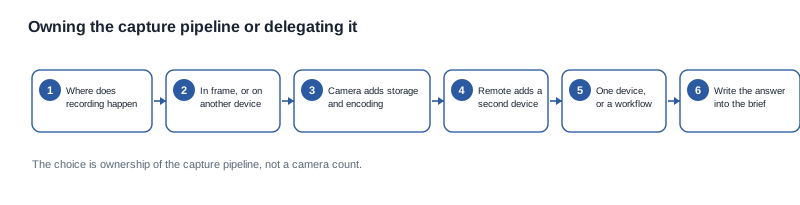
Two commercial consequences follow from the mechanism. First, the ZH12's accessory and packaging story is smaller, because there is no camera assembly, no storage and no encode path in the product — that is a genuine cost advantage at volume. Second, the V06's technical file is longer, because a camera adds parameters that have to be described and, in our documentation, have not been published.
For a buyer, the honest summary is this. The V06 is a more self-contained product with a larger documentation burden and a wider runtime band. The ZH12 is a smaller, faster-charging product that is useful only inside a workflow the customer already has. Neither is a better product; they serve different briefs, and the brief is the buyer's to write.
On the supply side, the delegation model has one advantage buyers rarely price. A product with no camera assembly, no storage and no encode path has fewer components to qualify, fewer failure modes to inspect for and fewer spare parts to hold. At volume, that difference is often worth more than the feature it gives up — which is one reason an audio-only platform is frequently the better margin business even when the camera is the more attractive product on a shelf.
Against that, the ownership model has an advantage in support. One device means one thing to describe, one thing to troubleshoot and one warranty claim to process. A two-device workflow means the support question becomes "which one is at fault", and answering it requires a fault tree the supplier has to give you. Ask for that fault tree if you are choosing the delegated route, and write it into the technical file before the first purchase order.
Charging, cell and the endurance each model publishes
The power rows are the part of this comparison that can be stated directly, and they are worth stating carefully.
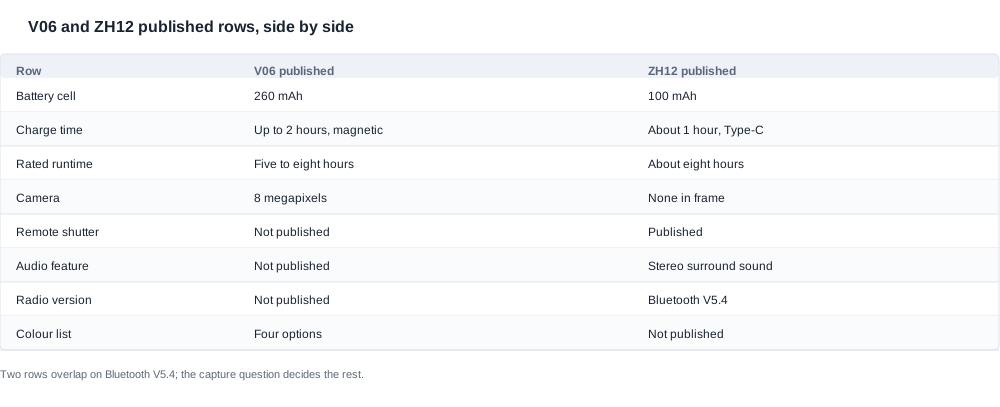
| Row | V06 published | ZH12 published |
|---|---|---|
| Battery cell | 260 mAh | 100 mAh |
| Charge time | Up to two hours, magnetic | Roughly one hour, Type-C |
| Rated runtime | Five to eight hours | Approximately eight hours |
| Charging interface | Magnetic | Type-C |
| Camera | 8 megapixels | None in frame |
| Remote shutter | Not published | Published |
| Audio feature | Not published | Stereo surround sound |
| Colour list | Four options | Not published |
Read the first three rows together and the mechanism is visible. The V06 carries nearly two and a half times the cell capacity and publishes a shorter charge time and a runtime band. The ZH12 carries a smaller cell, charges in roughly half the time and publishes a single longer figure. A larger cell serving a heavier load produces a band; a smaller cell serving a light load produces a figure. Neither is an engineering failure and neither is a marketing choice — both follow from what the product does.
The charging method difference matters commercially as well as technically. Magnetic charging means the customer cannot lose a cable; Type-C means the customer already owns the cable, which is cheaper in the box and simpler in the supply chain. Both are defensible. They are not interchangeable, and a listing that implies a Type-C cable is supplied with the V06 is describing a package we have not published.
The charge-time row has a second-order effect on the model choice, and buyers should look at it before deciding. A roughly one-hour Type-C charge is genuinely convenient in a way that a two-hour magnetic charge is not — the product is usable again within a working day rather than across one. If your customer's usage pattern involves a shared device that has to be recharged between people, the charge time may matter more than the runtime figure. If the device is worn continuously by one person, the runtime figure matters more. Neither model is wrong for the other case; they simply answer different scheduling problems.
And a supplier question that both rows raise. Ask whether the charge time is measured from an empty battery or from a partial one, and whether it is a measured figure or a design target. A charge time quoted from a partial battery is not comparable with one quoted from empty, and our documentation does not state which applies to either model. Record the answer with the rest of the row rather than assuming.
The caution on all four figures is the same. Neither model's runtime figure comes with a published test condition — no volume level, no camera state, no ambient temperature, no connection state. So the endurance comparison cannot be closed from documentation. It has to be closed with a sample order that follows a written test method, which is why the sample stage is not optional on this pair any more than it is on any other.
And a transport note that applies to both. A battery carried across a border has its own compliance position, and it is not on either specification row. The battery transport page and the charging solutions page cover how that sits alongside the published rows.

Documentation boundaries a buyer must not blur
Both models carry documentation traps, and they are different traps, which is why this comparison has to be read carefully rather than quickly.
The ZH12's ingress marking is a family claim, not a model row. The IP54 marking, the detachable inner frame and the ergonomic frame come from the sport family's shared feature list. The ZH12's own published row is the audio row — Bluetooth V5.4, the cell, the charge time, the runtime, the remote shutter and the stereo surround sound. A listing that gives the ZH12 an ingress marking because the family list mentions one is describing a claim the model row does not make, and the IP rating page explains why a family list is not the same as a test report.
The V06's camera figure is published and unverified. The 8 megapixels is in the documentation. The sensor model, field of view, video resolution, frame rate, aperture and pixel size are not published for it, and no comparison claim about image quality should be built on the number alone. The camera imaging page sets out the parameters that actually determine picture quality.
Shared by both models, and absent from both rows: frame weight, temple length, lens dimensions, certificate numbers, issuing bodies, validity periods, the model schedule each certificate covers, MOQ, lead time, unit price, packaging specification, warranty terms and the defect categories treated as returns. Every one of those is a question to the supplier, and every one of them belongs in your technical file before the first purchase order rather than after the first shipment.
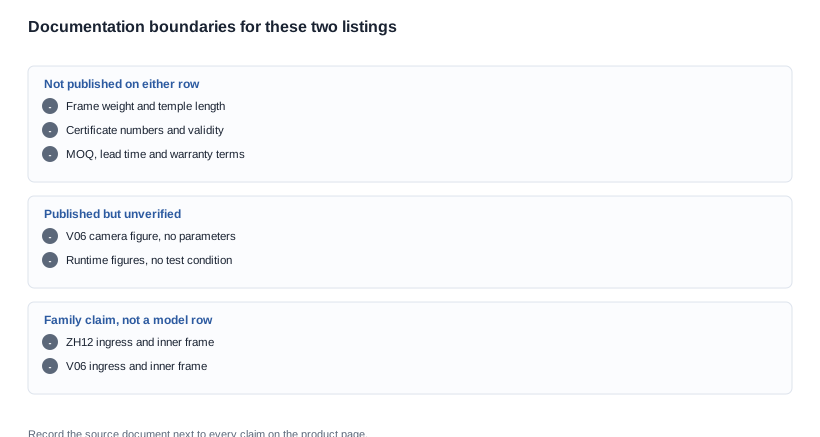
The habit that protects you is small and worth naming. Record, next to every claim on your product page, the document that supports it. When a customer disputes a claim, the difference between a one-line answer and a fortnight of argument is almost always that record. Our certification checklist sets out the file structure, and the model-level positions are in ZH12 certification status and V06 certification status.
One further boundary that buyers in this category trip over constantly. Our documentation publishes specification rows; it does not publish a completed technical file, and it does not publish the supplier's answers to a buyer's own questions. Any file you assemble describing camera parameters, test conditions or certificate scope is work done with the supplier or from your own sample stage. That is not a limitation to work around — it is the correct division of responsibility, and a buyer who expects a supplier to hand over a finished file is asking for a document that nobody in this industry can legitimately sign.
Three worked scenarios, and the procedure behind them
The scenarios above are not illustrations; they are the procedure. Here is how we would run a use case comparison on this pair, in the order we would run it.
- Write the requirement in one sentence, in the customer's words. Not "needs a camera" — "records a walk-through of a site and uploads it before leaving". The second version tells you what the technical file must contain; the first only tells you which shelf to shop in.
- Name where the capture happens. In the frame, outside the frame, or not at all. This single answer decides the comparison.
- Check what the chosen model can complete from published documentation. If it can, the listing is straightforward. If it cannot, the gap has to be closed before launch, not after.
- Send one enquiry covering both models. Ask the same missing-parameter questions of each, in one document, so the answers are comparable. The V06 pre-ordering checks and ZH12 pre-ordering checks are built on that basis.
- Fix the commercial terms while the order is still small. MOQ, lead time — and specifically what the lead time is measured from — payment terms, deposit structure, warranty defect categories. The MOQ, lead time, payment terms and contract terms pages set out how each is normally structured.
- Write the acceptance criteria before the samples arrive, so the sample is measured against criteria you agreed rather than against an impression you formed.
What to ask that usually gets skipped. Ask whether the ZH12's remote shutter is a single button, a paired remote or an app control — our documentation publishes the feature and not its mechanism, and the mechanism changes what your customer has to own. Ask whether the V06's colourways run on the same production window as each other, which decides whether four SKUs are one lead time or four. And ask what the total cost is at your actual volume including packaging, because that is the number that decides whether a second platform is affordable.
Two questions about the supplier rather than the product, which belong in the same enquiry. Ask whether the two models can be sourced under one purchase order with one payment term, because that decides whether a range costs one transaction or two. And ask what the lead time would be if one of the two models were discontinued — not the reorder time, the replacement time, because a brand that has put both models on one product page needs an answer to that question before it puts them there. The production capacity page covers what an audit should establish about that.
Our position on the matching question is narrow and we will not widen it for a sale. If the capture happens in the frame, the V06 is the model and the ZH12 is not an option. If the capture happens outside the frame, the ZH12 is the model and the V06's camera is dead weight. Everything else — cell size, charge time, colour list, published runtime — is a consequence of that one answer and should be treated as a consequence.
Tell us the channel, the volume and where the recording happens, and we will tell you which of the two to shortlist. Both sit on the sport smart glasses range page, with the full model detail in V06 compared and ZH12 compared.
Related reading
- The power rows in full — V06 and ZH12 battery and charging
- Where each model belongs — V06 best for and ZH12 best for
- Pre-ordering checks — V06 checks and ZH12 checks
- The sport family feature list — sport family questions


