
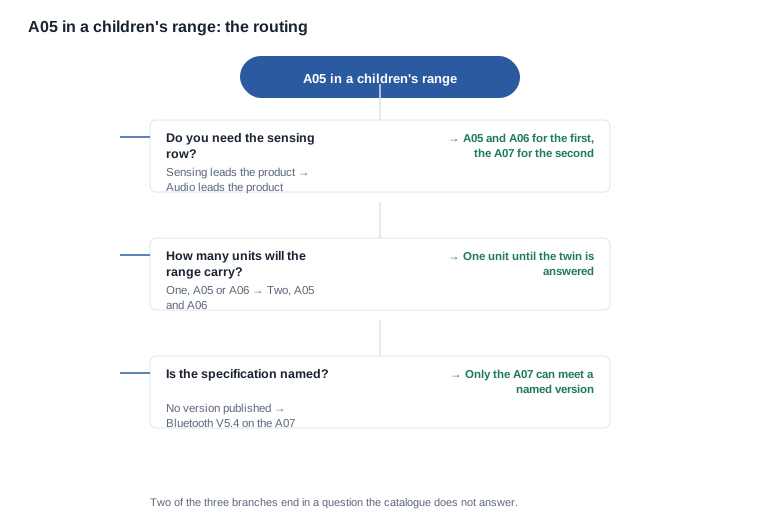
The A05 smart glasses publish a 40 mAh cell, roughly twenty hours of rated use, a charge time of two hours or less, magnetic charging, a lens-type electronic fogging element, and posture and distance sensing. The A06 publishes exactly the same rows. The A07 shares the runtime class but drops the sensing, adds Bluetooth V5.4 and carries a 70 mAh cell.
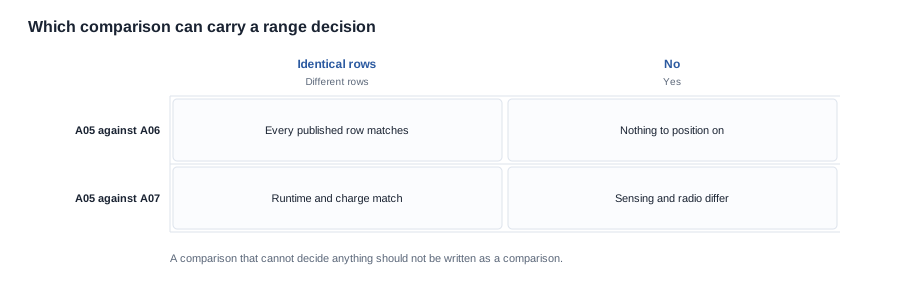
So the useful comparison for a buyer is the A05 against the A07, with one caveat that has to be stated before the comparison starts: our own documentation records the difference between the A05 and the A06 as an open item, and they carry the same catalogue product name of a children's smart protection model. That is not a documentation gap you can work around. It is a range decision you have to make before you build the range.
A05 smart glasses and its two siblings: what the three models actually separate on
The comparison a buyer can make and the one they cannot
Three readers arrive at this comparison with three different decisions, and it is worth saying which is which before any row is compared.
A brand owner building a children's range needs to know how many stock units it can carry and what each one is differentiated on. A range built on two models that publish identical rows fragments the channel, the shelf space and the inventory for no commercial gain.
A procurement manager quoting this category into a school, a retailer or a district needs to know which specification rows can be put in front of a customer and which have to be marked as unpublished.
A channel buyer choosing between the models for a single listing needs the one decisive difference, not a full feature matrix.
For the first reader the comparison is a range-design problem, and the A05 against the A06 question is the whole of it. For the second it is a document-discipline problem, and the comparison is between a published row and an absent one. For the third it is a substitution question, and the answer is usually the sensing row, because it is the only published feature difference in the family.
The row-by-row position across the three models
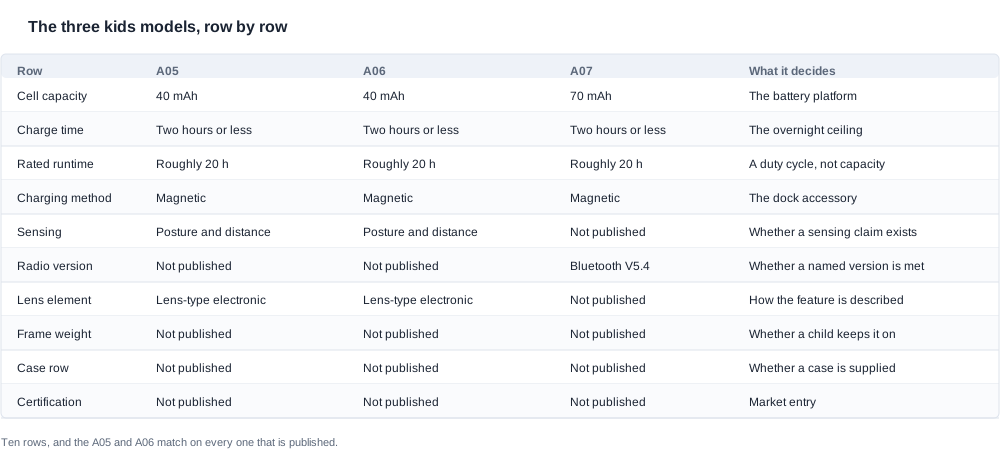
The table below sets the three models against each other on every row that is published for at least one of them, and marks the rows where all three match.
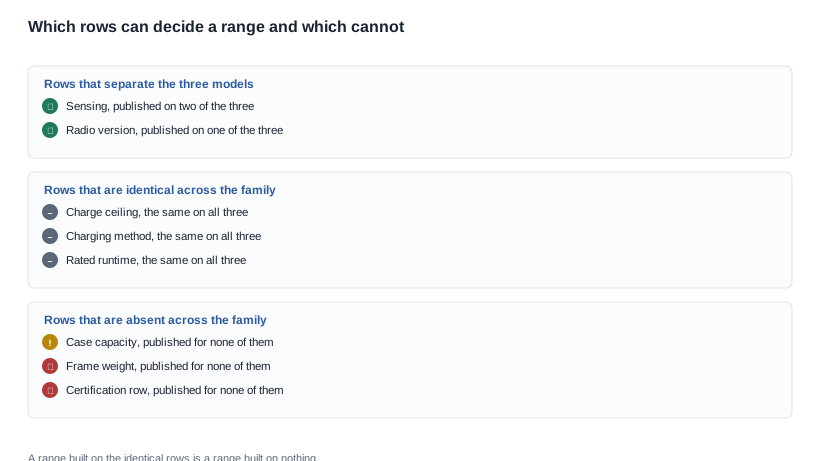
Read it for the pattern rather than for the individual cells. The A05 and the A06 are identical on every published row. The A07 differs on the cell, on the sensing and on the radio, and matches on the charge time, the runtime and the charging method. And on four rows — frame weight, the charging case, the certification position and ingress protection — the family publishes nothing at all for any member.
The three published rows that carry the whole family
The cell, the runtime and the charge ceiling
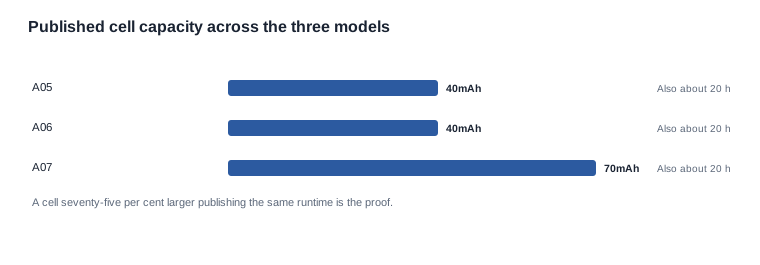
The cell capacity. 40 mAh on the A05 and the A06, 70 mAh on the A07. This is the single largest published difference in the family, and it is the one that appears least useful, because all three models publish the same roughly twenty hours of rated use.
That combination is worth a moment. A cell seventy-five per cent larger delivering an identical runtime can only mean the runtime describes a light duty cycle with long idle periods, and that the cell size is not what sets it. The A05 and the A06 are sensing products that wake periodically to sample and remind; the A07 is an audio product. They reach the same headline by different routes, and the cell difference reflects the two architectures rather than a runtime advantage.
The charge time. Two hours or less for all three. This is a ceiling, not a promise about a partly charged cell, and it is published for every model in our range rather than being a property of this family. There is no comparison to be had here, and a listing that treats the two-hour figure as a feature of the A05 is claiming something about the whole category.
The charging method. Magnetic for all three, which puts a dock in the box for each of them. The A07 is the one with a published Bluetooth version, and the A05 and the A06 are the two where a specification that names a radio version cannot be satisfied from the catalogue.
What the identical A05 and A06 rows mean for a range
Everything published is the same. The cell, the charge ceiling, the runtime, the charging method, the lens element, the sensing function and the illustrations that accompany them — all of it matches, and so does the catalogue product name.
There are two answers and both of them are commercially useful, which is why this question is worth asking rather than assuming.
If they are the same product under two designations, the range decision is a simplification. One stock unit with two colourways or two pack configurations may serve the channel better than two units, and the difference in inventory, listing count and channel complexity is larger than any unit price difference. It also means one set of compliance documentation rather than two.
If they differ on something that is not published — a colour, a sizing revision, a shell design, a firmware revision — then that attribute is the only thing you can position on, and it has to be confirmed before the artwork and the listing are designed around it.
The A05 versus A06 specification comparison works through what the possible answers mean for the range, and the A05 best-for analysis covers when a brand is better off with one unit than with two.
The rows that differ, and the one that does not
The radio version and the sensing feature
Bluetooth V5.4 is published for the A07 and for no other model in this family. If your customer's specification names a radio version, you can confirm the A07 meets it and you cannot confirm anything about the A05 or the A06. An unpublished row is a question, not a match, and it belongs in the request for quotation written as a question rather than as a tick.
The sensing function is published for the A05 and the A06 and not for the A07. This is the decisive functional difference in the family, and it decides whether a posture or viewing-distance proposition can be made at all. The A07 carries a cell and a radio; the A05 and the A06 carry the fogging element and the sensing.
The A05 versus A07 comparison covers that functional split in detail, and the sensing notes for the kids range set out what the published functions are.
The rows that are identical across all three
Four rows are absent for all three models, and their absence is uniform, which means a buyer who has solved them for one model has solved them for the family.
Frame weight, temple length and lens dimension. Not published for any of them. This is the row that most affects whether the product works, and it is the reason a sizing sample is the cheapest instrument a buyer can own in this category.
The charging case row. Not published for any of the three. The camera models elsewhere in our range do publish case capacities, running from 900 mAh to 1400 mAh, so the absence here is specific to this family rather than a house convention.
The certification row. No per-model certification information exists for any of the three models. Our catalogue carries a company-level export certification page whose content is images rather than text, and the catalogue text contains no reference to CE, FCC or RoHS anywhere.
Ingress protection. Not published for any of the three. Two models in our wider range carry an IP54 rating; none of these three does, and a rating published elsewhere in the catalogue is not a rating for these.
Checking a three-model comparison rather than accepting it
The five questions to send with the request for quotation
A comparison built from published rows is a starting point, not a conclusion, and the five questions below convert the two rows that are identical and the four rows that are absent into decisions.
Which published rows are shared, and on what unpublished attribute do the A05 and the A06 differ? One question, sent with the request for quotation, and the answer belongs in the product file before the shortlist is scored.
What condition is attached to the rated-use figure? A rating is a bound under defined conditions, and the condition is what makes it comparable. Ask what was running, what was idle, at what reminder frequency, over how many units, and whether the figure is a mean or a best case.
What is the frame weight, and can we have a sizing sample? For a child's product this is a genuine obstacle: a frame that is too heavy causes the slouching the posture sensing exists to correct, so the product's own differentiating feature depends on a number nobody has published.
What are the certification documents for this model, and what is their scope? Children's eyewear in Europe and the United States commonly attracts requirements beyond general consumer electronics, and whether they attach to a given product depends on how it is categorised and how it is marketed. We cannot confirm applicability from a catalogue, and neither can you.
What may the lens feature be called in our copy? Describe the physical feature, make no health claim in any market, and have that instruction confirmed in writing rather than assumed.
How a comparison gets built on rows nobody published
Three failure shapes recur in this category, and they are worth naming because each one produces a listing that cannot be defended.
The radio version was assumed. The symptom is a shipment that does not meet a specification which named a version. The root cause is an absent row treated as a match. The prevention is to write the absence as a question in the request for quotation.
The lens feature was written as a health benefit. The symptom is copy making a claim nobody has evidence for, in the most sensitive category the company sells into. The root cause is a physical design feature described in therapeutic language. The prevention is to describe the physical feature, make no health claim, and review the set of published claims as a set rather than page by page.
The certification question was deferred to launch. The symptom is a delayed market entry or a held shipment with no plan, because no one asked. The root cause is treating the requirement as a post-order task. The prevention is to ask for the documents and their scope with the request for quotation and treat the answer as a condition of the order.

What a three-model range costs commercially
The range structure decision and its inventory effect
The comparison changes the commercial conversation in one specific way: it moves the negotiation away from the unit price and towards the range structure.
If the A05 and the A06 turn out to be the same product, a two-unit range is a stock problem rather than a growth strategy. Two units a customer cannot tell apart compete with each other on the shelf, split the reviews, divide the inventory and double the compliance work, because documentation is per model and per market. A one-unit range solves all four problems at once, and it does so at no cost to the unit price.
If they differ on something unpublished, then the differentiation is available but it has to be built on: artwork, listing copy, packaging and the channel plan all have to carry an attribute nobody has described yet. That is more work than it sounds, and the work is cheaper if it happens before the artwork exists rather than after it is approved.
Which terms move and which are fixed
The range structure, the sample order and the delivery split are the terms worth spending negotiating capital on. The sizing sample and the range structure decide the range more than price does, and the delivery split that lets a first tranche be the one which proves sizing and behaviour is worth more than a price concession on the whole order.
Certification cost and lead time are fixed and follow the process and the testing body. Pressing on either produces a longer schedule rather than a shorter one.
Tooling is normally amortised across the first order, and asking what volume it is amortised over, and what happens to it if the programme is discontinued, are both useful questions. The two are frequently bundled into a single quotation line, so ask which one you are being quoted.
What belongs in the agreement: the published rows for the configuration you order, the frame weight, the radio version, the certification documents and their scope, the conditions attached to the rated-use and charge-time figures, and the position on the lens feature in any copy either party publishes.
What must be left out: any claim of a health, hearing-assist or eyesight-protection effect, in the listing, the packaging or the sales material. It is a regulatory exposure and a reputational one, and no price negotiation makes it acceptable.
The listing consequences of carrying two units
A comparison is not only a sourcing decision; it decides what the channel sees, and the effect is larger than the inventory effect alone.
Two units split the reviews and the ranking. Two listings for products a customer cannot tell apart compete with each other in the marketplace. One of them accumulates the reviews, the ratings and the search visibility, and the other accumulates the returns. That is a self-reinforcing position, and it is the opposite of what a range is for.
Two units double the listing work. Copy, images, the instruction leaflet, the support script and the packaging artwork are per unit. In a category where the copy is the compliance surface, the copy work is not a marketing cost; it is the cost of making a claim defensible.
Two units multiply the documentation. The A05 and the A06 publish identical rows, so a document that names one may not name the other, and a brand carrying both may be carrying two document sets where it budgeted for one. The certification status covers what that request has to contain.
One unit concentrates the risk instead of spreading it. If the A05 is the only behaviour unit in the range, then an unresolved question about the sensing behaviour or the certification position threatens the whole behaviour half of the range. That is an argument for resolving those questions before launch, not an argument for adding a duplicate unit.
A worked comparison: building a two-unit children's range
This is a hypothetical scenario rather than a client project, and it is written to show the decision sequence.
Assume a brand that wants two units in a children's range: one behaviour unit and one audio unit. The A05 and the A07 are the obvious candidates on the published rows, and the A05 and the A06 are the obvious conflict.
Step one is the proposition, and it ends the A07 question. The brand's range needs a behaviour unit, and the sensing row is published only for the A05 and the A06. The A07 is eliminated on a functional row rather than on price, which is the more direct way to eliminate a model.
Step two is the twin question, which is asked before the range plan is built. The brand asks which published rows the A05 and the A06 share and on what unpublished attribute they differ. The answer is that they are the same product under two designations, and the brand collapses the range to one unit for the behaviour slot.
Step three is the specification discipline. The brand's customer specification names a radio version. Because the A05 publishes no version row, the brand requests the fitted version in writing and makes it a condition of the order rather than a tick on a comparison table.
Step four is the commercial structure. The brand negotiates the sizing sample first, places inspection against the first payment node, and splits the delivery so that the first tranche is the one that proves sizing and behaviour. The unit price is settled last.
Step five is the copy. The brand's listing describes the physical lens element and the sensing function, makes no claim about eyesight, and states the runtime as a rated figure with its condition attached rather than as a day of continuous use.
The result is a two-unit range with one behaviour unit, one audio unit, a first tranche that proves the two things most likely to fail, and a written list of the rows still open. The decisive decisions were made before the deposit, and none of them was made on price.
What we can and cannot tell you about the comparison
The A05 is the model to consider if posture and distance sensing is the requirement, and the A06-versus-A05 question is one only the supplier can answer. We will not invent a distinguishing feature to make a range appear broader, and we will not convert a lens design feature into a health claim on a product used by children. Where a row is unpublished we will mark it as unpublished rather than supply a typical figure, and we will not quote a weight, a radio version or a certification document for a configuration we have not been given.
Tell us the age group, the market and whether sensing is part of the requirement, and we will tell you which model fits and which rows remain unpublished. The range is on our kids smart glasses page, and the institutional requirements are set out in the school requirements checklist.
Related reading
- The kids range these models belong to — kids smart glasses
- School procurement requirements for this category — kids smart glasses school requirements
- Sensing versus health claims — sensing notes for the kids range
Share the target market, the quantity and the required configuration, and we will come back with what is available and what is not.


