

The A05 smart glasses are the right model for a buyer whose product is a behaviour tool, and the wrong model for most of the rest of the children's category. A 40 mAh cell, a charge time of two hours or less, roughly twenty hours of rated use, magnetic charging, a lens-type electronic fogging element and posture and distance sensing make it the only camera-free product in our range that carries a sensing proposition at all. It is also the model with the widest documentation gap: the catalogue publishes no per-model certification row anywhere, no weight, no sensing threshold, no charging case row and no radio version for it.
So the answer to "best for" is not a feature ranking. It is three buyer situations, and in two of the three the A05 is the correct model with written conditions attached to it. In the third it is the wrong model, and the article below is more useful for telling you which one you are in than for telling you that the A05 is good.
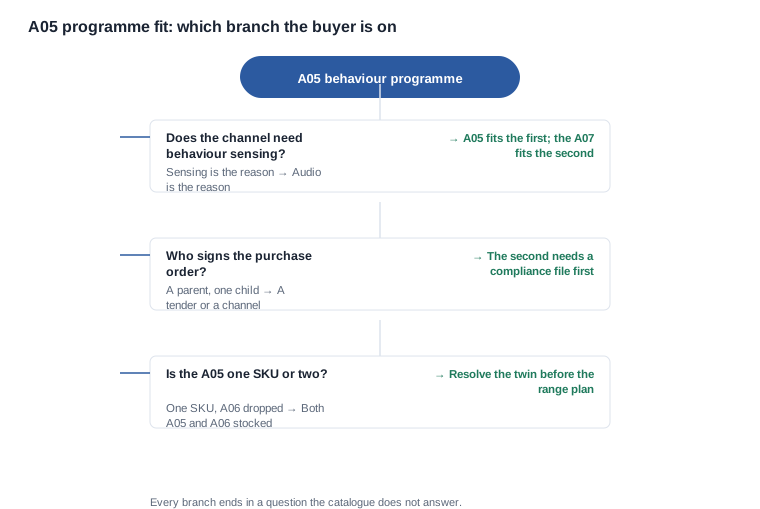
A05 smart glasses and the three buyers who read the same row differently
The published rows are identical for everyone. What changes is what a buyer is trying to decide with them, and that is why the same 40 mAh cell settles one purchase order and blocks another.
A parent buying one pair for one child
This buyer is not running a tender. They are deciding whether a product that exists to remind a child about posture and viewing distance is worth the money, and they will decide on the basis of what the product does rather than on what it publishes. The A05 is genuinely competitive here, because it is the only camera-free model in the range with a sensing function, and "no camera" removes the largest single objection a parent brings to a children's electronics listing.
What this buyer cannot be given is a sensing specification. The catalogue publishes posture and distance sensing for the A05 and illustrates the correct and incorrect states, but it publishes no threshold, no reminder interval, no accuracy and no range. A parent asked "how often will it tell my child off" cannot be answered from anything we hold. That is a support cost and a return driver, and the privacy considerations piece sets out the seven questions a parent-side application raises before any of this can be sold.
A procurement team answering a tender
This buyer has to put a specification in front of a school, a district or a corporate programme, and every line in it has to survive a question. The A05 is defensible on the hardware rows and indefensible on the paperwork rows, because no per-model certification row exists for it in any document we hold. The catalogue carries a company-level export certification page whose content is images rather than text, and the catalogue text contains no reference to CE, FCC or RoHS anywhere.
That distinction is not a detail a tender team will let slide. A specification that asks for a compliance document and receives a product page is a specification that cannot be scored, and the school requirements checklist sets out the institutional list while the export considerations cover the paperwork that travels with the goods.
A brand building a kids range on one platform
This buyer is deciding how many stock units a range can carry. The A05 and the A06 publish identical rows — the same 40 mAh cell, the same two-hour-or-less charge time, the same roughly twenty hours, the same magnetic charging, the same fogging element, the same sensing illustrations, and the same catalogue product name of a children's smart protection model. They are two designations in our documentation, and we do not publish what separates them.
For a range buyer, that is not a curiosity; it is a decision. Two units a customer cannot tell apart fragment the shelf space, the listing count and the inventory for no commercial gain, and they double the compliance work because documentation is per model and per market. The A05 versus A06 specification comparison works through what the possible answers mean for the range.

What the A05 published rows settle for a behaviour programme
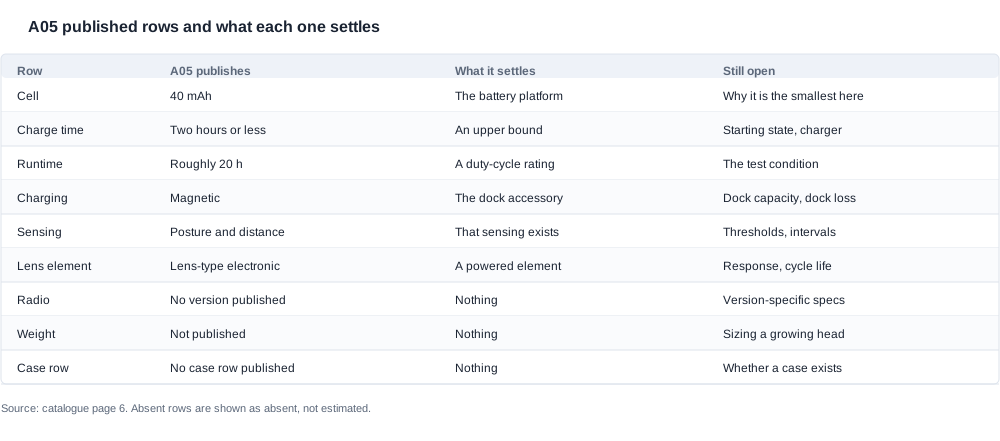
The catalogue page for the A05 is short and the rows are consistent, and consistency is worth something in a category where documentation is thin. Everything in this section comes from that one page, and anything not on it is treated as absent rather than estimated.
The rows a programme can plan around
Five rows are published for the A05 and they describe a coherent product: a lens-type electronic fogging element, a 40 mAh battery, magnetic charging, a charge time of two hours or less and roughly twenty hours of rated use. The sensing function appears on the same page as a pair of illustrations contrasting correct and incorrect posture and distance, and a second pair contrasting a clear lens against a fogged one.
Two of those illustrations carry commercial weight that the rows do not. The first tells a buyer that the detection state is visible on the lens itself, which is a product claim you can demonstrate and photograph. The second tells a buyer that the fogging element has a visible state, which is what makes it a demonstrable feature rather than an invisible mechanism. In a category where no product photograph, no video and no test report exists for any model, the illustrated state is the whole of the available evidence, and it is more than most of the range publishes.
The rows that are conspicuously absent
The A05 page carries no Bluetooth version row, and the absence matters commercially even though the product is camera-free: a buyer whose own specification names a radio version cannot confirm this model meets it, and cannot get written confirmation of a row that does not exist. The A07 publishes Bluetooth V5.4 on its page, so the comparison within the range is stark.
There is no camera, which is a positive for this model and a positive worth stating plainly rather than leaving to inference. There is no weight, no temple length, no lens dimension and no recommended age band. There is no charging case row, which is different from the camera models in the range where several publish case capacities of 900 mAh, 1400 mAh and a 1200 mAh foldable case; for the A05 the catalogue simply does not carry that line. And there is no ingress protection rating for this model.
The thresholds a programme buyer should hold before sampling
A programme does not fail because a row is missing. It fails because a row was assumed, or because a number was copied into a listing without its condition. The thresholds below are what to write down before the first sample arrives, because they are the points at which a buyer's specification either holds or quietly becomes fiction.
Endurance: two hours or less is a ceiling, not a promise
The A05 publishes a charge time of two hours or less. That is a ceiling, and the distinction is not pedantry. A ceiling of two hours means the wait never exceeds two hours under the conditions the supplier measured. It does not mean the frame is full after any particular elapsed time, because the catalogue publishes no starting state and no termination criterion — no indication of what charge level counts as complete, and no indication of whether the figure assumes a depleted cell.
Write the row as "two hours or less" on a product page and you are accurate. Write it as "fully charged in under two hours" and you have made a stronger claim than the catalogue supports, and a stronger claim is the kind that turns into a returns argument when a parent measures it at two hours and five minutes from a partly charged cell. The same discipline applies to every other duration in this category.
The twenty-hour rating is a duty-cycle figure, and the family proves it
Roughly twenty hours on a 40 mAh cell is the highest published endurance figure in the range and the smallest published cell. That combination is not a contradiction; it is an architecture. But the proof that it is a duty-cycle figure comes from the A07, which publishes a 70 mAh cell and the same roughly twenty hours. A cell seventy-five per cent larger delivering an identical duration can only mean the duration describes a light duty cycle with long idle periods, and that the cell size is not what sets it.
The threshold to hold is therefore about conditions rather than about the number. What was active during the measurement, what was idle, at what reminder frequency, over how many units, and whether the figure is a mean or a best case. A rating without a condition is not a figure you can put in a specification; it is a headline. The A05 battery life analysis covers the same reading with the measurement questions laid out.
The rows that are not published, and what each one blocks
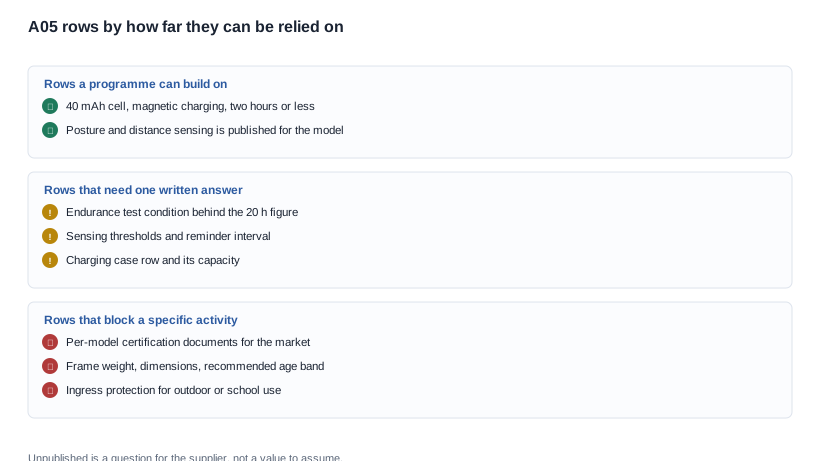
Each absent row blocks a specific activity, and it is worth being precise about which one, because a buyer who knows that a single row is blocking a single activity can solve it. A buyer who only knows that "documentation is thin" cannot prioritise anything.
- Sensing thresholds and reminder interval block the sensing proposition itself. A reminder that fires continuously is switched off inside a week, and a switched-off reminder is a product that has stopped doing the thing it was bought for. The posture monitoring analysis covers what the detection functions are designed to observe.
- Frame weight, dimensions and the recommended age band block sizing. A fixed frame on a growing head is the classic children's eyewear return driver, and the age suitability analysis covers the seven items that decide the band.
- The smallest detachable part blocks the age decision independently of everything else, because a detachable accessory sets a floor on the age band on its own.
- Ingress protection blocks any outdoor or school-corridor claim. There is no rating for this model, and the rating published on two other models in our range is not a rating for this one.
- Per-model certification documents block market entry, and no company-level page substitutes for a document that names the A05.

Checking the A05 before the purchase order is signed
Verification for a behaviour programme is documentary first and physical second, and the order matters because a document failure usually shows up earlier and more cheaply than a sample failure.
The five-step document and sample sequence
Step one is the twin question, and it is free. Ask which published rows the A05 and the A06 share, and on what unpublished attribute they differ. Send it with the request for quotation so the answer arrives with the pricing rather than after the artwork is approved. If the answer is that they are the same product under two names, that is a simplification you can plan around. If they differ on colour, sizing or a firmware revision, that attribute is the only thing you can position on, and it needs to be in writing before the product page exists.
Step two is the conditions package. Ask for four things in one message: the endurance test condition, the sensing duty cycle and how drain changes with the reminder interval, the charging input and whether a case exists for the configuration, and the lens element's response time and cycle life. A supplier who answers all four has a documentation habit. A supplier who answers one is telling you something useful before the deposit.
Step three is the sample, run in the condition the product will actually meet. Put the frame on a child of the intended age for a full day, with the reminders active, and record what happens at the end of it: how many reminders fired, whether the child could dismiss them, whether the frame was still charged, and what the lens element did. Weigh the frame and measure it while it is on the sample. The A05 buyer review checklist covers the sample-stage tests in the order that catches failures earliest.
Step four is the certification conversation, in the destination market's terms. Do not ask "are these certified". Ask which documents name the A05 for the market you are shipping into, who issues them, what their validity dates are, and which standard each one evidences. If the answer is that the documents are pending, that is a usable answer, because it tells you the programme is a scheduling problem rather than a blocker, and it tells you the schedule.
Step five is writing the open rows into the purchase order. A gap that lives in an email is not a condition. A gap written into the order as a stated acceptance item is something you can withhold a lot against. This is the step that is most often skipped and it is the one that converts a buyer who discovered a problem into a buyer who had a remedy.
How a behaviour programme fails in the field
The reminder is too frequent and the child switches it off. The symptom is a return that cites "my child stopped using it". The root cause is a reminder interval that was never specified and therefore was never set deliberately. The prevention is in step three: count the reminders on the sample, and put the acceptable interval into the order.
The lens element fails and nothing announces it. The symptom is a parent reporting that the product stopped working, months after purchase, with no visible fault. The root cause is a powered optical element with no published cycle life and no published low-battery behaviour. The prevention is to ask for the response time and the cycle life, and to write a behaviour into the customer instruction leaflet for what the product shows when the element is no longer active.
The dock is lost or the frame is not seated. The symptom is a defective-product report on a product that is not defective. The root cause is magnetic charging with no published charge-indicator behaviour on this model. The prevention is to ask whether a visible charge indicator exists, and if it does not, to design the instruction leaflet and the support script around a physical check rather than a visual one.
The listing claims an outcome the catalogue does not support. The symptom is a complaint or a regulatory enquiry, and it is the most expensive failure in this category because it is not a manufacturing problem. The root cause is copy written from a retail word rather than from the published rows. The prevention is to fix the claim wording before the product page is written, and the safety requirements piece sets out the boundary in the category's own terms.

What a supplier can move and what a programme cannot
The commercial conversation for this model is not about the unit price, because the unit price is the smallest of the numbers that decide whether the programme works. It is about the three cost lines that sit outside it: the documentation work per model and per market, the return rate that an unsized frame produces, and the support cost of a product whose behaviour a customer will ask about and a supplier cannot answer from a document.
The terms that respond to the published gaps
These are the lines worth spending negotiating capital on, and each one maps to a gap rather than to a number.
- The sample order cost, and whether a sizing sample is included. In a category where the frame weight is unpublished, a sizing sample is the cheapest instrument you own for closing the sizing question.
- Payment nodes against inspection, with the sample approval as the first gate rather than the last. This is the only structural protection against a range built on a twin you have not resolved.
- Packaging specification, and whether the box includes a dock or a case. The dock is a separate object with its own loss rate and its own return reason, and the packaging decision determines whether it is a consumable or a possession.
- Delivery splitting against a pilot quantity, so that the first tranche is the one that proves the sizing and the behaviour.
- A warranty period with a stated response, and a written statement of what constitutes a failed lens element, because without that criterion a warranty claim on that element cannot be settled.
- The range structure itself. Whether the A05 and the A06 are one SKU or two is a decision you can make with one email, and it is worth more than any unit price movement.
The claims that must not be negotiated
Certification cost and certification lead time follow the test house and the process. Pressing on either produces a longer schedule rather than a shorter one, and a schedule pressure that reaches a laboratory is a schedule pressure that reaches the programme. The tooling position is similar in kind but different in structure: tooling is normally amortised across the first order, while certification is a per-model and per-market cost, and the two are frequently bundled into one quotation line that hides which is which. Ask which one you are being quoted.
The third fixed item is not commercial at all. No negotiation turns a behaviour reminder into a clinical intervention, and we hold no clinical data, no test protocol and no regulatory assessment for this category. Nothing in the agreement should create the impression that the sensing functions produce a vision, health or prevention outcome, and we will not support a listing that implies one. That line is not a negotiating position; it is the only one we hold.

A worked example: a retail buyer choosing between the A05 and the A07
This is a hypothetical scenario rather than a client project, and it is written to show the decision sequence rather than to report a result.
Assume a retailer planning a small children's range for three markets, with a two-unit limit and a buyer who has been told by a previous supplier that the unit price is where the negotiation happens. The retailer wants a behaviour proposition, because the neighbouring brand in the category has one and the shelf comparison is unavoidable. The A05 and the A07 are both camera-free, and both are published with roughly twenty hours and magnetic charging.
The first step separates the two on the proposition, not on the price. The A05 publishes the fogging element and the posture and distance sensing with its illustrations. The A07 publishes neither, and carries a 70 mAh cell and Bluetooth V5.4 instead. If the behaviour proposition is the requirement, the A07 is out on the feature row, and the comparison stops being a price comparison.
The second step establishes what the A05 does not give. The retailer now has to price the things the catalogue does not publish: certification per model and per market, a sizing risk on a fixed frame, a support load from unanswered behaviour questions, and a return risk from a reminder interval that nobody has specified. The retailer asks for the same four conditions the sequence above sets out, and the supplier answers three of them.
The third step resolves the range question before the range plan is built. The A05 and the A06 remain identical in the answer, and the retailer decides to take one designation and to ask again for the distinguishing attribute in writing. The A05 versus A07 comparison covers the functional split in more detail, and the published A05 specification list is the baseline the buyer is working from.
The fourth step sets the commercial structure. The retailer negotiates the sample order and the sizing sample first, puts inspection against the first payment node, and splits delivery so that the first tranche is the one that proves sizing and behaviour. The unit price is settled last, and it turns out to be the least interesting number in the file.
The result is a range with one behaviour unit, one audio unit, a pilot tranche that proves the two things most likely to fail, and a written list of the rows that are still open. The decisive decisions were made before the deposit, and none of them was made on price.
What we publish about the A05, and what we will not
The A05 is a well-defined product whose documentation is strong on the hardware and absent on the software, and in this category the software is the part a buyer inherits. We publish the cell, the charge ceiling, the rated runtime, the charging method, the fogging element and the sensing function, and we will describe the functional illustrations as illustrations. We do not publish a weight, a sensing threshold, a reminder interval, a charging case capacity, a radio version or an ingress rating for this model, and we would rather show you the empty row than a plausible number you cannot verify.
We also make no health, vision or prevention claim for the A05 or for any other product, in any market, because we hold no clinical data for this category. And we will state the certification position for this model as what it is: there is no per-model certification row in the catalogue, the catalogue text contains no reference to CE, FCC or RoHS, and the certification evidence for this model is something to be requested in writing and closed before a listing goes live.
A straight answer
Send us the buyer type, the age band, the destination markets and the channel, and we will tell you which model matches the requirement, which published rows we can stand behind today, and which questions have to be closed with a sample or a test house before the first order. The range is on our kids smart glasses page, and the detection functions are described in our the sensing notes for the kids range.
Related reading
- The functional split in this category — A05 smart glasses versus A07
- This model's published rows — A05 smart glasses specifications and features
- The sample-stage checks — A05 smart glasses buyer review checklist
- The data question on the sensing models — kids smart glasses privacy considerations
Send us the buyer, the age band and the markets, and we will tell you which model matches the requirement and which compliance questions remain open.


