
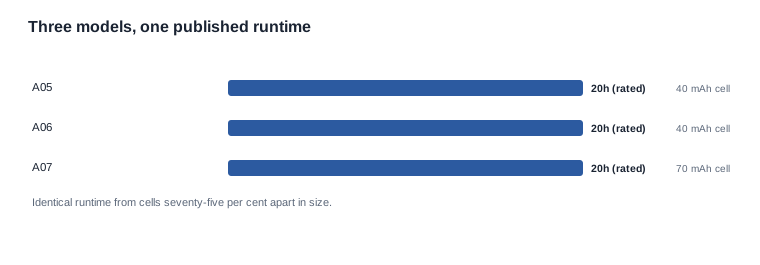
The A05 and the A06 publish the same battery row — 40 mAh, charged magnetically in two hours or less, rated at roughly twenty hours — and that figure is the most interesting number in this product's documentation rather than the least. Read it against the third model in the family and it stops being a capacity claim: the A07 publishes 70 mAh and the same twenty hours. A cell nearly three quarters larger delivering an identical runtime tells you the runtime is describing a duty cycle, not a battery.
That observation settles the battery question between the A05 and the A06 completely, and it settles it before any comparison starts.
A05 smart glasses vs A06 battery and charging: what the rows can and cannot settle
The comparison that cannot be won
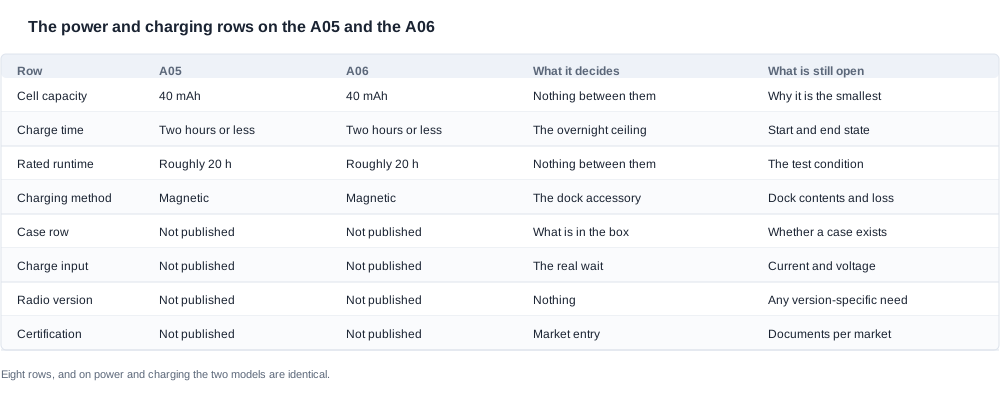
On power, charging and interface, the two models are the same product. Same cell, same charge ceiling, same rated runtime, same magnetic method. There is no power argument to be had between them, and any comparison you build on those rows will produce a difference that does not exist.
That is a useful conclusion rather than a disappointing one, because it removes four rows from the shortlist criteria and replaces them with one question that can be answered in a single email: what actually separates the A05 from the A06?
Our own documentation records the difference between the two as an open item, and they carry the same catalogue product name of a children's smart protection model. It may be a colour, a sizing revision, a shell design or a firmware difference. Until it is written down, it is a question rather than a specification.
The arithmetic that settles the whole family
The published rows across this family are: 40 mAh and roughly twenty hours for the A05 and the A06, and 70 mAh and roughly twenty hours for the A07. A 40 mAh cell is the smallest published cell anywhere in our range, and roughly twenty hours is the highest published endurance figure in it.
Two models at opposite ends of both ranges, publishing the same duration, can only mean one thing: the duration describes a light duty cycle with a long idle period, and the cell size is not what sets it. The A05 and the A06 wake periodically to sample and remind and then sleep again. The A07 reaches the same headline by a different route.
This is the single most useful thing to understand about a children's device. A twenty-hour figure on a 40 mAh cell is not a promise that a child can use the product for twenty hours of active operation. It is a promise that a product which spends most of its time idle, waking periodically to give a posture or viewing-distance reminder, will last for a working day and then some. The two-hour-or-less charge ceiling and the magnetic charging are the parts of the design that make the long idle period tolerable.
It also means the runtime is not a competitive differentiator here. Nobody in this family has a longer published runtime, so nobody can claim one. A buyer whose listing says "longer battery life" is claiming something that does not exist in the range.
Reading the twenty hours as a duty cycle
What a seventy-five per cent larger cell proves
The proof is external to the A05's own row, and it is worth stating as an argument a buyer can make in a meeting without our help.
The A07 publishes a 70 mAh cell and the same roughly twenty hours of rated use. A cell seventy-five per cent larger, delivering an identical duration, means the duration is not set by the cell. If it were, the larger cell would have produced a longer figure. It did not, and the reason it did not is that both products are dominated by idle time.
The same reasoning disposes of a second argument that is sometimes made in this category. There is no runtime advantage to be had here, and a comparison sheet that puts "20 hours" next to "20 hours" next to "20 hours" is telling the buyer that the runtime is a class property rather than a model property. That is a useful thing for a buyer to know, because it means the runtime cannot be used to differentiate, and a listing that tries to will be checked against the rest of the range by anyone who reads it carefully.
The five conditions that turn a rating into a figure
What the test condition is is the thing to ask about, because the published figure is meaningless without it. Five questions:
- What was active during the measurement — sensing with reminders firing, or the device idle with detection disabled?
- What was idle, and for how long in proportion to the active periods?
- At what reminder frequency, which is the input that links the runtime to the behaviour.
- Over how many units, and on new cells or on aged ones?
- Whether the figure is a mean or a best case.
A supplier who answers all five has a documentation habit. A supplier who answers one is telling you something useful before you place a deposit.
The battery specification guidance covers the general set of questions for any runtime figure in this category, and the A05 battery life analysis covers the same reading for this model in more detail.
The charging rows and what they leave open
Two hours or less is a ceiling, and a ceiling has edges
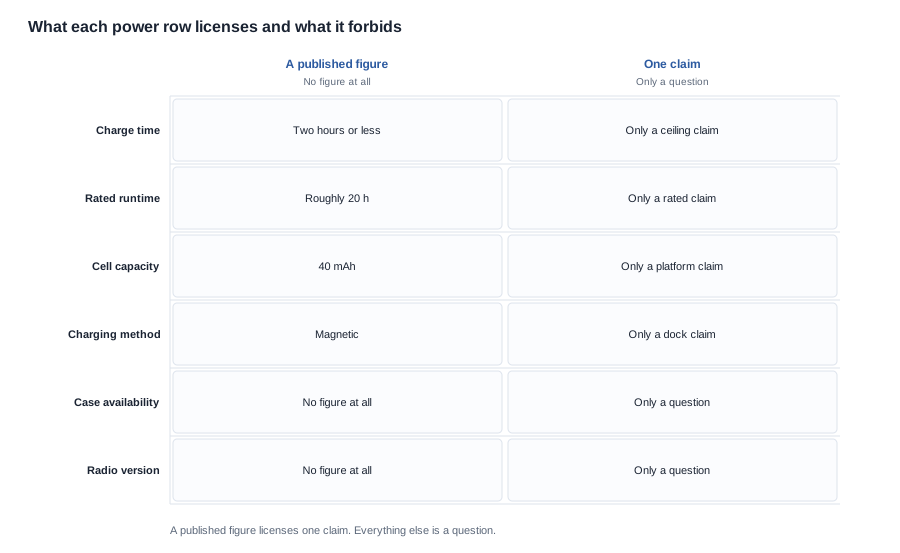
The A05 and the A06 publish a charge time of two hours or less. That is an upper bound, and the distinction from a guarantee is not pedantry — it is the difference between a true statement and a false one.
Two hours or less means the wait never exceeds two hours under the conditions the supplier measured. It does not mean the frame is full after any particular elapsed time, because the catalogue publishes no starting state and no termination criterion: no indication of what charge level counts as complete, and no indication of whether the figure assumes a depleted cell.
It does not mean the frame reaches full charge from a part charge within the same window. That is a different measurement with a different answer, and it is the measurement a parent actually performs, because nobody waits for a flat battery before putting a child's glasses back on the dock.
So the wording on a product page has to be the ceiling, and the wording in the instruction leaflet has to be the routine. A page that says the frame charges fully in under two hours has made a stronger claim than the catalogue supports, and a parent who measures two hours and five minutes from a half-charged cell has grounds to complain about a statement that was never warranted. The A05 charging options article covers the rest of the charging arrangement in detail.
The input, the dock and the accessory nobody has described
The input current and voltage the frame accepts are not published. On the smallest cell in the range that matters more than it does elsewhere, because a low charge rate on a small cell stretches the wait disproportionately. A frame that reaches its ceiling in two hours on the supplier's adapter may take considerably longer on a laptop port or a low-output travel adapter. That is not a defect; it is a consequence of an unpublished input requirement, and it lands on a family's evening routine rather than on product quality.
Magnetic charging is published, so a dock is in the box, and what is in the box is not. Whether a charging case is available at your quantity is not published for either model, and the catalogue's silence is not the same as a negative answer — some models in our range are has no charging-case row, and these two are simply silent. A dock that is only a dock and a dock that also holds charge are different products with different costs and different accessory economics, and the A05 charging options article sets out the three commercial answers and what each one does to a buyer's own costs.
Whether a visible charge indicator exists is not published for either model. A frame seated on a dock that is not charging is invisible to a child and usually invisible to an adult, and it is reported as a defective product. That single row decides whether the most common support reason in a magnetic product exists at all.
The two-hour figure is a category convention, not a feature of this pair
One more piece of context belongs alongside the ceiling, because it tells a buyer what the number is worth as a comparison point.
Across our whole catalogue, twenty-six of the twenty-eight models publish a charge time of two hours or less. The two exceptions are the sport models, which publish a figure of about one hour. The A05 and the A06 are inside the twenty-six.
So the two-hour-or-less ceiling is a house convention rather than an achievement, and it cannot be used to differentiate this model from anything else in the range. A comparison sheet that presents "two hours or less" as a selling point is presenting the category's default as though it were a choice the buyer made. The honest presentation is as a baseline the buyer can rely on, and the interesting comparison is the two models in the range that publish something better — which are neither of these two.
This matters in a specific commercial way. A buyer who assumes the charge time is negotiable has spent negotiating capital on a number that was never variable, and has left the charge time from a part charge — which is the number a parent's routine actually depends on — unexamined. Asking for the part-charge measurement is a better use of the same conversation.

What the identical rows mean for a range decision
On power, the two models are one product
The practical consequence of identical power rows is that the two models cannot be separated on power, and a range decision cannot be built on their power difference. Any shortlist criteria that reach for battery life, charge time or charging method to separate them will produce a tie, and a tie in a range plan is usually a sign that the range is being planned on the wrong attribute.
The rows that remain as genuine criteria are the functional ones: the sensing function, the radio version, the certification scope, the frame sizing and the accessory contents. And of those, the radio version is published only for the A07, so a specification that names a version can be confirmed for one model in the family and for neither of the other two.
The two questions that actually separate them
Question one: what separates the A05 from the A06? One email, one reply, and the answer determines whether the range carries one stock unit or two. If they are the same product under two designations, then your catalogue, your product pages and your inventory logic should say so plainly — that is not a problem, it is a simplification, and it is cheaper than discovering it after the packaging is printed. If they differ on something unpublished, that attribute is the only thing you can position on, and it needs to be confirmed before the artwork and the listing are designed around it.
Question two: which of them does your programme actually need? If the answer is that the range needs a behaviour unit and a customer-facing audio unit, then the A05 and the A07 are the pair, and the A06 is a second route to the same behaviour slot rather than a second unit in the range. The A05 versus A06 specification comparison covers what the possible answers mean for the range, and the A05 versus A07 comparison covers the functional split.

Questions to ask and terms to set
The request list for the power and charging rows
Send these together, in writing, and attach the model string to the request:
- The endurance test condition — what was active, what was idle, at what reminder frequency, over how many units, mean or best case.
- The input current and voltage the frame accepts.
- The charge time from a part charge, measured, and the termination criterion for a full charge.
- Whether a visible charge indicator exists, and whether a charging case is available at your quantity and at what capacity.
- What separates the A05 from the A06, in writing.
Each of those has a decision attached to it, which is what makes the list work: the first sets the runtime claim, the second sets the support script, the third sets the customer instruction leaflet, the fourth sets the packaging and the accessory line, and the fifth sets the range.

Which terms respond to the open rows
The delivery split that lets a first tranche be the one which proves the runtime and the reminder rate. In a category where the rating is a duty cycle, the first tranche is the measurement, and a delivery split is worth more than a unit price concession because it turns an estimate into a figure before the rest of the order is committed.
The payment node that places inspection at the documentation review. A runtime condition, a charge ceiling and an accessory list are all acceptance items, and they are checkable against a document rather than only against a shipment.
The packaging specification and the accessory line. Whether the dock is supplied, what it contains and whether it is replaceable are commercial terms, and they decide whether the accessory loss becomes a refund or a spare-part sale.
The warranty period with a stated response, and a written failure criterion for the lens element. Without a criterion, a warranty claim on that element cannot be settled, and the lens element is the one powered part a child can reach.
Certification cost and lead time are fixed, and they follow the test house and the process. Pressing on either produces a longer schedule rather than a shorter one. Tooling is normally amortised across the first order, so ask what volume it is amortised over, and ask which of the two you are being quoted.
A worked reading of the twenty-hour figure
This is a hypothetical scenario rather than a client project, and it is written to show the reading rather than to report a result.
Assume a buyer comparing the A05 and the A06 for a single children's listing, with a copy deadline and a supplier sample of one unit. Both models publish 40 mAh, magnetic charging, a two-hours-or-less ceiling and roughly twenty hours.
The first step ends the comparison on power. The buyer reads the rows, sees that they match, and stops searching for a battery difference that is not there. The shortlist criteria collapse from four power rows to one question, which is what actually separates them.
The second step reads the twenty hours against the A07. The buyer asks the supplier what the A07's larger cell produces, is told the same twenty hours, and concludes that the rating describes a duty cycle. That single exchange converts the runtime from a headline into a specification with an understood condition.
The third step measures it. The sample goes on a child for a school day. The reminder count is recorded, the runtime is recorded with that count next to it, and the recharge from a part charge is timed. The measured figure is lower than the published rating, which is not a failure — it is the condition the rating omits, and it is now attached to a number the buyer can defend.
The fourth step fixes the copy. The listing says the frame is rated at roughly twenty hours under a stated condition, and the instruction leaflet says what the family should do about a part charge. Neither sentence promises continuous use.
The fifth step asks the range question. The buyer asks what separates the A05 from the A06 and gets a written answer, and the listing is built on one designation.
The result is a listing with one measured figure, one ceiling written as a ceiling, and a specification file in which every open row is a question with an owner. The battery question, which appeared to be the interesting part, turned out to be the easy part.
Two models that cannot be separated on power
The A05 and the A06 cannot be separated on power, because they publish the same rows and because the family's runtime figure is a duty cycle rather than a capacity. The only two real questions are what actually differs between the models and what the certification position is, and both are questions rather than comparisons.
We will not estimate a runtime under a different condition, we will not fill a certification row, and we will not restate the twenty-hour figure in a way that implies twenty hours of continuous use. We hold no clinical data for this category and make no claim about myopia, vision development or eye health, and nothing in this article should be read as one — the boundary is set out in our medical boundary guidance and in the sensing notes for the kids range.
If you name the target market, the volume, the channel and the age range, and we will send back the availability picture and the gaps in it. The family is on our kids smart glasses range page.
Related reading
- The buyer-side check for this family — A07 buyer checklist
- How a runtime figure should be read — battery life
- The charging arrangement and who performs it — A05 smart glasses charging options
Send the volume, the age range, the target market and the channel, and we will reply with the availability picture and its gaps.


