

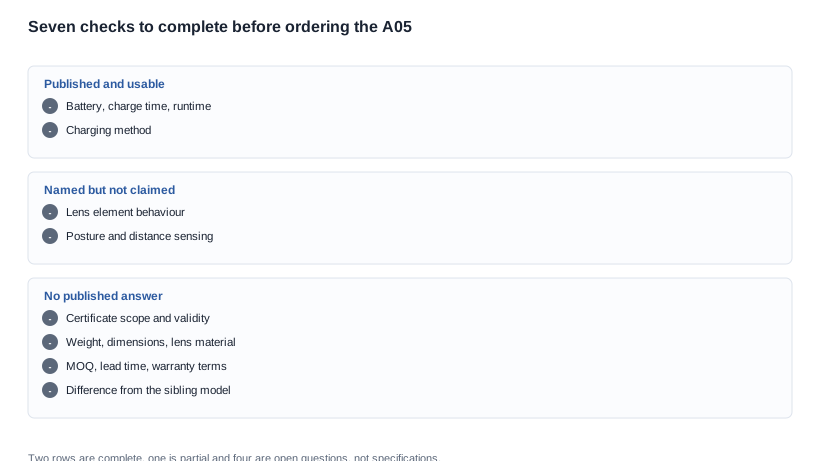
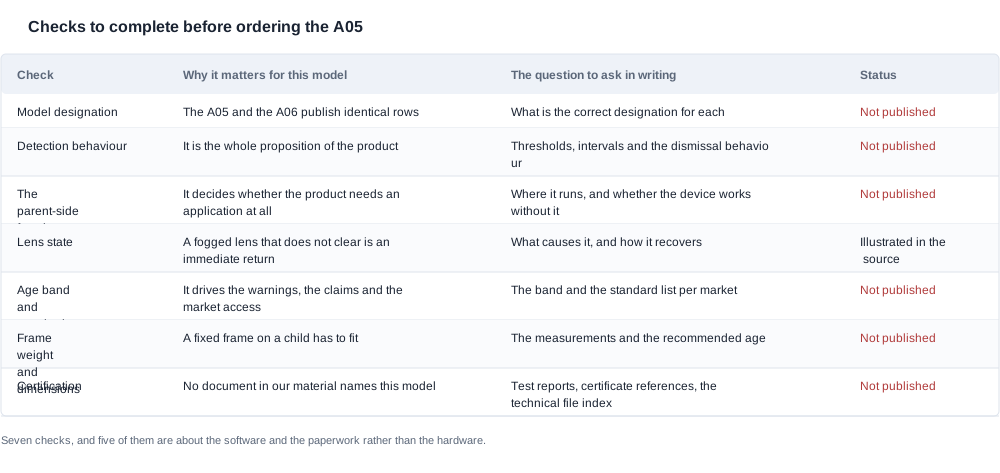
The A05 is a kids sensing product, and the checks that matter before ordering it are about behaviour and paperwork rather than about hardware. It publishes a 40 mAh cell, roughly twenty hours of rated use, a charge time of two hours or less, magnetic charging, a lens-type electronic element and posture and distance sensing with a reminder function. Five of the seven checks below have no published answer at all, which is why this list is more useful to a buyer than a specification summary would be: you cannot order the gaps, you can only close them or accept them.
So an a05 smart glasses what to check before ordering question has an unusual answer. The hardware rows are short, consistent and easy to verify. The ordering risk is concentrated in three places: a second model that publishes an identical row, a children's-product compliance position that our documentation does not summarise, and a set of physical questions about a fixed frame on a growing head. Everything below is organised around those three.
A05 smart glasses checks, and what each published row actually licenses
Before the checklist, the baseline — because a checklist is only useful if you know what is already answered. Five rows are published: charge time, cell capacity, rated runtime, charging method and two sensing features. Everything you want to write on a listing has to come from one of those five rows or from a document the supplier gives you. Note what is not in that list: no dimensions, no weight, no certification scope, no commercial terms and no test conditions. The five rows describe a product; they do not describe a purchase.
| Check | Published? | What it blocks if unresolved |
|---|---|---|
| Battery, charge and runtime | Yes | Nothing — usable as written |
| Charging method and cable | Yes | Nothing |
| Lens element and sensing behaviour | Feature named | Any functional claim |
| Certification status and scope | No | Retail listing, tender response |
| Frame weight, dimensions, lens material | No | Fit guidance, sizing policy |
| MOQ, lead time, price, warranty | No | The purchase order itself |
| Model identity against the sibling | No | Choosing between two identical rows |
The pattern in that table is the useful part. Two rows are complete, one is partially complete, and four are entirely open. A buyer who treats the open four as detail will discover them one at a time, usually after the order is placed. A buyer who treats them as the actual content of the pre-ordering conversation will have a shortlist that survives contact with a customer.
There is a fifth item the table does not list, because it is not a parameter at all: the destination market. Every row in it is market-dependent in practice, because what a listing may say, what a certificate must cover and what a product may be shipped into are all set by where the goods are going. A buyer who has not fixed the destination market cannot answer the certification question, cannot finalise the labelling and cannot write the listing, and the whole pre-ordering sequence runs in the wrong order.
And the row about model identity deserves its own attention, because it is unusual. Another model in this range publishes the same rows. Not a similar cell, not a comparable charge time — the same figures. If you cannot tell the two apart from documentation, then the first question you ask a supplier is not a specification question at all, and asking it costs nothing.

Check one: can you tell this model apart from its sibling?
This is the first check because everything after it depends on the answer. Our documentation records the two models as carrying the same catalogue product name within the kids protection range, and records the difference between them as an open item. We are not going to resolve that inside a marketing article, and we will not publish a comparison that pretends the rows differ when they do not.
What to ask, in order. What distinguishes the two products today, in the factory and on the packaging? Is there a bill of materials difference? Is the difference one of market, of certification scope, or of nothing at all? And if the difference is one of market, ask which markets each one is intended for.
Why the answer decides the rest. If the two models are the same product, then your range decision is a sourcing and branding decision, not a product decision, and you should negotiate on volume across both rather than split the volume between them. If they differ in certification scope, then the compliance question below becomes the main event, and it has to be answered before either is listed. If they differ in bill of materials, then the specification rows are the same by coincidence and you need the different rows.
A red flag to name. If a supplier answers this question with a feature difference that our documentation attributes to a third model, the answer has come from a different context. Ask which row in their own documentation supports it.
A second red flag, quieter than the first. If a supplier volunteers a difference between the two models without being asked, and the difference is something they have clearly decided on for their own commercial reasons rather than something recorded in a bill of materials, treat it as unverified. The question that settles it is simple: show me where it is written. A difference that exists only in a conversation is a difference that can be withdrawn in a later conversation, and a range built on it will fail at the reorder.
And a practical consequence either way. If you are going to stock both models, your packaging, your listing copy and your channel training material have to distinguish them — by name, by image, or by configuration — because a customer comparing two identical product pages will decide on price, and you will lose the higher-value one. Deciding the distinguishing mechanism is part of the range decision rather than a marketing detail to sort out after the first shipment, and it has to be agreed with the supplier before the packaging artwork is approved.

Check two: what can you claim about the two sensing features?
The A05 publishes a lens-type electronic element and posture and distance sensing with a reminder function. Those are feature names, and feature names are not claims.
The distinction matters more in a children's product than in an adult one, because the audience for the claim is a parent rather than the user. A reminder function is a behaviour; whether it is permitted to be described as supporting a specific outcome, in which market, and under which consumer protection rules, is a compliance question that our documentation does not answer. We are not going to answer it here, and any article that did would be inventing a regulatory position.
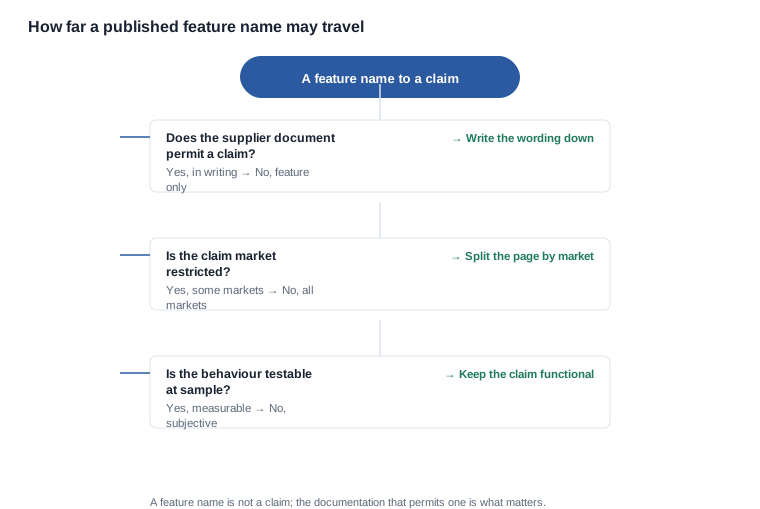
What to ask. What does the supplier's own documentation permit to be stated about each feature? Which markets is each feature intended for, and is any claim restricted to some of them? Is there a manual or a technical file that describes the behaviour, and may it be reproduced?
What to do with the answer. Record it next to the feature name in your own file, and write the claim no more broadly than the documentation allows. If the answer is that the feature may only be described functionally — it senses posture, it senses viewing distance, it reminds — then that is a usable claim set, and it is narrower than a benefit-led one. A narrower claim set that survives a customer complaint is worth more than a broader one that does not.
The arithmetic behind that twenty-hour figure deserves a paragraph of its own, because it is the kind of number that gets copied into a listing without a second look. A 40 mAh cell and roughly twenty hours of rated use describes a duty cycle, not a continuous capability. Unless you know what the product is doing during those twenty hours — how often the lens element is active, how often the sensing functions fire, what the reminder function is set to — you cannot tell your customer what they will actually get. Ask for the test condition, record it, and state it in the same place you state the figure. If the supplier cannot say, then the honest listing writes the figure as a rated value with the condition undisclosed, and says so.
One practical note. The two features also belong in your quality control route, not only in your listing. A sensing feature that behaves inconsistently is a return reason, and the question "what was the expected behaviour" needs an answer written into the acceptance criteria before the first shipment. Our quality consistency page covers how that route is normally built.
And a note about the imagery, because it is unusual in this category. The A05 is one of only two products in our catalogue whose pages carry functional illustrations — one set contrasting a correct posture and viewing distance against an incorrect one, and a second set contrasting a clear lens against a fogged one. In a category where no product photograph, no video and no test report exists for most models, that is a genuine documentation asset. It is also something to check the terms on before you use it: ask whether the illustrations may be reproduced in your own listing, in your packaging and in your channel material, and whether they may be cropped. A supplier who declines to say is telling you something worth knowing before you build your page around the imagery.

Check three: certification, scope and what a children's product adds
For a children's product, this check outranks all the others, and the reason is structural rather than technical.
A children's product is not a smaller adult product. It carries its own regulatory and consumer protection expectations, its own market-access requirements and its own documentation burden, and the burden changes with the destination market. Our documentation does not publish certificate numbers, issuing bodies, validity periods or the model schedule each certificate covers for this model, and we will not imply that they exist.
There is a practical reason this matters more here than in the audio or camera families. In an adult product, a documentation gap is usually a commercial inconvenience. In a children's product it is a listing that cannot be written, a tender response that cannot be completed, and a shipment that may be held. The consequence arrives earlier and it arrives in public, which is why the order of the checks below is not negotiable in the way a specification checklist usually is.
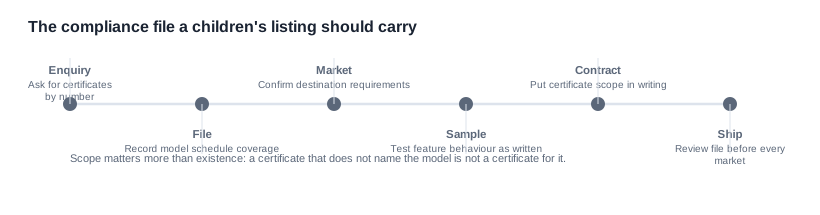
What to ask, and it is a long list. Which certificates cover this model, by number, with issuing body and validity period? Does each certificate's model schedule name this model or a family that includes it? Which target markets do those certificates support, and which markets would require additional documents? Is there a children-specific test report for the destination you are shipping to?
Why the model schedule question is the one to insist on. A certificate that exists, is valid and covers the right standard is still no use to you if its schedule does not name the product you are importing. Ask for the schedule itself, not for a statement that the product is covered, and check your model against it. In a range where two models publish identical rows, that check is the only thing that tells you which document belongs to which product.
And then the two questions that decide whether the file is usable. Can you have the documents themselves, rather than a summary of them? And will the supplier put the certificate scope into the contract, so that a lapsed certificate becomes a breach rather than a surprise?
One more, which costs nothing to ask and is skipped constantly. Ask whether any claim about the two sensing features is restricted in any destination market you intend to ship to. A feature claim that is fine in one market and restricted in another means your listing has to be split by market, and that is a packaging and content decision made at the wrong stage if you find out at the port.
Our certification checklist sets out the structure of that file, and the family-level position is in A05 certification status. The child product compliance page sets out why the children's question is a separate one rather than a stricter version of the same one.
Check four: the physical questions nobody asks until a return arrives
Frame weight, temple length, lens dimensions and lens material are not published for this model, and together they decide more returns than any feature claim will.
The reason is specific to this product's user. The end user grows. A fixed frame that is correct for an eight-year-old is wrong for a twelve-year-old, and the same unit is often sold into both age bands because nobody wrote the dimensions down. A listing cannot give age guidance it does not have, and a retailer cannot either.
What to ask. Frame weight and the dimensions that determine it. Temple length and whether it is adjustable. Lens dimensions and lens material. Whether different sizes exist as separate SKUs or as one adjustable unit. And, the question that costs the most to get wrong: what is the stated warranty position on a frame that the child has outgrown?
A second question in the same family that is easy to miss. Ask whether the lens element is consumable, replaceable or permanent, and whether it has a service life. A removable element with a service life is a recurring revenue line and an after-sales question; a permanent one is neither, and the two positions require completely different packaging, spare part planning and warranty language. Our documentation names the element but does not describe its service position, so this is a question rather than a row.
And a third, which is really a compliance question wearing a physical costume. Ask what the ingress position is for this model and where the supporting report is. The sport family's marking is published on other models; on a children's product the question of what the marking covers — and under what test conditions — is one a buyer should ask before using the word at all.
A useful way to state the whole position to a colleague. The published rows tell you what this product is made of. They do not tell you what you are allowed to say about it, where you are allowed to sell it, or which of two identically specified models you have actually been quoted. Those three questions are the pre-ordering work, and none of them is answered by the specification table.
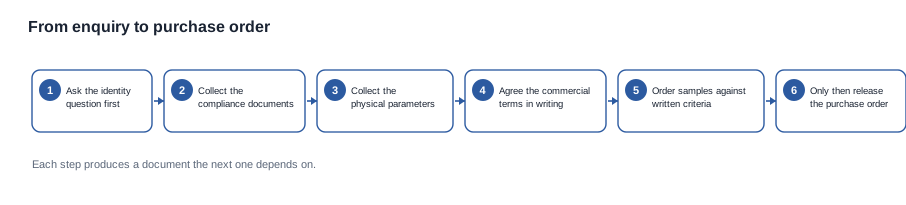
And the commercial parameters, in the same conversation. MOQ per model and per configuration. Lead time, and specifically what it is measured from. Unit price at your actual volume, including packaging. Payment terms and deposit structure. Warranty terms and the defect categories treated as returns. The MOQ, lead time, pricing and payment terms pages set out how each of these is normally structured.
A closing habit for this category. Because the target user grows and because the feature claims are narrow, the two questions a support team will receive most are "will it still be right in a year" and "what does it actually do". Both answers should exist in your own file before the first order, not in your support team's head after the first hundred tickets.
And a sequence that avoids the commonest mistake in this category, which is to negotiate the unit price first and the paperwork afterwards. The unit price is the only term that is identical at every stage of the relationship. Everything else — the certificate scope, the defect categories, the acceptance criteria, the lead time baseline — becomes harder to change once goods are in production. So the order of negotiation should be compliance, then acceptance, then commercial, and the price should be the last thing you settle rather than the first.
A short version of the whole article, for a buyer who has one hour rather than one day. Ask what distinguishes this model from the one that publishes the same rows. Ask for the certificates by number, with their model schedules. Ask what each sensing feature is permitted to claim, and in which markets. Ask for weight, temple length and lens dimensions. Write MOQ, lead time baseline, payment terms and warranty defect categories into the contract. Order two samples against written acceptance criteria. Then release the purchase order.
Our position on this model is that the published rows are usable and the gaps are closeable, provided you close them in a specific order. We will not present the runtime figure as a tested result without a stated test condition, we will not extend a feature name into a benefit claim the documentation does not support, and we will not resolve the model-identity question inside a sales conversation. Tell us the destination market, the volume and the age band you are targeting, and we will tell you which of these checks have to be closed before the order and which can be closed after the first shipment.
Related reading
- The five published rows and what each licenses — A05 specifications and features
- Where the gaps sit — A05 limitations
- The identity question in full — A05 compared across the range
- The runtime row — A05 battery life


