

Buyers do not arrive at the A06 with one question. They arrive with six or seven, asked in whatever order the meeting happens to run, and the reason the meeting stalls is rarely the product. It is that some questions can be answered from the published rows in under a minute, three of them cannot be answered at all without work that has to be paid for, and one of them decides whether the model should be in your range at all. Separating those three groups before the first call is worth more than any additional specification detail, because it tells you which questions to send to us, which to send to a test laboratory, and which one to settle internally before anybody spends money.
The published rows for the A06 are short, and it is worth reading them in full before the questions start. The catalogue gives this model a 40 mAh cell, a charge time of two hours or less, a rated runtime of about twenty hours, magnetic charging, and a lens-type electronic atomiser. The page carries the posture-and-distance states — correct posture and distance, poor posture and distance — and the two lens states, clear and fogged. That is the whole of what is published for the A06.
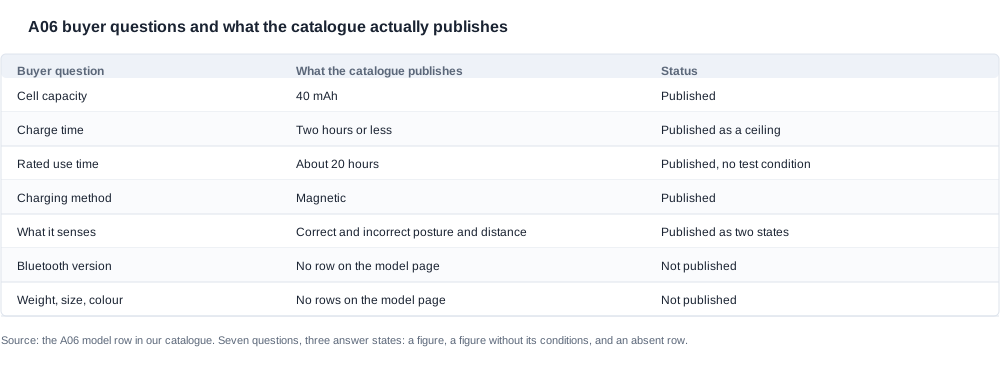
Seven questions come up in almost every enquiry, and they resolve into three very different states: a published figure, a published figure with no test condition attached, and an absent row that has to be requested in writing. The table above maps each question to the state it actually sits in. Only the first group can be answered from the catalogue in the time it takes to open the page, and knowing which group a question belongs to is most of the work.
A06 smart glasses: what the published rows answer
The five rows that carry the model
Four electrical rows and one feature description do the carrying. A 40 mAh cell, a charge time of two hours or less, a rated runtime of about twenty hours, and magnetic charging are the electrical set, and they are internally consistent in a way that is worth noting before anything else: twenty hours of rated runtime on the smallest single cell in this catalogue is a duty-cycle figure, not a chemistry claim.
The fifth row is the feature description, and it is worth being precise about what it says. The catalogue publishes a lens-type electronic atomiser with two lens states, clear and fogged, alongside correct and incorrect posture-and-distance states. It does not publish a measurement for any of it — no sensing range, no detection threshold, no reminder interval, no cycle life for the atomiser, no power draw. So the feature can be described accurately, and its performance cannot.
What a published row does not carry
A published row carries a number and nothing else. It does not carry the conditions that produced the number, and the difference matters commercially in three specific ways. A charge time of two hours or less does not say what state the cell started in, what charger was used, or what the ambient temperature was. A rated runtime of about twenty hours does not say what fraction of that time the device spent detecting, what the reminder frequency was, over how many units, or whether the figure is a mean or a best case. And a charging method does not say whether a case or a dock is included, or whether the case has a capacity.
None of that makes the rows useless. It makes them the floor of what you know rather than the ceiling, and the practical consequence is that a specification sheet you can quote is not the same thing as an acceptance criterion you can defend. The A06 specification reading works through each published row separately and marks what each one does and does not settle.

The questions buyers send, and what each needs
Buyers cluster their questions into five groups, and each group has a different answer and a different owner. Getting the routing right at the first call is what keeps a programme from spending three weeks on a question that was never going to be answered by a supplier email.
Group one — the identity questions. What distinguishes the A06 from the A05? Do both models publish the same rows? Is there a difference at all? These are answered in one sentence from the catalogue, and the answer is uncomfortable enough that it is better delivered early.
Group two — the electrical questions. Cell capacity, charge time, runtime, charging method, and whether the runtime is continuous or intermittent. The first four are published; the fifth is not, and it is the one that decides whether the twenty-hour figure is usable in your copy.
Group three — the physical questions. Frame weight, temple length, lens dimensions, colour options, and ingress protection. None of these are published for this model, and the honest answer for each one is that it has to be requested or measured.
Group four — the compliance questions. Which certificates exist, which markets they cover, and which model they name. This is the group where the answer requires a supplier and a test house rather than a catalogue, and it is the group that determines the schedule.
Group five — the commercial questions. Minimum order quantity, lead time, unit price, and whether the difference between the A05 and the A06 can carry a price gap. These are answered in a quotation, and they depend on the answers to groups one through four.
The five groups appear in the order above because that is the order in which they become expensive to fix. Identity and electrical answers cost nothing and unblock the most. Physical answers cost a sample and a measurement. Compliance answers cost a test programme. Commercial answers cost everything upstream.
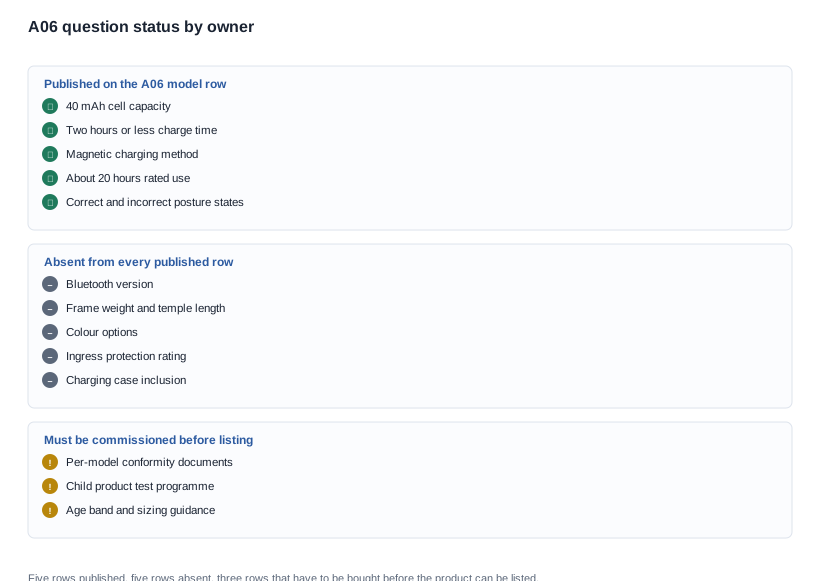
The checklist above assigns each group to an owner. Five rows are published and can be quoted today. Five rows are absent from every published page and have to be requested in writing — Bluetooth version, frame weight and temple length, colour options, ingress protection, and case inclusion. Three rows — per-model conformity documents, a children's product test programme, and age-band guidance — have to be commissioned rather than requested, because they do not exist yet for this model.
Routing a question to the right owner
The routing itself is a three-question test, and the branches matter more than the answers because they tell you where the clock starts. If the answer is on the model row, you answer it now and the programme loses nothing. If the answer needs a market document, you scope a test programme, and the programme gains a schedule line and a budget line. If the answer changes the range, you settle it before the order, because a range decision taken after the stock is committed is a decision taken with no leverage.
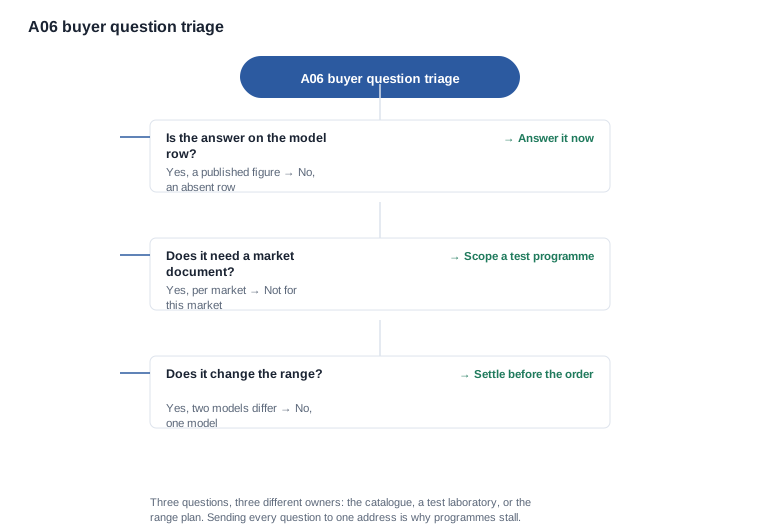
The most common failure here is sending every question to one address. A compliance question sent to a sales contact comes back as "we will check"; a dimension question sent to a test house comes back as a request for a purchase order; and a range question answered in either place is answered without authority. Separating the three at the first call removes most of the delay from a typical evaluation, and it does so at no cost — the routing decision is made before anyone has spent anything.
Answering the power question without a test condition
The power question is the one that most often gets answered wrongly, in both directions, so it is worth setting out carefully.
The published set is unambiguous. A 40 mAh cell, a charge time of two hours or less, a rated runtime of about twenty hours, magnetic charging. That is what the catalogue says, and it is what should go in a quotation request and a comparison sheet.
What it does not say is what the twenty hours describes. Two hours or less for a charge on a 40 mAh cell is a comfortable ratio rather than a tight one, which is consistent with a device that spends most of its time between active checks. The figure is also the longest rated runtime published anywhere in this catalogue — every other model in the range sits in the five-to-eight-hour band — which tells you something about how the other models are used and nothing at all about how this one is used. A buyer who compares a 40 mAh twenty-hour rating against a 220 mAh seven-hour rating is comparing two different duty cycles and reaching a conclusion about battery quality.
What to ask for, specifically. Five things, in this order: what was active during the twenty hours and what was idle; the reminder or detection frequency; the number of units the figure was measured on; whether the figure is a mean, a best case, or a single unit; and the starting state of the cell for the charge-time figure, together with the charger used and the ambient temperature. The battery and charging comparison against the A05 covers the same ground from the fleet-logistics side, where the identical rows change what you can plan around.
One caution on the wording. "Two hours or less" is a ceiling, and it is the wording we use. It is not the same claim as "under two hours", and a listing that converts one into the other creates an obligation the published figure does not support.
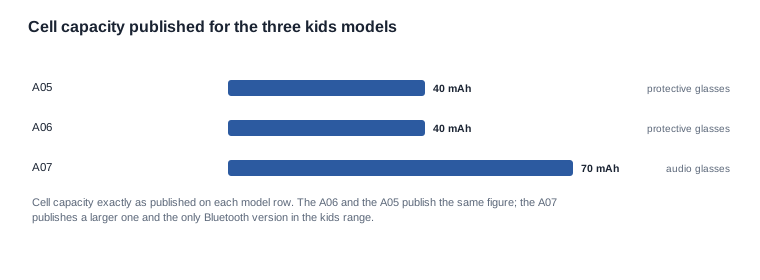
The three-model comparison in the chart above is worth reading carefully, because it is the cleanest example in this catalogue of why a cell size on its own tells you very little. The A05 and the A06 both publish 40 mAh. The A07, which is the audio model, publishes 70 mAh. All three publish the same rated runtime of about twenty hours. A 75 per cent larger cell producing an identical runtime figure means the runtime is describing a duty cycle rather than a chemistry property, and the two smaller-cell models are not running less — they are doing less work per hour while the cell does the rest.
That inference matters for two separate decisions. For the specification sheet, it means the twenty hours can be quoted as published without implying a continuous-use claim, because a 40 mAh cell sustaining continuous active operation for twenty hours is not a credible engineering outcome. For the acceptance test, it means the test protocol should specify the duty cycle first and measure the runtime second, because otherwise you will measure a different device every time the protocol changes. The A06 versus A07 use case analysis works through the same inference from the application side, where the size difference does carry a real consequence.
A caution on comparison shopping. The A06 and the A07 share a rated runtime and differ in cell size, which is the opposite of the usual pattern and therefore attractive to summarise as "the A06 is more efficient". That framing is wrong, because the two devices do different things and the runtime figures are not measured on the same workload. The honest statement is that both publish about twenty hours, that neither publishes the condition behind it, and that a comparison between them cannot be completed until the conditions are supplied.


The questions that need a written supplier answer
Two of the seven questions cannot be closed by reading anything we publish, and both of them are decisive.
The identity question
The catalogue publishes the same rows for the A05 and the A06 and states no difference between them anywhere. The two model pages carry the same cell capacity, the same charge ceiling, the same rated runtime, the same charging method, the same lens atomiser and the same posture-and-distance states. There is no row that separates them.
That is a harder position than an undocumented difference, and it needs to be handled carefully. It is not a claim that the two devices are the same product under two designations — we have no basis for that either. It is a statement about what our documentation contains. If a physical, functional or packaging difference exists, it has to be established in writing and then carried into your range plan, your listing and your inventory logic. Until it is, two indistinguishable SKUs in a category with a real compliance burden is a range-structure problem, and the A05 specification comparison works through what each possible answer would mean for the range.
The certification question
The catalogue holds a company-level export certification page, the content on it being images rather than text, and the catalogue text makes no mention of CE, FCC or RoHS. There is no per-model certification row anywhere. So the answer to "which certificates cover the A06" is not "the ones on page four". It is that a per-model file has to be requested for this model, and that request is the first thing to send to a test house rather than the last.
That page is also easy to misread, and the misreading is worth pre-empting. The images on it are ten patent certificates — eight appearance-design patents and two utility-model patents. They are evidence of design ownership, not of market conformity, and they do not substitute for a conformity assessment in any destination market.
For a children's product the point is sharper than for most categories. Products in this group attract requirements that adult electronics do not, commonly in the areas of small-parts and mechanical safety, and the applicable standards for children's products include EN 71 and ASTM F963 in the markets that use them. Which of them apply to a specific model in a specific market is a question for your compliance function and for a test house, and it belongs in the programme plan with a budget attached rather than in a follow-up email.
Turning an open question into a purchase-order condition
The practical payoff of this triage is that each unresolved question can be converted into something with a date and an owner, instead of remaining a topic in the meeting.
Write the question as a yes or no with a number attached. "Can the A06 be shipped into the destination market under a per-model conformity file?" is answerable. "What is the compliance story?" is not. The first version produces an answer with a date; the second produces a follow-up meeting.
Ask against the exact model designation. A test report names a model. A document written for one designation in this family does not automatically cover another, which is precisely why the A05/A06 identity question has to be closed before a file is commissioned rather than after.
Separate a measured figure from a stated figure. This distinction is cheap to maintain and expensive to lose. A measured figure has a method, a sample and a condition attached. A stated figure has none of those. Both can be quoted, but only one can be written into an acceptance criterion, and the twenty-hour runtime is currently a stated figure.
Then put the criteria in the order. Criteria that sit in a purchase order are binding; criteria that sit in an email are a description. For the items in this model that means the runtime test condition, the physical dimensions, the file that names the model, and the case inclusion all become conditions rather than correspondence. The A06 limitations analysis sets out which gaps are closable with a sample, which need a laboratory, and which are simply absent.
The boundary on health and certification claims
There is one boundary that will be asked about, and it should be answered the same way every time so nobody has to interpret it.
This product is a behaviour-monitoring device, and we make no claim about myopia, vision development, vision protection or eye health for it. We hold no clinical data, no test protocol and no regulatory assessment for this category. The catalogue describes a lens atomiser and two posture-and-distance states; nothing in that description supports a claim about a child's eyesight, and a listing that implies one is a regulatory exposure rather than a marketing decision. Our medical boundary guidance sets out the line, and the useful commercial consequence is that the claims you can make are narrower and safer: posture and distance indication, lens state, endurance, charging.
Our position on the A06 is that it is a well-specified product with a thin published row set and a real documentation gap underneath the sensing behaviour, and that the gap is closable with a sample, a written answer and a test programme — all of which cost money and time and all of which are cheaper than a recall or a withdrawn listing. We will confirm the published rows, we will tell you plainly which of the questions above we can close for you directly, and we will not fill an evidence gap with a typical industry value, because in a children's category a typical value is a claim about a child's eyesight.
Send us the market, the channel, the age range, the volume and the wording you intend to use, and we will come back with which of these seven questions we can answer from published material, which ones need a written request, and which ones need a programme. The family sits on our kids smart glasses range page.
Related reading
- The published rows, read one at a time — A06 specifications and features
- The identical-row problem, worked through — A06 versus A05 specification comparison
- Where the sensing claims stop — child product compliance
Send the market, the channel, the age range and the volume, and we will tell you which of the seven questions hold and which ones need a programme.


