
A06 smart glasses vs A05 battery and charging produces the shortest electrical comparison in our range: four published rows, and all four read the same on both models. A a charge time of two hours or less, 40 mAh cell, a rated runtime of about twenty hours, and magnetic charging. There is no row on either model page that separates the two.
For a procurement team that is not a dead end. It is a change of subject. When two stock-keeping units share an electrical specification, the question stops being "which one performs better on power" and becomes "what does one shared charging plan actually cost me across two lines". That answer reaches dock hardware, spare-unit policy, packing, the accessory list and the replenishment routine — and every one of those is a range-level decision rather than a model-level one.
The part worth reading carefully is what the identical rows do not settle. They settle the current, the connector, the dwell time and the rated endurance. They settle nothing about the cell's internals, the charging case, the input supply, the test condition behind the twenty-hour figure, or the cost of carrying a second designation that a warehouse has to stock, count and reconcile.
A06 and A05 charging: one electrical specification, two stock lines
The four rows that are identical, and the ones that are absent for both
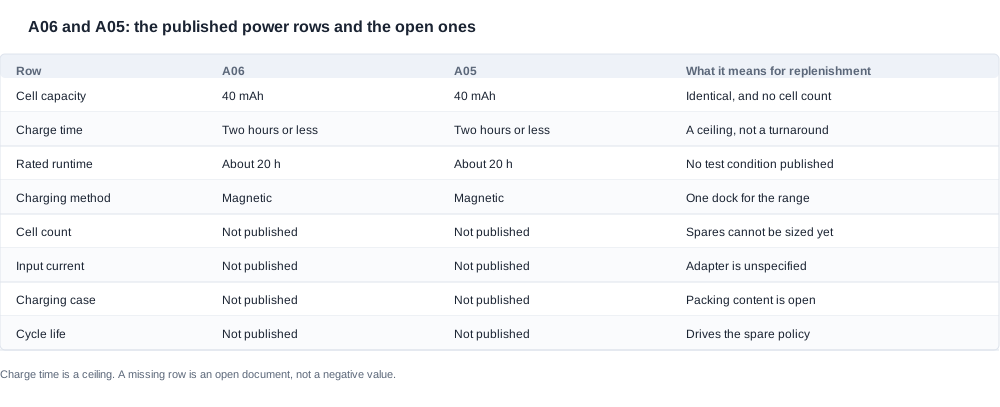
The comparison table above is the complete published electrical position for this pair, and it is worth reading the shape of it before the numbers. Four rows carry a value, and every value matches. Four rows that a buyer would expect to see are open for both models at once.
The four that match. The cell is 40 mAh on the A06 and 40 mAh on the A05. The charge time is two hours or less on both. The rated runtime is about twenty hours on both. The charging method is magnetic on both. That is the whole of it, and it means a technical buyer does not have a power question to arbitrate between these two — the power specification has already been decided for them, identically.
The four that are open. The catalogue publishes no cell count for either model, so a 40 mAh figure cannot be read as a single cell or as two. It publishes no input current, voltage or adapter specification for either, so the two-hour ceiling cannot be tied to a named supply. It publishes no charging case row for either — which is an absence of documentation, not a statement that the box contains no dock. And it publishes no cycle life, no operating temperature range and no self-discharge behaviour for either.
That distinction between not published and not present is the one that has to survive into a buying decision. Our catalogue publishes a charging case row for other models, with capacities ranging from 900 mAh to 1400 mAh, and for four camera models it publishes no charging case row at all. For the A05 and the A06 there is simply no row, which means a buyer cannot infer the packing contents from the catalogue at all, and has to ask.
What identical rows mean for a charging station
One charging plan covers both models, and that is the single largest operational saving available in this range. Every downstream artefact follows from it: the dock hardware, the cable and adapter standard, the charging-station footprint, the spare-unit ratio, the electrical inspection routine, the staff training note and the replenishment route all describe one product, not two.
The catalogue's own structure supports that reading. Charging method is published for twenty-four of the twenty-eight models, split between magnetic and Type-C, and magnetic is the larger group by a wide margin. This pair sits in the magnetic group, and so does the A07, the third model in the kids range. A buyer planning accessories for the whole kids line therefore has one connector decision to make rather than three, and the same decision can be extended across a substantial part of the catalogue if the range grows.
But one plan is not one cost. The saving shows up in hardware and in training, and it disappears again in the stock-keeping lines, because two designations that publish identical electrical rows still produce two SKU codes, two packing operations, two artwork sets, two listings and two reconciliation items in the warehouse. The charging station gets simpler; the stock room does not. A buyer who expects the identical rows to make the second model operationally free is going to be disappointed by the shelf rather than by the charger.
Why the two models still do not share a replenishment line
A replenishment line is a demand object, and a demand object is not defined by its current draw. It is defined by how many units leave the dock, how fast they come back, how many are in service, and how often each unit is swapped. Two models that charge identically can sit on completely different replenishment lines if their deployment looks different — one in a fleet of daily-use units, one in a retail shelf where units are sold rather than rotated.
The published rows do not tell you which of those two situations you are in. Nothing in the electrical comparison distinguishes a rotating fleet from a sold-through retail line, because that distinction is not electrical. It has to come from your own channel plan, and it has to be applied before you convert an electrical row into a spare-unit policy.
And the two models may not even be the same product. Our documentation holds no row that states what separates the A05 from the A06. The A06 and A05 specification comparison works through what each possible answer means, and the A06 smart glasses specifications and features list is the honest published baseline for this model. A buyer who plans a single replenishment line across two SKUs and then discovers the two are different products commercially has done the arithmetic on the wrong object.
A comparison with no visible difference still needs selection criteria. The useful question is not which model is better on charge, but what the buyer will be measured on. If the measure is total cost of a deployed unit, the shared dock wins immediately. If the measure is units on a shelf, the two-SKU structure costs twice as much to run. The criteria have to be written down before the range is built, and they have to include the questions the catalogue cannot answer for you.

The cycle above is the one the published rows support, and it has no model-specific step in it. Every stage — rotation, return to dock, charge against the ceiling, redeploy — is identical for the two models. That is what an identical electrical specification buys, and it is a real reduction in operating complexity.

A06 charge ceiling and runtime rating: what a logistics plan may and may not use
A ceiling is not a turnaround time
"Two hours or less" is a ceiling, and a ceiling behaves differently from a duration in an operations model. A duration tells you when something is finished; a ceiling tells you only that the finish is no later than that. Both models publish the ceiling, and neither publishes the conditions that make the ceiling meaningful.
The catalogue does not publish a starting state for the charge. Whether the two hours assumes a full discharge, a partial top-up from a half-used unit, or a battery held at a mid-state is not stated. Those are three different operational durations, and a station that is planned on the third one will be planned wrongly.
Nor is a termination criterion published. There is no published statement of what percentage of capacity counts as charged, and the catalogue's runtime figures do not state a termination condition either. A buyer who assumes a full charge and a buyer who assumes a charge to a conservative threshold will size the station differently, and only one of them is right.
Input current and voltage are not published for either model, so the two-hour figure cannot be tied to a named adapter or to a company's existing charging infrastructure. This is a line item that quietly reappears: a fleet operation that already has Type-C or proprietary charging installed will need to add hardware, and the cost of that hardware is not in the catalogue.
The twenty-hour rating carries no test condition
About twenty hours is the longest rated runtime published anywhere in our catalogue — every other model sits between five and eight hours. That makes it a figure worth understanding rather than repeating, and understanding it means knowing what it measures.
No test condition is published for it. What was active during the test, what the reminder frequency was, how many units were measured, whether the figure is a mean or a best case, and what the start and end states were — none of that is in the catalogue for this model. The A06 battery life analysis sets out the same question in more depth, and the A06 charging options analysis covers the connector and the charge ceiling.
For a logistics plan, the practical consequence is narrow and important. A published twenty-hour rating cannot be converted into a shift length, because the rating is not stated to be an active-use figure. Any station plan that assumes "one charge per working day" is making an assumption the catalogue does not support, and the assumption belongs in the written specification of the trial rather than in the model of the fleet.
A second limit applies to the ceiling in the same way. Because the catalogue publishes the charge time for all twenty-eight models but publishes no starting state and no termination criterion for any of them, the two-hour figure cannot be used as a docking turnaround. Plan the station with a buffer, and state the buffer explicitly, so that a later change in the termination criterion is absorbed by the plan rather than breaking it.
The derived average draw, and why it is only an average
One number can be derived from the published rows, and it is useful precisely because it is labelled as derived. A 40 mAh cell published against a rated runtime of about twenty hours implies an average draw of roughly 2 mA across the whole rated period. That is a calculation, not a published figure, and the catalogue does not state it.
It is a budget, not a duty profile. An average draw tells you the total energy available; it does not tell you whether the draw is spread evenly or concentrated in pulses. A product that wakes periodically to evaluate a posture state and then returns to idle behaves very differently from one that runs a sensor continuously, and both can present the same twenty-hour headline. The derived figure is the right basis for a first-pass energy budget and the wrong basis for a charge-point sizing decision.
The same calculation applied to the A07 shows why the range is worth reading as a set. The A07 publishes a 70 mAh cell against the same rated runtime of about twenty hours, which implies an average draw of roughly 3.5 mA on the same basis. The two models therefore sit on the same published runtime headline from opposite ends of the energy budget. The A06 and A07 use case fit comparison works through what that means for the way each model is deployed, and the A07 battery life analysis covers the larger cell in detail.
For due diligence purposes, treat the derived figure as a screening tool and not as a specification. Its job is to let you shortlist a charging supplier and size a first-pass station, not to write a service-level agreement. To verify a claim beyond that, you need the duty profile, the termination criterion and the measured units — and those three are what to ask a supplier for, in that order.
A06 magnetic charging: accessory, dock and warehouse decisions
One dock decision covers three models
Magnetic charging is published for the A05, the A06 and the A07, and that is a range-level accessory decision that has already been made for you. Whatever the dock, the contact arrangement and the cable standard turn out to be, they are the same dock for all three models in the kids range, and the same decision extends further if the range is widened into the magnetic group.
The value of that decision is larger than the dock price. A charging estate is a maintenance and inspection surface as well as a hardware purchase: contact cleaning, seating faults, cable and adapter spares, and the electrical checks that go with them all scale with the number of distinct arrangements in service. One arrangement across three models means one training note, one fault code, one spare-part line and one inspection procedure. A range that had mixed magnetic and Type-C charging would need two of everything, and the catalogue shows both arrangements in active use elsewhere.
The cell difference in this family does not propagate into accessory planning. The A07 carries a larger cell than the A05 or the A06, and it still charges magnetically on the same ceiling. A buyer who expects a bigger cell to mean a different dock, a different adapter or a different station footprint is carrying a problem that this range does not have. The capacity difference is real, and it stays inside the product.
The case question the catalogue leaves open
No charging case row is published for the A05 or the A06, and the honest way to read that is as an open documentation line rather than as a product fact. Elsewhere in the catalogue the charging case is treated as a first-class published row: capacities of 1400 mAh for three camera models, 900 mAh and 1400 mAh as two listed options for one model, a 1200 mAh folding case for the MT6, and a case whose capacity is not published for two further models. And four camera models simply have no case row in the catalogue at all.
That last case is the one to copy. The catalogue's own treatment keeps a published capacity, a published case without a figure and a published absence of any case row as three separate positions, and a buyer should use the same distinction here. The question to put to the supplier is therefore not "does it come with a case" but "what is the packing content for this model, and does the case have a published capacity" — the second question has a documented precedent in the catalogue, which is what makes it worth asking.
For the A05 and the A06 the packing question has commercial weight. A children's product is bought by a family or a school, and a dock in the box is a strong and visible reason to choose one listing over another in a way that a specification sheet is not. If the packing content is genuinely identical between the two models, that is another dimension on which the range carries no distinction, and it is worth knowing before the packaging is committed rather than after.
Contact, cleaning and the spare-unit policy
Magnetic charging is a contact interface, and a contact interface has a maintenance profile that a battery row does not describe. The catalogue publishes the method and the ceiling; it does not publish the contact rating, the number of cycles the contact survives, the cleaning interval, the behaviour when a unit is seated incorrectly, or whether the device reports charge state to the operator. Those are the rows that turn a charging method into a maintenance schedule, and they have to be requested as a set.
The spare-unit ratio is a direct function of the runtime figure, and the runtime figure has no test condition. If the real figure under your duty is shorter than the published rating, the spare-unit ratio has to be higher than the plan assumed, and the extra units sit in the same charging estate. This is the point at which an untested runtime rating turns into a warehousing cost, and it is why the test condition question is not a curiosity.
Three operating rules can be written down now, before the missing rows arrive. First, size the station on the two-hour ceiling plus a stated buffer, because no starting state is published. Second, treat the twenty-hour figure as a marketing-grade rating until a duty profile is confirmed, and do not put it in a service-level document. Third, decide the spare-unit policy against the deployment model rather than against the cell, because the cell tells you nothing about how often a unit is cycled in your channel.
And the two models need one spare-parts line, not two — for the docks, the cables, the adapters and the contact spares — because those are the physical parts that wear, and they are shared. The items that do not share are the units themselves, the packaging and the paperwork attached to them, and the distinction between those two lists is the practical shape of this comparison.
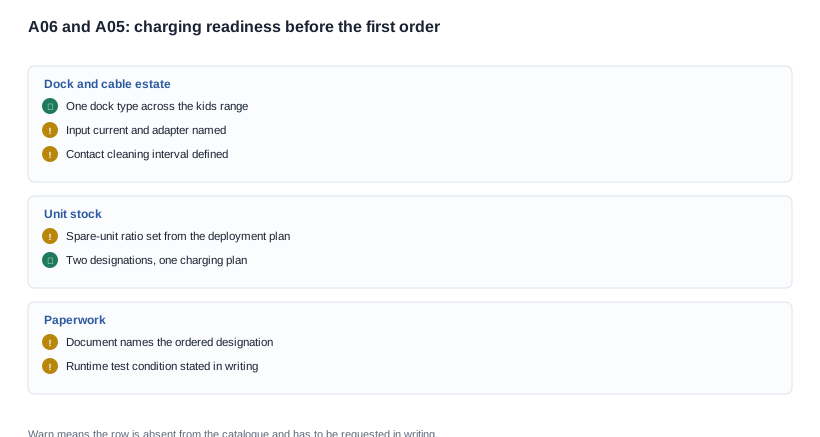
The checklist is a readiness test, and it is a short one because the range is short. Three groups, no more than a dozen lines, and every warn on it is a line the catalogue does not publish. That is an unusually cheap due diligence pass to run, and it is the reason the accessory side of this comparison can be closed in a single exchange with the factory rather than over a procurement cycle.
A06 and A05 replenishment questions to close before the first order
Ten questions, in the order they block work
Ask the charging questions first, because they are the ones with a schedule attached. A dock that arrives late stops a deployment, while a packaging decision that arrives late only stops a print run.
- What starting state does the two-hour charge figure assume — a full discharge, or a partial top-up from a partly used unit?
- What capacity level counts as charged, and is that the same level used for the twenty-hour runtime rating?
- What input current and voltage does each model accept, and is a specific adapter required?
- How many cells does the 40 mAh figure describe, and what is the cell chemistry?
- What is the published cycle life, and what does the warranty say about capacity retention?
- What is in the box — dock, cable, adapter, case — and does the two models differ in packing content?
- Does the case have a published capacity, and is a case included at the ordered quantity?
- What was active, idle and at what reminder frequency in the twenty-hour test, over how many units, and is the figure a mean or a best case?
- What are the contact cleaning and seating-check intervals, and what is the failure behaviour if a unit is seated incorrectly?
- Are the two model designations covered by separate written documents, or does one document name both?
The tenth question is the one that decides whether the other nine are worth asking twice. The certification and compliance documentation work for a category like this is a per-model file, and a test document names a designation. Two designations that publish identical electrical rows still do not automatically share a document, and a buyer who assumes they do is building a compliance position on an inference.
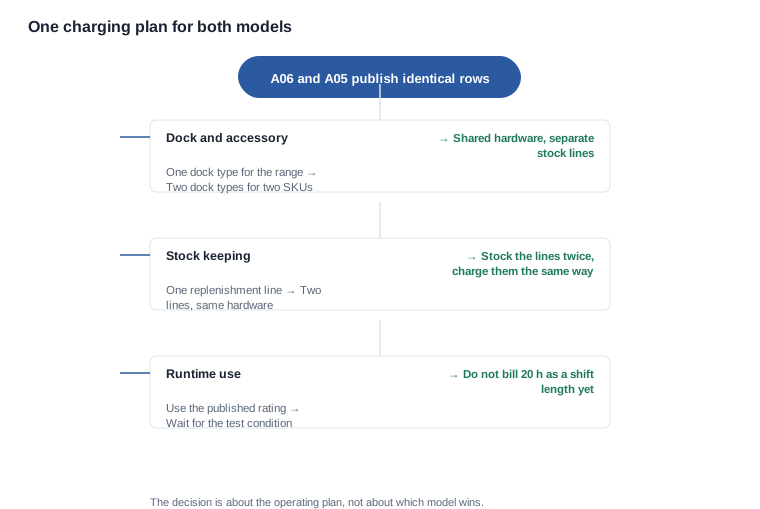
The three branches in the chart are the whole decision, and they resolve in that order. Hardware first, because it has a lead time attached. Stock lines second, because they set the working capital. Runtime use last, because it needs a written condition before it can be relied on and nothing else is blocked by it.
A worked shift cycle
A short worked example shows how the published rows behave in an actual operating model, and it is a hypothetical planning exercise rather than a report of a deployment. Assume a brand running a rotating fleet of children's units across three sites, with a charging room at each site, and with the A05 and the A06 both in the range for two different reasons — one on a general rotation and one on a pilot for a specific programme.
The shared electrical plan is straightforward. One dock type, one adapter standard, one inspection routine and one spare-parts line cover both models and the A07 as well. The charging room is designed against the two-hour ceiling with a buffer, and against a spare-unit ratio that is set from the deployment plan rather than from the cell.
The thing the plan cannot absorb is an unconfirmed runtime. The published rating says about twenty hours, and the plan puts a nominal charge cycle at a working day on the assumption that the figure reflects a comparable duty. If the real figure under the pilot's duty is materially shorter, the shortfall appears as extra units in the charging room at every site at once, and it appears as a supplier escalation at the same time, because the shortfall will be read as a product problem rather than as an unstated condition.
The pilot therefore needs one written condition that the catalogue does not supply: the duty profile under which the twenty-hour figure was measured, and the duty profile the pilot will actually impose. Getting that in writing before the first order is the cheapest decision in this whole comparison, because it converts the largest open variable into a known one at no cost at all.
What we can confirm on charging today
We can confirm that these two models publish identical power rows. Same cell capacity, same charge-time ceiling, same rated runtime, same charging method, and no published row that separates them on any of it. We can confirm that the twenty-hour rating is the longest published runtime in the catalogue and that no test condition accompanies it. And we can confirm that magnetic charging lets one dock, cable, adapter and spare-parts decision cover the whole kids range.
What we will not do is fill the gaps with plausible values. We will not quote a cell count, an input current, a case capacity or a cycle life for either model, because the catalogue publishes none of them. We will not convert the two-hour ceiling into a turnaround time, because the starting state and the termination criterion are not published. We will not present the twenty-hour rating as an active-use figure, and we will not attach any vision, health or prevention claim to the posture-and-distance sensing that the catalogue lists for this family, because no supporting evidence is published for it and the regulatory exposure in a children's category is real.
What we can do is close the list quickly. Send us the channel, the sites, the volume, the target markets and the packaging intent, and we will tell you which of the ten questions above we can answer from our own records, which ones need the factory, and which ones stop the listing. The family sits on our kids smart glasses range page, and the A06 and A05 price positioning analysis covers what a two-SKU line costs commercially when the two SKUs publish the same rows.
Related reading
- The published rows behind this model — A06 smart glasses specifications and features
- The formal meaning of an identical row — A06 versus A05 specification comparison
- Reading the runtime claim properly — A06 battery life
Send us the channel, the sites, the volume and the markets, and we will tell you which of the ten charging questions we can answer and which ones stop the listing. A06 smart glasses vs A05 battery and charging is a planning question before it is a specification question.


