

The comparison across this category is short because the category is short: three models in the kids range, five published rows each, and one question that has to be answered before the range can be planned. The A06 sits inside the sensing pair and matches the A05 on every published row, so the analysis below is as much about the range structure as about this model. A buyer who only wants to know whether the A06 is competitive will find the answer in the first two sections; a buyer who has to build a three-model line will find the range decision in the middle.
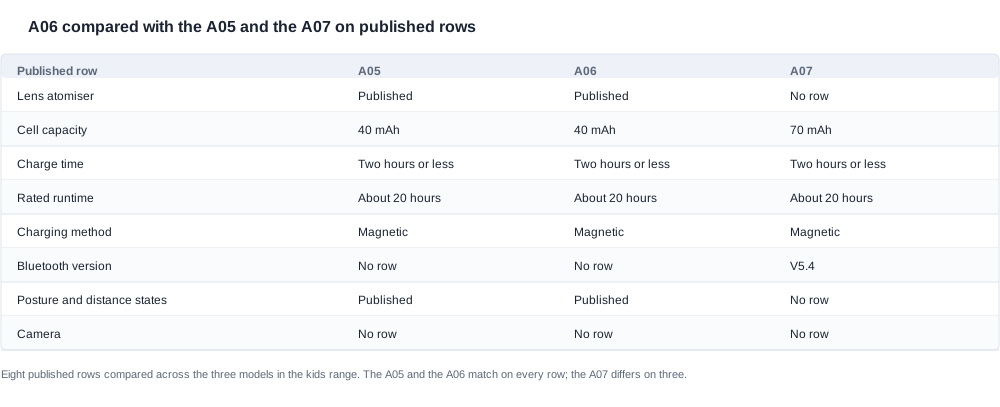
The table above is the whole published comparison, and it is worth reading the shape of it before reading the numbers. Eight rows were compared across the three models. The A05 and the A06 match on all eight. The A07 differs on three: it publishes a larger cell, it publishes the only Bluetooth version in the range, and it publishes neither the lens atomiser nor the posture-and-distance states.
A06 smart glasses compared across the three-model kids range
What a row-by-row comparison actually settles
Three rows decide the entire kids range, and they are worth naming separately from the rest because they are the only ones a buyer can use to make a selection without any additional information.
The first is the sensing set. The A06 and the A05 publish a lens-type electronic atomiser with clear and fogged lens states, and they publish correct and incorrect posture-and-distance states. The A07 publishes neither. That is a capability difference, not a specification difference, and it is the difference that separates a behaviour-monitoring device from an audio device.
The second is the Bluetooth version. The A07 publishes V5.4. The A05 and the A06 publish no Bluetooth version row at all — not a lower version, not an older generation, no row. This is the correction that matters most for anyone working from a secondhand comparison sheet, because our catalogue does not state a radio version for the two sensing models, and a comparison that puts a Bluetooth figure against them has imported it from somewhere we do not publish.
The third is the cell capacity: 40 mAh for the A06, 40 mAh for the A05, 70 mAh for the A07. On paper that reads as the A07 being the better-specified product, and the published rows do not say otherwise. What the rows do not say is what the cell is doing, which is the subject of the runtime discussion below.
Everything else in the table is either identical across the range or absent from it. Charging method is magnetic for all three. Charge time is two hours or less for all three. Rated runtime is about twenty hours for all three. No camera is published for any of them.
Where the comparison is thinner than it appears
Two absences in the table are worth calling out because they are the kind of absence that gets noticed late.
The twenty-hour runtime is published without its test condition. That is not a defect in the comparison — the comparison is accurate — it is a limit on what the comparison can support. A figure with no condition behind it cannot be compared with another figure, because the two may have been measured on different workloads. It can be quoted, and it can be planned around, but it cannot be used to argue that one model is better than another on endurance, because on the published evidence there is no endurance difference between the three to argue about.
Three of the eight rows are absences rather than values. No row for a Bluetooth version on the A05 and the A06, no row for the lens atomiser or the posture states on the A07, and no camera row anywhere. An absent row is not a negative value. It means the catalogue does not carry that information for that model, and it is a legitimate subject for a written request rather than a conclusion you may draw from the comparison.
A short worked case: three models, one shelf
This is a hypothetical range rather than a client programme, and it is written to show how the published rows decide a range rather than to report a result.
Assume a brand selling into a general retail channel in three markets, planning a three-model kids line with a price ladder. The range has to cover a behaviour-monitoring product for a parent's health-adjacent use case, an audio product for general daily use, and a third position that sits between them commercially.
The first decision kills the middle position. The A06 publishes nothing beyond the A05, so a middle rung built on the A06 would have to be justified on something our documentation does not contain. Either the middle rung is dropped, or the middle rung is a different model that publishes something more. The second decision is which model carries the behaviour proposition, and the answer is the A06 or the A05, with the same published evidence and the same open identity question in both cases — which is why the range owner has to close that question before choosing between them, not after.
The third decision is the radio. If the retail channel's listing template, connection instructions and support script all assume a Bluetooth model, the A07 is the only model in this range that can fill those slots with published evidence, and the sensing models have to be briefed without a radio row. The fourth decision is the accessory set, and because charging is magnetic and identical across the range, one dock or case decision covers all three models rather than three.
The result of walking the published rows in this order is a range with two sensing designations, one audio designation, and an open question about the sensing pair that has to be closed before artwork is finalised. That is a different range from the one the same buyer would have designed if they had assumed a documented difference between the A05 and the A06.
Where the A06 sits in a three-SKU range
The A06 is the sensing model, and it is one of two models that publish the same sensing set. That is the position. A range built on this category has two product ideas in it — a behaviour-monitoring device and a camera-free audio device — and three model designations across them. The A06 and the A05 are both the first idea; the A07 is the second.
This matters for range planning in a way that a single-model comparison never reveals. A buyer choosing between the A06 and the A07 is making a genuine product choice, with a real capability difference and a real radio difference. A buyer choosing between the A06 and the A05 is not, because the published documentation offers them nothing to choose on. Treating these two comparisons as one comparison is the most common structural mistake in this category, and it is why range discussions stall: half of the range decision has already been made by the documentation, and the half that has not been made is the half that requires a written answer from us.
The commercial consequence of a duplicate designation is not the unit price. It is the working capital held in a SKU that cannot be distinguished at the shelf, the artwork and packaging cost of a second identity that adds no specification, and the support cost of a customer who asks why two products are identical and gets a non-answer. Those three lines belong in the range plan next to the unit price, because they are usually larger than the price difference between the two models.

What the range shares, and how the sensing and audio models separate
Three things are shared across the entire range, and they are worth stating because they remove arguments that would otherwise consume time.
Charging is identical. All three models publish magnetic charging, and all three publish a charge time of two hours or less. There is no charging story to tell between them, which means the case, the dock and the charging logistics question is a range-level question rather than a model-level one. The A06 versus A05 battery and charging comparison develops that logistics point, because identical electrical rows change what you can plan around far more than they change what you can sell.
Runtime is identical on paper. All three publish a rated runtime of about twenty hours, on cells of 40 mAh, 40 mAh and 70 mAh respectively. That figure is the longest published runtime in our catalogue — every other model sits between five and eight hours — and it is also the figure whose test condition is not published. Both facts have to be carried together.
None of the three publishes a camera. That is a genuine advantage of the whole category in a children's segment, and it is one that no model in the range gives up in order to compete with the other two. In a category where the parent's first question is usually about the camera, a range that publishes no camera anywhere is a range with one answer to that question, applied consistently across three products.
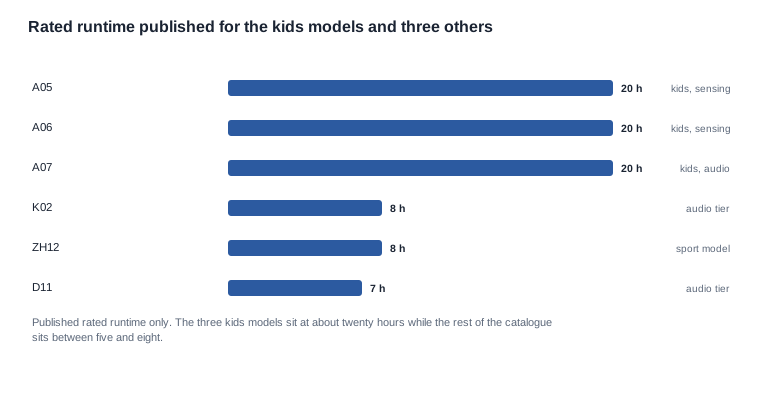
The runtime chart above puts the three kids models against three others from elsewhere in the catalogue. The gap is large enough that it tells you something about the category's duty cycle: the kids models are built for intermittent sensing and long idle periods, not for continuous operation. That reading is an inference from the published numbers, and it is the correct one — but it is an inference, and the runtime test condition still has to be requested before any of it goes into a buyer-facing document.
How the sensing and audio models separate in practice
Where the range does separate, it separates clearly, and the separation is on capability rather than on specification density.
The A07's larger cell buys a larger cell and nothing else that is published. It does not buy a longer rated runtime — all three models publish about twenty hours — and it does not buy a sensing function, because the A07 publishes neither the atomiser nor the posture-and-distance states. A range brief that presents the A07 as "the more advanced option" is describing a cell size, not a capability ladder.
The radio difference cuts the other way. The A07 is the only model in this range with a published Bluetooth version, which means it is the only one a channel can write a connection instruction, a compatibility statement and a support script for from published evidence. For a channel that has already built those assets for other models, that is a genuine commercial advantage and it may outweigh the absence of a sensing function in a particular market.
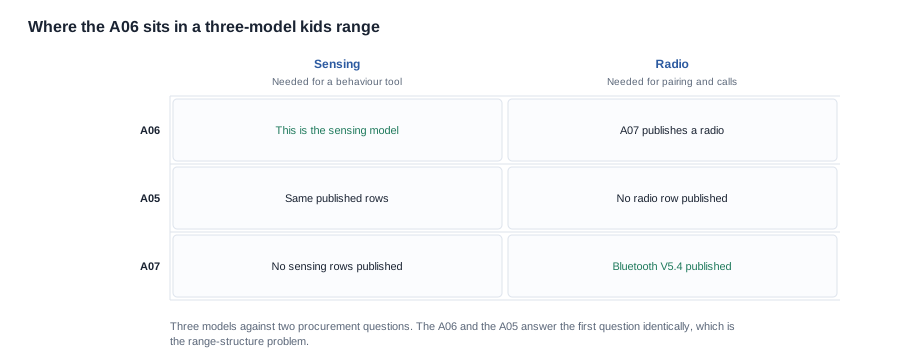
The matrix above places the three models against the two procurement questions that actually select between them. Read the first column: the A06 and the A05 answer the sensing question identically, which is the range-structure problem stated as a table. Read the second column: only the A07 has a published radio, which is a genuine differentiator and a genuine limitation of the other two.
A caution on reading the matrix as a recommendation. It is a routing diagram, not a preference. A buyer whose requirement is the posture-and-distance indication has one product idea and two designations to choose from, and the choice between them is a documentation question rather than a specification question. A buyer whose requirement is an audio device with a published radio has exactly one designation. Neither of those is a judgement about which model is better, because the published rows do not support one.
The one question that decides the range
What differs between the A05 and the A06? Nothing in the published documentation. Identical sensing set, identical cell, identical rated runtime, identical charging method, no camera on either, and no row anywhere that separates them.
We do not publish a difference, and we will not describe one we cannot document. What we will say plainly is that the absence of a published difference is a statement about our documentation, not a claim that the two devices are physically identical — a colourway, a lens option, a packaging tier or a component revision are all ordinary reasons for two models to share a specification, and all of them have commercial consequences that a range plan needs to capture.
Get that answered in writing, because it decides whether a range is two sensing models or one. If the answer is a physical or packaging difference, two SKUs is a legitimate merchandising structure with a known cost. If the answer is a firmware or component revision, that is an engineering difference and it changes the documentation file, the accessory list and the support load. If the answer is that they are the same product under two designations, then your range, your listing and your inventory logic should say so rather than leaving the customer to work it out. The A05 versus A06 specification comparison works through what each possible answer means in practice.
The commercial lines a range plan has to carry
Four cost lines travel with the A06 and are not visible in any published row. They belong in the range plan next to the unit price, because in this category they are usually the larger numbers.
The duplicate-identification cost. Two designations that publish identical rows create artwork, packaging, listing, inventory and support work for a second identity that adds no specification. The cost is knowable in advance once the difference is established, and it is unknowable while it is open — which is the argument for closing the question before artwork rather than after.
The accessory cost. Charging is magnetic and identical across the range, so a single dock or case decision can cover all three models. What cannot be shared is anything that depends on the sensing hardware, and the A06's atomiser is the one component in this range with no published specification behind it.
The documentation cost. A per-model conformity file is a per-model cost. Three designations means three files, not one, and the A06's file is one of the two that cannot be assumed to cover the other sensing model.
The data-work cost. A range that includes a sensing model inherits a data-handling workstream. Whether that workstream is trivial or substantial depends on what the parent-side function turns out to do, and that is the one item on this list with no published basis at all.
None of these four is a reason not to carry the A06. They are reasons to carry it with a budget attached, rather than to discover the difference between a quoted price and a landed programme cost after the first order has shipped.
How to brief the range without inventing a middle tier
A range brief that leans on the A06 as a middle rung between the A05 and the A07 will not survive a customer who checks. The A06 does not publish more than the A05, and it does not publish a radio, so a brief that says the A06 sits above the A05 has to be justified on something the documentation does not contain.
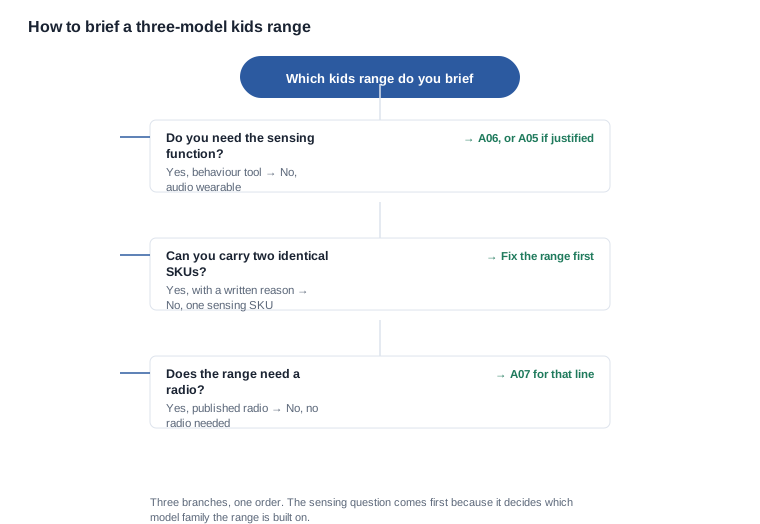
The decision chart above is the honest version of that brief. The sensing question comes first, because it decides which model family the range is built on. Then the duplicate-SKU question, because a range cannot carry two identical designations without a written reason attached to one of them. Then the radio question, which decides whether the range needs a third line at all.
The A06's own value in this structure is specific, and it is worth stating it precisely because it is stronger than a middle-rung argument. It is the model a buyer selects when the posture-and-distance indication is the requirement — an optometry practice building a routine programme, a school running a behaviour scheme, a brand whose whole proposition is behaviour change rather than audio. For that buyer there is no alternative in this range, and the fact that the A05 publishes the same rows is a documentation problem for the range owner rather than a reason for the buyer to go elsewhere.
On the other side, the A06 has a real structural cost that should be priced rather than discovered. The posture-and-distance indication produces data, and the catalogue publishes nothing about what that data is, whether it leaves the device, who operates the application, or what a parent-side function would show. A range that includes the A06 carries that question into every market it sells in. The privacy considerations piece sets out the questions that need answering, and the who should buy the A06 analysis covers the buyer suitability question from the other side.
The range questions to close before the first order
Five rows sit open across this range, and closing them is a sequencing job rather than a negotiation. List every published row side by side, mark each as quotable, absent, or published without a condition, and then find the duplicate pair — step three in the chart below is the only one that finds a duplicate SKU before the inventory does.

- What differs between the A05 and the A06, in writing and specifically.
- Where the parent-side function runs, what it collects, and whether the device works without it.
- The endurance test condition behind the twenty-hour rating, and the same for the charge ceiling.
- The physical rows — frame weight, temple length, lens dimensions and the recommended age band — for each model.
- The per-model conformity file for each model in each destination market.
Our position on the range is that the A06 is a well-defined product with an unusually large documentation gap sitting in the middle of its operating routine, and that the gap is in the software and the file rather than in the hardware. We will describe the published sensing functions exactly as the catalogue describes them, and we will not attach a health, vision or prevention claim to any of them, because in a children's category that is a regulatory exposure rather than a marketing choice. We will also state plainly that the certification position for this range is not published as a per-model row, and that it has to be closed with a test house before the product is listed in a market that requires one. The published A06 specification list is the honest baseline, and the kids buying guide covers the category decision.
Send us the buyer, the age band, the volume and the markets, and we will tell you which model in the range matches the requirement, which rows we can confirm today, and which compliance questions remain open.
Related reading
- This model's published figures — A06 specifications and features
- The unresolved duplication, worked through — A06 versus A05 specification comparison
- The data question the sensing function raises — kids smart glasses privacy considerations
Send us the buyer, the age band and the markets, and we will tell you which model matches the requirement and which compliance questions remain open.


