

Two models in our range publish identical rows in every published line. The A05 and the A06 both carry a 40 mAh cell, both publish a charge time of two hours or less, both publish a rated runtime of about twenty hours, and both charge magnetically. Both publish the same six feature rows: a lens-type electronic element, an atomiser, correct and incorrect posture-and-distance states, and clear and fogged lens states. Neither publishes a Bluetooth version row at all.
So the question behind a price gap between them is not "which one is better". It is "what is the gap paying for", and the honest answer from the published documentation is that no specification is doing the work.
That is not a dead end for a range plan. It is a design brief. A price ladder is a commercial structure built on top of products, and a structure built on two indistinguishable designations has to be constructed from something other than the specification sheet. This piece sets out what can carry the gap, what cannot, what the ladder has to be made of to survive a customer who checks, and which cost lines actually set the price.
A06 and A05 price positioning: what a gap between two identical rows can rest on
The published rows, and the single difference in the family
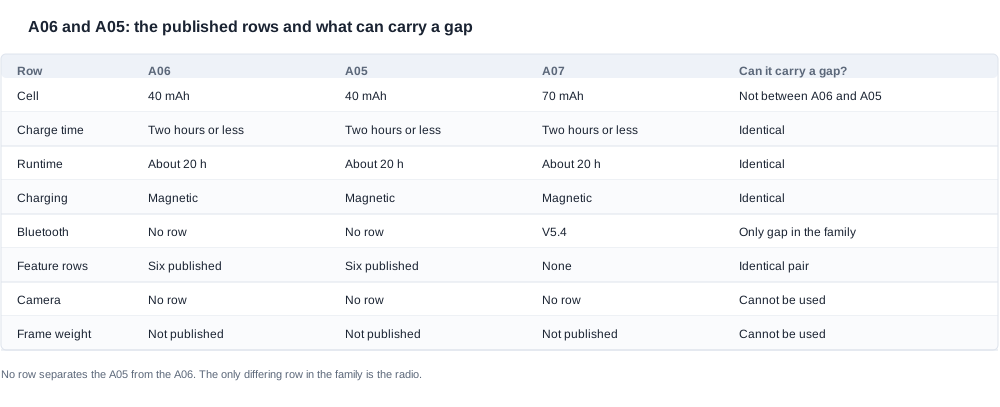
Read the table before the argument, because the shape of it is the argument. The A05 and the A06 match on every published row: cell, charge time, runtime, charging method, the six feature rows, and the absence of a camera row. The catalogue publishes no row that states a difference between them, anywhere.
Across the whole three-model kids family, exactly one published row differs. The A07 publishes a Bluetooth version, V5.4. The A05 and the A06 publish no radio version at all — not an older one, not a lower one, no row. The A07 also publishes a larger cell, 70 mAh, and the catalogue names that model as a kids smart audio glasses model while publishing no further feature rows for it.
That gives a family with one describable technical difference inside it, and it does not sit between the A05 and the A06. It sits between the pair and the third model. A price ladder built on a radio version is therefore a two-rung structure, not a three-rung one, and any range plan that describes three tiers in this family is describing one distinction twice.
We do not publish prices, and this article does not contain any. It is not useful to state that as a disclaimer and move on, because it changes what a buyer can build: the ladder has to be described in words that the published rows support, and those words are about packaging, channel, service and scope rather than about hardware. The kids smart glasses range page is where the models sit, and the A06 published specification list is the row-level baseline.
What a price ladder has to be made of
A ladder is a set of rungs that a customer can climb, and every rung has to be describable in one sentence that survives a check. If a customer can open the two product pages and find the sentence does not hold, the ladder is not a ladder — it is a price difference with a story attached, and it converts at the point of comparison rather than at the point of purchase.
Three things can make a rung describable without a specification difference. The first is scope: what is in the box, what the warranty covers, how long the support window runs, whether a replacement unit is included, what the documentation file contains. The second is channel: which market the designation is built for, what the listing says, what the retailer is expected to stock. The third is presentation: a different colourway, a different lens option, a different packaging tier, a different bundle. All three are legitimate, all three are commercial, and none of them requires the catalogue to publish a different number.
Two things cannot make a rung describable, and they are the two buyers reach for first. A rung cannot rest on a specification the catalogue does not publish, and it cannot rest on a quality or performance claim that has no measurement behind it. Both are red flags in a category where a customer with a supplier's own catalogue can check.

A06 ladder arguments that do not survive a customer check
The three arguments buyers reach for first
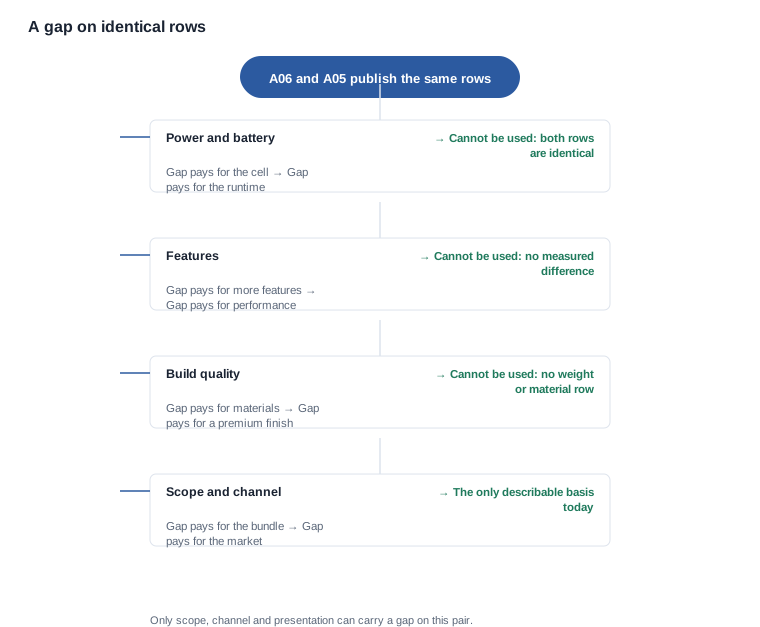
Argument one: "the higher-priced model has the better battery." This is the easiest to settle, and it settles immediately. Both models publish a rated runtime of about twenty hours, a 40 mAh cell and a charge time of two hours or less. There is no electrical difference to price. A gap that claims one will not survive a customer who compares two product pages, and it is the argument most often made by accident in a listing written from memory rather than from the catalogue.
Argument two: "the higher-priced model has more features." The six feature rows are the same on both, so there is nothing extra to charge for there. And the performance behind those features is not published for either model: no sensing accuracy, no sensing range, no reminder interval, no trigger logic, no atomiser mechanism, no power draw, no cycle life. A gap cannot rest on a feature whose performance nobody has measured, and a listing cannot describe a feature difference the documentation does not contain.
Argument three: "one of them is simply better made." This one has no published basis at all in this family. No frame weight is published for the A05, the A06 or the A07 — the only weight published anywhere in our catalogue is for a different model in the camera group, and it is the eyewear body alone, excluding its folding case. No material, no finish, no hinge, no temple specification and no lens dimension is published for any of the three. A "better built" claim is therefore a claim about a row that does not exist.
The arguments that survive are duller and stronger. A difference in what is in the box, in the warranty and support terms, in the documentation supplied, in the market the designation is built for, or in the presentation of the pack. None of them needs a specification, and all of them can be written down and delivered.
The trade-off of describing the gap honestly
There is a real cost to honest copy, and it belongs in the range plan rather than in the copy review. If the only describable difference between the two designations is scope and presentation, then the gap has to be paid for by something the customer can compare — a bundle, a service window, a documentation pack, a channel commitment. Each of those has a cost, and the cost of the gap is the cost of the thing that differentiates the two.
That is a healthier structure than most buyers expect. A gap justified by a tangible bundle has a calculable cost and a visible delivery, and it does not erode the first time a customer reads two listings side by side. A gap justified by a vague quality impression has no cost, no visible delivery, and an erosion rate that is set by customer scepticism rather than by your operations.
The failure mode to watch for is the drift. A ladder that started on packaging quietly becomes a ladder on "premium build" in the second revision, because a vague claim is easier to write than a bundle cost. Setting the description of each rung once, in writing, before the artwork exists, is what prevents the drift — and it is a documentation discipline, not a marketing one.

A06 and A05: building the ladder without a published difference
The three rungs that are describable today
Working with what is actually published, the kids family supports three commercially distinct rungs rather than three technically distinct ones. The A05 published specification list and the A07 published specification list are the row-level baselines for the other two.
Rung one is the audio designation, and it is the only rung in this family with a technical difference behind it. The A07 publishes a Bluetooth version, which means a channel can write a pairing instruction, a compatibility statement and a support script from published evidence. It publishes a larger cell on the same charge method and the same charge ceiling. It publishes no feature rows beyond the standard five, and it publishes no camera. That combination — a published radio, a camera-free form and a larger cell — is describable in a single sentence without inventing anything.
Rung two is the sensing designation, and it is currently occupied by two designations. The A05 and the A06 publish the same six rows, so a range that wants two sensing rungs has to build the split on scope, packaging or channel rather than on hardware. That is a legitimate construction, and it is the one this article exists to describe, but the buyer has to be honest with themselves that the second rung is commercial.
Rung three is the range-level decision: one sensing designation or two. This is a decision about the number of stock-keeping units, not about a technical rung, and it is the decision that most affects the total cost of the line. The A06 and A05 specification comparison sets out what each possible answer to the duplication question means for the range, and the A06 best-for analysis covers the buyer-side fit for this model.
And the number that decides which of these is available is the differing-row count, which is worth tracking explicitly.
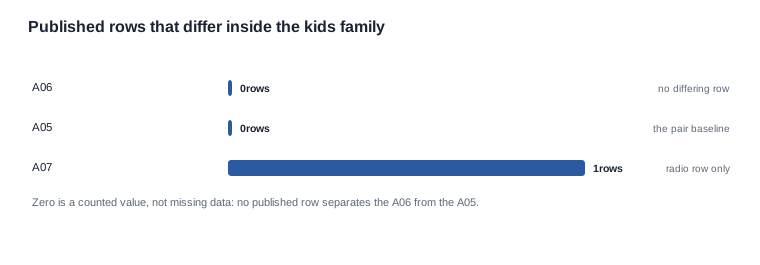
The chart counts the published rows that differ within the family. Zero is a counted value in that chart, not missing data: the A06 publishes no row that differs from the A05, and the A07 publishes one, the radio version. A range plan built on this count will always be shorter than a range plan built on assumption, and that is the point of counting it.
The cost lines that actually set the price
In a category where the specification sheet is nearly empty, the price is set almost entirely by lines that the specification sheet does not show. Four of them dominate, and only one of them is the unit price.
The compliance programme is the largest of the four, and for this family it is not published at all. There is no per-model certification row anywhere in our catalogue, no certificate number, no issuing body, no validity period and no covered-model schedule. The catalogue's text contains no reference to CE, FCC or RoHS, and the certification information that does exist is presented at company level rather than attached to a model. That is a deliberate distinction in how our documentation is built, and it means the cost of putting a product into a market has to be established before a price can be defended. The child product compliance framework is where that work is scoped.
The return rate is the second, and it is a function of fit. No frame weight, temple length, lens dimension or recommended age band is published for any model in this family, and a children's product worn by a growing head cannot be sized from a catalogue. The commercial consequence is a returns cost that is unknown at the point of pricing, and it falls hardest on the rung that cannot be differentiated by specification.
The support cost is the third, and it scales with the number of missing rows. Every unpublished row becomes a question that arrives after launch, and the number of questions is proportional to the documentation gap. This is the cost that a two-SKU structure with a missing identity roughly doubles.
Only then does the unit price matter, and it is the one number a supplier can answer directly.
One further cost line belongs on that list even though it is not a cost in the factory's sense: the cost of the range being wrong. A two-SKU structure built on a duplication that turns out to be a true duplication does not fail gradually. It fails at the point of the second order, when the stock is already in the channel and the second listing has no defensible reason to exist. The cost of finding that out late is the write-down, not the paperwork, and it is the reason the duplication question is asked before the price is discussed.
A last point on the architecture itself, because it is the one buyers mis-model. A price ladder is often treated as a margin structure — three rungs, three margins, one buy. It is better modelled as a risk structure. Each rung that cannot be described from published evidence is a rung whose gap can be challenged at any point in its life, and a challenged gap does not cost the difference between the rungs, it costs the whole ladder. That is why the safest ladder in this family is the one with the fewest rungs that cannot be evidenced, even if it is not the one with the widest spread.

A06 price positioning: what to ask before the ladder is priced
The questions to ask, and what each answer decides
The first set of questions is about the difference itself, and it is one question with three possible answers. Ask what distinguishes the A05 from the A06, in writing and specifically. If the answer is a colourway, a lens option or a packaging tier, then two SKUs is a legitimate merchandising structure with a cost you can calculate before the artwork. If the answer is a firmware branch, a component revision or an application version, then it is an engineering difference, and it changes the documentation file, the accessory list and the support load. If the answer is that they are the same product under two designations, then the ladder has to be built on something outside the product entirely.
The second set is about the paperwork, and it is the set most often skipped. Ask whether the conformity file names one designation or both, and ask for the document rather than the summary. Ask what the applicable requirements are in each destination market, stated as requirements rather than as a general statement that the product is compliant.
The third set is about the commercial terms, and it is the set that decides the ladder. Ask what the minimum order quantity is for each designation separately, because the duplication question makes a combined figure meaningless. Ask for the lead time per designation and per order quantity, since a two-SKU line with the same production route still has two schedulings. Ask what the warranty covers and how the spare-unit policy works in practice, and ask what a replacement unit costs at volume.
The fourth set is the one that keeps a ladder honest after launch. Ask which rungs the supplier is prepared to describe in writing, and ask them to confirm that the descriptions will still be accurate at the next order. A supplier that will not put a rung description in writing is telling you something about the range that no catalogue row will.
A fifth question closes the loop, and it is the one that stops a price conversation becoming a specification invention. Ask the supplier directly which published row, if any, they expect a customer to use to justify the difference between the two designations. If the answer is a row that exists, write the rung description around it. If the answer is the bundle, the warranty window or the market, write the rung description around that. If the answer is silence, then the honest rung description is a commercial one, and the range plan should record it as commercial rather than dressing it in specification language.
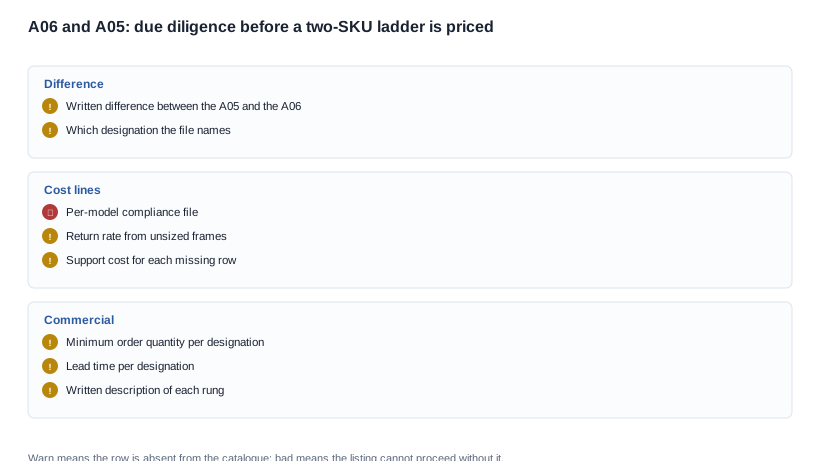
The checklist above is ordered by cost, not by ease. The compliance questions come first because they are the largest and slowest. The duplication question comes second because it determines how many of the other answers have to be collected twice. The commercial terms come third. The written rung description comes last, because it is worthless until the first three are answered.
What we can and cannot help with
We can tell you exactly which rows are published for the A05, the A06 and the A07, which rows are absent, and which single row differs inside the family. We can tell you that a gap between the A05 and the A06 cannot rest on power, features or build quality, because nothing in the published documentation supports any of the three. And we can tell you which rungs in this family are describable today, and which would need a written answer from the factory first.
What we will not do is invent a difference to justify a price gap. We will not present a family-level feature as a model-level one, and we will not describe the sensing functions as producing any vision, health or prevention outcome — we hold no clinical data for this category, and the boundary is set out in our medical boundary guidance. We will not publish prices, minimum order quantities or lead times in this article, and we will not quote a case capacity, a frame weight or a certification status that our documentation does not support.
What we can do is make the ladder cheaper to build. Tell us the channel, the volume, the target markets and how many models you plan, and we will come back with the published rows side by side, the cost lines that are not on the specification sheet, and a clear statement of which of the open questions we can close for you directly. The A06 and A05 battery and charging comparison covers the one cost line that this range does share, and it is worth reading before the range is priced.
Related reading
- The rows this model publishes — A05 smart glasses specifications and features
- The duplication question in full — A06 versus A05 specification comparison
- The regulatory work that sets the cost — child product compliance
Tell us the channel, the volume and how many models you plan, and we will come back with the cost lines. A06 smart glasses vs A05 price positioning is a commercial design problem, and it has to be solved with the published rows in view.


