
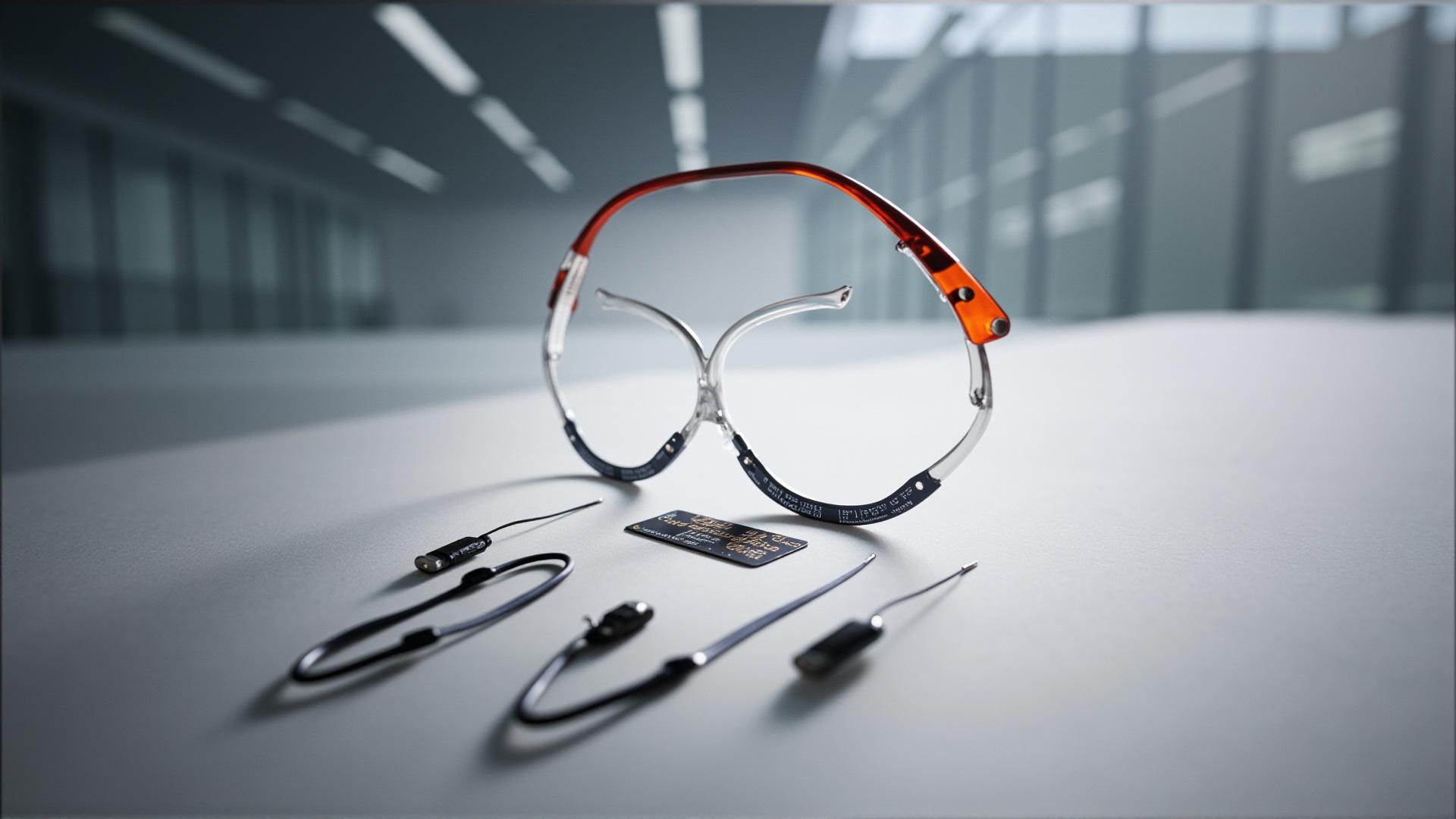
The A07 and the A05 publish the same rated runtime on cells that differ by 30 mAh, and they reach it in opposite ways. One model spends its energy on an audio path, the other on a sensing path, and that single difference explains most of what separates them on paper — and most of what separates them in the qualification effort a buyer has to fund before either can be ordered with confidence.
The published rows are short enough to set out in full. The A07 publishes a 70 mAh single cell, a rated runtime of about 20 hours, a charge time of two hours or less, magnetic charging and Bluetooth version V5.4. The A05 publishes a 40 mAh single cell, a rated runtime of about 20 hours, a charge time of two hours or less and magnetic charging — and, on its model row, a lens-type electronic fogging element with posture and viewing-distance indication. Neither model publishes a frame weight, a frame dimension, a charging-case capacity, an acoustic figure, a Bluetooth version for the A05, or a certification reference.
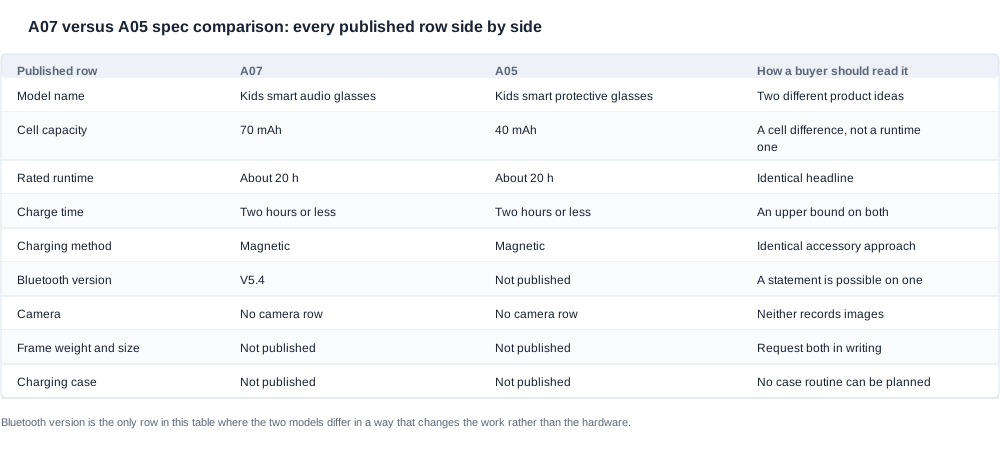
A07 versus A05 spec comparison: reading the published rows
The cell row. 70 mAh on one model, 40 mAh on the other, one cell in both cases. Because both cells are single, there is no arithmetic to do and no ambiguity about what a multi-cell figure would mean. Read the row as a hardware difference, not as a runtime difference, because the runtime row is identical.
The runtime row. About 20 hours on both, with no test condition published for either. This is the highest rated runtime in the catalogue and it appears across a 30 mAh spread, which tells you the figure describes a duty cycle rather than a capacity-to-load relationship. A specification comparison that treats the runtime row as a tie is making a statement the rows cannot support, and a comparison that treats the cell row as a runtime advantage is making one the rows actively contradict.
The charge row. A charge time of two hours or less, on both, with magnetic charging on both. The same charging method means the same accessory decision for both models, which is a genuine advantage when you are building a range across them. The ceiling itself carries no start state and no termination criterion, so it plans a recharge window without planning a charging-tray rotation.
The radio row. Bluetooth version V5.4 on one model, nothing on the other. This is the row that changes the amount of downstream work rather than the amount of hardware, and it is the row most often overlooked, because a buyer scanning for battery and camera specifications does not expect the radio to be a differentiator. It is one: a published version lets you write a compatibility statement, a connection procedure and a support script immediately.
The feature row. A lens-type electronic fogging element, correct and incorrect posture and viewing-distance indication, and the lens clear and lens fogged states, on one model; nothing on the other. This is the largest difference in the comparison and the one with the widest commercial consequence, because it decides whether the product carries a sensing subsystem and a data question at all.
The rows neither model publishes. Frame weight, frame dimensions, temple length, the recommended age band, the charging-case capacity, the acoustic figures, the endurance test condition and any certification reference. Each of these is a request rather than a comparison, and a buyer who treats them as small gaps will find them in the sample stage.
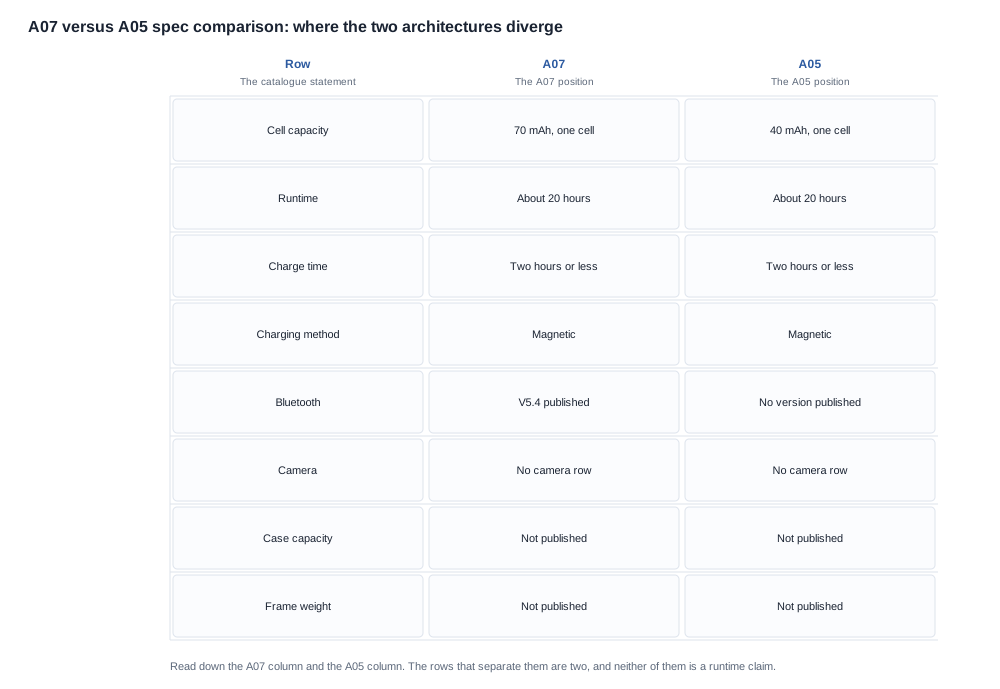

Two architectures, and the qualification work each one creates
A specification comparison is only half a comparison. The other half is the work each model creates downstream, and in this pair that work is not symmetric.
The sensing architecture creates a characterisation job. Where a model documents posture and viewing-distance indication, a buyer inherits a set of questions that an audio model simply does not raise: what triggers the indication, what the thresholds are, how often it operates, whether it can be dismissed, how quickly the lens returns to its clear state, and what the behaviour is when the device is not being worn as intended. None of these is published. Each of them has to be established on a sample, written into the purchase specification, and then verified on incoming production units.
The sensing architecture also creates a data position. A detection function produces something. Whether that something leaves the device, whether a companion application is involved, who operates it and whether the product functions without one are all unpublished, and all of them are questions a distributor, a channel partner or a regulator's reviewer will ask before the product goes on sale. The privacy considerations piece sets out the question set, and it is worth reading before the sample order rather than after.
The audio architecture creates a support job instead. A model with a speaker, a microphone and a published radio version produces a familiar support load: connection problems, pairing instructions, firmware behaviour, sound expectations and a compatibility statement. It does not produce a data question, and it does not produce a behaviour-characterisation job. The acoustic figures are not published either, so a claim about sound output cannot be made from the catalogue, and the listing has to describe the product without it.
Both architectures create a physical-qualification job. Frame weight, dimensions, temple length and age band are unpublished for both, and in this category those are the numbers that decide whether a child keeps the product or returns it. A returns provision built on an assumed weight and an assumed sizing band is a provision built on nothing, which is why the sample measurement is not optional in a programme of any size.
The net effect on programme duration. The sensing model requires a longer qualification because it has more behaviour to characterise and more claims to bound; the audio model requires a shorter one because its published rows cover more of what a listing needs to say. Neither of those statements is a quality judgement. It is a statement about how many unanswered questions each one leaves on the table, and therefore about how much of the programme's schedule is spent waiting rather than building.


The rows that look identical but cannot be compared
Three rows in this comparison are numerically identical and still cannot be used to compare the two models. Treating them as comparable is the most common error in a specification table of this kind.
The twenty-hour runtime. Two models, the same figure, different loads. A buyer who wants to know which one lasts longer cannot answer from this row, and a buyer who wants to know which one is engineered better cannot answer from it either. The only route is the test condition, which is unpublished: what was running, what was idle, whether the radio was connected, at what interval a periodic function operated, over how many units and whether the figure is a mean or a best case.
The two-hour charge ceiling. Identical, and identical in the way a bound is identical rather than in the way a measurement is identical. There is no published start state, no termination criterion and no distinction between a typical and a worst-case duration. A bound can be planned against; it cannot be compared, and it cannot be converted into a number of units per charging position.
The magnetic charging method. Identical, and it describes a connector family rather than an accessory. Two models charging magnetically do not necessarily ship the same pad, the same cable or the same carton contents, because the packing list is a separate decision from the charging method and is not published for either model. A buyer who assumes a shared accessory has assumed a packing decision.
A fourth, subtler one: the camera. Neither model publishes a camera row, so neither is a recording device on the published specification. That is worth stating in a comparison because the category it sits in usually includes recording products, and a buyer moving between models within the family may assume that absence of a camera row means the camera is absent from the hardware rather than unpublished for the model. The distinction matters for customs classification and for the claim language on a listing.
Where the comparison genuinely is comparable. The cell capacity is a comparable number. The charging method is a comparable method. The presence or absence of a Bluetooth version row is a comparable documentation fact. Those three are enough to establish that the two models are different products aimed at different jobs, and that is enough for a shortlist decision. Everything else is either a request or a qualification task.
Closing the specification before a purchase order is issued
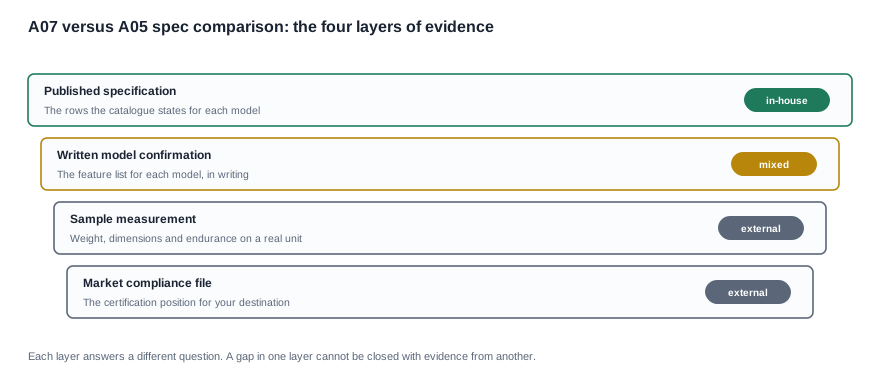
A specification comparison becomes commercially useful at the moment the open rows are closed. The sequence below is ordered so that the expensive questions are asked while there is still time to act on the answers.
Step one, narrow on the published rows. Do this before any supplier contact, so the first conversation is about configuration rather than about the catalogue. Write down which of your programme requirements the published rows already satisfy and which they do not. The output is a short list of models and a list of open rows per model.
Step two, request the per-model feature list in writing. For the model that carries the sensing functions, ask what is physically present in the unit that ships, and ask for the behaviour characteristics alongside it: thresholds, intervals, dismissal behaviour and the lens recovery behaviour. For the model that carries none, ask for written confirmation that none is fitted, so the listing copy can be written from a statement rather than from an absence.
Step three, request the physical rows and measure them. Frame weight with the cell fitted, frame dimensions, temple length, lens dimensions and the recommended age band. Then weigh and measure a production-revision sample rather than accepting a drawing or a typical figure, and record the measurement in the purchase specification.
Step four, put the endurance question to every supplier in identical wording. Ask for the test condition behind the rated runtime, the cell cycle life, the starting state and termination criterion for the charge measurement, and whether a charging case exists for the model and what its capacity is.
Step five, establish the conformity position per model and per destination market. The catalogue carries a company-level export certification page that holds images rather than text, and the catalogue wording names no CE, FCC or RoHS. There is no per-model certification row. So the file you need has to be requested: the certificate or test report reference, the issuing body, the covered model numbers and the validity period. For the European framework, the radio equipment directive is (EU) 2014/53/EU and the electromagnetic compatibility directive is (EU) 2014/32/EU; they are different instruments with different scopes, and EN 301 489 and EN 300 328 are harmonised standards that support assessment under them rather than directive numbers in their own right.
Step six, approve the sample against a written specification. The specification should carry the model number, the cell capacity, the charging interface, the case configuration, the colour, the packaging contents and the firmware version, plus every measurement and every confirmed figure from the five steps above. A sample approved against a photograph is not an approval; it is a first impression.
Step seven, write the incoming inspection criteria from the specification. The criteria are what protect the programme between the first shipment and the last, and they are written from the confirmed values rather than from the catalogue, because the catalogue values are the ones most likely to be quoted back to you by a factory that has drifted from them.
A catalogue row is not a purchase specification
The gap between a comparison table and a purchase specification is where most programmes lose time, so it is worth naming what a catalogue row is and what a purchase specification has to be.
A catalogue row is a summary of a product position. It says what the factory is prepared to state publicly about a model: the cell capacity, the rated runtime, the charging method, the interface where one is stated, the pixel class on a camera model, the case capacity where the catalogue publishes one. It is written for a broad audience, which means it is deliberately conservative and deliberately compressed. It is not a tolerance, a test method or a contractual value.
A purchase specification is a contractual value with a method attached. For every line that matters to the programme, it carries the nominal value, the permitted tolerance, the measurement method, the number of samples and the acceptance rule. A frame weight in a purchase specification is not a number; it is a number plus the tolerance band plus the measurement method plus the sampling rule plus the consequence of a unit outside the band.
The tolerance is the line buyers most often skip. A catalogue cell capacity of 70 mAh is a nominal figure. A purchase specification for the same cell would state the acceptable range, and for a lithium cell that range interacts with the cycle life claim, because cells are routinely supplied in several grades. The same applies to the charge time: the catalogue publishes a ceiling of two hours or less, and a purchase specification needs the typical figure, the tolerance on it, and the measurement procedure that produces it.
The method is what makes the number enforceable. If the specification says a frame weighs a stated value but does not say whether the cell is fitted, whether the temple is in the shipped configuration and how many units are weighed, then a dispute at incoming inspection is unresolvable, because two parties can measure different things and both be right. Every numeric line in a purchase specification should be readable as an instruction.
The acceptance rule is what makes it usable. A specification that lists values without stating what happens to a unit that misses them leaves the programme with a return, a rework or a concession decision and no agreed basis for making it. Where a figure is a measured characteristic rather than a controlled one, the sampling rule and the remedy belong on the same line as the value.
Applied to this pair, the gap is large on one model and small on the other. The model that carries sensing functions needs specification lines for behaviour characteristics that have no catalogue counterpart at all; the model that carries none needs specification lines for audio and radio behaviour, where the published version is a useful starting point but not a tolerance. This is why the seven steps above are sequenced the way they are: the characterisation work has to be finished before the specification can be written, and the specification has to be written before the sample can be approved.
How these two models should appear in a range
They should not appear as two options on one page. A customer reading two models side by side is being asked to choose between a device that senses viewing behaviour and a device that does not. That is not a preference between variants; it is a choice between two product ideas, and a page that presents them as variants misleads. The published rows support the distinction clearly, and a range built on that distinction is defensible.
The runtime row should not be used as the selling point for either. Both publish about 20 hours, so the figure cannot separate them, and a listing that leads with it says nothing a customer can act on. Where the runtime appears in a listing, it should be presented as a manufacturer rating attached to the model, not as a comparison.
The claims boundary applies differently to the two models and should be handled differently. We make no claim about myopia, vision development, vision protection or eye health for either model, and we hold no clinical data for this category. For the model that carries a detection function, the boundary is close to the product's own proposition, which makes the wording discipline a commercial requirement rather than a formality; the medical boundary guidance sets out where the line sits. For the model that carries no detection function, the boundary is easier to hold and easier to lose in a copy template written for the whole family, which is another reason the per-model feature list should be obtained before any listing text is drafted.
The third model in this family needs its own line in the range plan. The A05 and the A06 publish identical specification rows, and the catalogue carries no statement that separates them. A range that carries both is carrying two lines of stock whose distinction has not been documented. The A05 versus A06 specification comparison covers what the possible answers mean commercially, and that question should be settled before either is committed to a range.
Our position on this comparison. We publish the electrical rows and the radio row for both models, we publish the feature note exactly as the model row states it, and we name every row the catalogue leaves open rather than filling it with a typical figure. We will not present the twenty hours as an active-use figure, we will not describe the detection functions as producing any vision, health or prevention outcome, and we will not quote a weight, a dimension, an age band, a case capacity or a certificate number that the documentation does not contain. The published specification list for the A07 and the published specification list for the A05 are the honest baselines for any comparison you build from them.
A short criteria list for anyone deciding between them. Run four criteria against both models before you order, and the answer stops being a matter of preference. Does the brief need a published radio version, because the listing and the support script depend on it? Does the brief need a sensing function, because one model publishes it and the other does not? Can the programme fund the characterisation work that a sensing model requires? Will the destination market accept a product whose data position is unpublished? The questions to ask a supplier are listed above; the criteria that decide between them are these four. When two of them point at different models, what you have is a decision to make and a qualification to fund, not a comparison to keep arguing about. When they point the same way, what you have is a shortlist, and the red flags to watch are the ones in the open rows rather than in the published ones.
Related reading
- The published rows for the A07 — A07 specifications and features
- The published rows for the A05 — A05 specifications and features
- The functional split between them — A05 versus A07
- The pre-order checklist for the sensing model — what to check before ordering the A05
Send us the buyer, the age band and the markets, and we will tell you which architecture fits the brief and how much qualification each one needs.


