
These two models publish the same rated runtime, the same charge ceiling and the same charging method, and they differ on two rows that both point the same way. The A07 publishes a 70 mAh cell and Bluetooth version V5.4. The A06 publishes a 40 mAh cell and no Bluetooth version on its model row. The twenty hours and the two hours or less are identical on both.
So the question of which brief each model serves is not about the product working differently. It is about which one a buyer can describe, and how much of the documentation work each brief creates before a single unit is ordered.
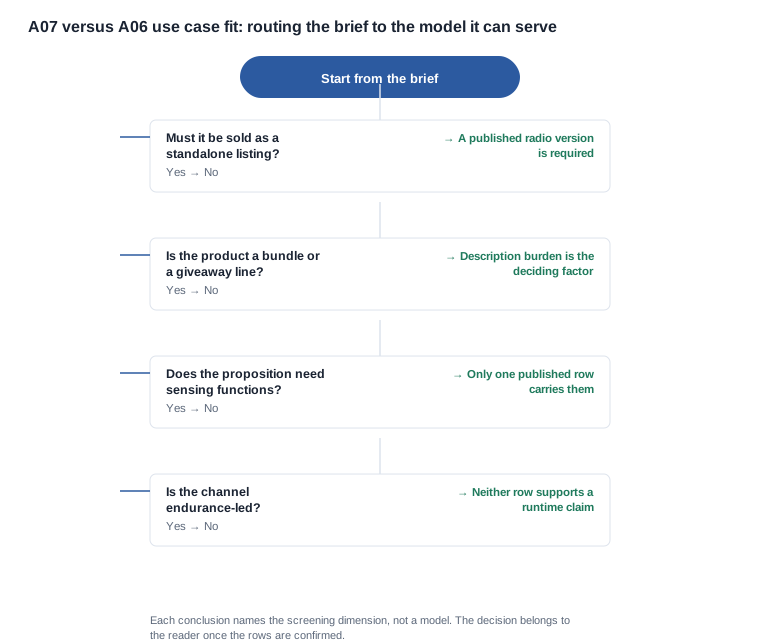
A07 versus A06: the two published rows that change the work
The Bluetooth version is the row that changes the workload. With a published radio version, a brand can write a compatibility statement, a connection procedure, a support script and an instruction leaflet directly from published rows. Without one, every one of those artefacts waits on a supplier, and the programme waits with them.
The cell is the row that changes the engineering margin. Seventy milliamp hours against forty, with the same published runtime and no published test condition on either. The larger cell does not produce a longer day, because the day is already published as the same length for both. What it produces is tolerance of a heavier workload than the rating assumes, which is invisible in a listing and visible in the return rate.
A third row is not a difference between the models but a difference in the work they impose. The A06 publishes a lens-type electronic fogging element with posture and viewing-distance indication. The A07 publishes no feature note at all. One model therefore brings a detection behaviour, a data position and a claims boundary into the programme; the other does not.
Two rows that are identical on the sheet and still cannot be compared. The twenty-hour runtime carries no test condition on either model, so it cannot be differentiated, argued about or put in a comparison table as a point of difference. The two-hour charge ceiling is an upper bound with no stated start state and no termination criterion, so it plans a recharge window without planning a charging-tray rotation. Both rows are usable for planning and unusable for positioning.
Where the two models genuinely differ in the published documentation. The A07 is the only model in this family whose radio version is published, and the A06 is the only model in the family whose model row carries a feature note. Those are the two separators, and they are the ones a buyer should build a range on.
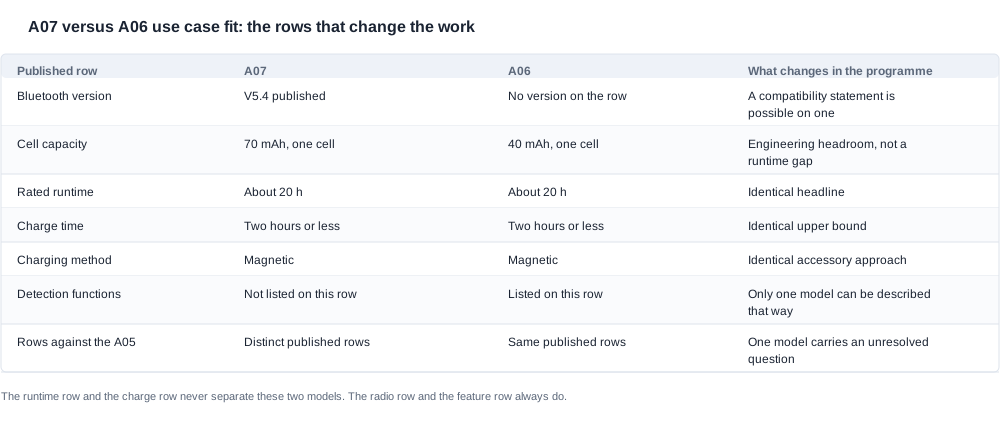

What a published radio version unblocks in the documentation
A radio version is not a performance figure. It is a line of text on a model row, and its commercial value lies entirely in what it lets a buyer produce without waiting for anyone.
The compatibility statement. A statement of which radio version the product carries is the document that stops a support conversation about whether it will work with a given phone. It can be drafted from a published row on the day the row is read, and it can be corrected in one place if the row ever changes. Without a published version, the statement waits on a supplier who has their own priorities, and the buyer has a marketing deadline attached to somebody else's reply time.
The connection procedure. The instruction leaflet and the setup page both depend on the radio version, because the connection journey, the connection stability and the behaviour when the paired device moves out of range are all version-dependent. A published version lets the procedure be written and reviewed by a technical writer; an unpublished version means the procedure is written by a factory engineer, which is a different document with a different owner and a different review cycle.
The support script. A support script is a list of the questions a customer asks first. In an audio product, the first three are always about connectivity. A published version lets the script name the answer. An unpublished version turns the first three questions into escalations, and escalations are a measurable cost in a channel with a service-level agreement attached to it.
The accessory and packaging decision. The radio version informs what a buyer needs to plan around connectivity: whether a charging accessory ships, what the carton contains, and what the setup language in the box insert says. It does not determine these, but it determines how confidently they can be written.
What it does not do. A published radio version does not tell a buyer how the radio behaves in a crowded environment, whether the connection drops under load, whether there is a firmware update path, or whether the version on the model row is the version that ships. Those remain questions for the supplier, and a buyer who assumes the published version settles them will find them unanswered at the sample stage.
Why this matters more for one model than the other in practice. A product that is sold as a standalone listing, with a listing page, a specification sheet, a support script and a compatibility promise, cannot be completed without that row. A product that is a second line in a bundle, where the buyer is not asking questions about connectivity because the bundle is sold on something else, can be completed with a much thinner document set. The row decides how much work the brief creates, and that is the practical meaning of use case fit in this category.
The questions to ask about the radio version, in the wording that gets an answer. Which version is fitted to production units, and does the model row reflect it. Which devices has the connection been verified against, and against which operating systems. What the connection behaviour is when the paired device is out of range or competing with other radios. Whether a firmware update path exists and who operates it. Whether the procedure written for the leaflet has been run by someone other than the factory. A buyer who asks these in one request gets a single document back; a buyer who asks them one at a time gets five partial answers, and the programme waits through all five.
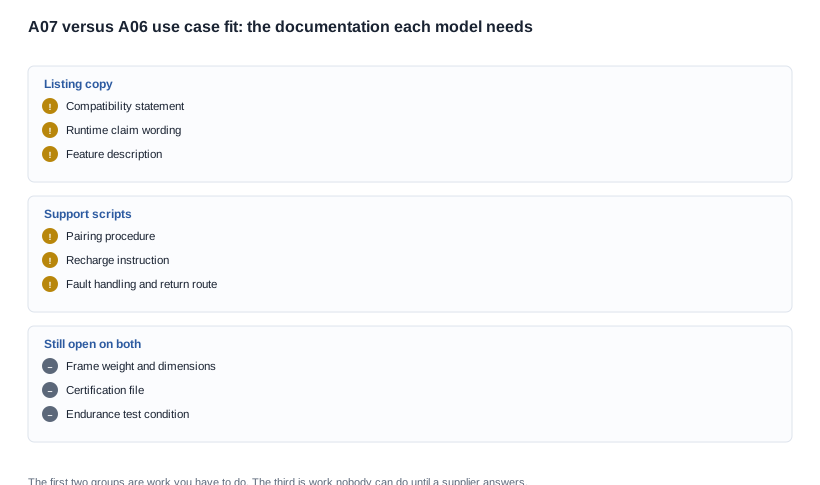
What a sensing function adds to the compliance and claims work
The A06's model row documents a lens-type electronic fogging element, correct and incorrect posture and viewing-distance indication, and the lens clear and lens fogged states. This is the row that makes the A06 a different commercial proposition rather than a smaller version of the same thing, and it brings three categories of work with it.
Data work. A detection function produces something. Whether it leaves the device, whether a companion application is involved, who operates that application, and whether the product functions without one are all unpublished for this model. In a children's category those are not technical footnotes: they are the questions a distributor's due diligence will ask, and in some markets the questions a regulator's reviewer will ask. The privacy considerations piece sets out the question set in full, and the school requirements checklist covers the institutional side.
Claims work. We make no claim about myopia, vision development, vision protection or eye health for this category, and we hold no clinical data for it. A behaviour indication is not a vision product, and the boundary between them is exactly where marketing language turns into a claim the supplier cannot support and the buyer cannot defend. The medical boundary guidance sets out where we draw that line and why the line belongs to the buyer's counsel rather than to a factory. For a model that carries no detection function, the boundary is easier to hold and easier to lose in copy written for a whole family.
Compliance work. The catalogue includes a company-level export certification page whose content is images rather than text; nothing in the catalogue text refers to CE, FCC or RoHS. There is no per-model certification row for any model. So the conformity position of whichever model you select is a document you must obtain, with an issuing body, a reference and a covered model schedule. Add to that the additional scrutiny a children's product attracts in major markets, and the certification route becomes the longest lead-time item in the programme rather than a box to tick.
The European framework, stated correctly. The radio equipment directive is (EU) 2014/53/EU and the electromagnetic compatibility directive is (EU) 2014/32/EU. They are separate instruments with separate scopes, and the scope of a smart glasses product usually touches both. EN 301 489 and EN 300 328 are harmonised standards that support assessment under those directives; they are not directive numbers and should never be written into a technical file as if they were. The EU general product safety regulation (EU) 2023/988 adds the economic-operator and traceability obligations that a marketplace channel will expect in the file. UN 38.3 is not published for any cell in the catalogue, so the battery transport documentation has to be requested as well.
And the commercial consequence of all of it. A model with a sensing function carries more documentation work, a longer certification path and a narrower claims space. A model without one carries less of each. Neither is better; they are different amounts of work, and a buyer should price the work rather than assume it is the same.
How to establish the data position rather than guess at it. Ask three questions in one request: what the detection produces, whether any of it leaves the device, and whether the product functions with no application present at all. Then ask for the answer in the form your own compliance function can use — a description of the data flow, a statement of whether any storage occurs and for how long, and a written confirmation of the offline behaviour. If the supplier cannot produce that, the finding is that the product cannot be placed into an institutional channel yet, and that is a materially different conversation from a feature discussion. Record the answer against the specific model, because in this family two models publish the same feature note and the answer may not be the same for both.

The rows that do not separate the two models
A comparison that repeats the same rows as a differentiator is costing the buyer attention. Three rows in this pair are common ground, and a programme should stop treating them as arguments.
The rated runtime. About 20 hours on both, with no test condition published for either. It is the largest rated runtime in the catalogue and it appears across a 30 mAh cell spread, which means it describes a duty cycle rather than a capacity ratio. It cannot be used to claim that one model lasts longer, and it cannot be used to claim that one model is better engineered. What it can be used for is stating a manufacturer rating against a named model.
The charge ceiling. Two hours or less on both, with magnetic charging on both. The upper bound plans a recharge window; it does not plan a rotation, and it does not differentiate. Two models with the same charging method also share one accessory decision, which is a real advantage when the programme is building a range.
The camera. Neither model publishes a camera row, so neither is documented as a recording product. In a category where recording products are common, that is worth stating explicitly in any comparison a buyer writes, because the absence of a camera row is not the same as a published statement that no camera is fitted.
And the case, which is common ground because neither publishes it. No charging-case row is published for either model. So a case-based routine cannot be planned from the catalogue on either side, and the case question has to be asked for both before the accessory decision is made.

Mapping a brief to the artefact it requires
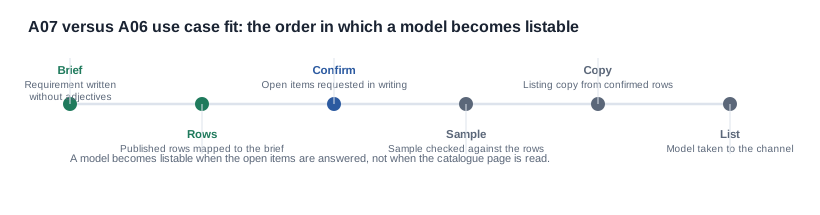
The most efficient way to assess which model serves a brief is to start from the artefacts the brief obliges you to produce, and work back to the rows that make each one possible.
A standalone channel listing. Obligations: a product page, a specification sheet, a compatibility statement, a setup guide, a support script, a claims-compliant description and a conformity file. Of these, one is enabled by a published row on one model and blocked on the other, and one is materially harder on the model that carries a sensing function because of the data and claims work. This brief puts the documentation burden at the centre of the decision.
A bundle or multi-buy line. Obligations: a short description, a stock position, a packing arrangement. The description burden is low, the unit cost is the driver, and the published runtime reads the same on both models. Here the decision is driven by cost and by whether the model can be described without a radio version at all.
An institutional programme. Obligations: a conformity file with covered model numbers, a data position, a battery transport document, a warranty and returns position, and a specification that a tender can be evaluated against. The data question on a model with a sensing function is the item most likely to delay a tender, because the answer may need to come from the buyer's own compliance function rather than from the supplier.
A channel that sells to parents directly. Obligations: a description a parent can evaluate without technical language, a charging routine that works at home, and a return rate the channel can carry. Here the deciding row is the one that is identical on both models and therefore cannot decide anything, which means the decision has to be made on content: does the product need to sense viewing behaviour, or is it sold as an audio product.
The assessment rule that falls out of this. Where the brief obliges you to produce a compatibility statement, the published radio version decides which model is documentable. Where the brief obliges you to produce a data position, the feature note decides it. Where the brief obliges neither, the published rows do not decide it, and the decision is a commercial judgement about cost and content that has to be made with the supplier rather than from the catalogue.
A worked brief
Take a hypothetical buyer with a specific set of obligations. A brand owner has committed to a marketplace channel launch with a fixed date, and the channel's listing template requires a compatibility statement, a specification sheet, a support script and a conformity file. The brand owner has two candidate models from the same family and a sample order budget that covers one model, not two.
Run the obligations against the published rows. The compatibility statement and the support script are the two artefacts that depend on a radio version, and only one model publishes one. The conformity file is required for either model and is unpublished for both, so that obligation is common ground and does not discriminate. The specification sheet can be written for either model from the published rows, with the same gaps. So the two obligations that actually differ point at the same model, and the sample budget covers it.
What the brand owner must still do before ordering is request the open rows for that model: the frame weight and dimensions, the age band, the charging-case capacity, the endurance test condition and the conformity position for the destination market. The feature note is not on that model's row, which removes the data and claims work from the programme entirely, and that is as large a saving as the documentation difference itself.
The generalisable point is that the artefacts a brief obliges you to produce are a faster route to a decision than the models themselves. The programme in this example resolved the model choice in an hour of reading, and then spent its remaining effort on the rows that are open for whichever model it chose.
Where our use case analysis lands for these two models
The A07 is the model a programme can complete its documentation from today, because it is the only model in the family whose radio version is published, and the A06 is the model whose proposition carries a sensing function and the data, claims and compliance work that comes with one. We will not present the extra cell as a longer runtime, because the published figures are identical, and we will not describe the detection functions as producing any vision, health or prevention outcome. We will not invent a difference between the A05 and the A06 in order to justify carrying two SKUs, because the catalogue publishes identical rows for those two and states nothing that separates them.
What we will do is tell you which artefacts each model lets you produce now, which ones wait on a supplier, and what to ask so that the waiting is as short as possible. The family is on our kids smart glasses range page, and the A07 buyer review checklist is the question list that works for this category.
Related reading
- The row the siblings do not publish — A07 best for
- The gaps on the other model — A06 limitations
- The privacy question in full — kids smart glasses privacy considerations
- How the categories are documented — child product compliance
Tell us the channel, the volume and whether the product is a standalone listing or a bundle line, and we will come back with what is available and what is not.


