
A rated runtime is a number without a condition attached, and the condition decides whether that number survives contact with a real working day. For this model the catalogue publishes two of the numbers a buyer usually wants — the cell capacity and the rated runtime — and leaves the measurement protocol, the charging input and the accessory position unstated. That combination is workable, but only if the published figure is treated as the start of a test rather than the end of one. The approach below sets out what is published, what is missing, what a comparable figure would require, and how to turn the pair into a reproducible measurement on a sample unit before any of it reaches a product page or a quotation.
D11 battery life: two published numbers, six missing conditions
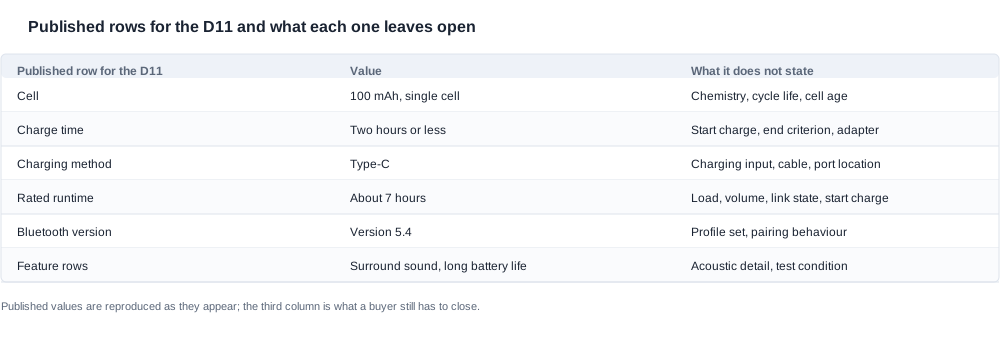
The table is the honest starting point for any buyer who has to defend a runtime claim internally. Each row on the left is a published row for this model. The middle column is the value as it appears on the page. The right column is the set of conditions a reader will assume were fixed when the number was produced, and that the catalogue does not state.
The two numbers that are published
Three facts anchor the power budget. The cell is a single 100 mAh cell. The charge time is published as two hours or less. The rated runtime is approximately seven hours. Charging is Type-C, and the radio version is V5.4.
Those are the rows that can go into a specification annex without further work, and the 100 mAh figure earns its place in the file because it is stated as a cell value rather than as a total. That distinction matters when the same range also contains twin-cell models quoted as 55 mAh times two or 90 mAh times two, because a total and a cell value are not interchangeable when a buyer is comparing charge behaviour across products.
The six conditions that are missing
Every runtime figure in this category is the output of a protocol, and this model publishes the output without the protocol. The conditions a reader will assume are:
- The load. Was the unit playing audio, maintaining a call, sitting idle behind a paired phone, or some combination of the three? A runtime measured with a live call in the loop is not comparable with one measured on continuous playback.
- The volume level. Published runtimes are volume-sensitive, and no level is named anywhere in the published rows.
- The link state. Whether the radio was actively connected, in range but idle, or disconnected changes the power draw considerably.
- The start and end points. A runtime needs a defined starting state of charge and a defined end point. Without them, seven hours is a starting point rather than a duration, and a charging routine cannot be built on it.
- The environment. Ambient temperature affects both the capacity a cell can deliver and the rate at which it accepts charge.
- The cell's history. Age and cycle count are not published for any model in the catalogue, which means a batch bought eighteen months after production may not behave like a first batch.
None of these six is a defect. They are the reason a rating cannot be converted into a working-day claim, and they are all cheap to close — once, in writing, with the supplier.
Why the charge time is not a second number
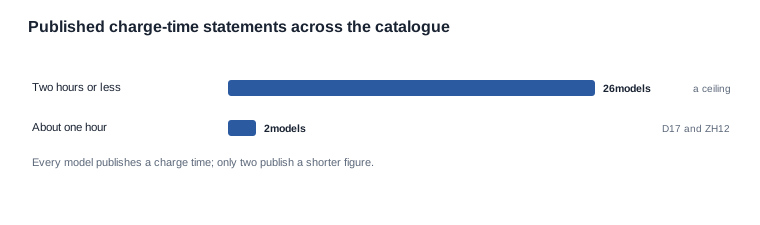
The charge time is published as two hours or less, and it is tempting to treat it as an operating parameter. It is not. A ceiling tells a buyer that a charge will not exceed two hours; it does not tell a buyer how long a charge takes, because no start state and no termination criterion is published for any model. Every model in the catalogue publishes a charge time, so this is not an omission particular to this product — but it does mean the row cannot be turned into a turnaround window without a written answer.
D11 charge time: what a ceiling cannot plan for
A ceiling is not a duration
Two hours or less permits exactly two hours and forbids three. That is a useful guarantee in one direction and an unhelpful one in the other: it tells a buyer the unit will not be sitting on a cable for half a shift, and it tells a buyer nothing about whether it will be ready in twenty minutes or in nearly two. A shift-planning exercise, a warehouse charging rota or a trade-show charging table all depend on the second thing, so all three have to be built on a measured duration rather than on the published row.
The two models that publish something shorter
Twenty-six models publish the two-hour ceiling, and two publish a figure of about one hour: the D17 and the ZH12, both of them sport models with Type-C charging. Those two rows are the only published evidence in the catalogue about relative charge speed, and they are enough to show that a ceiling hides a spread. A buyer comparing charge behaviour across the range has one pair of data points and no published protocol behind either of them, so the only safe conclusion is that the charge time row settles nothing on its own.
What the charging row does not say
The charging method row for this model is Type-C, which makes it one of the two audio models that charge over a USB-C interface rather than magnetically. That is a commercially useful row because it determines the accessory chain, the replacement cable policy and the packaging list. Three things about that interface are not published for this model: the charging input in watts, whether a cable ships in the box, and where the port sits on the frame. None of them can be read off the catalogue, and each one changes the calculation a buyer makes on the sample — the input determines the adapter a channel must stock, the cable inclusion determines what has to be bought on top of the unit, and the port location determines whether a customer can charge the product without taking it off. See Bluetooth audio glasses charging options for how the interface row divides the range into two accessory chains.

D11 runtime against the audio range
The same cells, two different ratings
The clearest published evidence that these endurance figures were not taken under one protocol comes from the audio range itself. The G07 and the YK12 publish about six hours on two 55 mAh cells. The LC-105-1 and the LC-105-2 publish about eight hours on the same two 55 mAh cells. Identical cell values, different ratings, no protocol published to explain the difference. Any table that lines these runtimes up as a league table is therefore comparing the publisher's conditions as much as the product.
That is also the reason the seven-hour rating for this model cannot be positioned as "mid-range" or "long" inside the family. On the published numbers the K01, the K02 and the LC-105 pair sit above it and the G07 and the YK12 sit below it, and the catalogue gives no basis for saying which of those positions is a product difference and which is a measurement difference. The battery life comparison method sets out the procedure for separating the two.
The D12 comparison, and what it does not settle
The D12 publishes the same power rows as this model: the same single 100 mAh cell, the same Type-C charging, the same charge time of two hours or less and the same approximately seven-hour rated runtime. The two pages differ on one published line, because the D12 carries no surround-sound feature row while this model does. So a runtime figure cannot be the reason to prefer one over the other, and neither can the cell value. The D12 smart glasses how it compares piece works through what is left once the power rows are set aside.
Why the range cannot be used to fill the gap
Borrowing a figure from a neighbouring model is the most common way a runtime file goes wrong, and the audio range makes the temptation concrete. The LC-105 pair publishes about eight hours; the G07 and the YK12 publish about six hours on the same cell values. The D17 and the ZH12 publish a charge time of about one hour while every other model in the catalogue sits at the two-hour ceiling. None of those figures can be transferred onto this model, because none of them was measured on this model. A buyer who uses the range to fill a gap is not being conservative — that buyer is publishing a number that belongs to another product and cannot be reproduced on the sample, which is the same failure as inventing one, only harder to spot later. The only route from a published rating to a usable figure runs through the supplier's written condition and the buyer's own measurement.
The long-battery-life feature line
The catalogue publishes two feature lines for this model: surround sound and long battery life. The second one is a name, not a second runtime, and it cannot be quoted as a number or compared with the seven-hour figure. A buyer who puts "long battery life" on a product page is making a comparative claim that no published measurement in the catalogue supports, because there is no baseline in the range that the word "long" is being measured against.

D11 duty-cycle test plan for the sample

A runtime claim that will hold up internally has to come from a measurement the buyer's own team can reproduce. The protocol below is written so that the same script works on any model in this range, which means a buyer comparing two models can run one method across both and get comparable numbers of its own.
Define the duty cycle before the test
The first decision is not technical, it is commercial: the duty cycle has to match how the channel will actually use the product. A retail associate on a shop floor, a warehouse picker with a headset and a driver on a route are three different workloads, and a runtime measured against the wrong one is worthless even if the measurement itself is perfect. Write the duty cycle down before the sample arrives, because a duty cycle defined after the number is known is a duty cycle fitted to the number.
The six conditions to record
For every run, the log records: the load and its mix, the volume level and the content played, the link state, the starting state of charge, the ambient temperature, and the unit identifier with the date. The same unit should be used for repeated runs, and a second unit should be measured once so that unit-to-unit variation is visible rather than assumed.
Writing the acceptance rule before you order a runtime figure
An acceptance rule has to be written before the result, and it should be about the number, not about the product. The rule below is the one this methodology suggests: the published rating is accepted for quotation purposes when the measured runtime on the sample falls inside the range that the published figure implies, and it is published as a measured figure with the duty cycle attached when it does not. Either way, the listing carries a condition, which is what makes it defensible. The rule is deliberately not "the sample must beat the rating" — that is a test the supplier can pass by choosing the measurement condition, which is exactly the failure mode that produces a disputed claim later.
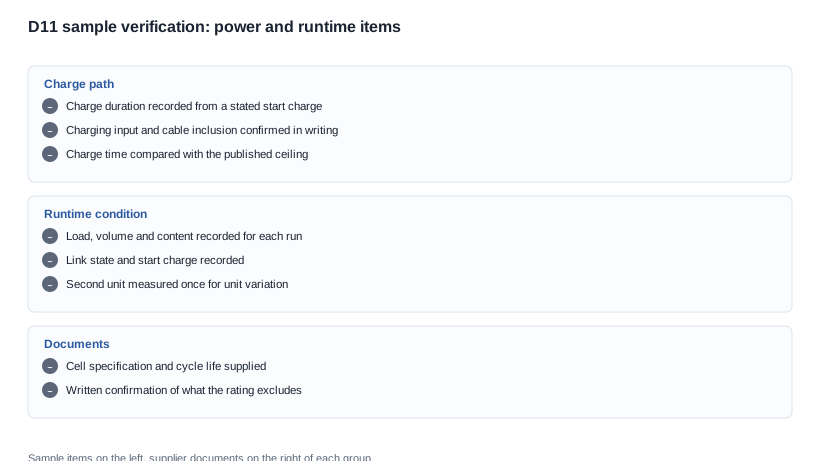
The checklist above separates the items a buyer can close on a sample from the items that only the supplier can close in writing. A tick in the first group is a measurement; a tick in the second group is a document. Both belong in the file before the purchase order is issued, and both are cheap — the measurements take an afternoon, and the document requests take one email.
D11 runtime in a written specification file
What goes into the file
The specification annex for this model should carry five rows and no more: the cell value, the charge time, the rated runtime, the charging method and the radio version. Every one of those is published, and every one of them can be traced to a catalogue line, which is what makes the annex auditable. The sixth row — a measured runtime with a duty cycle attached — belongs in the file as an appendix once the sample work is done, and it should be labelled as the buyer's measurement rather than as a catalogue figure. Mixing the two in one table is how an internal document ends up making a claim the supplier never made.
The battery document chain
The runtime row and the battery documentation are separate workstreams that a buyer tends to start in the wrong order. The chain runs from the cell specification through the cell test summary and the watt-hour rating to the packing instruction and the shipping paperwork, and the document for each cell has to match the cell that is actually fitted. Where a model publishes no charging case row — and this model publishes none — the question is narrower: the frame cell is the one that travels, and the accessory, if any, has to be established from the packing list rather than from the product page. The certification position for this model covers the rest of the file, and the published D11 specification list is the row-by-row baseline.
What to ask, and in what order
The order matters because early answers change the shape of later questions. Ask in this sequence:
- The measurement condition behind the seven-hour rating. What was running, at what volume, with the link in what state, and from which starting state of charge.
- The charge duration from a stated start. Whether the published two hours or less was measured from empty, and what the termination criterion was.
- The charging input and the cable. Watts, cable inclusion, and the port location on the frame.
- The cell specification. Chemistry, the cell's rated cycle life, and whether a spare cell is serviceable.
- The battery transport paperwork. The test summary for the fitted cell, the watt-hour rating, and the packing instruction derived from it.
- The acoustic rows. What the surround-sound feature line covers acoustically, since no acoustic figure is published for this model or for any other.
A buyer decision checklist for the runtime row
How to choose between quoting the published rating and quoting a measurement is a channel decision rather than a technical one, and the criteria below are the ones this methodology applies. The questions to ask are the same for every model in the range, which is what makes the method repeatable across a shortlist.
- Can the published rating be quoted at all? Only if the supplier states the condition behind it in writing. If not, it stays a manufacturer rating and the listing says so.
- What to ask before you order: the six runtime conditions, the charge duration from a stated start charge, and the acceptance rule that will be applied to the sample.
- What are the red flags? A supplier who quotes a runtime without a condition, who cannot say whether a figure came from one unit or from a batch, or who offers a different figure when the question is asked, is telling you the number is not traceable.
- What is the total cost of an open row? For the runtime, it is a listing claim a customer can disprove with a timer. For the charging input, it is the wrong adapter in every unit sold. For the cell specification, it is a documentation problem that surfaces at the shipping stage.
- Which trade-offs are acceptable? A channel selling single units can absorb an unevidenced runtime in exchange for a faster launch. A channel shipping pallets to a retail floor cannot, because the claim reaches the customer without an internal review.
- What should you verify before you order? The published rows against the sample, the sample against your own duty cycle, and the duty cycle against the specification annex.
The cost of leaving a row open
Each open row has a different price, and the ordering is worth knowing before a purchase order is signed. A runtime condition left open is the cheapest to fix and the most expensive to ignore: cheap because it is one email, expensive because an unsupported runtime figure on a product page is a claim a customer can disprove with a timer. A charging input left open is a stocking error waiting to happen, because a channel will buy the wrong adapter. A cell specification left open is a documentation problem that surfaces at the shipping stage, where it is expensive to fix. The frame weight is the row most often left open in this category, and it is the row that decides the freight class; no weight is published for this model, and the comfort and fit analysis explains why the single-cell architecture makes that number more than a logistics detail.
The limits of what is published
Our position is narrow and deliberate: we publish the electrical rows, the feature rows and the accessory rows for every model in the catalogue, and we publish nothing else. For this model that means Bluetooth V5.4, a single 100 mAh cell, a charge time of two hours or less, an approximately seven-hour rated runtime, Type-C charging, a surround-sound feature line and a long-battery-life feature line. We do not publish a price, a minimum order quantity, a delivery schedule, a warranty term, a production capacity figure, a frame weight, a charging input, a cell cycle life, an ingress rating, an acoustic figure or a per-model certification row, and we will not substitute a typical value for any of them.
We will not present approximately seven hours as a working day, we will not convert a ceiling of two hours or less into a promise of a faster charge, and we will not treat the long-battery-life feature line as a second runtime figure. The seven hours is a manufacturer rating that the catalogue publishes without a condition, and the buyer's job is to attach the condition — on the sample, in the channel's own duty cycle, before the figure is repeated anywhere it can be tested.


