
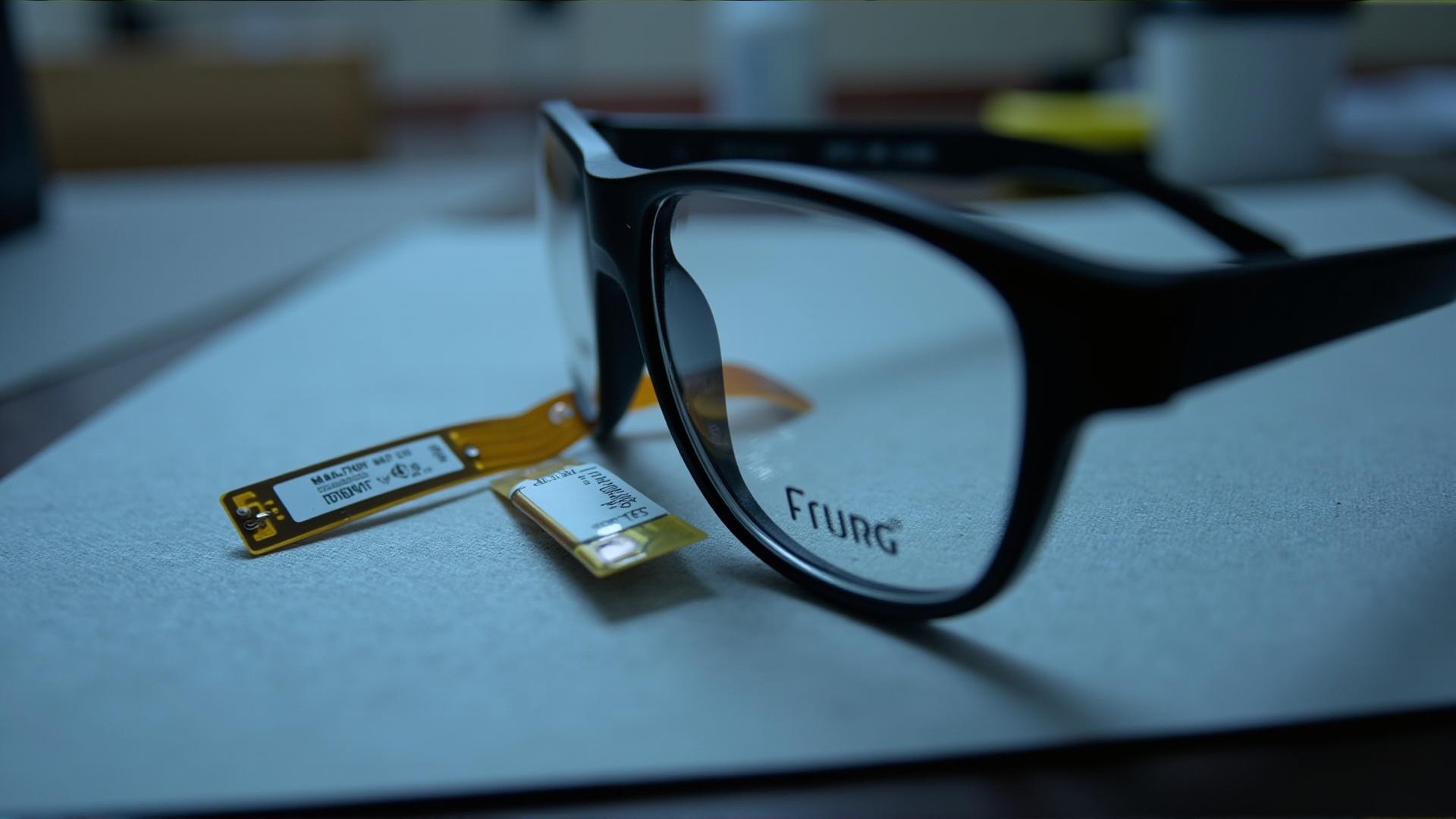
The D12 smart glasses occupy a specific middle position in this audio range. It is one of two models that publish a single 100 mAh cell, one of two that publish a Type-C charging interface, and one of two that publish about seven hours of rated use. It is the one of that pair that publishes no acoustic descriptor at all — no surround-sound row, no driver figure, no frequency response.
Compared with the two-cell models on either side of it, the D12 is simpler in the box and lighter in the cell. And there is one thing it is not, which is a copy of its nearest sibling: the D11 publishes a surround-sound row and the D12 does not. That single difference is the only published specification difference between the two, and it is worth more attention than the rows they share.
D12 across the audio range: the single-cell Type-C position
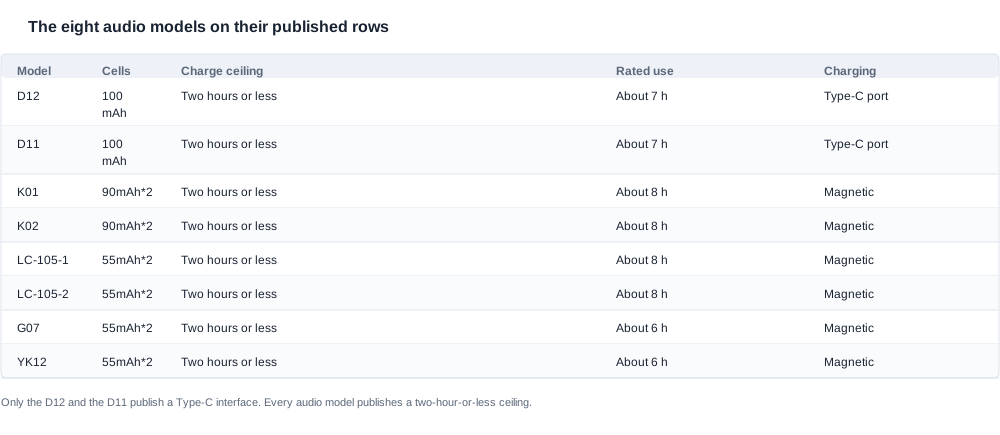
The eight audio models fall into three cell configurations, and the charging interface lines up with them in a way that is useful to know before you start comparing.
The four models on a 55mAh2 configuration charge magnetically, as do the two models on a 90mAh2 configuration. The two models on a 100 mAh cell — the D11 and the D12 — are the only audio models in the range that publish a Type-C interface. Every audio model publishes a charge ceiling of two hours or less.
| Model | Cells | Charge ceiling | Rated use | Charging |
|---|---|---|---|---|
| D12 | 100 mAh | Two hours or less | About 7 h | Type-C port |
| D11 | 100 mAh | Two hours or less | About 7 h | Type-C port |
| K01 | 90mAh*2 | Two hours or less | About 8 h | Magnetic |
| K02 | 90mAh*2 | Two hours or less | About 8 h | Magnetic |
| LC-105-1 | 55mAh*2 | Two hours or less | About 8 h | Magnetic |
| LC-105-2 | 55mAh*2 | Two hours or less | About 8 h | Magnetic |
| G07 | 55mAh*2 | Two hours or less | About 6 h | Magnetic |
| YK12 | 55mAh*2 | Two hours or less | About 6 h | Magnetic |
What the single-cell position buys. A simpler accessory chain, a smaller carton, and no second lithium cell in the parcel unless a case is added. The D12 charging options page takes that part of the decision in detail, and the published D12 specification list is the row-level reference.
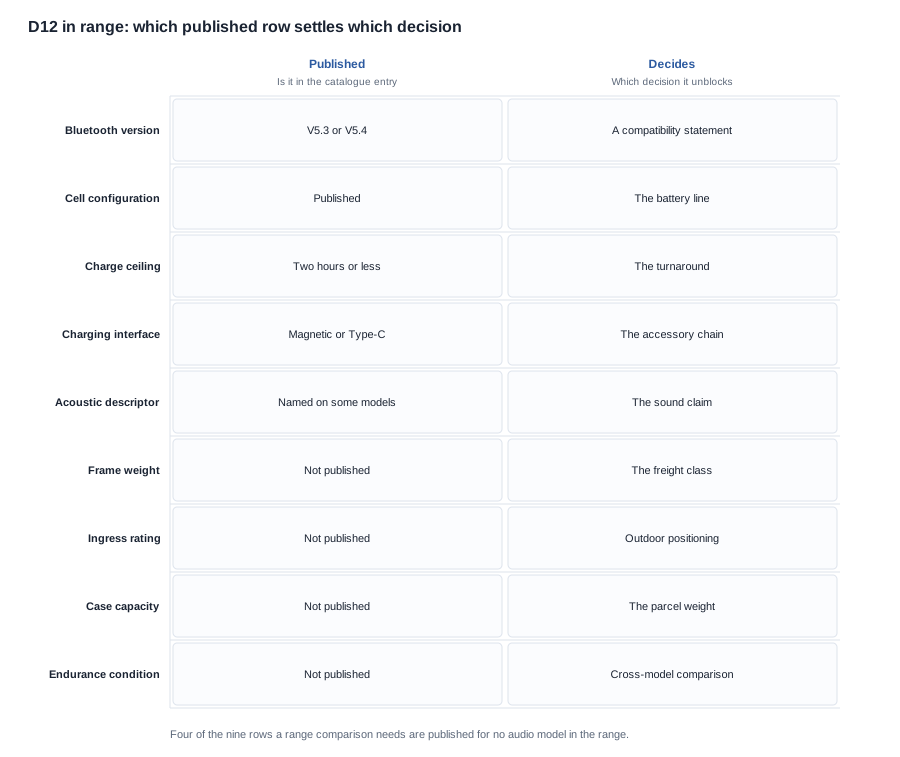
What it does not buy. Our catalogue publishes no frame weight for any audio model, so the single-cell architecture cannot be turned into a weight claim or an ergonomic claim. It can be described as a cell configuration and nothing more.
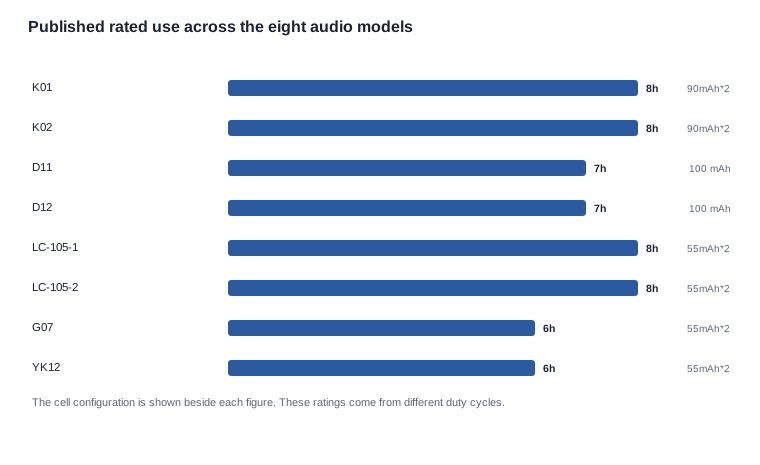
And a note on the numbers in that chart. The cell configuration is shown beside each rated figure because the figures do not line up with the capacities in a way a buyer should read as a result. A 55mAh2 configuration publishes about eight hours on two models and about six hours on the other two; the 90mAh2 models publish about eight hours; the 100 mAh models publish about seven. Those differences are consistent with different duty cycles rather than with different cell capacities, and the method for comparing battery life explains why a cross-model endurance comparison needs the test condition before it needs the number.
How to build a comparison chart from these rows without publishing a ranking
The published rows are enough to build a comparison table, and they are not enough to build a ranking — and the difference between those two documents is where most of the risk in this category sits.
Put the cell configuration in the catalogue's own form. The catalogue publishes cell values and counts, written as a value with a multiplier for the two-cell configurations. Keep that form in any table, and if a derived total is needed for a cost model, mark it as derived. A table that mixes the published form with a bare total makes the derived number read as an official figure, and a buyer who quotes it downstream is quoting something the catalogue never said.
Never rank on the endurance column. The ratings were produced under different protocols and the documentation does not say whether one shared protocol was used at all. A chart with a descending order of rated hours across the eight models therefore implies a performance ordering that the data does not support. Group by configuration instead — by cell form, by charging interface, by the presence of a named acoustic feature — and let the reader see the structure rather than a winner.
Mark the rows that are open rather than leaving them blank. A blank cell in a comparison table reads as "not important" or as zero; a cell reading "not published" reads as an open item. That single convention removes most of the disputes that arise when a channel partner asks why one model has no frame weight next to the others.
And keep the acoustic row visible even where it says nothing. The D12's row should read "no acoustic descriptor published" rather than being left out. It is the fact that separates it from the D11, and it is the fact that stops a buyer from carrying a surround-sound claim across from a sibling model.
Finally, add a fourth column that is not in the catalogue. For each model, note the milestone that the open rows block. A comparison table that only carries published values tells a buyer what the products are; a comparison table that also carries what is missing tells a buyer which one to chase first, and that is the column that actually changes a purchasing decision.
The D12 against the D11, and the one published row that separates them
The two models publish the same Bluetooth version, the same 100 mAh cell, the same two-hour-or-less charge ceiling, the same rated seven hours and the same Type-C interface. The D11 publishes a surround-sound row. The D12 publishes no acoustic descriptor. The catalogue does not state what else, if anything, separates them.
That is the whole published difference, and it is a consequential one. A brand running both is running two stock-keeping units whose published rows are identical except for an acoustic feature name on one of them — and the name is a feature label rather than a characterised product, since no driver size, frequency response, leakage figure or sound-field description is published for any model in the range.
The consequence for the range. The D12 and the D11 can be separated on the page by their acoustic positioning, and a customer who wants the named feature has a reason to choose the D11. What they cannot be separated on is specification, and they cannot both be sold on an endurance or interface claim because on both of those the published rows are identical. If the acoustic difference is the only axis, then one of the two is a single-model decision for most channels — and the question of what physically differs, beyond the catalogue, is the first thing to ask. The D12 versus D11 comparison takes that decision at model level, and the D11 and D12 price positioning analysis covers the commercial terms behind it.
And there is a compliance dimension. A document that names the D11 does not automatically cover the D12, even where the two publish identical electrical rows, because certification attaches to a model designation. The D12 certification status page sets out what has to be requested per designation.
The D12 against the two-cell models: what the cell arithmetic does and does not show
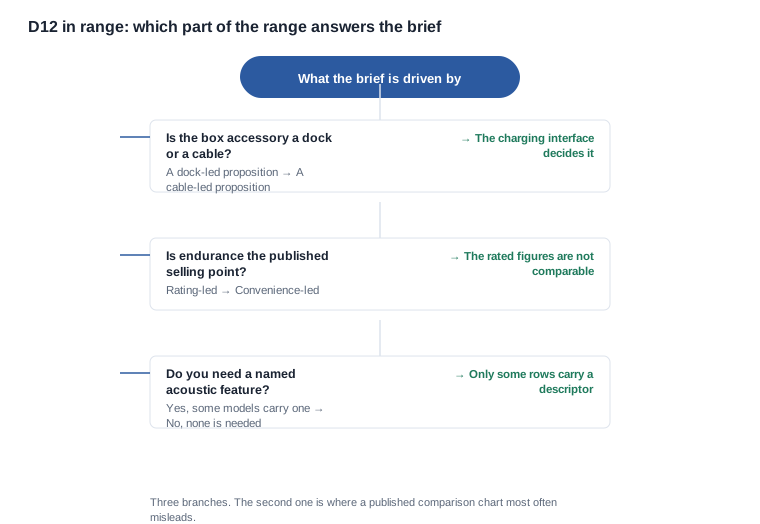
Against the K01 and the K02, it trades cells for simplicity. The K-series publishes a 90mAh*2 configuration, about eight hours of rated use and magnetic charging. The D12 publishes a single 100 mAh cell, a Type-C port and no published charging-case capacity. If the channel's proposition is that the customer never has to think about the charger, the D12's arrangement is the simpler one; if the proposition is a dock-led ritual at the desk, the magnetic arrangement is the one that supports it.
One point of accuracy, because it is often written the other way: our catalogue publishes no capacitive touch row for any model, including the K01. The touch behaviour of a temple has to come from the supplier, and the K01's published rows are its Bluetooth version, cell configuration, charge ceiling, rated use and charging method. That is a useful correction for a buyer who has seen a touch feature quoted elsewhere.
Against the LC-105 pair, it trades cell capacity for a higher rated figure. Both LC models publish a 55mAh*2 configuration, about eight hours, Bluetooth V5.4 and magnetic charging. The LC-105-2 specification list sets out that model's published rows in full.
Against the G07 and the YK12, it has more cell and more hours. Both publish a 55mAh*2 configuration and about six hours. The G07 adds a detachable temple and the YK12 a slim temple with a surround-sound row, so those two carry a named physical or acoustic feature where the D12 carries neither. That is the real trade in this pairing: a published feature against published endurance.
And the accessory question that sits underneath all of it. Our catalogue publishes no in-box accessory list for any audio model, so whether a magnetic-charging model ships with a pad, a cradle or a cable is not something the documentation settles for any of them. That matters for the parcel comparison, because a second cell in the parcel changes the freight class and the battery transport documentation — but the catalogue does not establish that any particular model ships one. Ask it per model, in the same request as the other open rows.
The procurement terms behind a two-model audio range
Once the specification rows have done their work, what decides a two-model audio range is a set of commercial terms that our catalogue does not publish for any model. They are worth listing explicitly, because a buyer who compares two audio models on published rows alone has compared the part of the decision that was never in doubt.
The order minimum. Not published. This is usually the single largest driver of the effective unit price, and it is frequently the real reason two otherwise similar products sit at different price points. Our own internal documentation has historically held more than one minimum order quantity figure that has not been arbitrated, which is a further reason to treat any figure you are quoted as something to have confirmed in writing against the order you are placing.
The production capacity and the committed lead time. Not published. A shorter committed lead time is worth real money to a channel buyer, because it is the difference between holding stock and replenishing against demand, and it is one of the most common foundations of a commercial tier between two models.
The certification scope. Not published per model, and this is the term with the longest timeline in the set. Our catalogue holds a company-level export certification page whose content is images rather than text, its text contains no reference to CE, FCC or RoHS anywhere, and there is no per-model certification row for the D12 or for any other model. A document that names the D11 does not automatically cover the D12, so a two-model range can require two sets of evidence where a one-model range requires one.
The accessory and packaging specification. Not published. Which models ship with a cradle, what the cable specification is, and whether the carton artwork is shared determine the operating cost of the second model more than any specification row does.
And the quantity breaks. Not published. Ask for the unit price at each break for both models and put the answers side by side in one table. A table makes the point that a paragraph hides: if the terms match as well as the rows, the pair is a platform decision rather than a product one, and it should be recorded as such in the range plan.

Where the published rows contradict each other
Two of the apparent contradictions in this range are real and worth naming, because a buyer who builds a comparison chart without noticing them will publish a chart that a customer can disprove.
The first is endurance against cell capacity. A 55mAh*2 configuration publishing about eight hours alongside a 100 mAh single cell publishing about seven hours is not a physical result; it is a sign that the ratings were taken under different duty cycles and different protocols. Nothing is wrong with any of the figures. What is wrong is reading them as a ranking.
The second is the acoustic language. A surround-sound row on some models and no acoustic descriptor on others reads as a feature gap between the two groups. It may be exactly that, or it may be a documentation difference — and the catalogue does not say which, because it publishes no acoustic measurement that would settle it. The honest position for a buyer is that the D12 publishes no acoustic descriptor, and that a sound-quality claim has to be established on a sample unit rather than read off a comparison table. The open-ear audio guidance sets out the measurement.

What the D12 does not publish, and what that blocks
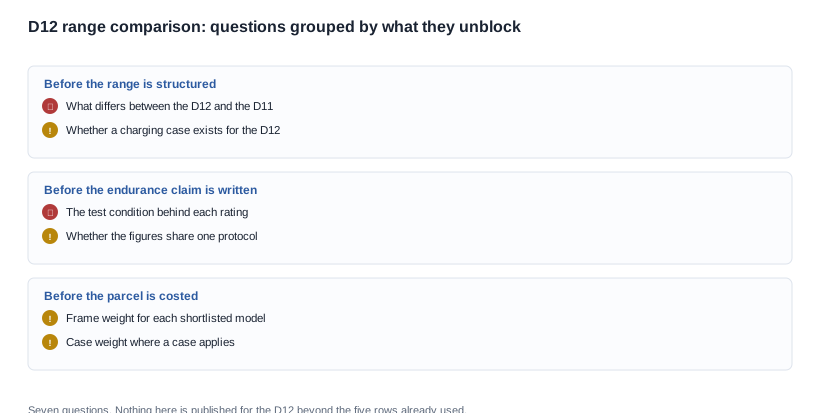
The open rows for this model are the same ones the other audio models carry, and each one blocks a different decision.
Frame weight blocks the freight class and any ergonomic claim. Frame dimensions and temple length block a size range. Ingress protection blocks outdoor positioning — our catalogue publishes IP54 on the V06 and the S7, and on no audio model. The charging case position blocks the accessory set and the parcel weight. The endurance test condition blocks any cross-model comparison of the ratings. The colour list blocks the merchandising plan. Certificate numbers and model coverage block market access.
And the two that are specific to this model: the acoustic specification, where the D12 is the only model in its group publishing no descriptor at all, and the difference from the D11, where the published rows are identical except for the acoustic row.
The four questions that would change the comparison. What physically differs between the D11 and the D12, in the supplier's own words. What the frame weight is for the D12 and for the LC-105 pair, since weight is what decides the shipping class. Whether a charging case is available for the D12 and what its capacity would be. And what the endurance figures were measured under, and whether the D-series, the K-series and the LC-series were measured under one shared protocol at all.
A shortlist sequence that keeps the comparison honest
The published rows narrow the range to a shortlist in one move, and a shortlist is much easier to manage than a catalogue of twenty-eight models. The sequence below is the one that avoids the two failure modes: comparing figures that were measured under different protocols, and treating an open row as a zero.
Step one: eliminate on the interface. If the channel's proposition is cable-led, the magnetically charging models are out of scope regardless of what their endurance figures say. If the proposition is dock-led, the Type-C models are. That single cut removes six of the eight audio models, and it costs nothing because the row is published.
Step two: eliminate on the acoustic requirement. If the channel needs a named acoustic feature in the copy, the models that carry an acoustic row stay and the ones that do not go — and the D12 is one of the ones that goes, because it publishes no acoustic descriptor. If no acoustic claim is needed, this step does nothing and the D12 remains in scope. Either way, the decision is made from published rows.
Step three: eliminate on the endurance requirement. If the channel needs a rated figure of about eight hours, then the models publishing about eight hours remain — but with the caveat that the figures were produced under different protocols, so the requirement is written as a rating and not as a guarantee. If the channel needs about seven hours or accepts a lower rating with a lighter cell configuration, the D12 and the D11 both remain.
Step four: apply the commercial criteria to whatever survived. The order minimum, the lead time, the certification scope, the accessory specification and the quantity breaks, all of them as commercial criteria rather than as specification rows. This is the step that usually ends the process, and it is the step that a catalogue can never support.
And then check the two things that would invalidate the whole shortlist. Whether the endurance figures share a protocol, and what physically differs between the D11 and the D12. A shortlist built on figures taken under different conditions is not a shortlist; it is a set of preferences that happen to be in a table.
And how to judge the answers. Each must be tied to a model designation, must state the configuration it was measured on, and must say what it excludes. A reply that answers for the family is not an answer, and the reason matters here because two models in this range publish identical rows and a third publishes rows that resemble them. The red flags are a figure with no date, a case described by what it does rather than by what it holds, and an endurance answer that restates the rating instead of the condition behind it.
Where our D12 position on the range sits
The D12 is a well-defined product for a specific brief — a simple, single-cable audio frame for a channel whose customer will not run a charging case — and a poor match for a brief that needs a visible feature ladder, because the model publishes no acoustic descriptor to build one with.
We will not rank the range. The published data does not support a ranking: the endurance figures are inconsistent with the cell capacities, no frame weight is published for any audio model, and the acoustic claims are unquantified. We will not present the D12 as the best model in the range, we will not carry the D11's surround-sound row across to it, and we will not describe the D12 as a feature-led product, because on the published evidence it is not one.
What we will do is lay out the published rows, tell you where they contradict each other, and name the questions that have to be answered before the product goes on a page. The D12 battery life breakdown takes the rated figure in more detail, and the bluetooth audio glasses buying guide covers the category-level questions behind this comparison.
Related reading
- The published figures for this model — D12 smart glasses specifications and features
- Choosing across the whole range — Bluetooth audio glasses buying guide
- Where a customer starts — Bluetooth audio glasses entry level options
Tell us the target price band, the expected daily routine and the destination market, and we will tell you which models in the range suit that brief.


