

Choosing between the models in the published audio range is mostly a question of which rows you need to quote on a product page. The frames look similar from the outside, several of them publish the same cell format, and the differences hide in lines a specification sheet lists without explaining them. This comparison works from the published sheet outward: the cell format, the charging method, the published runtime, and the feature rows that carry an audio claim. It is written for a buyer who has to decide which model goes in front of a customer, and who has to be able to say why afterwards.
D11 against the published audio range
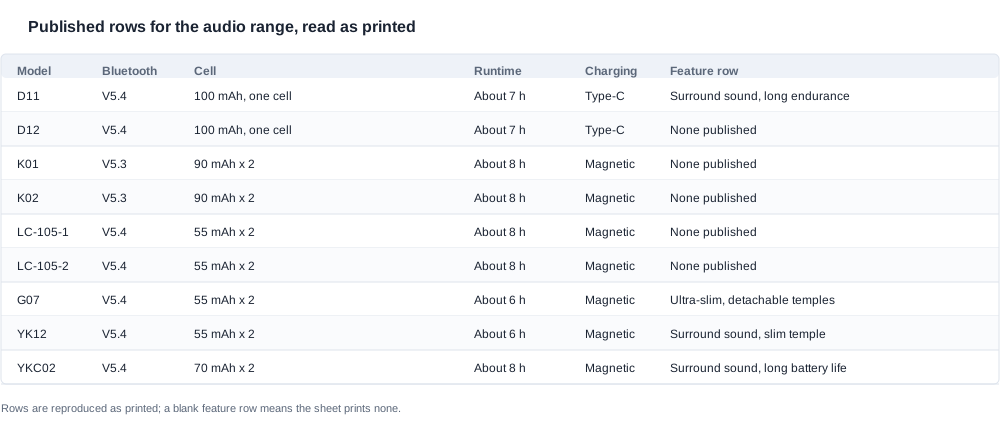
The table below is read straight off the published sheet, model by model, because the only comparison that survives a customer question is one that can be traced back to a printed row. Nothing in it is inferred, and the empty cells are empty because the catalogue does not print them.
| Model | Bluetooth | Cell | Published runtime | Charging | Published feature row |
|---|---|---|---|---|---|
| D11 | V5.4 | 100 mAh, one cell | About 7 h | Type-C | Surround sound, long endurance |
| D12 | V5.4 | 100 mAh, one cell | About 7 h | Type-C | No separate feature row |
| K01 | V5.3 | 90 mAh x 2 | About 8 h | Magnetic | No separate feature row |
| K02 | V5.3 | 90 mAh x 2 | About 8 h | Magnetic | No separate feature row |
| LC-105-1 | V5.4 | 55 mAh x 2 | About 8 h | Magnetic | No separate feature row |
| LC-105-2 | V5.4 | 55 mAh x 2 | About 8 h | Magnetic | No separate feature row |
| G07 | V5.4 | 55 mAh x 2 | About 6 h | Magnetic | Ultra-slim, detachable temples |
| YK12 | V5.4 | 55 mAh x 2 | About 6 h | Magnetic | Surround sound, slim temple |
| YKC02 | V5.4 | 70 mAh x 2 | About 8 h | Magnetic | Surround sound, long battery life |
Nine models, and the sheet compresses into fewer decisions than it looks like it should. Two of the nine publish a single cell. Two publish two 90 mAh cells and Bluetooth V5.3; the other seven publish V5.4. Seven charge magnetically and two charge over Type-C. Four of the nine carry a feature row beyond the audio description, and on three of those four the feature is a surround-sound line. The remaining spread — 55 mAh, 70 mAh and 90 mAh cells, one cell or two — is the part that actually separates a range.
What the table does not contain matters just as much. There is no weight column, because no weight is published for any of these models. There is no ingress column, because an ingress figure is published for two models in the whole catalogue and neither of them is in this range. There is no control column, because the catalogue prints no capacitive touch row and no touch gesture row for any model anywhere in it. A buyer reading this table for the first time usually starts from the differences and only later notices that the missing rows are the same across every model in the range.
The runtime figures compress further still:
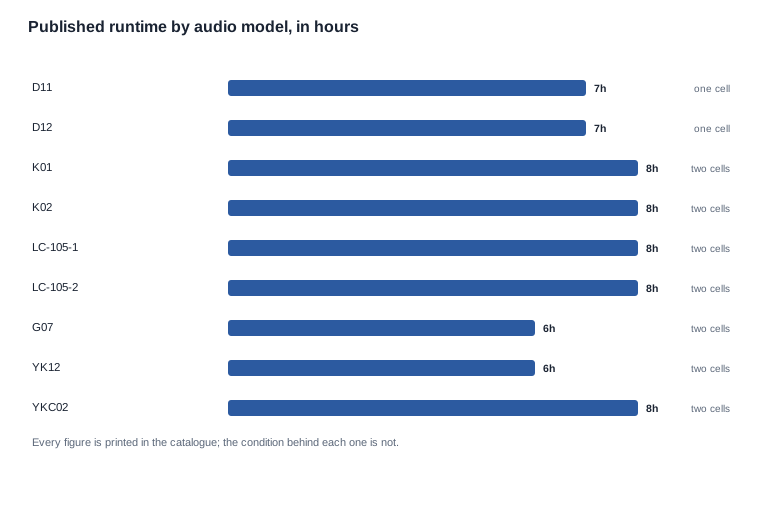
Three values across nine models: about six hours, about seven hours and about eight hours. That is a one-hour spread between the lowest and the highest published figure in the range, and it is the smallest spread on the sheet. A buyer who treats those numbers as a ranking will over-read them, because the sheet does not print the condition behind any of them. The same 55 mAh twin-cell format publishes about eight hours on one model and about six hours on two others, which is only possible if the measurement conditions differ. The figures are real; they are not a comparison. How to ask the supplier for the condition behind an endurance figure is covered in how to compare smart glasses battery life.

The single-cell position: what the D11 buys and what it costs
Two models in this range publish one cell, and this is one of them. Everything that makes the frame easy to ship and everything that makes it fragile comes from the same line on the published sheet.
The parcel. A single cell means no accessory cell travelling in the same box, and no charging-case row is published for this model. The carton is small, there is no second item in the battery chain, and the freight class follows from the parcel rather than from a choice. The shipping weight analysis sets out how that figure is established for this category, and the charging options analysis covers what an accessory adds to the chain and to the cost.
The first week. A customer with a USB-C cable charges the product on a desk, on a power bank or in a car. There is no accessory to find, no magnetic orientation to learn and nothing to buy a second time. For a channel that ships a product and lets the customer sort out the power, that is worth more than another row on the specification sheet, and it is the reason this model and its twin are often discussed together for a simple audio wearable.
The feature row. The published surround-sound line is the only feature line on this model. In the wider range, three models publish a surround-sound line, and the other two of them publish it alongside a second feature row — slim temples for one, long battery life for the other. What sits behind the label is not published for any of the three: no driver size, no frequency response, no leakage figure. The line is a name, and a product page that treats it as a name is defensible in a way that a product page that treats it as a specification is not.
The tolerance. One cell has no fallback. When it is flat, the product is flat. The twin-cell models can keep working with one temple's cell drained, and that matters in exactly the situations a buyer cannot predict: a customer on a long flight, a customer whose day ends away from a charger, a channel whose returns arrive because a unit was flat rather than because it was faulty. This is the trade that has to be priced in, not argued about.
The balance. One cell means an asymmetric frame, with the mass on one side. No weight is published for this model or for its twin, so the asymmetry cannot be dismissed with a number. A buyer who has held both formats knows the single-cell frame feels different in the hand, and a buyer who has not should treat that as a sample question rather than a preference. How that number should be established is set out in the weight comparison across the audio range.
The endurance figure. About seven hours against the eight hours published for the twin-cell models. The gap is one hour on a figure that does not carry its measurement condition, which is exactly the kind of gap that should not be used as a decision input on its own. What matters more is the shape of the product behind it: a model that can run for half a day without a cable is a different purchase from one that cannot, whatever the two catalogue numbers say.
Reading the audio range battery rows without comparing them
A catalogue sheet of runtime figures is a list of claims, not a benchmark. The only way to read one honestly is to ask what condition sits behind it, and then to decide in advance whether that condition matches the way the product will be used. Three questions cover most of it.
- What was the load and the volume? Playback at a stated volume on a stated content type produces one number; playback at maximum produces another. A figure without the load cannot be compared with anything, including the same model measured on another day.
- What was the link state and the start charge? A paired model in standby and a paired model in active use are two different products. The start state matters in the same way: a figure measured from a part-charged cell is a different claim from one measured from a full cell.
- What was the ambient condition? A frame that is used outdoors in summer behaves differently from one used indoors. The catalogue does not print any of this, which is precisely why the request has to be made before the first order rather than after the first complaint.
The charging rows need the same treatment. Every model in this range publishes its charging time as a ceiling rather than as a measurement — a figure of two hours or less, with two models in the catalogue outside the audio range publishing about one hour. A ceiling says what the worst case is allowed to be. It does not say what the unit will do on a cold morning with a partly used cell, and a buyer who quotes it as a typical figure is making a claim the sheet does not support. Treat the ceiling as the number the product is guaranteed not to exceed, and ask for the measurement behind it if the listing needs more than a guarantee.
The cell format is the one hard structural difference in the range. One cell or two is a physical fact that does not depend on any measurement condition, and it drives three things at once: the accessory chain, the weight distribution in the frame, and the tolerance to a flat cell. A buyer who has only the runtime figures is comparing the least reliable column in the sheet. The format is the column to decide on.
That reorders the whole comparison. The order below is the one that closes the most risk per unit of effort, and it is the order we would use before a first order of any model in the range:
- Decide the cell format first, because it is published and structural.
- Decide the charging method second, because the accessory chain and the customer expectation follow from it.
- Treat every published runtime as a ceiling to be tested, not as a figure to be ranked.
- Only then compare the feature rows, and only if the listing is going to claim the feature.
- Collect the missing rows — weight, dimensions, acoustic specification, case capacity — as an open list rather than assuming they match the model you like.
Where the D11 and the D12 stop being distinguishable
Two models publish the same rows: Bluetooth V5.4, a 100 mAh single cell, a charging time of two hours or less, a published runtime of about seven hours and Type-C charging. The one printed difference between them is that the surround-sound line appears on one of the pair and not on the other. Everything else that would separate a buyer — the fit, the temple profile, the acoustic tuning, the packaging, the commercial terms — is not a published row, and the catalogue does not state what the difference between the two is.
That is a genuinely awkward position for a channel, because the two models look equivalent in a comparison table while being distinguishable in a sample. The practical answer is to stop looking for a published difference that does not exist and to pick the tie-breaker that matters for the application.
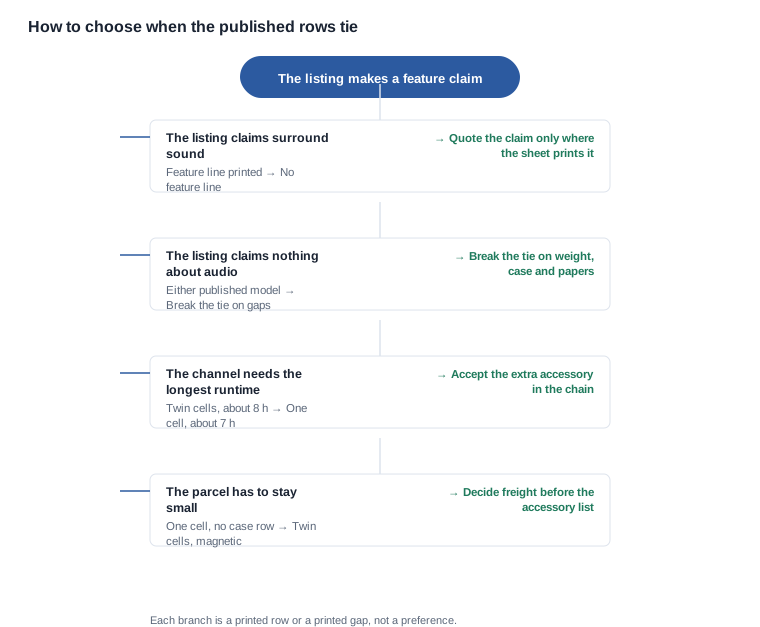
If the listing carries an audio feature claim, the feature line decides it, because it is the only printed difference and a claim that cannot be sourced is a claim that has to come off the page later. If the listing carries no audio feature claim, the two are interchangeable on the published sheet, and the decision moves to the rows that are missing from both: the measured weight, the frame dimensions, the case and its capacity, the acoustic specification, and the certification position for each destination market. The price positioning analysis for this pair covers what those missing rows are worth commercially.
A buyer who cannot separate two models on published evidence should say so in writing to the supplier before ordering, because the answer usually arrives in one of two forms. Either the supplier states the difference and it becomes a usable row, or the supplier confirms that the models share a platform and the difference is commercial. Both answers are usable. Silence is not, and a silence that is only broken after the first shipment is the expensive kind.
The same discipline applies across the wider range. When two models publish identical rows, the tie-breaker is never the feature line on its own; it is the feature line plus the cost of closing what the sheet leaves open for the model you did not choose.

What a buyer should measure before placing a first order
The range comparison is a shortlist tool, not a substitute for a sample. What the sample has to close is set out below: each row is either printed in the catalogue, or it has to be measured or requested, and the right-hand column is the form the answer has to take before the order is placed.
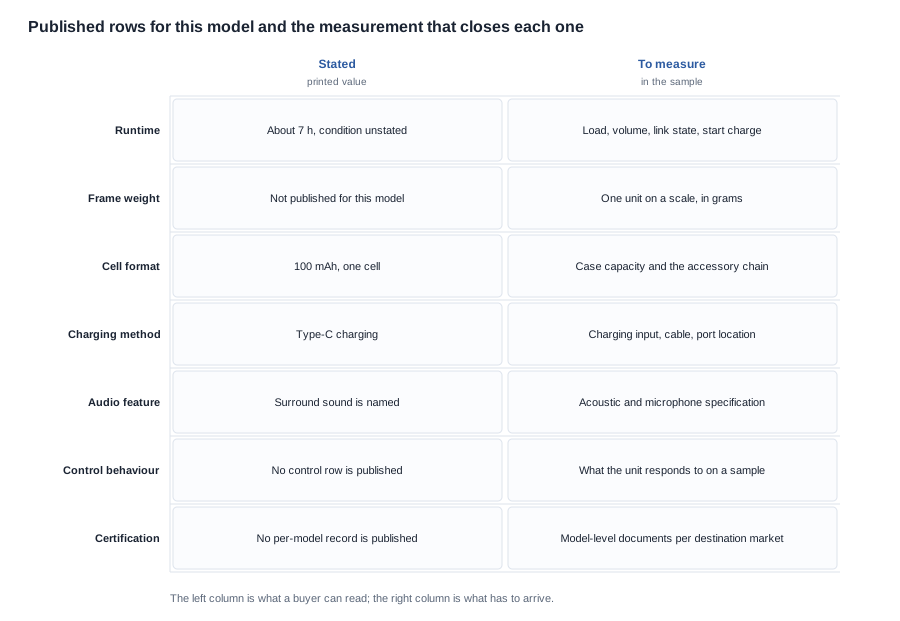
Six of those rows need work before a first order, and the order in which they are closed is the order of how expensive they are to get wrong.
- The endurance condition. Which load, which volume, which link state and which start charge the published figure was measured under. If the supplier cannot state it, the figure stays a ceiling and the listing says so.
- Frame weight and dimensions, measured on the sample. No weight is published for this model, and the single-cell layout makes the mass distribution uneven, which is a wearability question as much as a freight question.
- The charging accessory question. Whether a case exists for this model, whether it is a charging case or a storage case, and what capacity it carries. The catalogue prints no case row for this model, and a case that turns up later with a second cell in it changes the battery documentation chain.
- The acoustic and microphone specification. The feature line is published; the numbers behind it are not. A buyer who plans to claim the feature needs the document, and a buyer who does not needs to keep the line as a name.
- The charging input and the port. The published method is Type-C, which fixes the cable family and nothing else: the input current, the included cable and the port location are all open.
- The certification position for each destination market. There is no per-model certification record in the catalogue for this model or for any other, so the paperwork has to arrive, has to name this model, and has to sit on the register before a shipment is planned.
The red flags are simple to name and easy to miss. A supplier who answers the endurance question with a marketing sentence instead of a condition. A supplier who sends a document that names a product range rather than the model. A supplier who quotes a case capacity for a model whose sheet has no case row. A sample that reacts to a tap on the temple is not a touch control: the catalogue prints no capacitive touch row and no gesture row for any model in it, and the only control rows anywhere in the catalogue are the indicator light and button control on the AR model, which is a button. A channel that reads a tap response as a touch feature is publishing a claim that no document supports.
The total cost of an open item is where the commercial decision actually sits. An open endurance condition costs a rewritten listing paragraph, which is an hour of work. An open acoustic specification costs a feature claim, which is a conversion rate on the pages that carry it. An open certification position costs the shipment itself, because a consignment without the right radio and battery documentation stops at the border rather than in the office. When to walk away from a first order is easier to decide when those three costs are written next to each other, because they are not the same size and the cheapest-looking model is not always the cheapest model to buy.
Where CYNRIN stands on the D11 position in the range
Our position on a range comparison is that the published sheet is a starting point and not a specification set. We publish the rows we hold, and we do not print rows we do not have. We will not present the surround-sound label as an acoustic specification, we will not present a published runtime as a working day, and we will not put a figure on a product page that our documentation does not carry. The published specification list for this model is the honest baseline, and the buyer review checklist covers the sample-stage work that closes the rows a sheet cannot.
The selection method is the deliverable here, not a verdict. A channel that needs an audio feature claim and a single-cell parcel points at this model and its twin; a channel that needs the longest published runtime and a magnetic accessory points at the twin-cell models and accepts the extra item in the chain; a channel that needs a detachable or slim temple points at the two models that publish that row. Which of those fits depends on the market, the customer and the accessory policy, and the honest answer to a buyer who asks which one to take is the set of questions to ask the supplier first.
Six questions to ask before a first order in this range, in the order that closes the most risk:
- What condition was the published runtime measured under, and can it be re-measured on a sample with the condition written down?
- What is the measured frame weight and the frame dimension, and is the cell layout even or single-sided?
- Does a charging case exist for the model, does it charge, and what capacity does it carry?
- What is the acoustic specification and the microphone specification behind the feature line?
- What is the charging input, and which cable is included in the carton?
- Which documents cover this model for each destination market, and who signs them?
The answers to those six questions are what turn a catalogue table into a decision. Send the application, the expected wear time and the markets, and we will tell you which rows in this range can be quoted as published evidence, which ones have to be measured first, and where the comparison has to be decided on something the catalogue does not print.
Related reading
- The rows this comparison is built on — Specification rows published for this model
- The model published beside it — The twin model and how it compares
- The accessory chain and its cost — Charging options across the audio range
- The method for reading runtime figures — How to compare battery life properly
- The sample-stage work — The review checklist before an order


