

The D11 is a Bluetooth V5.4 open-ear frame with a single 100 mAh cell, Type-C charging, a rated runtime of around seven hours and surround sound published as its distinguishing audio feature. That is a short specification and an easy product to understand — which is exactly why the gaps underneath it matter, and why a pre-ordering checklist is more useful for this model than a long description.
A d11 smart glasses what to check before ordering question is mostly about the difference between a product you can describe and a product you can ship. The published row supports a good product page: a radio version, a charging interface, a cell capacity, a rated runtime and one named audio feature. What it does not support is a compliance file, a durability claim, a weight, a fit statement or a warranty position — and those are the things that decide whether the order goes smoothly.
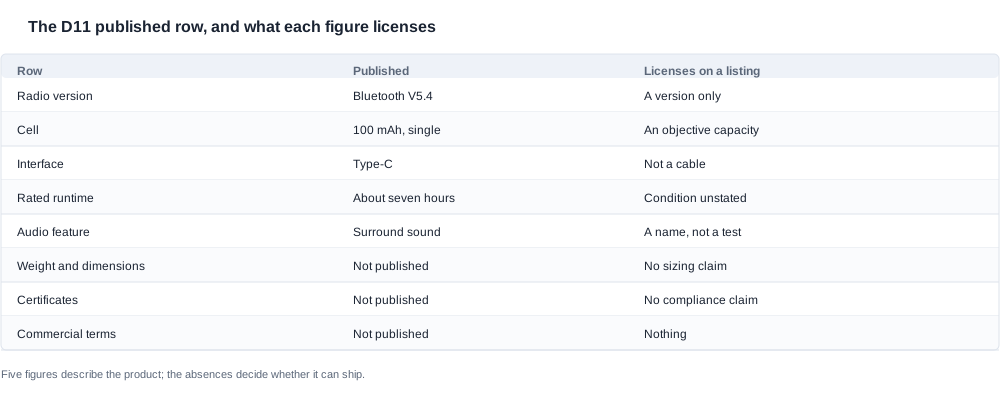
D11 smart glasses: a short row and a long list of what it leaves open
Five figures, and it is worth stating precisely what each one licenses.
| Row | D11 published | What it licenses on a listing |
|---|---|---|
| Radio version | Bluetooth V5.4 | A version number, nothing more |
| Cell | 100 mAh, single | An objective capacity |
| Charging interface | Type-C | An interface, not a cable inclusion |
| Rated runtime | Around seven hours | A rated value, condition unstated |
| Audio feature | Surround sound | A feature name, not a tested result |
Everything a buyer needs to know is in what that table does not say. Frame weight, temple length, lens dimensions and lens material. Certificate numbers, issuing bodies, validity periods and the model schedule each certificate covers. The runtime test condition and the charge-time measurement state. Ingress position and the report behind it. MOQ, lead time, unit price, packaging specification, warranty terms and the defect categories treated as returns. And the answer to a question that is easy to miss: is the cable in the box.
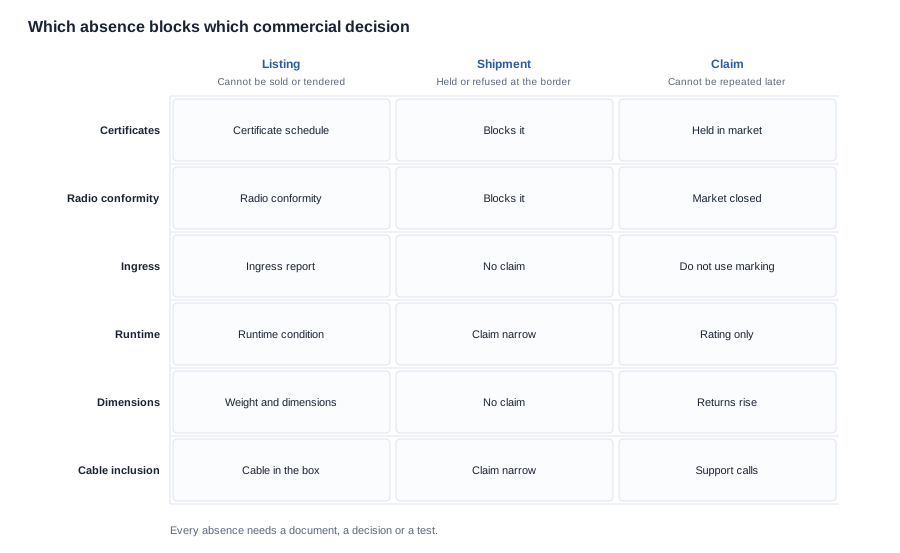
The practical consequence for a buyer who reads the sheet quickly. The specification table for this model is short enough to complete in one sitting, and it is complete enough to satisfy a purchasing checklist that is really a formality. That is the trap: the artefact and the work look the same from a distance. The five rows describe a product that exists. The six documents describe a product you can import.
And a question worth asking yourself before you start. Why is your channel choosing an audio-only open-ear frame rather than a camera platform? The honest answers are endurance, unit cost, a simpler compliance surface, or a customer who already records on another device — and each of them changes what you need from the documentation. A buyer who chose this model for the runtime figure and then asks about camera parameters is asking the wrong questions.
A short row is not a simple product, and it is worth being clear about why. Every one of the five published figures is a component number a factory can read off a bill of materials. Every one of the absences is a document, a decision or a test. A buyer who completes the specification table in an hour has completed the easy tenth of the work, and the remaining nine tenths are what determines whether the product can be listed in a given market, shipped into it, supported in it and reordered without argument.
And one specific caution for this model. A radio version and an audio feature name are the two rows most often extended into claims that the documentation does not carry. Bluetooth V5.4 does not indicate range, codec, latency or stability in any particular environment, and surround sound is a name until somebody has described the test behind it. Both extensions are discussed below.

Single-cell architecture and what the shared platform means
The single 100 mAh cell is the structural fact behind most of this model's commercial behaviour, and it is worth reading as architecture rather than as a number.
Our audio range uses several cell architectures: dual cells at 90 mAh, dual cells at 55 mAh, dual cells at 70 mAh, and a single 100 mAh. The D11 sits on the single-cell platform, which it shares with one other model. A single cell in an open-ear frame is simpler to package, simpler to charge over Type-C and simpler to describe — and it is the reason the runtime figure is a single approximate value rather than a band, because the load is continuous and low.
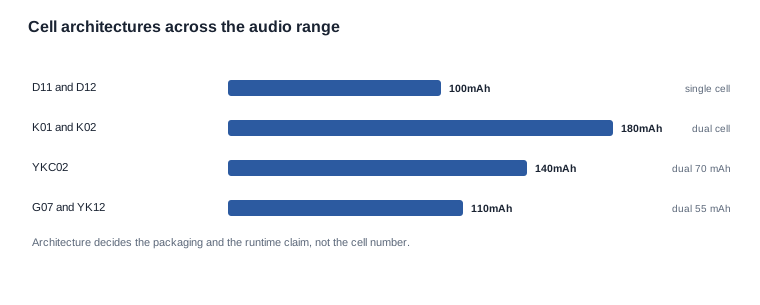
What a shared platform buys a buyer. One production route to qualify, one packaging system, one accessory line, one firmware branch and one compliance position — provided the compliance position is genuinely shared rather than assumed to be. The D11 compared across the range page sets out where the platforms divide.
What a shared platform costs a buyer, and it is the same thing. A single-cell architecture used by two models is easier to replace than a unique one, and that is an advantage. It also means that a change to the cell, the charge circuit or the firmware may affect a model you did not intend to change, so ask what else moves when this model moves. A platform that is shared is a platform with a blast radius, and the radius is worth knowing before you commit a volume to it.
One more architectural consequence worth naming. A single cell means the product's endurance and its weight are the same decision. Buyers who want a longer figure usually reach for a larger cell, and a larger cell in an open-ear frame is a comfort and a balance question before it is a capacity question. Since frame weight is not published for this model, any endurance comparison against a dual-cell model in our range is a comparison between a capacity difference and a distribution difference, and the two are not interchangeable in a listing.
And the practical instruction that follows. If the runtime figure is going to lead your product page, then weight is not an optional extra on that page — a customer comparing seven hours against a competitor will ask what the unit weighs, and "not published" is not an answer a product page can give. Ask for the weight before you commit to leading with the figure.
Two questions on the power rows specifically. What is the runtime test condition — volume level, ambient temperature, connection state, and whether the source was playing continuously? And is the charge time quoted from an empty battery or from a partial one? Neither is published, and both change the number a customer will measure. Our battery life and charging options pages set out the rows, and battery guidance covers why the condition matters.
And one practical question that decides a real number of returns. Ask whether the Type-C cable is supplied. Not published, and it changes what goes in the box, what the customer is told to expect and how many support calls arrive in week one. For an interface that most customers already own a cable for, it is a cheap question with an expensive answer if skipped.

Surround sound, and the narrow test behind the name
Surround sound is published for only three frames in our range, and that scarcity makes the name more valuable in a listing and more dangerous at the same time.
The name is not a specification. No driver size, no frequency response, no channel configuration, no codec, no volume limit and no acoustic test condition is published for this model. That does not make the claim wrong — it makes it narrow. The defensible version is the name itself; the indefensible version is any sentence about what the customer will hear, in what environment, relative to what.
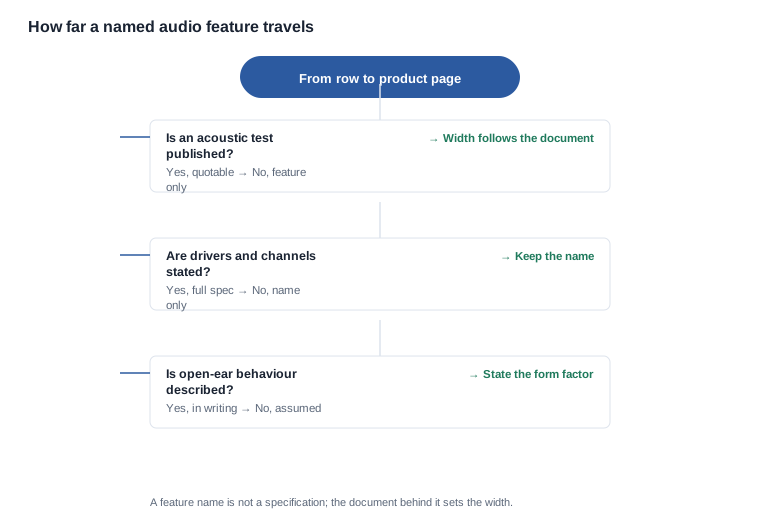
What to ask. What is the driver and channel configuration? What is the rated maximum volume, and under what conditions? Is there a published acoustic test, and may its results be quoted? And what does the feature actually do in wind, in traffic and on a busy street — because an open-ear frame is an open acoustic environment, and that is a design fact rather than a defect.
A note on the asymmetry between the name and the test. Because surround sound appears on only three frames in the range, the name carries more weight in a buyer's shortlist than it would on a common feature. That is precisely why the supporting question matters more here rather than less: a scarce, desirable name invites a confident sentence, and a confident sentence without a test is the exact failure mode a technical file exists to prevent.
And a question to put to the supplier that usually gets a good answer. Ask them to describe what a customer hears differently with this feature on a busy street. A supplier who has thought about that has a test; a supplier who answers in superlatives has a marketing page. The quality of that answer tells you how much room your own copy has.
What to do with the answers. Write the claim at the width the documentation supports, and put it in the file with its source. A page that says "surround sound, as published for this model" is thin and safe. A page that says "immersive sound in any environment" is wide and undefendable, and the difference between them is discovered by a customer rather than by you.
A note on open-ear design that belongs in a buyer's own file. An open-ear frame leaks sound and admits it. That is a consequence of the form factor, not a defect, and it matters commercially in exactly one direction: it changes where the product can be sold and how the listing should describe it. Our open-ear audio page covers the trade-off, and it is worth reading before the positioning work rather than after it.

The six missing documents, and the questions that close them
This section is the actual checklist, and the six items are documents rather than parameters.
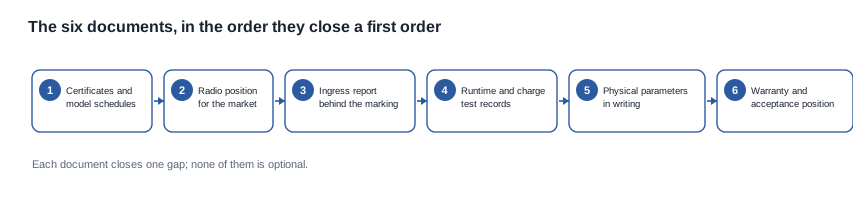
- The certificate file. Numbers, issuing bodies, validity dates, and the model schedule each certificate covers. Our documentation publishes none of these for this model, and we will not imply that they exist. See certification checklist and D11 certification status.
- The radio position for the destination market. Bluetooth V5.4 is published; Bluetooth SIG qualification and radio regulatory conformity are separate questions in most markets. See Bluetooth SIG.
- The ingress position and its report. A marking and a report are different documents, and a marking with no report behind it is not a tested result. See IP ratings.
- The runtime test record and the charge-time measurement state. A rated figure without a condition cannot be repeated as a capability.
- The physical parameters. Frame weight, temple length, lens dimensions, lens material, and whether adjustability exists.
- The warranty and acceptance position. Defect categories, remedy, freight responsibility, and the acceptance route at the destination.
Two of these are worth sequencing deliberately. The certificate file should arrive before the acoustic conversation, because a market that will not accept the product makes an acoustic test irrelevant. And the warranty position should be agreed before the physical parameters, because the defect categories you agree determine which physical parameters you most need — a weight tolerance and a lens material question matter differently depending on whether a breakage is a warranty item.
A note on what to do if a document cannot be produced at all. That happens, and it is not automatically disqualifying. What matters is that you know, and that the gap is written into the file with the reason. A model with no published ingress report and a buyer who has recorded that fact is a manageable position. A model with no ingress report and a buyer who assumed otherwise is a shipment problem.
The order is not arbitrary. The certificate file gates everything, because a product that cannot be listed should not be priced, sampled or discussed with a channel. The radio position gates the destination market, and the destination market gates the packaging. The runtime record and the physical parameters gate what you may write, and the warranty position gates what a return costs.
A third red flag, and it is the quietest. A supplier who answers all six document requests quickly and completely, but who cannot say which revision of the specification sheet each answer came from, is describing a product that is still moving. In a platform shared with another model, that is the condition in which a published row quietly stops matching the goods. Ask for revision dates once, early, and then stop worrying about it.
And a practical note on sequencing the requests. Send the certificate and radio questions first and separately from the parameter questions. Compliance answers gate the destination market, and the destination market can change your packaging, which changes the artwork approval, which changes the lead time. Letting those two sets of questions travel together is how a two-week enquiry becomes a six-week one.
Two red flags worth naming. A certificate list with no validity dates usually means it was assembled once and never maintained. And a supplier who answers the certificate question with "it is the same as the other models on this platform" may be entirely correct and is still not usable — insist on the schedule for this model, because a shared platform is exactly the situation in which one model quietly falls outside.
And one question about the file rather than the product. Ask whether the supplier maintains a single controlled specification sheet for this model with a revision date. If they do, your eight items are one document instead of eight emails. If they do not, you are going to be the document system for this model, and you should budget for it accordingly.
The ordering sequence and what the contract must contain
A short sequence, for a buyer who has the time to do it properly and not much more than that.
- Fix the destination market and the claim you intend to lead with. Everything else is downstream of those two.
- Send the six document requests and the eight parameter questions as one numbered enquiry.
- Hold the purchase order until the certificate schedule names your model and the runtime condition is stated in writing.
- Order samples against written acceptance criteria, covering the radio connection, the endurance and the acoustic behaviour you intend to describe.
- Negotiate the commercial terms while the order is still small, and put them in the contract rather than in an email.
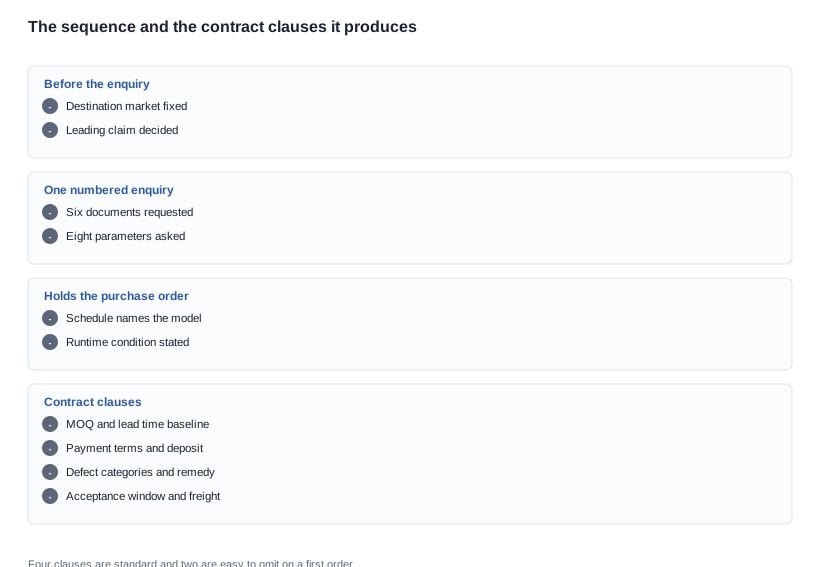
And how to evaluate the answers as they come in. The clause set tells you more about a supplier than the price does. A supplier who states a lead time baseline, a defect category list and an acceptance window without being pushed has a quality control route that will function at volume. A supplier who resists all three has decided that those are negotiating positions rather than facts — and that is worth knowing before the deposit, not after it. How to assess that in a wider review is covered on our factory audit and supplier evaluation pages.
Six clauses the contract should contain, and what each is worth.
- MOQ, with stock and production quantities distinguished. See MOQ.
- Lead time, with its baseline stated — measured from deposit, artwork approval, sample confirmation or order entry. A supplier quoting the same number from different starting points is quoting different products. See lead time.
- Unit price at your actual volume, with packaging shown separately. See pricing.
- Payment terms and deposit, and what changes on the second order. See payment terms.
- Warranty defect categories, remedy and freight responsibility, in the contract rather than in a policy document. See contract terms and quality consistency.
- Acceptance criteria and the inspection window, so that a claim raised outside the window is a known exclusion rather than a dispute.
And two clauses that are easy to omit on a first order. A continuity commitment — how much notice of discontinuation, and what stock position is held in the final period — and a mechanism for revisiting the price at the second order. Both are easy to agree at the start and nearly impossible to introduce later.
And the discipline that makes the whole checklist worth the time. Keep one file for this model, with every published row, every supplier answer, every document reference and every open gap, each dated and attributed. Review it before the second order and before every new market. The value of that file is not in the first month, when you could still remember the answers — it is in the twelfth month, when a certificate has expired, a parameter has been changed and nobody can say which version shipped.
A closing note on what to do when an answer is missing. Decide explicitly whether the gap blocks the order or can be carried into the first shipment, and write that decision down with a reason and a date. At the second order somebody else will review it, and a decision recorded with a reason survives that review while a decision recorded without one does not.
Our position on this model is that the short row is genuinely sufficient to describe the product and genuinely insufficient to ship it. We will not present surround sound as a tested acoustic result without a published test, we will not present around seven hours of rated use as a measured endurance without its condition, and we will not present Bluetooth V5.4 as evidence of range, codec or stability. Tell us the destination market, the volume and the claim you intend to lead with, and we will tell you which of these checks has to be closed before the order and which can follow the first shipment.
Related reading
- Where the model sits in the audio range — D11 compared across the range
- Where the documentation gaps sit — D11 limitations
- The power rows — D11 battery life and charging options
- Which job the model suits — D11 best for


