

Does the temple strength matter? Yes, and more than the question usually gets credit for, because in a pair of smart glasses the temple is not a decorative arm — it is the structural member that carries the battery, the electronics, the camera module and, on several models, the charging contacts, and it does that while the product is being put on and taken off several times a day. The catalogue publishes almost nothing about it. There is no material row, no hinge cycle rating, no torque figure, no dimension drawing, and no frame or temple weight anywhere in the range. The only weight published in the whole catalogue is for the MT6 glasses body, and even that figure is not a frame weight.
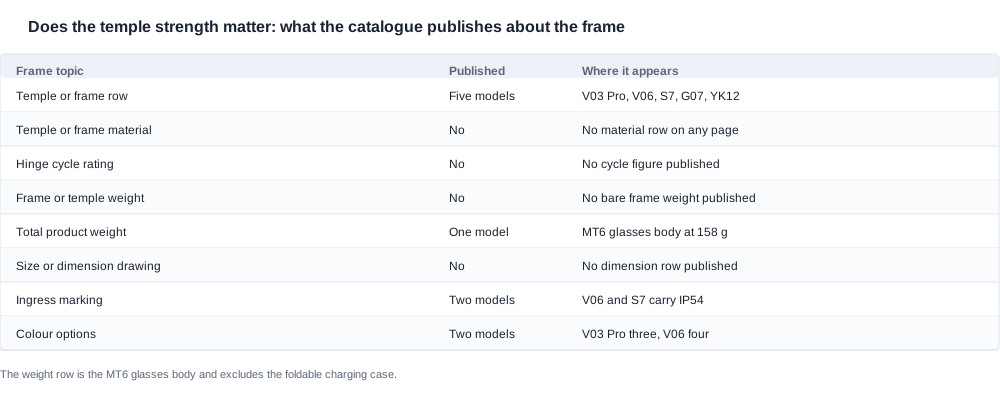
The answer therefore splits the way this category always splits. Published: five models carry a frame or temple feature row — the V03 Pro with a flexible temple, the V06 and the S7 with an ergonomic design and a detachable inner frame, the G07 with an ultra-slim detachable temple, and the YK12 with a slim temple. Not published: every material, every hinge or cycle rating, every dimensional measurement, every frame or temple weight, and every specification of the joints that the detachable designs imply. Ask the supplier: the material and the joint construction per model, the dimensional drawing, a cycle-rating figure, and a written statement of what the warranty treats as a consumable part.
That last request is the one that changes the commercial terms of a channel arrangement, because a detachable temple is not a styling feature. It is a specified serviceable part with a defined replacement method, and the question of who replaces it, at what cost and under which warranty condition is a procurement question rather than a design question.
Does the temple strength matter: what the catalogue actually says about the frame
The five frame-related rows in the entire range
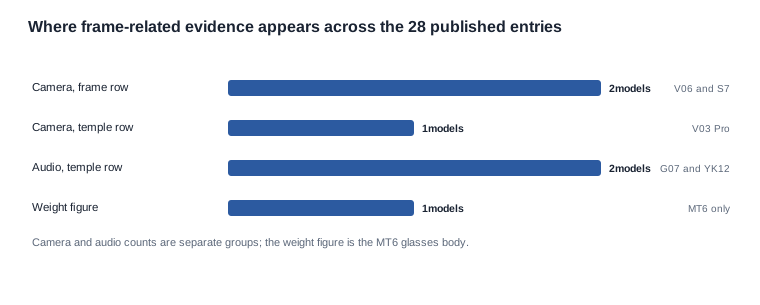
Searching the catalogue for anything structural returns a short list, and a buyer should know it by heart because it defines the whole evidence base. The V03 Pro publishes a flexible temple, a photochromic lens and a Type-C charging port alongside three colour options. The V06 publishes an ergonomic design, an extended-runtime claim, a detachable inner frame and an IP54 ingress marking across four colour options. The S7 publishes an ergonomic design, a thirteen-megapixel figure and a detachable inner frame with the same IP54 marking. The G07 publishes an ultra-slim construction with a detachable temple, and it is the only audio model in the range whose five standard specification rows are identical to another model's — the YK12, which publishes a slim temple and surround sound rather than a detachable temple.
Everything else is silence, and the silence is specific rather than general. No page states a temple material. No page states a hinge type, a cycle count or a torque figure. No page states a temple length, a lens width, a bridge measurement or any other dimension. No page states a bare frame weight. A buyer who reads a smart glasses datasheet expecting a materials section will find that the structural content of this catalogue consists of those five rows and nothing else.
What the 158 g figure measures, and what it does not
There is exactly one published weight in the range, and it needs stating precisely because it is easy to misattribute. The MT6 row carries three parallel features — portable, ultra-light, and 158 grams with a foldable charging case — with the case capacity of 1200 mAh listed separately. The 158 g is the weight of the MT6 glasses body, including the 265 mAh battery and the camera, and excluding the foldable charging case. The weight of that case is not published, and no bare frame weight is published for any model in the range.
This matters more than a footnote. A 158 g figure on the body tells a buyer something about the whole product in hand and nothing at all about how the mass is distributed between the front and the rear, how far forward the centre of mass sits, or what the temple section has to carry. Weight is not a structural rating. Two products of identical mass can behave very differently under the same abuse if one concentrates its mass near the front and the other distributes it, and a figure of 158 g cannot distinguish them. The comparison method that does distinguish them is set out in how to know whether the weight is distributed well, and it is a method question rather than a specification question.

Strength, stiffness and fatigue are three different questions
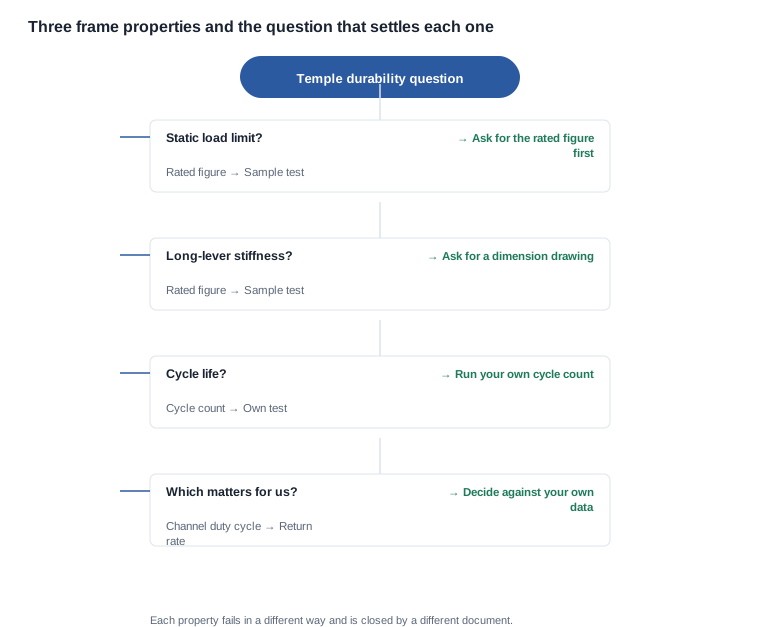
Buyers who collapse these into one conversation about "quality" tend to receive an answer that is technically true and practically useless, because the three properties fail in different ways, respond to different tests and produce different commercial outcomes. Naming them separately is what makes a request schedule precise.
Static strength and the one-off load
Static strength is the ability to carry a load that arrives once and stays. In a smart glasses product the relevant load is not weight but leverage: a cell, a camera module and a control board sit forward of the ear, and the temple acts as a cantilever carrying that mass at a distance. The failure that matters commercially is the one a customer causes by accident in the first week — a pocket, a sleeve, a car seat, a bag strap — and it is a sudden, visible, total failure of the product rather than a gradual one.
The question to ask is therefore not "is it strong" but "what load, applied where, produces what result, and how many times can it be repeated". A supplier with a real test programme can answer that; a supplier reading the question as a compliment cannot.
Stiffness and the long moment arm
Stiffness is how much the temple deflects under load, and it is a different property from strength in the way that matters commercially. A temple can be strong enough not to break and still deflect enough to make the product feel wrong — the front of the frame sits low, the electronics move relative to the head, and the customer concludes that the product is faulty. That conclusion is expensive because it produces returns on a product that has not broken, and returns on unbroken products are hard for a supplier to defend and harder for a channel to absorb.
Stiffness cannot be assessed without dimensions, because deflection scales with the square of the length of the lever arm. This is the practical consequence of the catalogue publishing no dimensional drawing: a buyer cannot reason about stiffness at all from published material, and must request a drawing before a structural conversation can begin. The sizing dimension is the other half of this and is treated separately in how to find your size.
Fatigue and the cycle count nobody publishes
Fatigue is what happens when a load arrives thousands of times rather than once, and in glasses the repeating cycle is the put-on and take-off motion combined with the hinge rotation. The failure appears long before any static load would break anything, and it appears at a point where the product is months old and the customer no longer associates the fault with the purchase. Fatigue is the failure mode that generates warranty claims, and it is the one most often absent from a datasheet.
The useful request here is a cycle count with a stated load, and the useful request after that is the replacement position for the part that eventually fails. A hinge that is rated for a number of cycles, and a temple that is replaceable when it is not, are two different products commercially even when they read identically on a shelf.

Where the failure mode changes shape
The five structural rows do more than describe styling, because two of them change where the risk sits. This is the part of the catalogue that a buyer should read most closely before drawing any durability conclusion.
The detachable temple on the G07
The G07 publishes an ultra-slim construction with a detachable temple. A detachable temple changes the failure model from a structural one to a connection one: the weakest point is no longer the section of the arm itself but the joint that holds it on. The joint is smaller, it carries load repeatedly, and it is the part that a factory is most likely to design for a mid-life replacement rather than for a lifetime.
For a channel this is a good thing and a documentation problem at the same time. If the temple is designed to be replaced, then the product has a consumable part and the channel needs to know the price of that part, whether it can be replaced in the field, and whether a replacement resets the warranty. None of that is published. If the temple is not in fact designed for replacement, then the joint is a single point of failure on a product line where the same joint geometry is being sold at volume.
The detachable inner frame on the V06 and the S7
The V06 and the S7 publish a detachable inner frame alongside an ergonomic design, and both carry the IP54 ingress marking — the only two models in the range with one. These are the two models where a buyer faces the most interesting combination in the catalogue: a removable element, a sealing claim, and a duty cycle that has to survive a channel's handling. A detachable inner frame means there is an interface between the frame and the removable element, and that interface is where water ingress and mechanical fatigue both act.
The ingress marking on those two models is a published row and can be quoted; what cannot be quoted is what it says about the removable element in isolation, whether the marking covers the assembled product or a specific configuration, and what the claim means for a service event. That is not a criticism of the catalogue, it is the normal state of a published figure, and it is precisely why a sample programme and a supplier request both need to address it.
The flexible temple on the V03 Pro
The V03 Pro publishes a flexible temple alongside a photochromic lens and a Type-C charging port, and it is the only camera model in the range with any frame-related row. A flexible temple is a deliberate tolerance for a load that would be a failure in a rigid design, which is the right approach for a product with a camera module in the front and a structure with a removable section.
What a buyer still cannot derive is how far it flexes before it is considered out of specification. The published row names the property without quantifying it, so a channel cannot describe the tolerance to a customer and a quality team cannot set an acceptance limit from published material. The request is narrow: a figure or a stated limit, and the condition under which the product is considered defective.
Why a detachable joint moves the risk into the warranty file
The commercial consequence of all of this is the same in each case, and it is the point a buyer should take to the negotiation. A joint that is intended to be serviceable creates a parts business that somebody has to run. The questions are practical: is the spare part sold through the same channel as the product, at what price, with what minimum quantity, and does installing it affect the warranty position. A supplier who cannot answer those questions has either not thought about them or does not intend to support the design, and a buyer who is sourcing for volume will encounter that answer eventually.

Four checks a sample programme can actually perform
Because the catalogue publishes no structural figures, the verification has to be done by the buyer, and it should be done before the order rather than after the first returns. The four checks below are practical, repeatable and produce records that can be filed against a model string.
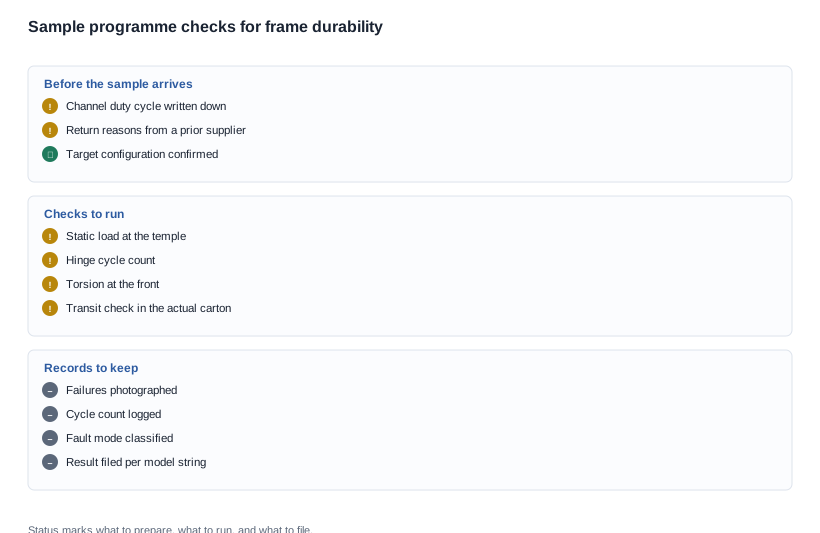
The load check. Apply a controlled load to the temple section away from the joint and observe both the deflection and the failure point. Record the load, the location, the duration and the result. The purpose is not to establish a universal rating — a single unit cannot produce one — but to detect a configuration that fails at a load the channel will see in normal service. Two suppliers that answer the same request can be compared, and two samples of the same model can be compared.
The hinge cycle check. Work the hinge through a fixed number of cycles under a stated load and watch for the three failure signatures that matter: looseness developing at the joint, a change in the temple's rest position, and a sound or a resistance change. The count you run should come from your own duty cycle rather than from a generic number, and the record should state the count, the load and the condition at the end.
The torsion check. Apply a twisting moment at the front of the frame, because that is where the camera module and the cell sit and where the moment arm is longest. This is the check that catches a design whose front end is heavier than the rear, and it connects directly to the weight-distribution question in the linked article above.
The packaging and transit check. Put the sample through the transit path it will actually take — carton, void fill, stack, conveyor — and inspect the joints and the front assembly afterwards. Packaging failures are the most common first failure in a hardware product, they are invisible to any test that stops at the bench, and they are almost entirely determined by decisions made before the sample arrives.
The request schedule for frame durability
The requests below are written in the order that closes the most uncertainty per question, and each is answerable in writing by a supplier who has the information. A request that names a model and asks for a specific document produces a comparable answer; a request about "build quality" produces a compliment.
- Temple and frame material. Published: nothing; no material row appears on any page. Not published: the material of the temple, the front and the hinge. Ask: the material for a named model, and whether it varies by colourway on that model.
- Hinge construction and cycle rating. Published: nothing; no cycle count or hinge description appears. Not published: the hinge type, the rated cycle count and the load used for that rating. Ask: the rating and its test condition, in writing, for a named model.
- Dimensional drawing. Published: nothing; no dimension row appears on any page. Not published: temple length, lens width, bridge, and the head size the geometry is designed around. Ask: a drawing with the key dimensions marked, plus the tolerance on the temple length.
- Weight. Published: one figure in the whole range, the MT6 glasses body at 158 g including the battery and the camera and excluding the foldable case. Not published: every other model weight, the case weight, and any bare frame weight. Ask: the product weight and the case weight separately for a named model, so that a shipping calculation and a balance test are both possible.
- The detachable parts. Published: a detachable temple on the G07, a detachable inner frame on the V06 and the S7, and a flexible temple on the V03 Pro. Not published: whether those parts are supplied as spares, how they are attached and what happens to the warranty when they are. Ask: the spare-parts position and the attachment method for each of those three models.
- Ingress marking scope. Published: IP54 on the V06 and the S7, and on no other model in the range. Not published: whether the marking covers the assembled product including the removable inner frame, and what a service event does to it. Ask: the scope of the marking for the exact configuration being ordered.
- Service life and durability policy. Published: nothing; the catalogue publishes no warranty or service policy per model. Not published: what the channel is responsible for, what the supplier is responsible for, and what the expected service life of the joint is under the channel's own duty cycle. Ask: the written service position, expressed against the channel's duty cycle rather than in general terms.
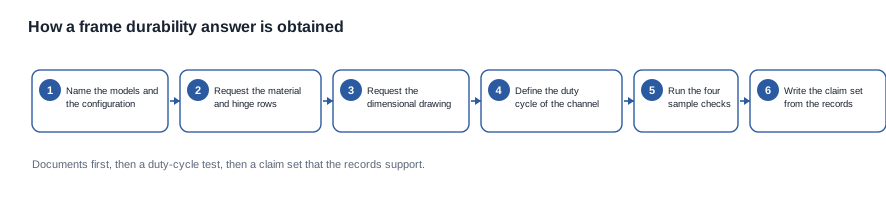
Two failure patterns are worth naming. The first is the answer that describes the product's design intent — "designed to be durable", "premium materials", "built to last" — without attaching a number, a drawing or a test condition to it. It is not false, and it is not usable. The second is the answer that is true of a different model in the same family, which is the more dangerous one because it arrives in the exact shape a sourcing file needs. The way to catch both is to require that every answer names the model string, and to compare the answers side by side rather than one at a time.
The same discipline applies to the evidence a buyer generates. A load check on one unit produces a record, not a rating, and the record is worth keeping precisely because it is specific: the model, the configuration, the load, the date, the result. Build the request schedule before the first order, and the sample checks before the second, and the structural question that no catalogue page answers gets closed with documents and records rather than with assurances.
The materials and construction side of this range is covered in frame materials for smart glasses, with the selection method in how to choose smart glasses frame materials and the bench checks in how to test smart glasses frame materials. The buyer-side file sits in smart glasses frame materials buying checklist and in why frame materials matter for smart glasses, and the question of what weight a product should carry is covered in what weight is acceptable for smart glasses.
Related reading
- The bench method that separates a good balance from a bad one — how to know if the weight is distributed well
- The dimensional half of a frame decision — how to find your size
- What a product weight should be for a shipping calculation — what weight is acceptable for smart glasses
- The selection method for frame construction — how to choose smart glasses frame materials
- The test procedures for frame construction — how to test smart glasses frame materials
- The buyer-side file for this range — smart glasses frame materials buying checklist
- The argument behind the frame decisions — why frame materials matter for smart glasses
- The reference page for construction and ergonomics — materials and ergonomics
Send the models you are shortlisting and the duty cycle of the channel, and we will tell you which structural rows exist to quote and which have to be requested in writing.


