

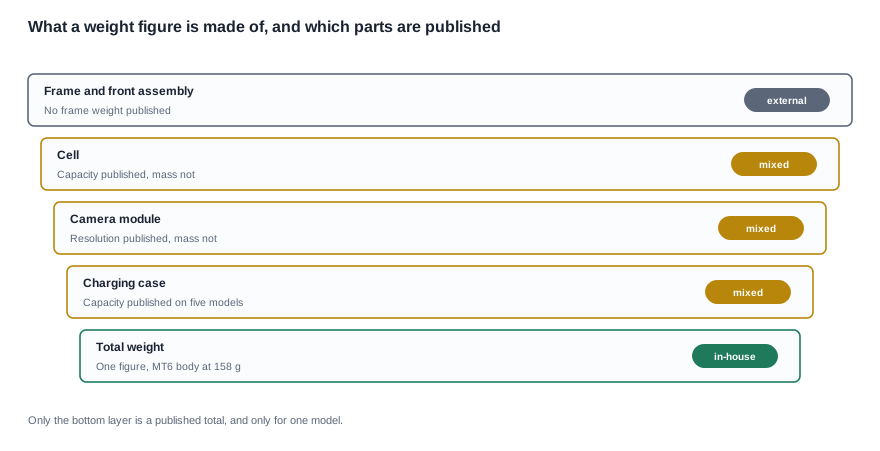
How do I know if the weight is distributed well? Not from the catalogue, and the reason is a single number. This range publishes exactly one weight: 158 g for the MT6 glasses body, including its 265 mAh battery and the camera and excluding the foldable charging case, whose own weight is not published. A total cannot describe a distribution. There is no bare frame weight for any of the twenty-eight entries, no case weight, no component mass, no centre of gravity and no balance point anywhere in the published material — so the question has to be answered on a physical unit with a repeatable method, and that method is worth more to a buyer than any published figure would have been.
The three-part answer holds. Published: one weight figure, on one model, covering the glasses body only. Not published: the case weight, the bare frame weight, the mass of the cell, the camera module, the electronics board or the hinges, the balance point, the tolerance on the balance point, and any distribution row of any kind. Ask the supplier: the component masses for a named configuration, the balance point measured from the front, and the tolerance within which it is held.
The cell capacity is often treated as a proxy for mass, and it is a useful proxy for exactly one component — but only an approximate one. The catalogue publishes cell capacities ranging from 40 mAh on the A05 and the A06 up to 290 mAh each for the CY05, the L1 Pro and the CY03, and the L2 Utral, and it publishes no cell chemistry, no rated voltage and no cell mass. Without those, a capacity cannot be converted into grams, so the proxy can order the products roughly and cannot tell a buyer anything about where the mass sits.
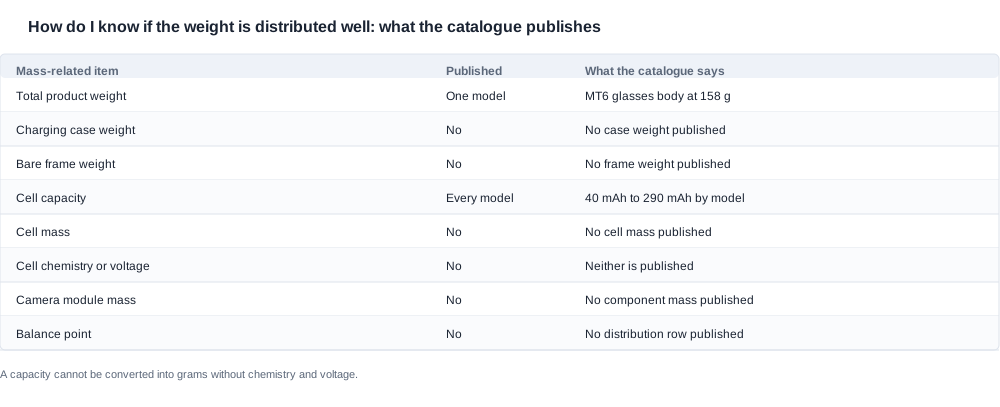
How do I know if the weight is distributed well: what one published figure can and cannot tell you
The single weight figure in the range
The 158 g belongs to the MT6 and to nothing else. Three things sit side by side on that row: portable, ultra-light, and 158 grams alongside a foldable charging case, with the case capacity of 1200 mAh set down separately from it. The correct reading is that the glasses body, with its battery and its camera, weighs 158 g, and that the foldable case is additional and unweighed. The MT6 is also the only model in the range with a folding charging case, so it is the only model in the range where a buyer has to add an accessory mass to the product mass and has nothing published to add.
For every other model there is no weight at all. That includes the camera models with the largest published cell capacities, the 290 mAh units; it includes the models whose feature rows describe an ergonomic design, the V06 and the S7; it includes the models with a detachable temple, the G07; and it includes the models whose published rows suggest a very different mass profile, the A05 and the A06 with 40 mAh cells, the bone-conduction entry with 200 mAh, and the AR entry with 100 mAh. A range-wide weight comparison is therefore not merely unavailable; the single figure that exists cannot be extended to any other row.
Why a total cannot describe a distribution
The arithmetic is simple and worth stating once, because it is the reason a buyer cannot work around the gap. A distribution is a ratio: how much of the total sits in front of the ear relative to how much sits behind it. To compute it a buyer needs at least two component masses and the distance between them, and the catalogue publishes neither. The one figure available — a total on one model — is exactly the quantity that a ratio cancels out.
What the published material does give is a set of structural facts that constrain the answer without determining it. The camera tier places a camera module and a cell in the front of the frame, which is the configuration most likely to load the temple lever; the published resolution classes split that tier into eight models at eight megapixel and three at thirteen, the larger of the three being the S7 and the L2 Utral, and the L1 Pro and a larger sensor is a reasonable expectation for more mass at the front even though no mass is published. The V06 and the S7 publish a detachable inner frame and an ergonomic design; the G07 carries an ultra-slim build with a temple that detaches; the V03 Pro publishes a flexible temple, which is a deliberate tolerance for a load applied at the front.
Every one of those is a hint rather than a number, and a hint is exactly what a buyer must not build a specification on.
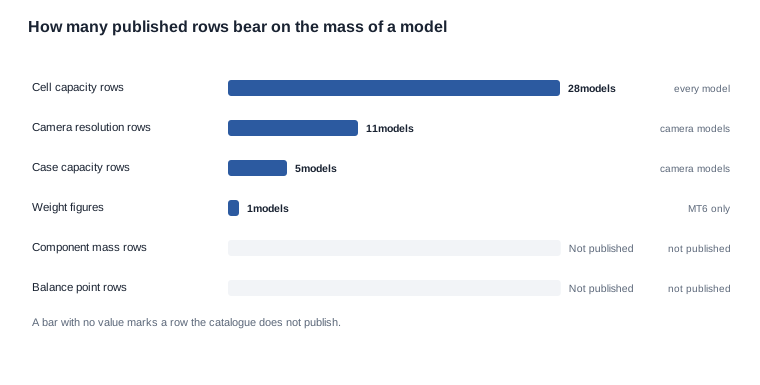

What a distribution actually decides
A balance question sounds cosmetic until a buyer traces what it touches in the commercial terms of the programme. Four consequences follow, and each one lands somewhere different in the cost stack.
The load carried by the temple
The temple is a cantilever, and the front of a camera model is where the electronics and the cell sit. A heavier front means a longer moment arm and a higher load at the hinge, and the temple failure that follows is the kind that arrives months later as a warranty claim rather than as a first-week return. The structural side of this is treated in does the temple strength matter, and the point that carries from there is that the catalogue publishes no material, no cycle rating and no dimension, so the balance measurement is often the only quantitative evidence a buyer will ever hold about the front-to-back mass of the product.
The stability of a front-mounted camera
For a camera product, balance is a functional property rather than a comfort one. A camera that moves relative to the head produces footage that moves, and a channel that sells the product for content creation discovers this through returns on the first production run rather than through a specification. A camera product with a stable front is also easier to mount, easier to align and easier to describe in a listing, because the alignment does not need to be repeated every time.
The behaviour of the product in its packaging
A front-heavy product settles, tips and leans in a carton in a way that changes the packing material needed and the presentation of the product when the box is opened. The MT6 is the only model in the range where this is immediately visible from published material, because it is the only model with a published weight and a published accessory capacity — 1200 mAh in a foldable case, unweighed. A buyer specifying the packaging for that configuration is specifying against a known total and an unknown distribution.
The first ten minutes and the return rate
The last consequence is the one a channel sees first. A product whose mass settles toward the front invites the customer to reposition it, repeatedly, and repositioning is the behaviour that precedes a return. This is the argument behind the what weight is acceptable for smart glasses question, and it is also the argument for treating a balance measurement as a quality-control record rather than as a preference.

A balance test that produces a record
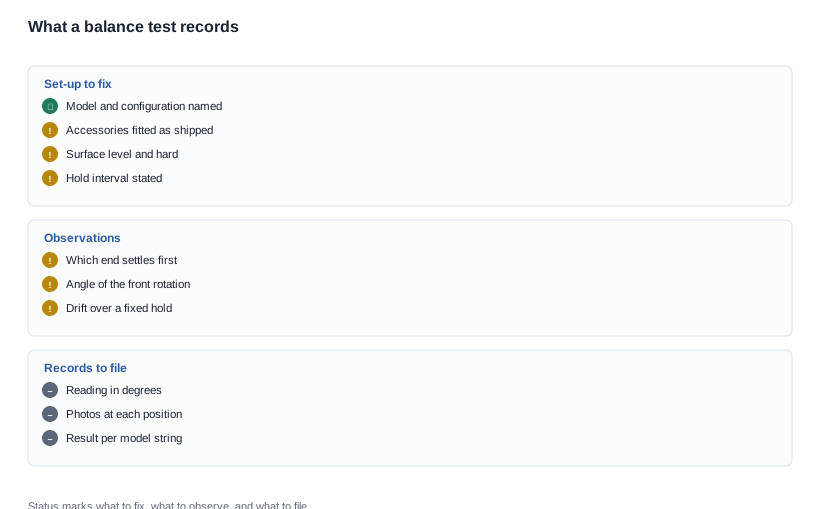
The value of a balance test is entirely in its repeatability. A method that produces an impression helps nobody, because there is nothing to compare and nothing to file. The three procedures below are deliberately simple, require no equipment beyond a flat surface and a stopwatch, and produce numbers that two suppliers' samples can be compared on.
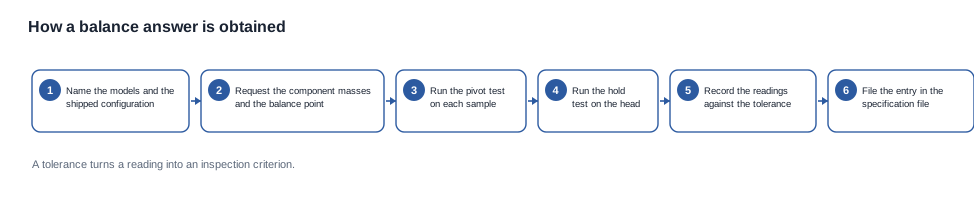
The pivot test
Place the unit on a level hard surface with the temples in their normal position and release it. Record which end settles first and the angle the front rotates down to. Then repeat with the charging case fitted where the model has one, because a case that sits behind the ear is a counterweight and a case that sits in front is not. The reading is not a pass or a fail; it is a number that can be compared against another unit of the same model and against another supplier's sample.
The hand-hold test
Hold the unit by the front only, without supporting the temples, for a fixed interval, and record how far the front rotates. This is the closest available approximation to the load the temple carries in use, and it is deliberately crude so that two people performing it will get comparable answers. Repeat it with the product resting in the position it takes on a head, because the point of the test is what happens when the support is at the temples rather than at the front.
The steady-state test on a head
For a camera model, put the unit on a head, keep the head still, and record the drift over a fixed interval. Drift is what a customer experiences as the product moving, and it is the observation that connects a balance reading to a return reason code. Where the camera tier is concerned, the drift reading and the pivot reading together describe the product better than either does alone.
What to record so two answers can be compared
The record has five fields: the model string, the configuration including any accessory fitted, the angle or drift reading, the conditions under which it was taken, and the date. A record without the configuration is not comparable, because a case or an accessory changes the answer, and the catalogue does not even publish which models ship with a case. A record without conditions is not repeatable.
Three configurations, not one
A balance reading is only meaningful against the configuration it was taken in, and in this range at least three configurations exist for some models. The first is the unit exactly as it ships. The second is the unit with its charging case fitted, which applies to the MT6 with its foldable 1200 mAh case and to the models that publish a case — 1400 mAh on each of the CY05 and the L1 Pro, and the CY03, two published figures on the MT5 and the KY06, and the L2 Utral, which show a case without a figure. The third is the unit with a removable part taken off or swapped: the G07 with its detachable temple, and the V06 and the S7 with their detachable inner frame.
The catalogue cannot tell a buyer which of these a customer ends up in, and it cannot even tell a buyer which case a given model ships with, because four camera models carry no case row at all. The specification entry for a balance figure therefore has to state the configuration, and a tolerance has to be stated for each configuration that will be sold. A tolerance quoted for the shipped configuration says nothing about the configuration with a 1200 mAh case fitted.
When two units of the same model read differently
Variance between units of the same model is the normal case rather than the exception, and it is the reason a tolerance is the output that matters. A single reading is evidence about one unit, however carefully it was taken. A set of readings across several units of the same model, taken with the same method, gives a spread, and the spread is what tells a buyer whether a supplier can hold the position in production.
This is also where the change-control request earns its place. A balance position depends on the cell, the camera module and the frame, and a substitution in any one of them moves it. The catalogue publishes cell capacities but no cell masses and no chemistry, so a buyer cannot predict the effect of a substitution; the supplier can. Asking for the balance specification to be re-confirmed after a component change is therefore a request about the notification route as much as about the figure.
Two units that read differently for another reason — a different accessory, a different configuration, a different measurement condition — are not a variance at all but a mismatched record, and the first task on receiving such a pair is to check that the two records describe the same thing.
The questions to put to a supplier about balance
The requests below are ordered so that the answer with the most value comes first, because the balance point is the single number that allows a buyer to check a shipment against a specification without repeating the test.
- The product weight, split. Published: one figure in the range, 158 g for the MT6 glasses body excluding the foldable case. Not published: every other product weight, the case weight, and the weight of the unit as it ships. Ask: the weight of the unit as it will be packed, with and without the case, for a named model and configuration.
- The component masses. Published: cell capacities on every model, and nothing else about mass. Not published: the mass of the cell, the camera module, the electronics board, the frame and the hinges. Ask: the component breakdown for a named model, so that a balance reading can be interpreted rather than merely recorded.
- The balance point. Published: nothing. Not published: the distance from the front of the frame to the balance point, or the equivalent front-to-rear mass split. Ask: the balance point measured from the front, with the method used.
- The tolerance. Published: nothing. Not published: the band within which the balance point is held between units and between production runs. Ask: the tolerance, because a tolerance is what turns a specification into an inspection criterion.
- The camera position and any anti-rotation provision. Published: the resolution class on eleven camera models, and no positional information. Not published: where the camera sits relative to the frame and whether anything prevents the front rotating. Ask: the position, and what prevents rotation.
-
- The removable parts. Published: a temple that comes away on the G07, an inner frame that comes away on the V06 and the S7, and a temple that bends on the V03 Pro. or replaced with a different one. Ask: the balance with each configuration, since a removable part is a second balance.
- The change-control position. Published: no firmware version, no update policy, and no component-change notice for any model. Not published: what happens to the balance specification when the cell, the camera module or the frame changes. Ask: the notice period and the re-confirmation obligation, because a cell substitution is invisible in a datasheet and decisive in a balance.
The first-article check
A balance specification earns its keep at the first-article stage, which is the point at which a production run is compared against the sample that was approved. If the balance point is in the specification file, the first article is checked against it alongside the other approved characteristics, and a unit outside the tolerance is caught before it becomes a production batch rather than after it becomes a complaint.
The same check applies at the point of change, for the reason given earlier: a substitution in the cell or the camera module moves the balance. A supplier's change-control route that does not trigger a re-check leaves the channel with a product that is nominally the same model and behaves differently, and no published row in the catalogue would reveal it.
Using the measurement after the samples arrive
The specification file entry
A balance measurement belongs in the specification file as a tolerance, not as an observation, because a specification file is what an inspector checks a shipment against. The entry has the model string, the configuration, the balance point with its method, the tolerance, and the date of the measurement the tolerance was derived from. A file entry without a tolerance is a note; with one, it is an inspection criterion.
That single change is worth more than the measurement itself, because it is what allows a channel to separate a production variance from a design characteristic. A batch that arrives outside the tolerance is a finding; a batch that arrives inside it needs no discussion, whatever the paperwork says.
The returns triage
The second use is in returns. A returns record that captures the model, the configuration and the stated reason will show, over a season, whether a particular configuration produces a disproportionate share of movement-related complaints. That is the finding that turns a balance reading into a negotiation, and it is also the finding that tells a channel whether the sizing guidance it publishes needs a note.
The commercial argument at the next price discussion
The third use is the commercial one. A channel that holds a specification file with a measured balance point, a component-mass breakdown and a returns history can discuss a specific configuration rather than a general impression, and it can ask for a change with a specific request attached. A channel that holds only published rows is discussing a product description, and a supplier is not obliged to change a product description.
The construction and geometry references for this range sit in materials and ergonomics. How a frame gets picked for a programme is covered in the selection method for frame construction, and the bench work is set out in the procedures used on the bench. A purchasing file for construction decisions sits in the buyer-side construction file, the reasoning behind those choices is in why construction decisions recur, and the shipping-side weight question is in AI camera glasses shipping weight.
Related reading
- The structural consequence of a front-heavy frame — does the temple strength matter
- The threshold a channel budgets against — what weight is acceptable for smart glasses
- The shipping consequence of the same figure — AI camera glasses shipping weight
- The geometry method the balance sits inside — how to find your size
- Construction selection for the same range — how to choose smart glasses frame materials
- The procedures carried out on the bench — how to test smart glasses frame materials
- The buyer file behind frame construction — smart glasses frame materials buying checklist
- Why construction decisions recur — why frame materials matter for smart glasses
- The ergonomics reference for the range — materials and ergonomics
Send the models you intend to stock and the configurations you will ship, and we will tell you which published rows bear on the mass and which have to come back as a measurement.


