

The G07 smart glasses can be screened against a buyer's brief, but they cannot be graded against it, and the difference matters more than it sounds. A grade needs a comparison set, a criterion and a threshold; the catalogue publishes two things that help a screen and nothing that would support a grade. It publishes a feature line — an ultra-slim note paired with a detachable temple — that is the only detachable part in the eight-model audio group. And it publishes an electrical set of rows that this model shares almost line for line with three siblings on cell arrangement and, on five of the electrical rows, with one of them entirely. Everything else a buyer would need to make a judgement call — weight, acoustic detail, protection marking, commercial terms — is absent from the page.
So the useful output of a selection pass here is not a verdict but a set of conditions: which briefs the published rows can carry, which briefs they cannot touch at all, and which ones have to be closed by a sample or a written answer before the model goes on a shortlist. That is what follows. The range guide to picking an audio model sets the wider context; this page stays on one model and one question.
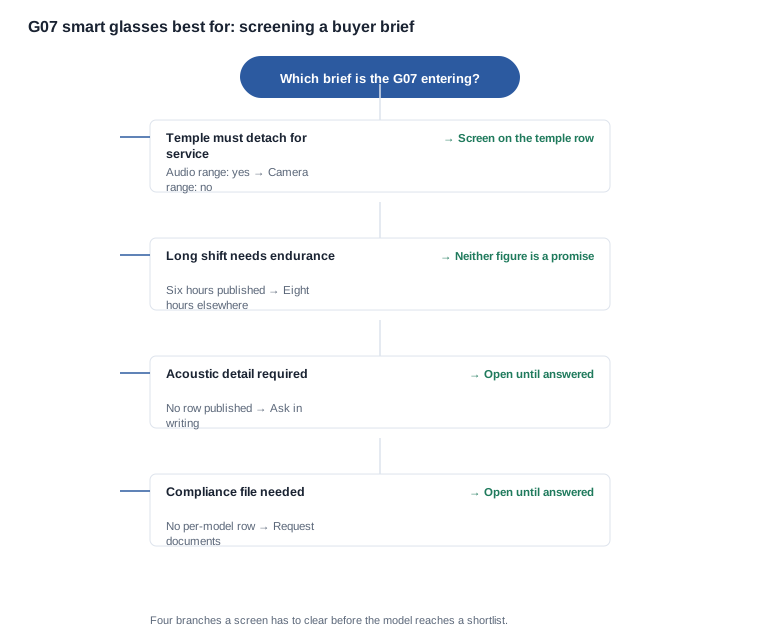
G07 smart glasses best for: three briefs this model fits and one it does not
The screen starts by turning a brief into constraints, because a brief written as a preference cannot be screened at all. "We want something light and modern" cannot be checked against a catalogue page. "The temple must separate from the frame for service reasons" can. Everything below is written in the second form.
Three briefs the published rows can carry
The first brief is the one the feature line was written for: a channel whose service model depends on the temple separating from the frame. No audio model in the catalogue publishes that, so a brief written this way has exactly one candidate in the group and the screen ends quickly. The second brief is a slim-profile brief, where the ultra-slim note on the same line gives a published answer to a question that most models leave open. The third brief is the ordinary audio brief — a channel that needs Bluetooth pairing, a magnetic charging interface and a stated endurance, and that has no requirement the published rows would contradict.
Those three briefs have one thing in common: each of them can be expressed as something the catalogue actually prints. That is the test the G07 passes, and it passes it on the strength of seven rows rather than on any claim about quality.
The brief that finds no row
The fourth brief is the one that cannot be screened at all from the page: a requirement for acoustic specification. The G07's catalogue page publishes no acoustic descriptor. There is no surround-sound line, no driver figure, no amplification value, no frequency response and no leakage number, because the model's only feature line concerns the temple rather than the sound.
That absence is easy to misread in two directions. It is not evidence that the model performs poorly — the catalogue is silent, not negative. And it is not a detail that a different page can fill in, because no audio model in the catalogue publishes a full acoustic set for a buyer to borrow. A brief that needs a documented acoustic response therefore cannot be closed by any reading of the range, and has to go to the supplier as a written question or to a measured sample. The G07 certification status page handles the parallel question of documents that the catalogue does not print, and the limitations of this model sets out which gaps are facts and which are missing rows.
Writing the screen into a shortlist
A screen is only useful if it produces a written record, because the next person to touch the shortlist will not know which conditions were checked and which were assumed. The record has three columns: the constraint as the buyer stated it, the published row that supports or fails it, and the gap that remains open. Stating the criteria in advance is what makes the checklist runnable by somebody who did not attend the screen in the first place. The third column is the one that gets dropped under commercial pressure, and it is the one that determines whether the model can be re-screened later without starting again.
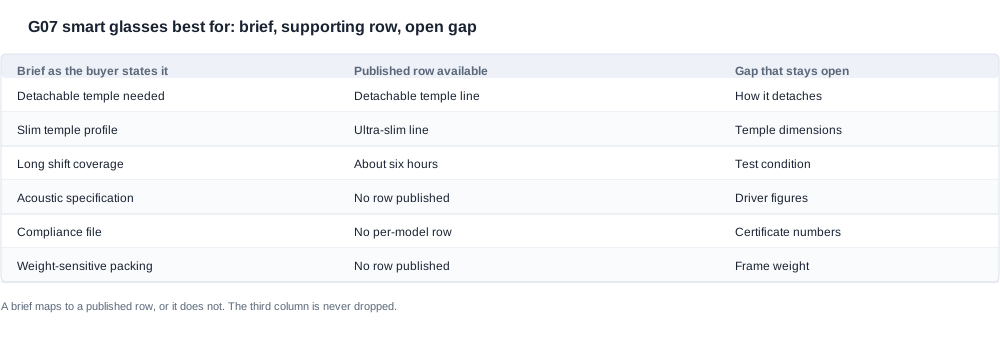
Writing a brief that can survive the screen
The transformation from preference to constraint is not cosmetic, and it is worth showing the difference in full, because a buyer who skips it ends up with a screen that looks like it worked.
A preference reads: we want something that looks premium and feels light. A constraint reads: the product must present a slim temple profile, and the catalogue must publish a line that supports it. The first version cannot be checked against anything, cannot be falsified, and cannot be recorded as satisfied or unsatisfied. The second version can be answered on the day it is asked, and it can be answered no. That is the whole value of the work, because a brief that can only be answered yes was never a screen at all.
Three habits make the difference in practice. Replace adjectives with properties: not light, but a published weight, and since this model publishes none, the constraint becomes a request. Replace preferences with exclusions: not audio glasses, but anything whose charging interface is not magnetic. And separate the constraint from the hoped-for outcome: a channel may hope the model is popular with its customers, but popularity is not a constraint, and putting it into the brief only dilutes the parts that can be checked.
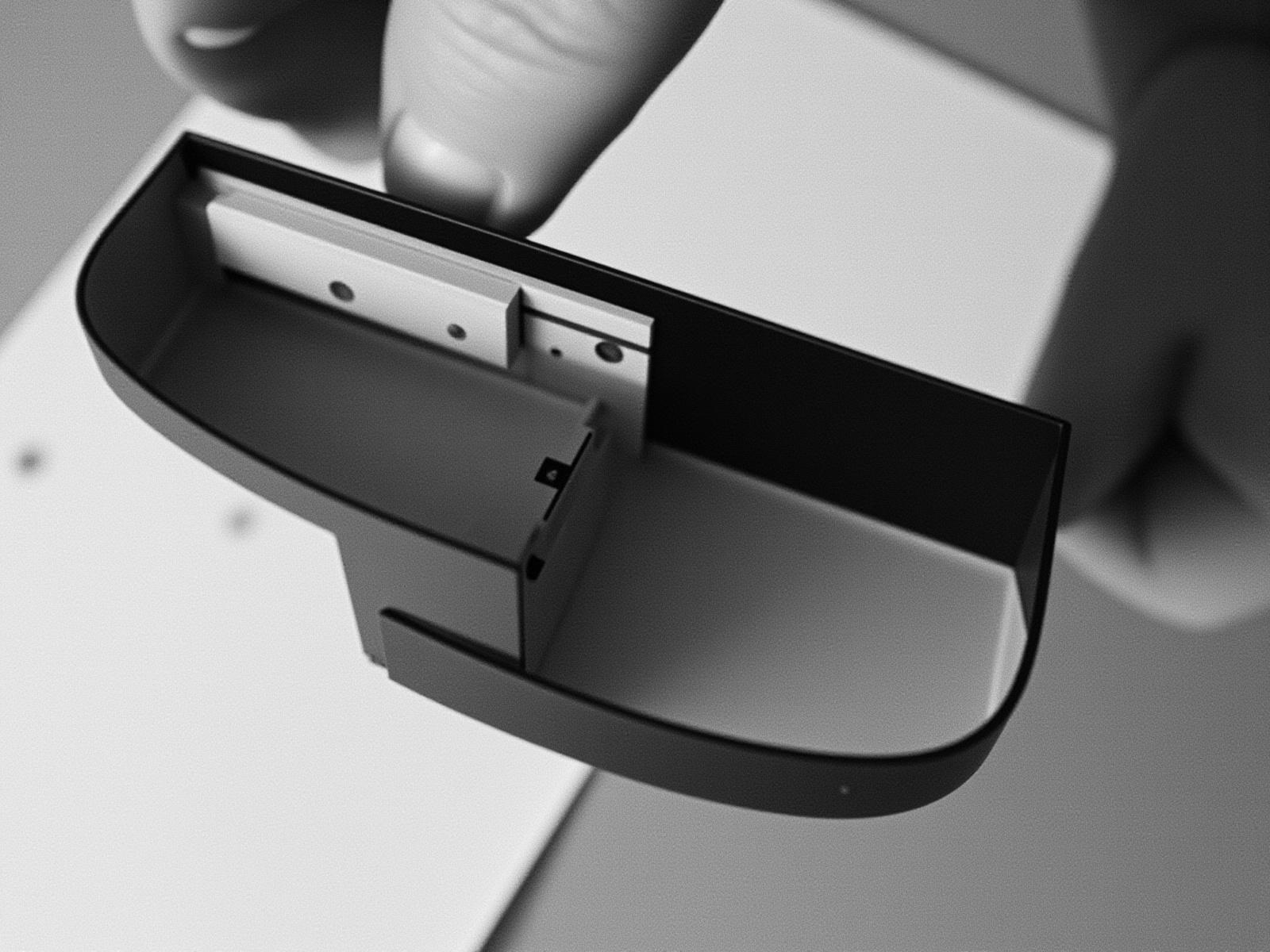
The detachable temple that only one audio model publishes
The detachable temple is the G07's only structural differentiator within the audio group, and it is also the row most often over-read. Getting it right requires holding three things at once: what the catalogue line says, what it does not say, and what the same document does elsewhere.
What the catalogue line actually says
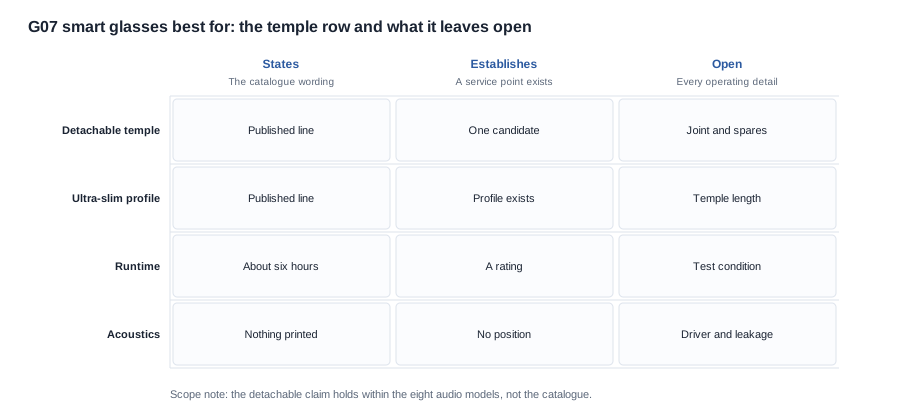
The G07's page carries one feature line and no others. It reads as an ultra-slim note and a detachable temple. There is no second line, no sub-variant, no colour list, no size list and no accessory list attached to it. The line is a descriptor, and a descriptor is a statement that a characteristic is present — not a specification of how it behaves, how it is secured, how it is replaced or what it weighs.
For a selection pass the useful reading is narrow and firm: among the audio models, one publishes a detachable part. That is enough to open a brief about serviceability, and it is not enough to answer a question about how serviceability would work.
The catalogue's other detachable parts, and why scope matters
Two camera models also publish a detachable element — the V06 and the S7 carry a detachable inner frame. Those parts are a different object from a temple and belong to a different class of product, and the honest way to write the G07's claim is with its scope attached: within the audio models, this is the only detachable temple on the page. A sentence that calls it the only detachable part in the whole catalogue is a category error, and a sentence that quietly drops the audio scope is the same error in different words. The commonest pitfall is the scope-free sentence, and it survives review precisely because the rows around it are all correct.
Scope also protects against the reverse mistake. Because the V06 and the S7 publish a detachable inner frame, a reader who has seen those pages may assume the G07's detachable temple is the same mechanism applied to a different body. Nothing in the catalogue supports that transfer, and the two claims should be kept apart in any comparison document.
Which briefs a detachable temple opens — and which it does not
A detachable temple opens the brief where the temple is a service point: an in-house repair channel, a high-churn use environment, a channel that stocks spares against damage rather than against warranty claims. It does not open the brief where the consumer replaces the whole frame, and it does not reduce the unit cost of a shipped product on its own — the catalogue publishes no weight, no material and no pricing for the part.
The disciplined way to use the row in a selection screen is to convert it into a question the supplier can answer: what the joint is, how a replacement temple is supplied, whether a spare can be shipped independently, and what documentation accompanies a spare. Those answers are what to ask for, and they are what turn a descriptor into a service proposition. A channel would need the same answers for any other detachable-part model.

Where the G07 and the YK12 cannot be separated by a specification table
A specification table is the tool most buyers reach for first, and it is the tool that produces the most confidently wrong shortlist entries in this category. It works by reading across rows and finding where a cell changes. For the G07 and the YK12, no electrical cell changes at all.
The rows that are identical
Set the two models side by side and every electrical row carries the same value: a V5.4 radio, the same 55 mAh × 2 cells, magnetic charging, a two-hour charging ceiling, and roughly six hours of rated use. Five rows, five matches. Any table built on those rows produces two identical entries, and a buyer sorting that table by rank sees a tie it cannot break.
This is also the point at which the range's runtime claim has to be handled in both directions. The G07 is one of two models that publish about six hours on this cell arrangement; the other is the YK12. Within the cell group of four, the other two — the LC-105-1 and the LC-105-2 — publish roughly eight hours. A table that merges the four into a single endurance column destroys exactly the distinction a buyer is trying to make, and the trade-off it hides is a false one, and the battery life analysis for this model sets out why that figure needs a stated condition before it is quoted anywhere.
The one differentiator, and what it is not
The G07's feature line and the YK12's feature line are the only points of difference, and they point in opposite directions. The G07's line names a detachable temple and an ultra-slim profile. The YK12's line names a surround-sound descriptor and a slim temple. Neither line is more capable than the other; they serve different briefs, and a table that forces them into a single ranked column has to discard one of them.
The second discipline is attribution. The surround-sound descriptor belongs to the YK12's page, and it must not migrate to the G07's product sheet simply because the two models share every electrical row and sit beside each other in the same cell group. That error is easy to make and hard to catch, because the surrounding numbers on the copied sheet all check out.
Separating them without a runtime claim
The practical separation method is to screen on the brief rather than on the table. A channel that needs a documented acoustic characteristic screens the YK12's line against its brief. A channel that needs a serviceable temple screens the G07's line. A channel that needs neither cannot separate the two from the catalogue at all, and should not pretend to.
The comparison against the D12 follows the same method in a different direction: that model's electrical rows are a different set again — a single 100 mAh cell, Type-C charging and roughly seven hours — so a brief built around Type-C connectivity already excludes both the G07 and the YK12 without any endurance argument. The G07 against the D12 works through that screening in detail.
The fit test that a paper specification cannot settle
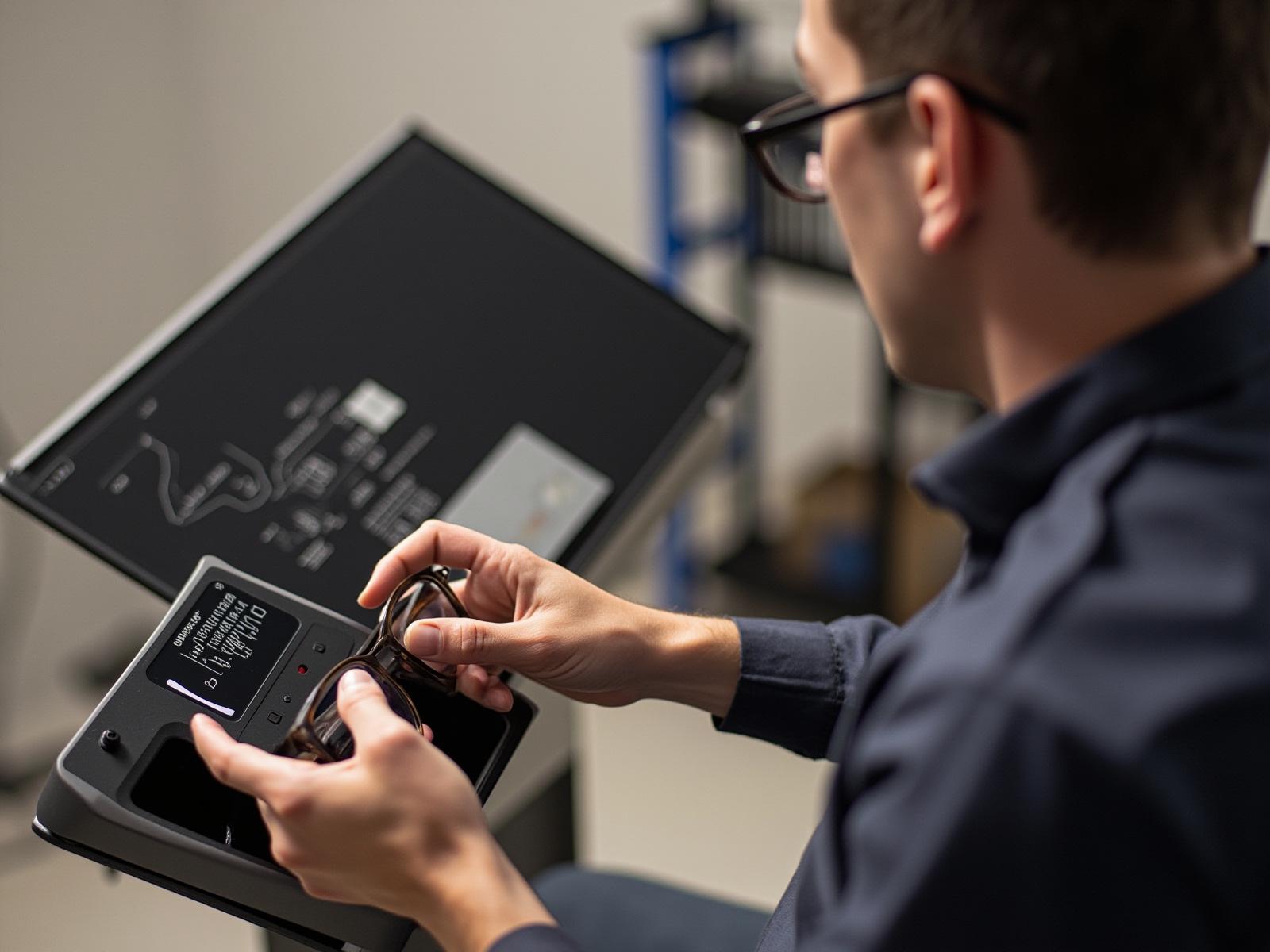
Some of a brief cannot be closed by any published row, and the honest thing to do with those parts is to say which instrument closes them and how to evaluate the result. For this model that instrument is the sample, and the question it must answer is about geometry and about the temple joint.
What only the sample can answer
Four things need a physical unit. The first is whether the temple joint releases and re-seats without a tool and without ambiguity, and how many discrete attempts it takes — a descriptor gives no basis for any answer. The second is what happens to the electrical path when the temple is detached: whether the unit continues to operate, which functions remain available, and how the state is indicated. The catalogue publishes no indicator-light row for this model, and no control-surface row of any kind, so there is nothing to predict against.
The third is the geometry: how the frame sits, whether the temple profile stays workable over a long afternoon, and whether the front of the frame clears the nose and the temple clears the ear over a full working day. The catalogue publishes no temple length, no lens dimension and no weight for this model, so nothing in the document can be used to short-circuit this test. The fourth is acoustic behaviour in use — including how much sound leaks when the temple is seated — which no page in the catalogue reports for any audio model.
The sample protocol that produces usable answers
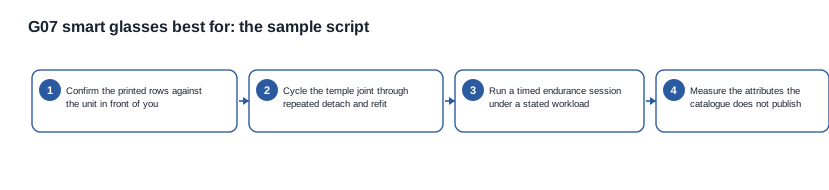
A sample session should be scripted rather than exploratory, because an exploratory session produces impressions and a procurement file needs observations. Four steps cover most of it: confirm the ten-row specification print against the physical unit, including the two cells, the magnetic interface and the radio version; run the temple joint through repeated detach-and-reseat cycles and record what fails and how; run a timed endurance session under a stated workload and log the observed result against the published figure; and record the physical attributes the catalogue does not publish, with measurements rather than adjectives.
The fourth step deserves emphasis because it fills gaps that would otherwise be filled by assumption. A frame weight taken from the sample is a measurement with a method attached, and it can be put in a spec sheet. A frame weight guessed from the range average is not, and it will eventually be contradicted by a competitor's datasheet.
What this page deliberately does not do
Two things are missing here on purpose, and their absence should be read as a statement rather than as an oversight.
The first is a ranking. This page does not place the G07 against the other audio models, because a ranking requires a criterion the catalogue does not publish — cost is the usual one, and we publish none for any model, nor any of the commercial terms that decide a landed figure. A ranking built on published rows alone would have to rank on the rows themselves, and that produces a table of ties rather than an ordering. A table of ties is not a decision aid.
The second is a scenario verdict. The framing here is deliberately written as a screen rather than a recommendation, and that is a deliberate limitation of what the documentation supports. We do not publish a price, an order minimum or a delivery window for this model or for any other in the range, and we do not publish an acoustic descriptor, a weight or a protection marking, so the honest output of a selection pass on this model is a set of conditions and a list of open questions. A reader who needs a single recommendation should treat the open list as the work still outstanding and close it before committing.
Deciding on G07 smart glasses without a price to lean on
Most selection work for a product like this ends in a commercial judgement, and it is the part of the process where documentation is weakest. The catalogue publishes no unit price, no price tier, no order minimum, no lead time, no warranty period and no commercial terms for this model or for any other in the range. That absence changes how a decision has to be recorded, but it does not make the decision impossible. The due diligence has to be done on the published rows instead of on a comparison, and the risk management has to be written down rather than assumed.
Three outcomes of the screen
The screen produces one of three states, and each needs a different next action. The criteria that decide between them are set out below. The first state is that every constraint in the brief maps to a published row; the G07 can then go on the shortlist with the open rows listed as questions for the supplier. The second state is that one constraint maps to no row at all — acoustic detail is the usual example — and the brief either becomes conditional on a written answer or moves to a model whose page does publish something on it. The third state is that the brief requires a property the catalogue actively contradicts, which for this model means either a Type-C charging interface or an eight-hour rating on the same cell arrangement; neither is available here, and the screen ends.
The document set that completes the decision
Whatever the state, the decision file for G07 smart glasses needs five documents or records, and all five can be requested in one message. The published rows themselves, so the screen rests on the source rather than on a summary of it. A written answer to the acoustic question, whatever its length. A supplier statement of the endurance test conditions, so that the six-hour figure can be published with its condition stated alongside it. A sample inspection record covering the temple joint and the physical attributes. And a quotation that states the commercial terms explicitly rather than by reference, because a landed cost assembled from assumptions is not a landed cost, and a warranty term read off a sample is not an agreement. A quality control clause that refers back to the catalogue rows instead of restating them carries the same weakness.
The published specification rows for the G07 are the first of those five and the one most often left out of the file after the screen is done. On the evidence available, G07 smart glasses are a screenable model whose structural row is distinctive within its group and whose specification set is otherwise ordinary — and a buyer who records the conditions of the screen, rather than a conclusion drawn from it, is holding a file that can be defended long after the people who wrote it have moved on.
Further reading
- The endurance row behind this model — six hours, and the condition behind it
- Document position for the G07 — what has to be requested in writing
- Which rows are missing — published facts separated from silences
- The seven published rows — the baseline for any screen
- Screening the G07 against the D12 — a comparison by published row


