

The G07 and the D12 share a radio version, a charge-time ceiling and an open-ear architecture, then diverge on the one thing a channel can actually sell. The G07 publishes 55mAh*2 in twin cells, charges magnetically and carries a published ultra-slim detachable temple. The D12 publishes a single 100 mAh cell, charges over a Type-C port, and publishes no feature line at all — it is one of five of the eight audio models in our catalogue that publish no feature row, alongside the K01, the K02 and the LC-105 pair.
That difference decides which channel each model reaches. The G07 supports a serviceability claim, because a detachable temple is the only published row in the pair that changes what happens after a unit is damaged. The D12 supports a clean-page claim, because a model with no published descriptor leaves a buyer's own branding and copy in sole possession of the product page. Screening the two on this basis comes before any specification table, and it is a screening method rather than a price recommendation — we do not publish unit prices, and the tier decision stays yours.
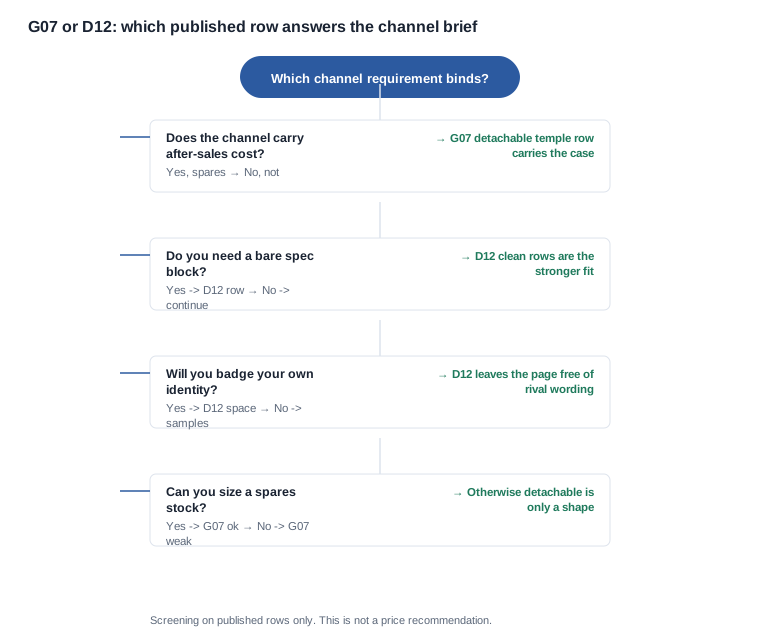
G07 against D12: start from the requirement that removes a model
The single question that eliminates one of them
Ask a channel what happens when a unit comes back damaged. If the answer is that the frame is scrapped and the channel absorbs the cost, then the detachable temple is the only published row in this pair that changes the outcome, and the D12 has nothing to offer on that point at all. If the answer is that damage is rare and immaterial, the G07's one distinguishing row stops being a deciding factor, and the comparison becomes a question of parcel architecture rather than service.
This is the correct order of operations because it is the only question in the pair that can eliminate a model outright. Every other row — the cell configuration, the radio version, the charge-time ceiling — is either identical between the two or too weak to carry a decision.
The D12 case: a channel that needs the page to say nothing about us
The D12's distinctive property is an absence, and absences are easy to overlook when a buyer is scanning a specification table for something to write. The D12 publishes no feature line. That means there is no acoustic descriptor to substantiate, no structural claim to defend, and no rival wording occupying the top of a product page that a private-label buyer would rather fill with its own.
For a channel that badges the frame in its own livery and writes its own copy, that emptiness is an advantage rather than a gap. It also means the D12 cannot be positioned on anything beyond its electrical rows — one cell, a Type-C port, a stated endurance figure, a radio version, a charge-time ceiling — and those are rows a competitor's model can reproduce.
The G07 case: a channel that carries the returns cost
The G07's detachable temple is a hardware decision with an after-sales consequence. When the arm can be separated and replaced, a damaged unit stops being a total loss, and a distributor handling returns can hold spares instead of writing the product off. That is a real change to the cost per unit that a channel can defend, and it is the reason a G07 can carry a higher tier without the difference resting on an unmeasured adjective.
The weakness is the same one it has everywhere else in this comparison: the supporting numbers do not exist in our documentation. The joint's cycle count, the connector design, the replacement route, the replacement price — none of them are published. A detachable temple without a replacement route is a design feature with a service problem attached, so the G07 case only completes when the buyer is prepared to stock parts.
The two cases are not symmetrical, and that is the point
A buyer who cannot articulate which of these two situations they are in has not finished the brief yet. The G07 answers a question about after-sales; the D12 answers a question about positioning. A channel that needs both at once — a private-label brand selling into a channel with a high damage rate — should recognise that it is describing two products, and price them as two.

What a published feature line does to a channel proposition
Feature lines across the eight audio models, and why the count matters
Across the audio range the feature rows are unevenly distributed, and the unevenness is the commercially useful part of the picture.
| Model | Published feature lines | What they permit a listing to claim |
|---|---|---|
| G07 | Slim and detachable temple | A serviceability and shape claim |
| D11 | Surround sound, long endurance | Two descriptors, neither quantified |
| YK12 | Surround sound, slim temple | A sound label and a shape label |
| D12 | None published | Nothing beyond the electrical rows |
| K01 | None published | Nothing beyond the electrical rows |
| K02 | None published | Nothing beyond the electrical rows |
| LC-105-1 | None published | Nothing beyond the electrical rows |
| LC-105-2 | None published | Nothing beyond the electrical rows |
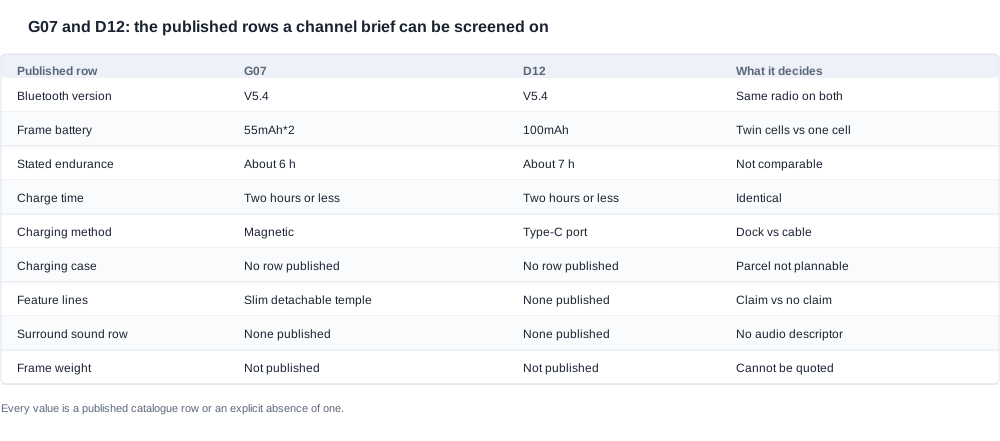
Five of the eight audio models publish no feature line at all. That is not a defect in those five — it is the shape of the range. It means a buyer cannot choose on features inside this group, because five of them are equally featureless. The only way the G07 and the D12 can be separated on a claim is if the buyer is willing to build the claim on what the catalogue does publish: a detachable temple in one case, and an empty descriptor in the other.
An absent row is a fact, and it constrains the copy
The absence of a feature row is a published fact in the same way a present one is. It has three consequences for a listing.
First, it removes a line of copy. A product page for the D12 cannot describe its sound, because no acoustic row exists to describe — the D12 best-for analysis covers the surrounding range context, and the published D11 specification list shows what a model with descriptors looks like next to one without.
Second, it removes a support burden. A channel that publishes a claim it cannot substantiate faces a different exposure from a channel that publishes no claim at all, and in most markets the second exposure is the smaller one.
Third, and this is the point a buyer should notice, it changes who wins the comparison. When two models are both featureless, the buyer wins on cost, on lead time, on packaging and on terms. When one model has a row the other lacks, the buyer wins on what that row is worth to the channel.
Why a channel copy written from the D12 risks over-claiming
The temptation with a model that publishes nothing beyond its electrical rows is to compensate in the copy. The usual result is a page that says the frames are comfortable, that they suit every face, that they deliver clear sound and long hours — none of which a document supports, and all of which a competitor's page can say identically.
The discipline that avoids this is simple and it is the reason this page exists: write the D12 on the rows it has. One 100 mAh cell. A Type-C port. A stated endurance figure. A stated charge-time ceiling. A radio version. That is a complete, accurate, defensible product block, and it is the block a procurement file should contain as well.
Where the D12's clean rows pay off, and where they do not
Scenario: a private-label frame for a retail shelf
Here the D12's lack of published descriptors is an advantage, and the reasoning is commercial rather than technical. A retailer with its own livery, its own naming and its own product photography needs a frame that does not arrive carrying another party's wording. The D12 gives it that. The buyer can then compete on its own brand assets, its own packaging, its own price architecture and its own distribution terms.
The screen for this scenario is whether the channel's copy can be written from electrical rows alone. If the proposition is brand, shelf position and price, it can. If the proposition requires a demonstrable feature in a demonstration video, it cannot.
Scenario: a field-service fleet with a shared charging point
This scenario favours the Type-C port. A fleet that already issues USB-C equipment to technicians does not need a dock to be carried, charged or lost, and a cable is cheaper to replace than a proprietary charging base. The D12's electrical architecture serves that fleet directly.
The limit here is the endurance row. The D12 states about seven hours with no test condition published, and that figure cannot be converted into a shift pattern without the condition. The battery comparison method covers the three questions that turn an endurance figure into a duty-cycle calculation.
Scenario: a promotion-led channel with heavy transit damage
Here the G07's detachable temple is the row that matters, and the question is whether the channel will stock the spares. A promotion channel shipping high volumes through sorting networks and courier bags will see damaged temples, and a detachable arm turns a scrapped unit into a replaced arm — provided the arm can be ordered separately, stocked, and fitted without a return to the supplier.
The buyer who cannot answer that question has not yet bought the advantage the G07 offers. It is the single most important follow-up in this comparison.
The scenario that does not work for either model
A buyer whose proposition is sound quality cannot use either model as the basis of it. The D12 publishes no acoustic descriptor at all, and the G07 publishes none either — its published line is about temple geometry, not audio. Any channel planning to lead with sound has to establish the acoustic specification, the microphone pickup and the call behaviour as separate evidence, and neither model in this pair supplies them from the catalogue.
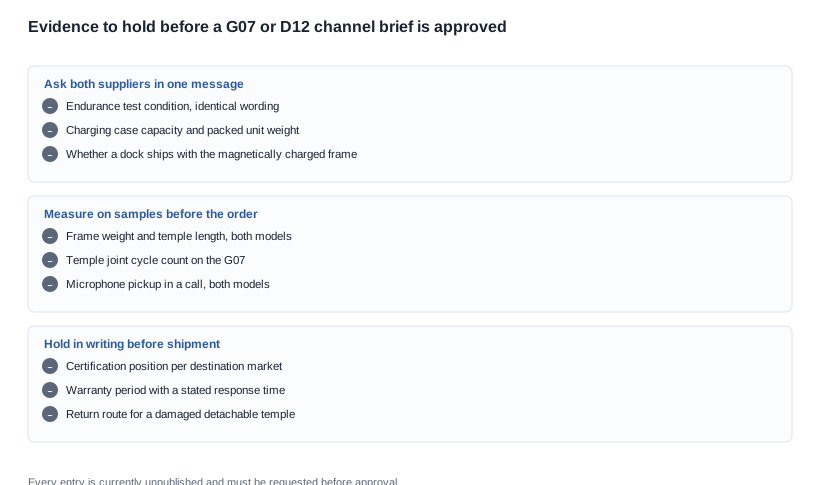

Checking the evidence before a channel brief is approved
One question set, sent once, to both
The most common way a comparison like this is wasted is by asking the two suppliers in different words and then comparing answers that were never comparable. Send one message, ask both models the same items, and keep the wording identical.
The items that matter for this pair are: the endurance test condition, whether the measured sample was the production configuration, the charging case capacity and the packed unit weight, whether a dock ships in the carton with the magnetically charged frame, the acoustic and microphone specification, the frame weight and dimensions, and the certification position per destination market. Every one of these is currently unpublished for both models, and every one changes the outcome.
The three measurements that have to happen on samples
Paper cannot settle this comparison, because the rows that decide it are the rows the catalogue does not carry.
Weigh both models. No frame weight is published for either. A buyer who commits to either model on the basis of the published electrical rows is committing to a product whose weight they have not seen, and weight is the variable most correlated with returns in this category.
Cycle the G07 temple joint. Open and close it a stated number of times, then confirm the connector is undamaged and that a replacement arm can actually be ordered. The cycle count is the number that turns the detachable temple from a shape into a serviceable part.
Make a call on both. Microphone pickup and call behaviour decide whether the channel can be used for anything beyond audio playback, and neither model publishes a microphone row. A ten-minute call test on each sample, in the acoustic environment the channel will actually operate in, costs less than one returned unit.
The written evidence to hold before a first order
Four documents should exist before the first order is placed rather than before the first shipment is delayed: the endurance condition per model, the certification position per destination market, the warranty period with a stated response time, and the return route for a damaged detachable temple if the G07 is in scope.
The last one is the document most often left out, because it only applies to one model and only in one scenario. That is exactly the document whose absence turns a service advantage into a channel cost.
Five ways this comparison produces the wrong model
The D12 was bought for its spec block and then over-written. Symptom: the product page claims sound quality, comfort or all-day use, and none of it can be evidenced when a retailer or a marketplace reviewer asks. Root cause: an empty descriptor list was treated as an invitation rather than a constraint. Prevention: write the listing from the electrical rows, and treat every additional line as a claim that needs a document.
The G07 was bought for its temple and the temple was never stocked. Symptom: the channel's repair advantage quietly disappears, because a damaged unit still has to go back. Root cause: the detachable row was read as a complete service proposition. Prevention: confirm the replacement route and price before the first order, and hold a stock of arms.
The endurance figure was used to justify a fleet duty cycle. Symptom: technicians run out of power mid-task and the channel blames the product. Root cause: an unconditioned figure was converted into a shift plan. Prevention: obtain the test condition, then compute the duty cycle from it, and only then size the shift.
The models were swapped mid-programme. Symptom: artwork, packaging and listing copy are built for one model and the order lands with the other. Root cause: two models with near-identical electrical rows were treated as interchangeable, which they are not. Prevention: decide the channel requirement first, as described above, and record the reason against the chosen model.
The certification position was assumed for both. Symptom: a market-access file opens late and the shipment waits behind it. Root cause: a company-level export certification page was read as a per-model guarantee. Prevention: request per-model evidence for the destinations in scope, and treat the catalogue's silence as an open item with an owner.
Negotiating the G07 or D12 without a published price
Because we do not publish unit prices, the useful output here is the structure of the negotiation rather than the number. Two models, two different commercial objects.
For the D12, the negotiation is about the parcel and the terms. One cell and a Type-C port mean the in-box item is a cable, so the questions are the minimum order quantity on the accessory set, the packaging specification, the split of a first order across delivery dates, the payment nodes tied to inspection, the warranty period with a stated response, and the terms of a pilot order. A buyer who treats the D12 as a simple, clean, low-complexity supply is making the most of what it actually is.
For the G07, the negotiation has a second front: the spares. Replacement temple pricing, the supplier's stocking commitment on arms, the lead time on an arm, and whether a spare is supplied with a repaired unit. These are the terms that determine whether the price gap between the two models is justified, and they are the terms most often left undefined because they look like after-sales rather than like commercial terms.
Neither model can be negotiated on certification. Certification cost and its timeline follow the testing body and the process, not the order size. Ask which cost you are being quoted — tooling or certification — because the two are frequently bundled into a single line that hides which one carries the volume.
Four items to put in the agreement
- The published rows of the exact configuration ordered, referenced to the catalogue page rather than restated in prose.
- The endurance figure and its test condition, or the explicit statement that no condition is agreed.
- The charging method, the in-box accessory set and the packed unit weight to be confirmed at inspection.
- For the G07: the temple arrangement — detachability, cycle count, replacement route and replacement price. For the D12: the absence of an acoustic descriptor, stated once, so that no listing is expected to make one.
What must be left out
Any weight figure that was not measured, any acoustic or microphone claim that was not evidenced, any endurance claim without its condition, any certification number, and any description of the D12's sound. Our catalogue contains no acoustic row for either model in this pair, and that absence is not a detail to be papered over in copy.
Where CYNRIN stands on the G07 and D12
The G07 and the D12 answer different channel questions, and the useful output of a comparison between them is a decision about which question a buyer is actually answering — serviceability or a clean product page — rather than a specification ranking. We will not present either endurance figure as a working day, we will not invent an acoustic descriptor for a model that publishes none, and we will not quote a weight, a case capacity or a certificate number that our documentation does not contain.
What we will do is tell you which published row each model can carry into a channel brief and which rows remain open for each of them. The published G07 specification list and the D12 versus D11 analysis cover the models involved, and the audio range charging options piece sets out what a charging method does to a delivered unit.
Five questions to close before you shortlist either model
- The endurance test condition for each, asked in identical words.
- The charging case capacity and the packed unit weight for each.
- Frame weight and dimensions for both, measured on samples.
- For the G07: the detachable mechanism, its cycle count and the replacement route.
- The certification position for each model in each destination market.
Related reading
- The published rows for the G07 — G07 smart glasses specifications and features
- The published rows for the D12 — D12 smart glasses specifications and features
- The accessory pricing logic — Bluetooth audio glasses charging options
- Choosing across the range — Bluetooth audio glasses which model to pick
Send us the channel, the damage rate you expect and the markets, and we will tell you which of the two published rows actually fits.


