

The G07's compliance position is short, and it is routinely misread in both directions. Here is the position as the documentation actually stands. The catalogue carries an export certification page whose content is images rather than text, and the catalogue text contains no reference to CE, FCC or RoHS. There is no per-model certification row anywhere in the document, so nothing in it attaches a conformity claim to the G07 specifically. The G07 sits in the Bluetooth audio glasses category of eight models, and nothing we publish attaches a conformity claim to any of them, so there is no certificate number for us to quote. That is why the request below is a request rather than a lookup. No test report is available for any of the twenty-eight models in the range either.
None of that is a barrier to ordering the G07, and none of it is a reason to order without asking. It is, precisely, the reason to write a request. A buyer who can state in one line what is missing and what would close it has a document; a buyer who can only state that certification is "being handled" has nothing. This page sets out what to ask for, what each item would prove, and how to read the answers when they arrive.
On the G07 smart glasses, our position is that we publish no certificate number, no test report and no per-model conformity row, and we do not imply otherwise in any document we issue.
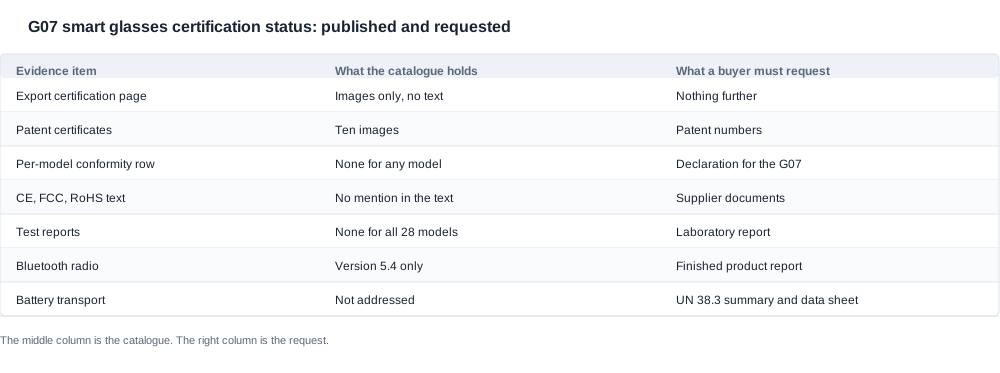
G07 smart glasses certification status: what the catalogue does and does not publish
Three separate bodies of documentation bear on this question, and they disagree with one another often enough that a buyer has to know which is which before asking anything.
The export certification page and what is actually on it
The catalogue carries one page headed as an export certification section. It is a picture page: the extractable text from that page is its heading and its page number, and everything else is rendered as images. Ten certificate images appear on it, and they split into two kinds — eight appearance-design patents and two utility-model patents.
That page is the reason many readers assume the range is certified. It sits on a page headed in a way that invites exactly that reading, and its images are the visual language of certification. What it actually contains is a set of patent certificates, which are a different kind of instrument, and the distinction is the subject of the next section.
The absence of any per-model certification row
Read through the rest of the catalogue, and the position is uniform across all twenty-eight models: there is no conformity row on any product page. The rows a model publishes are its specification rows and, for some models, a feature line. Nothing in the structure of the document allows a buyer to answer "does this model carry a declaration of conformity" by reading the document at all.
The catalogue text also contains no reference to CE, FCC, RoHS, REACH, the Radio Equipment Directive, UKCA or the General Product Safety Regulation. The count of those terms across the full text is zero. A buyer who wants to rely on any of them has to obtain them outside the catalogue, which is the normal situation for any hardware supplier and is not a criticism of this one — it is simply the shape of the evidence.
The three states our certification documentation can be in
Our published material, which is the only place we state anything at all, treats certification as an absence rather than as a status, and it treats that absence the same way for every one of the twenty-eight models. For the Bluetooth audio glasses category, to which the G07 belongs, nothing is published that would let a buyer cite a conformity position, and no certificate number exists for us to quote. Every other category in the range is published the same way: no conformity claim, no third-party report number, no certificate to hand over. What differs between categories is what has to be requested, not whether anything is claimed.
The value of a three-state field is that it says what is missing. A state in which a framework is named but nothing identifies it tells a buyer that the document behind the framework has not been issued — so the request to make is not "is this certified" but "issue the conformity document for the model in the build sheet". The certification status of the G07 is therefore a question about documents, and the rest of this page is written as a document request rather than as a compliance claim.
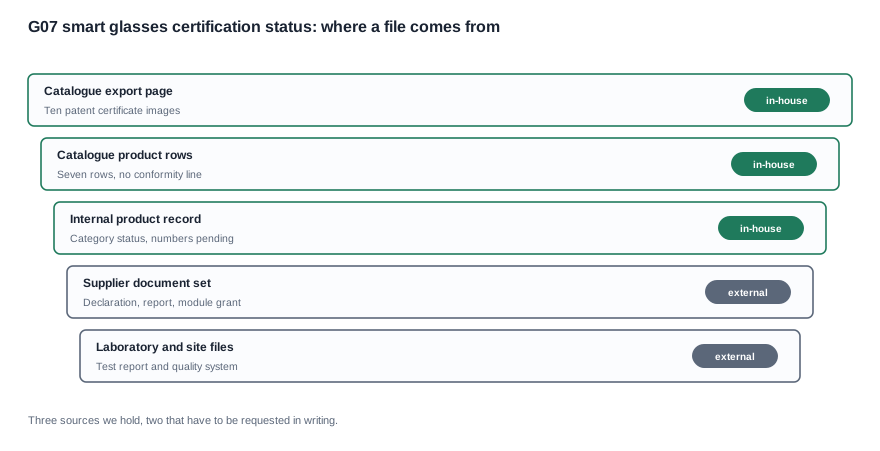
How the three sources disagree
The three sources do not contradict each other so much as describe three different objects, and a buyer who reads them as one document gets confused at every step. The catalogue page describes an intellectual-property position: this supplier has protected the appearance and the construction of its products. The catalogue product pages describe hardware: what each model is and how it behaves. Neither the export-certification page nor the product pages makes a conformity claim for the G07 or for any other model, and neither names a certificate, so nothing in them can be handed to a customs authority or a compliance reviewer as evidence.
Read together they say something coherent. A company that protects its designs, publishes hardware specifications it can stand behind, and states plainly which documents it holds and which it does not is a normal and healthy supplier profile. Read as if they were one document, they produce a different and wrong conclusion — that the protected design carries a certification, or that the published rows constitute a test report.
The practical consequence for a buyer is a discipline of attribution. When a statement is used in an internal or external document, it should be traceable to the specific source it came from, and it should carry that source's status with it. A sentence built on the product record has to carry the caveat that no conformity document is published behind it; a sentence built on the catalogue has to carry the caveat that no per-model conformity line exists. Losing that attribution is how an unissued document becomes a settled fact in somebody's marketing copy, and it is the commonest way this subject goes wrong in practice.

The patent certificate page and why it is not a conformity file
Ten certificates appear on the export certification page of the catalogue. Eight are appearance-design patents and two are utility-model patents. Neither kind is a conformity document, and the gap between them is worth understanding precisely, because the two are routinely treated as the same thing.
Ten certificates, two kinds
An appearance-design patent protects the ornamental appearance of a product — the shape, the pattern, the decoration. A utility-model patent protects a technical construction or a shape that has technical effect, and it is a lesser right than an invention patent, with a shorter term and a narrower test. Both are granted against a design or a construction, and both are national or regional rights with defined territories and defined terms.
A conformity document, by contrast, says that a product meets the requirements of a named regulation or directive, for a named market, on a named date, as demonstrated by a named standard and a named laboratory. That is a different claim with a different structure, and it is the structure a buyer needs when the product is going to be placed on a market.
What a patent establishes and what it does not
A patent on a frame establishes that the appearance or the construction of that frame is protected. It does not establish that the radio in the device complies with a radio directive, that the materials in the frame meet a substance restriction, that the product meets a general safety requirement for the market it is sold into, or that the factory producing it operates a quality system.
The practical consequence for a buyer is worth stating plainly. The presence of patent certificates tells a buyer that the supplier has taken steps to protect the product's appearance or construction — which is a legitimate commercial signal about how a supplier treats its designs, and is worth something. It tells a buyer nothing whatsoever about whether a unit can lawfully be placed on a given market with a given set of documents.
The mistake this page invites
The mistake is the sentence "the supplier holds export certification, so the product is certified". The inference fails at the first link, because the page holds patents. It is compounded by a subtler version — a documentation pack that lists a certificate number without saying which model it covers, without saying which market it was issued for, and without saying which laboratory produced it. Such a line is unusable, and it is worse than an open question, because it looks closed.
The EMC question and the two directive numbers
A radio file in Europe runs on two different instruments, and mixing them up costs a review cycle. The Radio Equipment Directive, numbered (EU) 2014/53/EU, covers equipment that emits or receives radio waves, and it is the instrument a Bluetooth product falls under. The Electromagnetic Compatibility Directive, numbered (EU) 2014/32/EU, covers the broader question of electromagnetic compatibility for equipment generally.
For a Bluetooth audio product the practical consequence is that the radio side of the file is assembled under 2014/53/EU, while the electromagnetic compatibility side is addressed through the harmonised standards cited within that file — the EN 301 489 series being the ones a buyer will most often see named on a product's supporting documents. The confusion worth flagging to a supplier is the reverse one: a document that cites the EMC directive as though it were the radio directive, or that quotes a standard number as though it were a directive number. Neither is fatal, but both mean the file has to be read again, and a buyer working to a deadline should raise the point in the first reply rather than at the stage where the file is assembled.
The rule for a request is simple: name the instrument, name the market, and ask which harmonised standards were applied to the finished product. A supplier who answers those three things precisely has given the buyer a usable file, whatever the certificate is called.

Bluetooth version 5.4 and what a radio declaration still leaves open
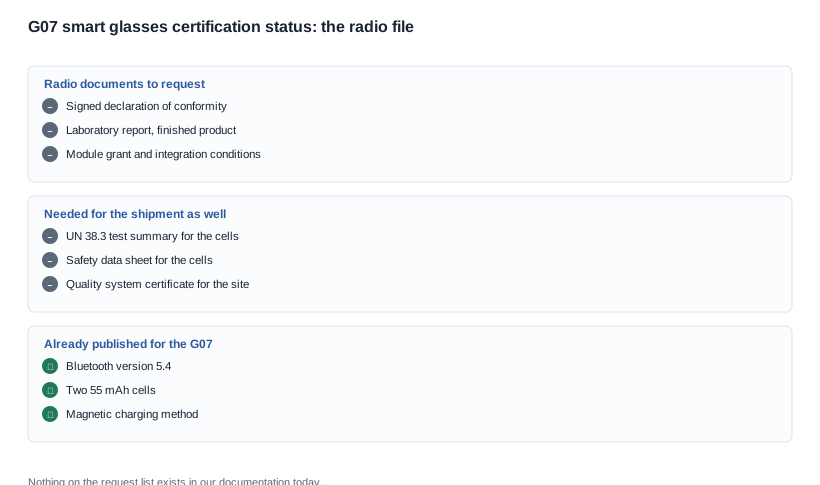
The G07's page publishes a radio version, and that row is the one place where the model has a specific technical fact that a buyer can test against. Bluetooth V5.4 is not a conformity claim, and it is the part of the published specification most often mistaken for one.
What a radio declaration has to contain
For a product containing a radio that is placed on a market, a radio conformity file normally rests on three documents. The first is a test report from a competent laboratory, listing the standards applied and the results. The second is a manufacturer's declaration of conformity, signed against a named directive or regulation and naming the product or product family it covers. The third, where the radio is supplied as a pre-certified module, is the module's own certification, together with the integration conditions that the module grant imposes on the finished product.
The integration condition is the part that gets missed. A module grant does not automatically extend to the finished device; it extends only as far as the module's certification allows, and the finished product inherits whatever antenna, enclosure and layout conditions the module certificate specified. A buyer who asks only for "the Bluetooth certificate" receives a document about a radio module, and has to work out for themselves whether the G07's configuration satisfies the conditions attached to it.
What the radio version alone does not tell you
A version number settles one narrow question: which revision of the Bluetooth specification the radio implements. It says nothing about the transmit power, the antenna type, the band configuration, the coexistence behaviour, the electromagnetic emissions or immunity, or the safety of the radio in an enclosure. It also says nothing about whether any test was performed on the finished product at all, since the version can be read from a running unit.
For a buyer running due diligence on this model, the practical request is therefore specific: the report covering the finished G07 configuration, not only the module; the signed declaration naming the G07; and the module grant with its integration conditions attached, so that the question of whether the final assembly complies can be answered on paper.
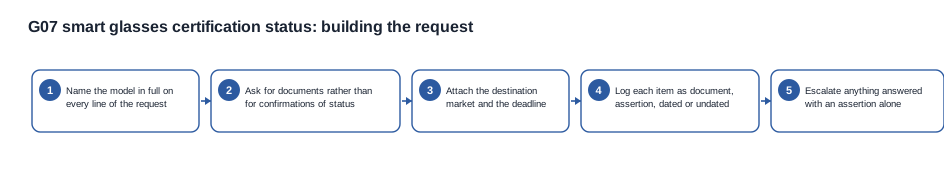
What to do with the internal status field
The status field in our internal record is a working document, and it should be read as one. A recorded status of claimed, numbers pending means three things at once: the claim is being made in our own material, the numbers are not yet issued, and the work of issuing them is in progress. It does not mean the product is uncertified, and it does not mean the product is certified.
What it does mean is that any document a buyer or a channel receives from us which repeats the claim has to repeat the caveat with it. That is not a small formatting point. A catalogue page, a specification sheet and a distributor price list are three different artefacts with three different readers, and the reader with the least technical background is usually the one who copies the claim without the caveat. When a certification claim appears in a listing that reaches a customer, the claim has become a statement about a product that the person publishing it cannot substantiate, and the cost of that is not symmetric with the benefit of a faster listing.
The practice worth following is simple enough to state in one line: the caveat travels with the claim, every time, in whatever form the claim is repeated.

The written request that starts a compliance file
A compliance file begins with a question, and the quality of the question determines the quality of the answer. A request phrased as "please confirm you are CE certified" invites a confirmation. A request phrased as a list of named documents invites documents.
Ten documents that complete a G07 file, each named rather than described
Ten items make a complete request for this model, and each one names a document rather than a status. The declaration of conformity for the G07, naming the market it was issued for and the date. The laboratory test report covering the finished product configuration, with the standards listed. The module grant and its integration conditions, if the radio is a certified module. The safety documentation covering the battery and the charger. The substance documentation for the materials in the housing and the temples, including the lens material. The transport documentation for the two cells — the UN 38.3 test summary and the safety data sheet. The declaration listing which models in the range the certification claim covers, since the claim in our internal record is category-wide and the G07 sits inside it. The quality system certificate for the production site. The factory audit or the third-party verification report, if one has been carried out. And the certificates themselves, with their numbers, issuers and dates, rather than a description of them.
How to phrase the request
Two phrases decide whether the request works. The first is naming the model in full on every line: the G07, not "the audio glasses", because the range contains eight audio models and a document covering one of them has no effect on the others. The second is asking for documents that can be filed, in a form that can be filed — a number, an issuer, a date, a scope — rather than a description of a process.
The request should also state the deadline and the market, because a compliance question with no market attached produces a document that cannot be used. A file assembled for one destination market is not automatically valid for another, and the record should say which market each document was issued for.
Logging each item against four possible states
Partial answers are normal and are not a failure, provided they are recorded as partial. The workable rule is to log each of the ten items with one of four states: received with a document, received as an assertion without a document, outstanding with a date, or outstanding without a date. Items in the second state are the ones that matter, because an assertion without a document cannot be filed with a market authority, cannot be passed to a distributor who asks for evidence, and cannot support a compliance claim in a listing.
We do not publish a certificate number for the G07 and we do not publish a test report, because neither exists in our documentation today. What we publish instead is the request list, so that a buyer can hold the supplier to the same standard we hold ourselves to.
The compliance evidence a buyer can hold before the first order
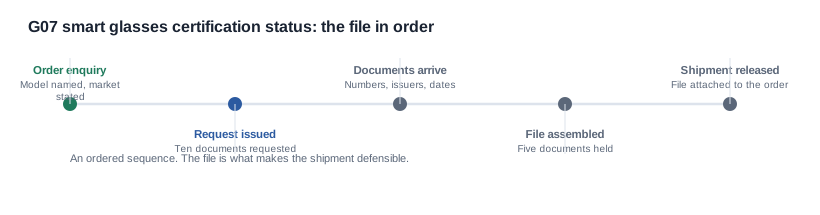
Before a first order goes out, a buyer should be able to point at a file. For this model, five documents in that file are the ones that decide whether the shipment can proceed.
The five-document file
The first is the signed declaration of conformity for the G07. The second is the laboratory report covering the finished configuration. The third is the battery transport documentation — the UN 38.3 test summary and the safety data sheet for the two cells — because a lithium cell that cannot be shipped cannot be sold, whatever its radio compliance says. The fourth is the certificate listing, which resolves which models the claim covers. The fifth is the factory quality system certificate, which is what a distributor or a retailer will ask for when they check the supplier.
The red flags in a compliance file
Four patterns should stop a procurement file. A certificate number with no named model. A report whose scope is a radio module while the question being asked is about the finished device. A document whose issue date predates a product revision, with no evidence that the revision was assessed. And a declaration that names a market the buyer is not selling into, which is not evidence for the market that matters.
None of these red flags means the product is non-compliant; they mean the file cannot be relied on. The distinction matters commercially, because a buyer who rejects a file on a red flag has spent a day, while a buyer who accepts one has transferred the risk to their own company and their own customer.
The file that is worth keeping
A compliance file is worth keeping for a reason that has nothing to do with the model it describes. The same supplier will supply other models, the same buyer will buy from other suppliers, and the value of the file lies in what it makes easy next time rather than in what it proves about this order.
Four practices make that value real. Keep documents in their issued form rather than as photographs of them, because a number that can be read, checked against an issuer's database and re-sent is worth several times more than the same number photographed at an angle. Record which model and which market each document covers, so a reused file does not quietly acquire a scope it never had. Note the issue date and any product revisions since, because a report dated before a design change is a report about a different product. And keep the request itself, because the request is the part that tells a reader what was actually asked for, and therefore what silence on a given item means.
A file assembled that way is also the basis of a much shorter future conversation with the same supplier. That is the real return on compliance work: not a certificate in a drawer, but a repeatable process that a buyer can run again without starting from nothing.
Also worth reading
- The published rows behind the request — the baseline a buyer starts from
- The silences on this model — which gaps are facts and which are missing rows


