
The battery and charging rows for these two models are identical, and the one row where they differ cannot be compared. That is an unusual comparison result, and it is worth understanding rather than working around, because it tells a buyer something specific: on the electrical side there is nothing to choose between them, and the difference that does exist sits in the frame.
The G07 and the LC-105-1 both publish 55mAh*2 in twin cells, both publish a charge time of two hours or less, and both charge magnetically. The G07 publishes about six hours of stated endurance and the LC-105-1 publishes about eight — two hours apart, on an identical published cell configuration, with no test condition published for either. That single discrepancy is the most informative fact available about battery claims in this range, and this page works through what it means for a buyer who has to order one of these two.
What the electrical rows do and do not settle
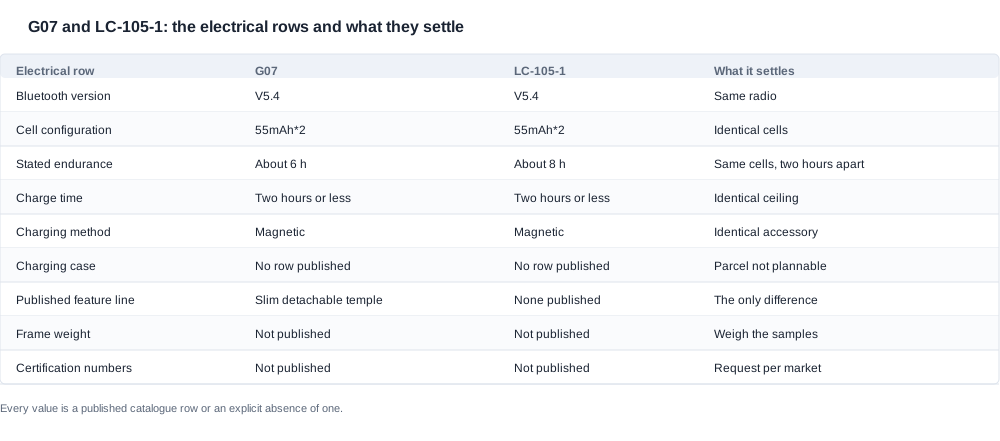
The published rows, side by side
| Electrical row | G07 | LC-105-1 | What it settles for the buyer |
|---|---|---|---|
| Bluetooth version | V5.4 | V5.4 | The same radio on both, so nothing to compare |
| Cell configuration | 55mAh*2 | 55mAh*2 | Identical cells, so nothing to compare |
| Stated endurance | About 6 h | About 8 h | The same cells, two hours apart, with no conditions published |
| Charge time | Two hours or less | Two hours or less | Identical ceiling, so nothing to compare |
| Charging method | Magnetic | Magnetic | Identical accessory approach |
| Charging case | No row published | No row published | Neither parcel cost can be planned from the catalogue |
| Published feature line | Slim and detachable temple | None published | The only qualitative difference between the two |
| Frame weight | Not published | Not published | Neither can be quoted on weight |
| Certification numbers | Not published | Not published | Neither can be quoted on certification |
Why the two-hour spread is a documentation problem, not a hardware one
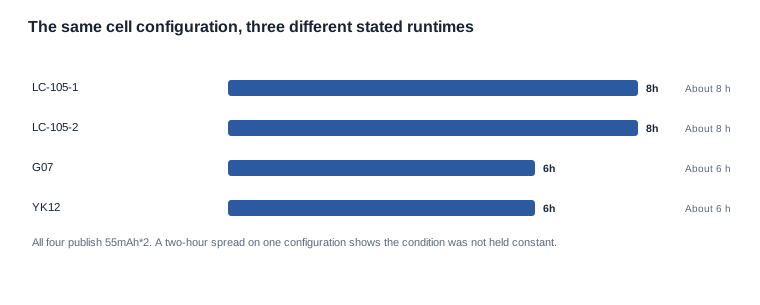
Two hours of difference between about six and about eight, on the same published cell configuration, is the clearest diagnostic in the audio range. It points at the measurement rather than at the product, and the reason is straightforward.
The same 55mAh*2 configuration appears on three models. The LC-105 pair publishes about eight hours. The G07 and the YK12 publish about six. If the G07's slim, detachable temple were responsible for two extra hours of drain, then the plain-framed LC-105 pair would show the same figure on the same cells — because the frame is the only thing that differs. They do not.
That leaves three candidate explanations, and they are worth distinguishing because each has a different remedy. The figures may have been taken under different conditions for different models. The figures may have been taken under one condition but recorded loosely, with rounding or a different endpoint convention. Or the frames genuinely differ in a way the catalogue does not describe, such as different amplifier efficiency or firmware power management between the two platforms.
The honest position is that our documentation does not distinguish between these three, because no test condition is published for any of these models. A buyer should treat both endurance figures as unverified numbers of similar magnitude and should not build a claim, a duty cycle or a price gap on either one.
What the catalogue's charge-time row does and does not tell you
Both models publish a charge time of two hours or less. That figure is a ceiling and it is a real published row, so it is usable — with three qualifications that matter more than the number itself.
There is no starting state. The catalogue does not say whether the two hours assumes an empty battery or a partially charged one. A device that reaches the ceiling from empty behaves differently from one that reaches it from a partial charge, and a buyer scheduling charging around a device needs to know which.
There is no completion criterion. The catalogue does not state at what point the charge is considered finished, whether that is a full cell, a fixed percentage, or a point where the charge controller stops. Without it, two models can both satisfy "two hours or less" and still finish their charges at different states.
It is not a case turnaround time. Both models charge magnetically, which means a charging dock is involved. The charge-time figure describes the frame on the dock; it says nothing about how long the dock itself takes to recharge, and it cannot be used to plan a dock rotation across a fleet.
Why the magnetic method is the real commercial difference
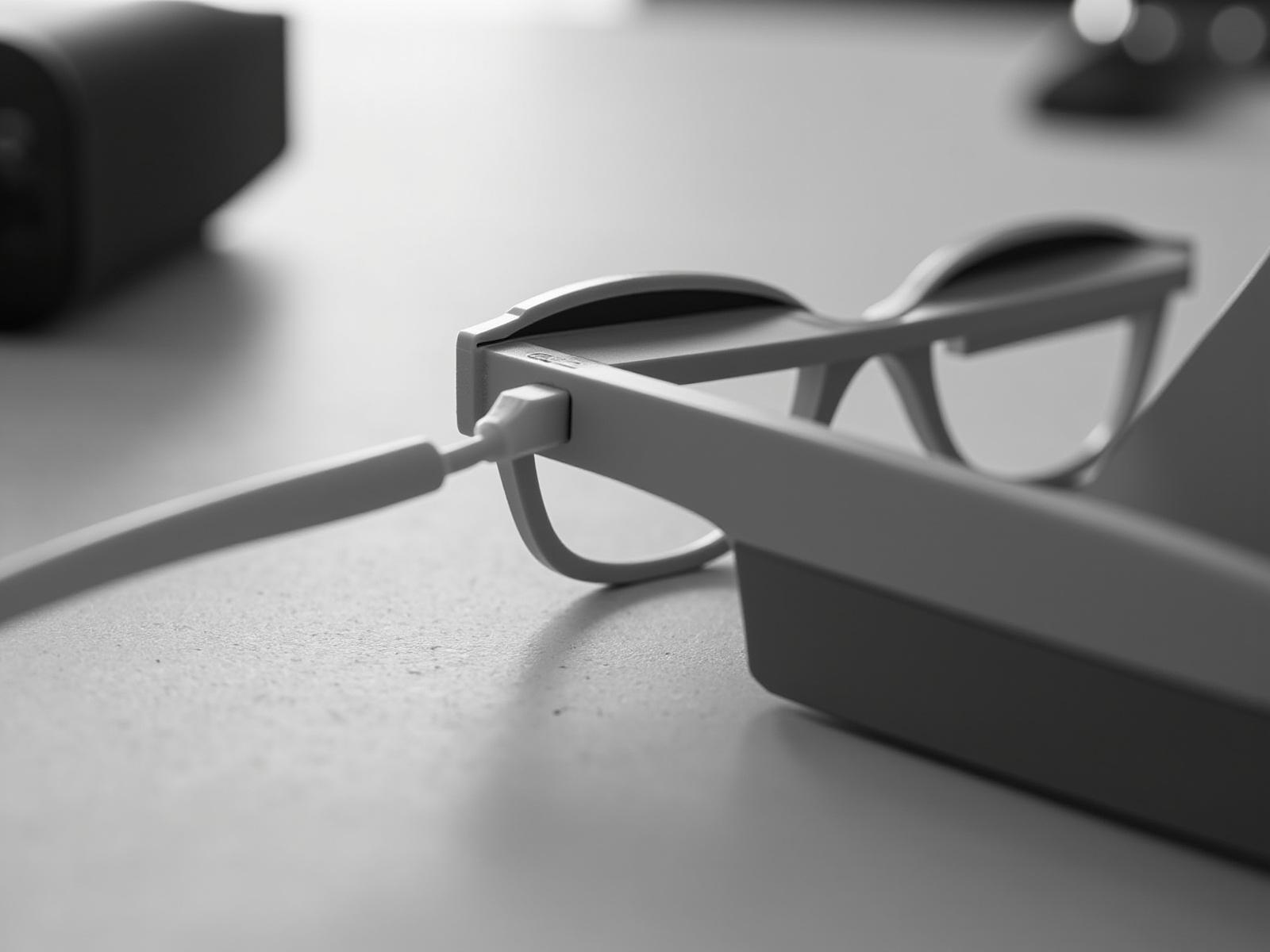
Both models charge magnetically, so the method does not separate them. What it does do is put a dock into both delivered units, and that is the row with a landed-cost consequence.
A dock is a second object in every carton. It has to be counted, packed, protected against the frame being dropped onto it incorrectly, and counted again at the warehouse. It has a weight of its own that goes into the packed unit weight, which goes into the freight class and the shipping documentation. And it has a failure mode that the frame does not: a dock that stops holding a charge properly makes the frame look defective, and returns arrive against the product rather than against the accessory.
Neither model publishes a charging-case row, so a buyer cannot plan either parcel from the catalogue. The audio range charging options piece covers what the magnetic approach means across the range, and the shipping weight breakdown covers the parcel arithmetic on the camera models that do publish case capacities.
What the battery and charging comparison actually reduces to
The temple, and the case capacity
Since the electrical rows are identical, the comparison reduces to two things: the G07's published slim detachable temple, and the charging case capacity that neither model publishes.
The temple is the only published difference between the two models. A detachable temple is a serviceability property as much as a design one — the part most likely to take the impact can be replaced instead of scrapping the frame — and a slim temple is what lets a product in a category of near-identical frames be recognised on a shelf. The LC-105-1 publishes no temple treatment at all, so a brand using it differentiates through colour, packaging and identity instead of shape.
The case capacity is the item neither model publishes, and it is the one that reaches the customer. A magnetically charging frame needs a dock or a case in the box, and that is a second lithium cell in every unit, which changes the packed weight, the freight class and the transport documentation. A buyer cannot model the delivered cost per unit for either model without this figure, and neither model's catalogue page supplies it.
The two documents that would settle the comparison
Ask both suppliers the same two questions in the same words, and compare the answers rather than the numbers.
The endurance profile. What was measured, at what volume, whether the Bluetooth link was active, whether the sample was the production configuration, and what the charge endpoint was. If the answers differ between the two models, the published figures are not comparable and the comparison is void. If the answers match, the published figures still do not become comparable — but the buyer now has a defensible basis of its own, which is worth more than the published row.
The case. Whether one exists, its capacity, its charging interface, its own charge time, and its weight. This is the row that decides the delivered cost per unit, and neither model publishes any of it.

A note on what a buyer must not conclude from this page
Two conclusions are available here and both are wrong. The first is that the LC-105-1 runs longer, which the catalogue does not support because the figures were not taken under one protocol. The second is that the two models are identical, which is also wrong because the G07's published feature line is a real difference that the LC-105-1 does not share.
The accurate statement is narrower and more useful: on battery and charging, these two models are the same product as far as the documentation goes, and the frame treatment is what you are actually choosing between. If the frame is not part of the proposition, this comparison has already been decided elsewhere and the buyer should look at a different pair.
Criteria a buyer should apply when choosing between the G07 and the LC-105-1
A shortlist built on a battery comparison is only as good as the criteria behind it, and in this pair the criteria have to be chosen carefully because the electrical rows tie. Five criteria are worth applying, in this order.
Criterion one: does the channel's proposition need a detachable temple?
This is the only published difference between the two models, so it has to come first. If the proposition includes field repairability, the G07 carries the row and the LC-105-1 does not. If it does not, the G07's feature line is worth nothing to you and the two models are equivalent on everything our documentation publishes.
How to evaluate it: ask the questions to ask about the temple joint — cycle count, connector design, adjustment range, whether a replacement arm can be ordered separately, and at what price. Then check the answer against the channel's actual returns rate. A detachable temple that cannot be reordered is worth nothing to a channel that loses units in transit.
Criterion two: is endurance genuinely central, and can the condition be documented?
If endurance does not drive the decision, this criterion is irrelevant and the buyer should move on — which is the outcome for most buyers, and the correct one. If endurance does drive it, then the criterion becomes whether a test condition can be obtained.
How to evaluate it: ask for the condition, then check whether the same condition applies to a second unit of the same model, because a condition that cannot be reproduced is not a basis for a claim. How to verify the answer is to run the test on the samples rather than to reason about the published figures.
Criterion three: what does the delivered unit weigh?
This is where the charging method shows up in the commercial arithmetic, and it is the criterion most often skipped because the catalogue does not prompt for it. Neither model publishes a charging-case row, so the dock's contribution to the packed weight is unknown.
How to evaluate it: weigh the frame, weigh the dock, weigh them together, and compare the packed figure against the freight thresholds that apply to the destination market. The total cost of a delivered unit includes freight, and freight is driven by weight.
Criterion four: what does the accessory chain cost to run?
A magnetically charged frame creates a second supply line. Docks get lost, damaged and returned. What to ask is whether a spare dock is available at your quantity, at what price, and with what lead time. The trade-off is straightforward: a channel that expects dock attrition should price replacement docks into the unit economics at the outset rather than discovering the cost in a returns cycle.
Criterion five: can the certification position be established per market?
Our catalogue carries a company-level export certification page whose content is images rather than text, and the catalogue text contains no reference to CE, FCC or RoHS. There is no per-model certification row for either model. So the criterion is not whether certification exists — it is whether the supplier will produce per-model evidence for the destinations in scope.
How to evaluate it: issue that request first, because it has the longest lead time, and treat a non-answer as a genuine red flag rather than a formality.
Red flags and pitfalls in a battery and charging comparison
Six patterns account for most of the trouble buyers run into when they compare these two models, and each has a recognisable symptom.
The runtime row decided the order. The symptom is that the model with the longer published figure was selected, and the field result contradicts the sheet. The root cause is treating a figure with no condition as comparable. The prevention is to exclude the row from the decision until a condition is documented, and to require the condition in writing before you buy a claim.
A runtime figure was copied into a duty cycle. The symptom is a scheduling promise to a customer that the hardware cannot keep. The root cause is converting an unconditioned figure into hours per shift. The prevention is to compute the duty cycle from a stated condition and to leave margin for the volume the end customer actually uses.
The charge-time ceiling was read as a charge duration. The symptom is a channel promising a full charge in under two hours when the figure was measured from a partial state. The root cause is ignoring that the catalogue publishes a ceiling without a starting state or a completion criterion. The prevention is to ask what the starting point was, and to state the starting point in any copy that uses the figure.
The dock was left out of the parcel model. The symptom is a freight cost that moves after the price is agreed, or a channel discovering at the warehouse that every unit needs an accessory nobody counted. The root cause is quoting the frame weight while shipping the frame and the dock. The prevention is to write the packed unit weight into the agreement, dock included.
The G07's slim temple was read as a light frame. The symptom is a positioning the returns rate does not support. The root cause is reading a design word as a measurement. The prevention is to weigh the samples and quote your own figure.
The certification position was assumed for both models. The symptom is a market-access file opening late, behind a shipment that has already been booked. The root cause is reading a company-level page as a per-model guarantee. The prevention is to request per-model evidence for the destinations in scope before the order is placed.
A useful discipline runs through all six. Before you order, list every claim your listing will make, and put each one next to the document that supports it. A claim with no document is either removed from the copy or turned into a question for the supplier — and it should never survive into a purchase order as an assumption.

Evidence to hold before a battery and charging order
The request list, in the order that saves time
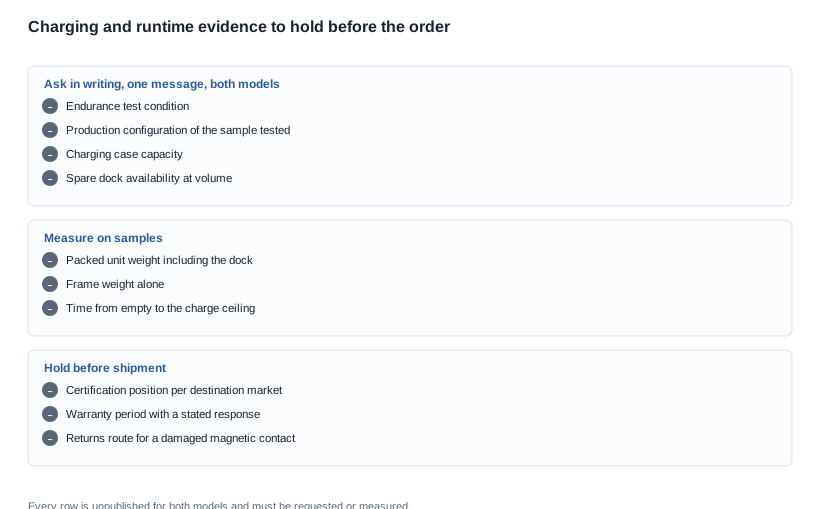
Ask for the endurance condition first, in identical wording for both models, in the same message as everything else. This is the one request that determines whether any runtime claim is defensible, and it is a single email.
Ask for the charging case in the same message — capacity, interface, its own charge time, and the packed unit weight of a frame with the dock. The two questions travel together because both are documentation and neither needs a sample.
Ask whether a spare dock is available at your quantity. A channel whose units circulate will lose docks, and a dock that cannot be replaced at volume turns a two-minute repair into a return. This is a supply question rather than a technical one, and it belongs in the same conversation as the unit price rather than in a separate support ticket.
Then measure. Put a frame and a dock on a scale, separately and together, and time a charge from a stated starting point. Those four numbers settle the parcel model and the schedule.
The commercial terms that follow from the electrical parity
Because the electrical rows are identical, the two models should be quoted on the same commercial basis, and any difference in unit price has to be explained by something other than battery or charging. That is a useful discipline at quotation stage, because it forces the supplier to identify what the difference actually is.
The terms worth working on are the standard ones for a magnetically charged frame: unit price at volume tiers, the accessory set and its own minimum order quantities, packaging specification, delivery splitting, payment nodes tied to inspection, the warranty period with a stated response, and the terms of a pilot order.
Two additional clauses matter more for this pair than for a Type-C model. The packed unit weight should be written into the agreement, with the dock included, because it drives the freight class and the landed cost. And the returns route for a damaged magnetic contact should be defined, because a dock or a contact failure is attributed to the frame by the end customer even when it is not the frame's fault.
Certification cost and its timeline are fixed by the process, and tooling is frequently amortised across a first order while certification sits per product family — ask which of the two is being quoted, because the two are often bundled into one line that hides which is which.
The claims and rows this battery and charging comparison cannot support
Any runtime claim that does not carry its test condition. Any statement that one of these two models lasts longer than the other. Any case capacity, packed weight or certification number that has not been supplied in writing. And any weight figure for either frame, because neither publishes one — the only weight in our catalogue belongs to a different model entirely, and that figure does not transfer.
Where CYNRIN stands on the G07 and LC-105-1 comparison
These two models are the same platform with a different frame treatment as far as the electrical documentation goes, and a buyer who wants to choose between them on battery is choosing on a measurement artefact. We will not present either endurance figure as a working day, we will not present the slim temple as a quantified advantage, and we will not quote a weight, a case capacity or a certificate number that the documentation does not contain.
The published G07 specification list and the published LC-105-1 specification list are the honest baselines, and the G07 versus LC-105-2 form factor comparison covers the same pair from the design side.
Five questions to close before you choose
- The endurance test condition for each, asked in identical words.
- Whether the measured sample was the production configuration.
- The charging case capacity for each, and a measured packed unit weight.
- Frame weight, dimensions and temple length, measured on samples.
- The certification position for each model in each destination market.
Related reading
- The published rows for the G07 — G07 smart glasses specifications and features
- The published rows for the LC-105-1 — LC-105-1 smart glasses specifications and features
- The accessory economics — Bluetooth audio glasses charging options
- The commercial structure around a range — OEM ready pricing tiers
Send us the application, the expected wear time and the volume, and we will tell you which of the two models the design argument actually favours.


