

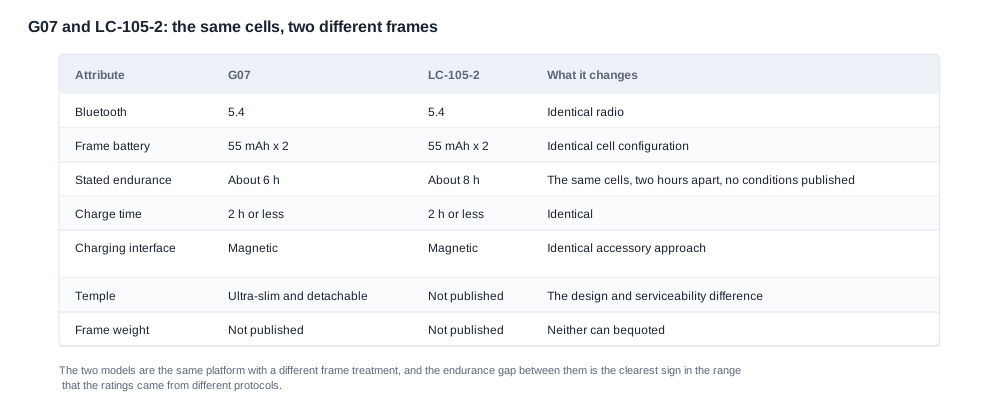
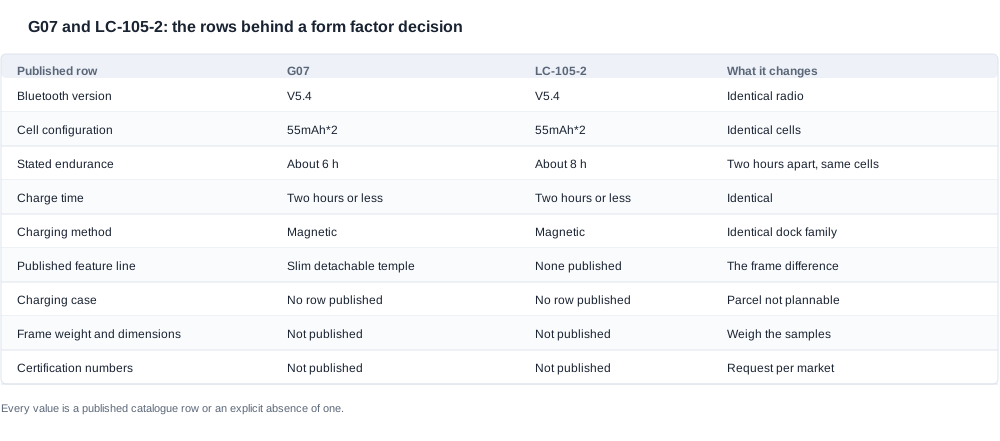
The G07 and the LC-105-2 are the same hardware platform with a different frame treatment, and the published evidence makes that unusually clear: the same radio, the same two 55 mAh cells, the same charge time, the same charging interface. The only published differences are the temple treatment and the endurance figure, and the endurance figure is the one that does not survive scrutiny. This page is written for the buyer choosing between them, and it separates the row that decides the purchase from the row most comparison tables lead with.
The buying task behind a same-platform comparison
Who signs off on a form-factor comparison, and on what
A brand owner is deciding whether the design and serviceability argument is worth a second product on the platform, or whether one model should carry the whole platform.
A procurement manager is comparing two quotes on identical hardware and needs to know what the price difference is actually buying, because the hardware rows do not explain it.
A channel buyer is deciding between a product that is recognisable on the shelf and one that differentiates through colour, packaging and identity, and the two are different merchandising strategies with different costs.
The decision in one line
The G07 and the LC-105-2 are the same platform with a different serviceability and design proposition, and the endurance row is a documentation artefact rather than a product difference. Everything the buyer negotiates — price, accessories, spares, packaging — follows from that.

The published rows behind a same-platform choice
| Attribute | G07 | LC-105-2 | What it changes | The threshold or question to write |
|---|---|---|---|---|
| Bluetooth | 5.4 | 5.4 | Identical radio | The customer's platform, checked against the version quoted |
| Frame battery | 55 mAh × 2 | 55 mAh × 2 | Identical cell configuration | The cell for the configuration ordered |
| Stated endurance | About 6 h | About 8 h | The same cells, two hours apart, no conditions published | The measurement profile, asked in identical words on both |
| Charge time | 2 h or less | 2 h or less | Identical | The starting point for the charge-time measurement |
| Charging interface | Magnetic | Magnetic | Identical accessory approach | Whether a spare dock is available at your quantity |
| Temple | Ultra-slim and detachable | Not published | The design and serviceability difference | Cycle count, connector design and replacement route — none published |
| Frame weight, frame dimension, temple length | Not published | Not published | Neither can be quoted | Weigh and measure a sample of each model you intend to sell |
Why the endurance gap is not a form factor fact
Two hours on identical cells, with no test condition published for either, is the single most useful diagnostic in this range — and it does not point at the frame.
The same 55 mAh twin-cell configuration appears on three models. The LC-105 pair publishes 8 hours, and the G07 and the YK12 publish 6. If the G07's slim and detachable temple were responsible for two hours of extra drain, the LC-105 pair would show the same figure on the same cells with a plain frame. They do not.
So the most likely explanation is a measurement convention rather than a design consequence: the figures were taken under different conditions for different models, and nobody published what those conditions were. That is the honest reading, and it has a practical consequence — the endurance row cannot be used to decide between these two models.
The question to ask both suppliers is the same one: what was the measurement profile, was the Bluetooth link active, and was the measured sample the production configuration. The how to compare battery life method covers the procedure, and the G07 battery life analysis covers this platform in more detail.
What the temple treatment actually changes
Serviceability. A detachable temple means the part most likely to be damaged can be replaced instead of scrapping the frame. For a brand with a repair promise, a distributor handling returns, or a product line with a spare-parts business, that is a real commercial property.
The need for a spares route. A detachable part creates a second business: replacement temples have to be orderable, stocked and priced. The cycle count, the connector design and the replacement cost are not published, and all three have to be established before a service promise is made. The G07 best-for analysis covers the commercial case.
A visible difference on the shelf. In a category where most open-ear frames look alike, a slim temple is what lets a product be recognised. The LC-105 pair publishes no design feature at all, so a brand using this platform differentiates through colour, packaging and identity rather than shape. The comfort and fit analysis covers why fit, rather than styling, is what a wearer notices.
The limitation that applies to both
Neither model publishes a frame weight, a frame dimension or a temple length. On the G07 that matters twice, because the design feature is weight-related and the number would substantiate it. On the LC-105-2 it matters because the "ultra-light" description in the source has nothing behind it.
A buyer who skips the measurement ends up quoting an adjective to a customer, and the customer returns the product. Weighing two samples takes an afternoon and settles the row that the catalogue leaves blank.
There is one weight published in the whole catalogue — the MT6 at 158 g, on a camera model with a different cell and a foldable case — and it cannot stand in for either of these. The weight comparison across the audio range explains why, and why weighing a sample of each model you intend to sell is the cheapest item on any list.
What a detachable temple changes downstream
A form factor decision is not really a decision about shape. It is a decision about what the shape obliges a channel to arrange downstream, and a detachable temple obliges a channel to quite a lot.
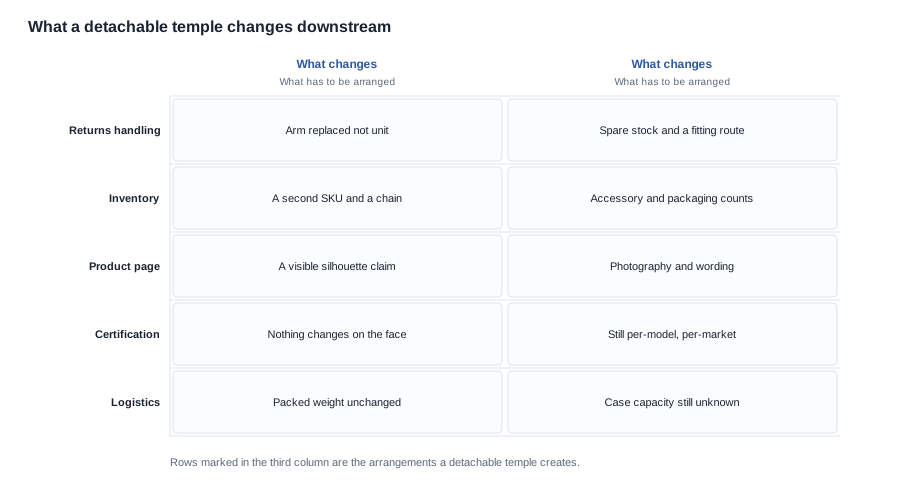
Returns handling changes shape. A unit with a cracked arm becomes a unit with a replaceable arm, which is a different operational process: a stock of spares, a fitting method, and possibly a bench somewhere in the network. The channel has to decide where that happens before it can promise anything about repair.
Inventory gains a second line. Replacement temples are a stock item with their own minimum order quantity, their own storage and their own replenishment cycle. A channel that did not plan for that line will discover it during a returns spike, which is the worst moment to discover it.
The product page gains a claim that has to be true. The silhouette is the only published differentiator in this pair, so the photography, the wording and the physical sample all have to support the same impression. If the sample that arrives does not look like the shot on the page, the page is the problem.
Certification does not change. A different frame treatment does not create a different certification obligation, and our catalogue carries no per-model certification row for either model in any case — so certification is still a per-model, per-market document request.
Logistics does not change either, on the published evidence. Both models charge magnetically and neither publishes a charging-case row, so the packed unit weight is equally unknown for both. The form factor difference does not resolve the parcel question.
One platform, two frames: how to merchandise the decision
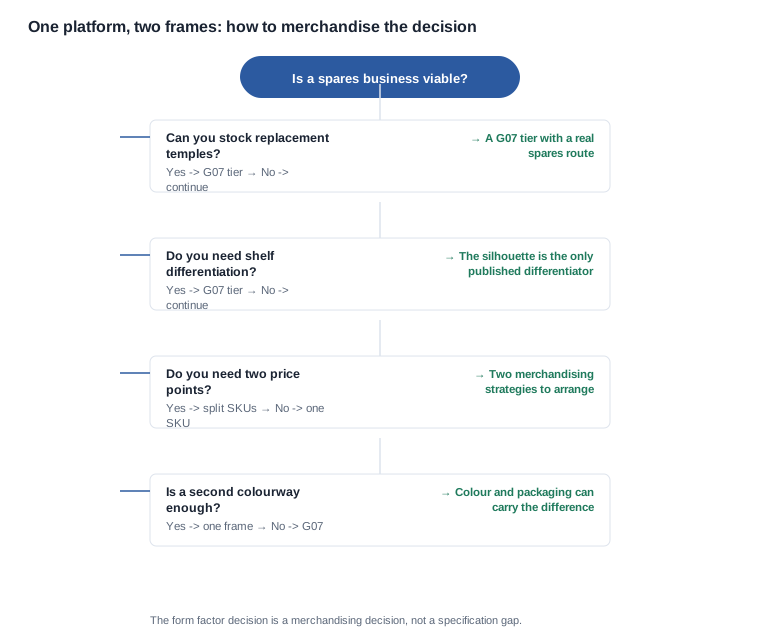
This is the branch that a buyer reaches last and should reach first. The question is not which frame is better; it is what the range is for.
If a spares business is viable and shelf differentiation matters, run the G07 as the design tier. The detachable temple does two jobs at once — it makes the product repairable and it makes it recognisable — and a channel with the operational capacity to hold arms gets both.
If neither condition holds, run the LC-105-2 as a single platform with colour differentiation. The LC-105-2 publishes no temple treatment, which means its differentiation has to come from colour, packaging and identity rather than shape. That is a legitimate strategy and a common one; it simply needs to be chosen rather than defaulted into.
If two price points are needed, that is a merchandising decision, not a specification one. Two models on one platform can carry two price points, but they carry two accessory chains, two packaging structures and two sets of artwork — and the buyer should count those before assuming the second price point is free.
The practical test is whether the range can survive being put side by side. Look at the two frames as a customer would and ask whether each one has a reason to exist that a competitor's product at the same price does not. If the answer is only the price, merge them.
The sequence from platform approval to a two-model launch
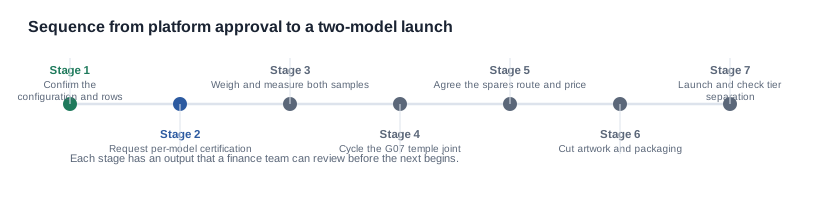
The staging matters because several of these steps have lead times that the merchandising work does not. Certification in particular has the longest, and it should be requested at the point where the configuration is confirmed rather than after artwork is approved.
The middle of the sequence is where the physical work happens: weighing and measuring both samples, cycling the G07's temple joint, and agreeing the spares route and its replacement price. Each of those produces a number or a commitment that the commercial terms then reference, which is why running them before the negotiation is cheaper than running them after it.
Evidence for a form factor decision
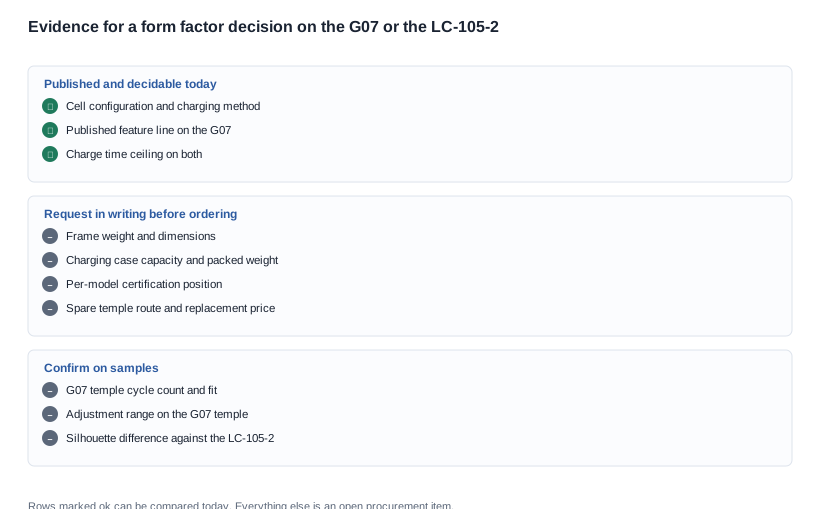
The published rows settle three things immediately: the cell configuration, the charging method and the charge-time ceiling are identical, and the G07's feature line is the only qualitative difference. Everything else is a request or a measurement.
Ask in writing: the frame weight and dimensions for both, the charging case capacity and packed unit weight for both, the per-model certification position for the destinations in scope, and the spare temple route and replacement price for the G07.
Confirm on samples: the G07's temple cycle count and fit, the adjustment range on that temple, and the silhouette difference when the two frames are held against each other rather than described in isolation.
Checking the platform decision before the order
Ask the endurance condition for both, in identical words, in the same message. This is the single question that determines whether the two models can be compared at all, and it costs one request.
Ask the three spares questions for the G07 temple. Cycle count, connector design and replacement route. A detachable temple without a replacement route is a design feature with a service problem attached, and the two are worth different amounts.
Weigh and measure a sample of each. Weight, frame dimensions, temple length. This is the row that predicts the return rate and it is missing on both sides.
Ask what a packed unit weighs with the dock, and the case capacity for each. Packed weight drives the freight class and the shipping cost, and it is a different number from the product weight.
Ask the certification position for each model in each destination market. The published G07 specification list and the published LC-105-2 specification list are the honest baselines, and the G07 versus LC-105-1 comparison covers the platform decision from the other end.
Decide the merchandising strategy before the order. One recognisable model with a spares business, or two models differentiated by colour and packaging. Both are legitimate; the accessory and inventory costs are not the same.

Six ways a same-platform choice goes wrong
The endurance gap was taken as a design difference. Symptom: the LC-105-2 was chosen for a longer day, and the two figures turn out to have been measured differently. Root cause: a figure with no condition was read as a product property. Prevention: ask the condition, and set the row aside until you have it.
The detachable temple was sold as a serviceability promise. Symptom: a broken temple cannot be replaced and the channel absorbs the cost. Root cause: the cycle count, the connector and the replacement route were never established. Prevention: ask the three questions, and price the answer.
The ultra-light description was carried into a listing. Symptom: a weight claim that nothing supports. Root cause: a catalogue word was read as a measurement. Prevention: weigh a sample and quote your own figure, or quote nothing.
The MT6's published weight was used as a stand-in. Symptom: a freight model built on a number from a different platform. Root cause: a catalogue figure was borrowed across platforms. Prevention: weight each model you intend to sell; the MT6 figure does not transfer.
Two models were listed on the same platform without a merchandising plan. Symptom: two SKUs that a customer cannot tell apart, with two accessory chains. Root cause: the platform was planned as a set. Prevention: decide the merchandising strategy first, and count the accessory chains before the artwork.
The case was assumed to be identical across the platform. Symptom: the packed weight and the freight class are wrong. Root cause: a shared platform was assumed to mean a shared accessory set. Prevention: ask the case capacity and the packed weight for each model.

What a same-platform choice is worth commercially
The price difference between two models on the same platform is buying the temple treatment and the spares business, not the hardware. That is a useful way to frame the negotiation: you are not buying more battery or a newer radio, you are buying a serviceability property and a shelf recognisability property. If the price gap is larger than the value of those two properties, one model should carry the platform. Run the criteria above as a checklist before the shortlist is scored.
The terms worth spending negotiation time on are unit price and volume tiers per model, the accessory set and its minimum order quantities, the replacement temple route and its pricing, packaging specification, delivery splitting, payment nodes against inspection, the warranty period with a stated response, and the terms of a pilot order. These are the trade-offs worth the negotiation time.
Two lines are fixed by the process rather than by the negotiation. Certification cost and lead time follow the testing body. Tooling is often amortised across the first order while certification cost is per product family — ask which one you are being quoted, because the two are frequently bundled into a single line that hides which is which.
The agreement should carry six items for this pair: the published rows for the configuration ordered; the endurance condition once established; the temple treatment and the spares route with its cycle count and replacement price; the packed unit weight; the certification position per market; and the warranty period with a stated response.
What to leave out. Any weight, temple profile, case capacity or certificate number that the documentation does not contain, and any endurance claim without its condition.
The accessory chain a two-model range quietly creates
A range decision is also an accessory decision, and the accessory chain is the part of the cost that does not appear in a unit price comparison.
Two models on one platform with magnetic charging means two dock chains to source, stock and replenish. If the two models use different dock variants — and the published rows do not say whether they do — the channel is now holding two dock types, two spare-parts lines and two sets of packaging inserts, and every dock becomes a model-specific spare. The question to ask is whether one dock serves both frames, because that single answer changes the working capital position more than any unit price movement.
There is a second, quieter cost: the dock is the part of the delivered unit most likely to fail or go missing, and it is the part a customer will blame on the frame. A returned unit whose fault is a dock contact is a frame return by any measure the channel tracks. So the spares arrangement on the G07's temple should be designed together with the dock replacement arrangement, not as two separate conversations with the supplier — the same returns process handles both, and a process that handles only one of them will handle the other badly.
The published rows do not settle whether either model has a case, so a buyer running two models should ask for the case and dock position of each model separately, in the same message, and treat the answer as a platform-level fact rather than a per-model one. If the answer turns out to be shared, the accessory chain collapses to one; if it is not, the two-model range carries a cost that the range plan has to show for.
Two questions to ask about the second model before approving it
The commercial risk in a two-model range is not the first model — it is the slow one. Two models on one platform produce two accessory chains, two packaging structures and two artwork sets, and the model that sells more slowly ties up inventory the faster model could have used.
How to evaluate whether the second model earns its place: put the two side by side as a customer would, with the packaging as it will actually ship, and ask whether each one has a reason to exist that a competitor's product at the same price does not. If the only visible difference is the frame shape and the price point, the range has a merchandising problem rather than a product problem, and merging the two is usually the cheaper answer.
How to evaluate the inventory consequence: work out how many units of each model are likely to move in a first quarter, then apply the accessory and packaging minimum order quantities to each. A minimum order on a slow model's insert can exceed the volume that model will sell in a year, which is a real cost hidden behind a small line in a quotation.
Where CYNRIN stands on the G07 and LC-105-2
The G07 and the LC-105-2 are the same platform with a different serviceability and design proposition, and the endurance row is a documentation artefact rather than a product difference. We will not present the detachable temple as a quantified advantage, we will not present the ultra-light description as a measured claim, and we will not quote a weight, a temple profile, a case capacity or a certificate number that the documentation does not contain. Choosing across the wider range is covered in Bluetooth audio glasses which model to pick.
Five questions to close before you choose
- The endurance test condition for each, asked in identical words.
- Frame weight, frame dimensions and temple length, measured.
- The detachable mechanism on the G07: cycle count, connector and replacement route.
- The charging case capacity for each, and a measured packed unit weight.
- The certification position for each model, in each destination market.
Send us the customer, the proposition and the volume, and we will tell you whether the design and serviceability argument survives a direct cost comparison.
Related reading
- The published rows for the G07 — G07 smart glasses specifications and features
- The published rows for the LC-105-2 — LC-105-2 smart glasses specifications and features
- Choosing across the range — Bluetooth audio glasses which model to pick
Send us the customer, the proposition and the volume, and we will tell you whether the design and serviceability argument survives a direct cost comparison.


