
Bone conduction glasses technology: measured on a head, not on a bench
Measuring bone conduction glasses is a different exercise from measuring any other audio product, because the output path runs through the wearer rather than through the air. A sound pressure meter pointed at a speaker tells you about a speaker; pointed at a bone conduction device it tells you almost nothing, because the measurable quantity is the vibration in the skull, and the quantity a buyer actually cares about — can the wearer follow a target source in noise — is a perception rather than an instrument reading. Bone conduction glasses technology smart glasses how to measure is therefore a product evaluation protocol rather than a laboratory measurement, and it produces a documented result rather than an instrument figure.
The short answer: fix three things before you test anything — the named wearer, the unaided baseline, and the environment — and record the volume setting at which a fixed target became followable. A protocol missing any one of the three produces a description rather than a comparison, and a description cannot settle a question with a supplier or support a warranty decision. This page is written for the buyer who has to run that protocol: it sets out the eight fields to record, the rows a supplier has to state before a sample is worth testing, and the boundary that a bone conduction product in this category must stay inside.
What follows is a product evaluation protocol, not a clinical one. Eight things to record, in an order that wastes the least time if something is wrong.
The buyer who has to run the protocol, and the constraint they hit
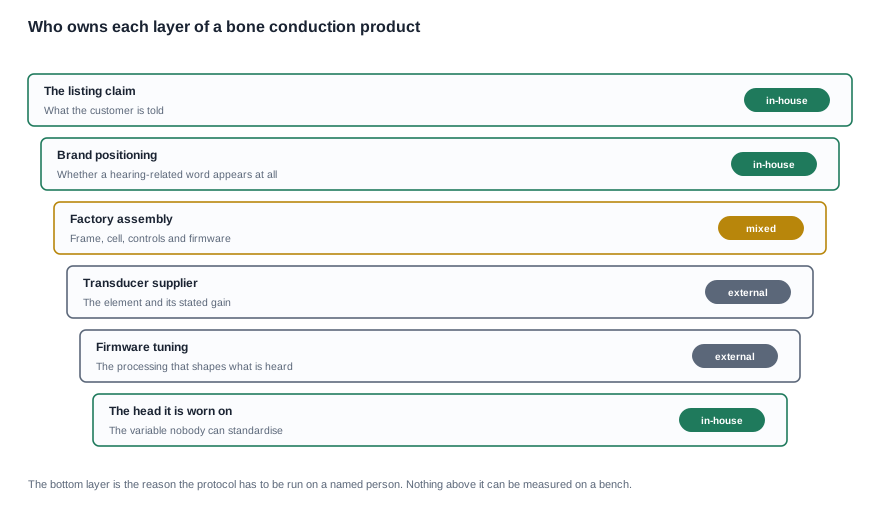
A buyer in this category is usually evaluating a sample before an order, or writing a case study for a product that is about to launch. They will hold a unit, a supplier's datasheet with a gain figure on it, and a channel in mind — outdoor sport, industrial work, or a personal sound amplification audience. What they will not hold is an acoustic data set, because in this category the acoustic data belongs to the transducer supplier and the assembly factory usually receives it as a component specification.
That is the practical reason the protocol has to be built rather than borrowed. The factory's datasheet describes a transducer; your programme has to describe the product on a head. The measurements are cheap, the discipline is what costs, and the discipline is a procurement problem rather than an engineering one: it is a question of who is going to run the protocol, on which units, and where the result is filed so that the next shipment can be compared against it.
There is a second audience for the protocol, and it decides whether the work is worth doing at all. The person who writes the listing needs to know which sentences the result supports. For a bone conduction product the answer is almost always narrower than the sentence they want to write, because the most commercially attractive sentences in this category are the ones that cross into health claims, and health claims are a regulatory problem that no measurement can solve.
Before you order, decide what the protocol is for. A procurement manager who needs to choose between two suppliers needs a ranking under stated conditions, and can stop once the scores are written. A buyer who needs to detect drift between production lots has to retain a reference unit and the audio, because a drift is only visible against a fixed reference. Those are two different jobs with two different costs, and confusing them is how a programme ends up with a protocol it cannot afford to repeat.
The rows a supplier has to state before a sample is worth testing
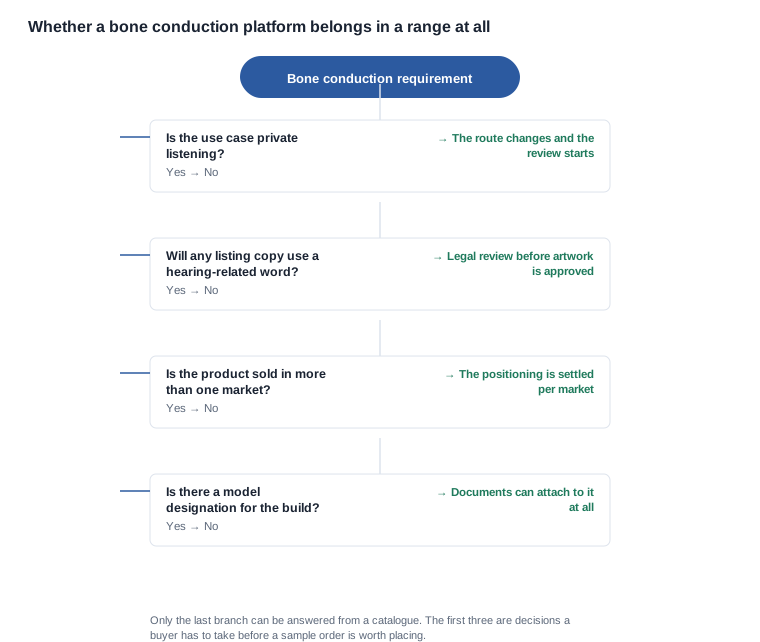
Send the table to the supplier alongside the sample request. The right-hand column separates a supplier who owns the acoustic design from one who is relaying a component specification. These are also the questions to ask during supplier due diligence on a platform you have not sampled, because a supplier who answers four of the nine is telling you that the acoustic design sits somewhere else, and how to evaluate the rest of the platform changes as a result.
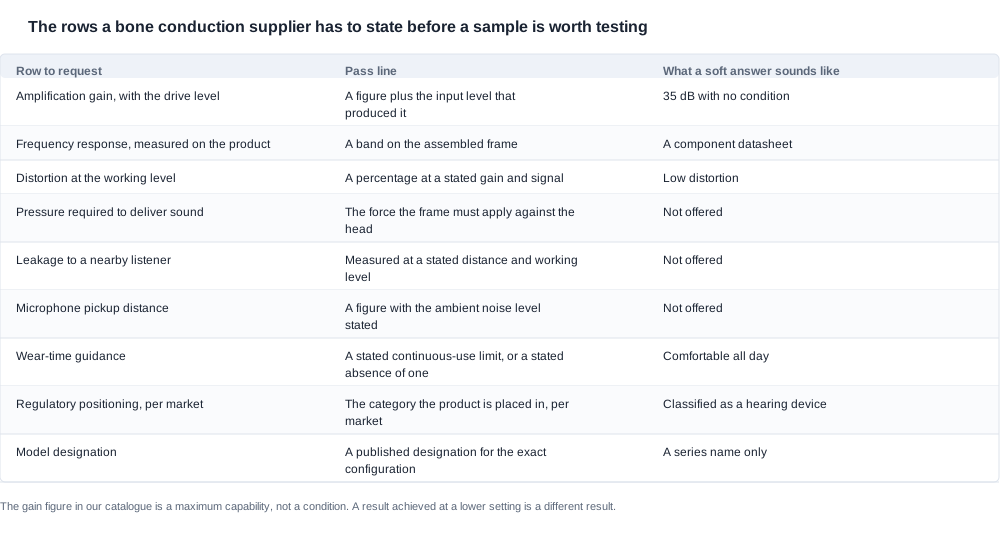
The gain setting actually used is part of the result, and the catalogue figure is a maximum capability rather than a condition. Our catalogue publishes 35 dB as a power amplification gain, and a result achieved at a lower setting is a different result from one achieved at the maximum. A protocol that records the setting alongside the observation is the only way to compare two products later, and it is also the only way to tell whether a lower-cost variant would work in the same application.
Pressure decides whether a bone conduction frame is wearable at all. A bone conduction transducer has to be held against the skull to transmit, and the frame has to press. A product that needs more pressure to deliver the same result is a frame problem, not a product problem, and it is a problem that no acoustic figure in a datasheet will reveal. This is the single most common reason a bone conduction product passes a demo and then sits in a drawer, and it is the reason the pressure question belongs in the supplier request rather than only in the sample session.
Privacy is the claim the technology makes uniquely, and it is worth confirming rather than assuming. Put a second person at arm's length and ask whether they can hear anything. On a bone conduction device the answer should be nothing at all, and a supplier who cannot state the measured leakage at a stated distance is telling you the claim is assumed rather than established. In an industrial or clinical-adjacent channel this is the row that determines whether the product can be sold at all.
Comfort over time is two different findings. How long the frame was worn before the person took it off, and whether the reason was discomfort or loss of usefulness. Discomfort is a frame problem and a return driver; losing interest is a product problem and a positioning problem. Conflating them produces a fix that does not address the cause, and it also produces a warranty term aimed at the wrong failure.
The regulatory positioning is a row, not a formality. In the United States, the FDA regulation at 21 CFR 800.30 defines an over-the-counter hearing aid as an air-conduction device intended for a person aged eighteen or older; a bone conduction product is neither air-conduction nor a hearing aid, and it cannot be sold in that category. The legitimate positioning is a personal sound amplification product. We make no health claim for any of our products, in any market, and a sample protocol cannot create one. The boundary is set out under medical device boundary.
One warning applies to every row: these numbers are not directly comparable between suppliers. A gain figure taken at a different drive level, a leakage figure taken at a different distance, and a response figure taken on a different frame are three different numbers that happen to share a label. Before you build a table, decide which column is your own measurement and which is a supplier's number, and never mix the two in one row without a note.
Know when to stop. A supplier who will not name the drive level behind the gain figure, the distance behind the leakage figure, or the method behind the response figure has told you the figure cannot be used in a comparison, and no amount of sampling changes that. The model designation row is the one that decides which model the documents attach to, and until it exists no certificate can be checked against a purchase order line.
The eight-field protocol, and the line it must not cross

1. Record the named test subject first. Name them, note their head size, and note whether they wear glasses, because both change the transmission path. This is the field that makes a result non-transferable if it is left empty, and it is the field that decides whether the result can be quoted in a listing at all.
2. Establish the baseline in the same spot at the same moment. What is audible to that person unaided. Without it, the comparison has no referent. This is the step most often skipped, and skipping it is what makes most published comparisons meaningless.
3. Record the environment, not just the room. The noise type, the level, and whether there is wind. A device that helps in a quiet room and fails on a road is doing what it was designed to do, and the case study has to say so rather than report the better half.
4. Record the volume setting reached at which a fixed target became followable. This tells you how much of the device's range the actual use case needs, which is a different question from how much the device can produce — and it is the number that tells you whether a lower-cost variant would work.
5. Run the intelligibility test with the same phrase, at the same distance, every time. Record whether the subject can follow it. This is the outcome that matters, because it is the outcome the customer will experience.
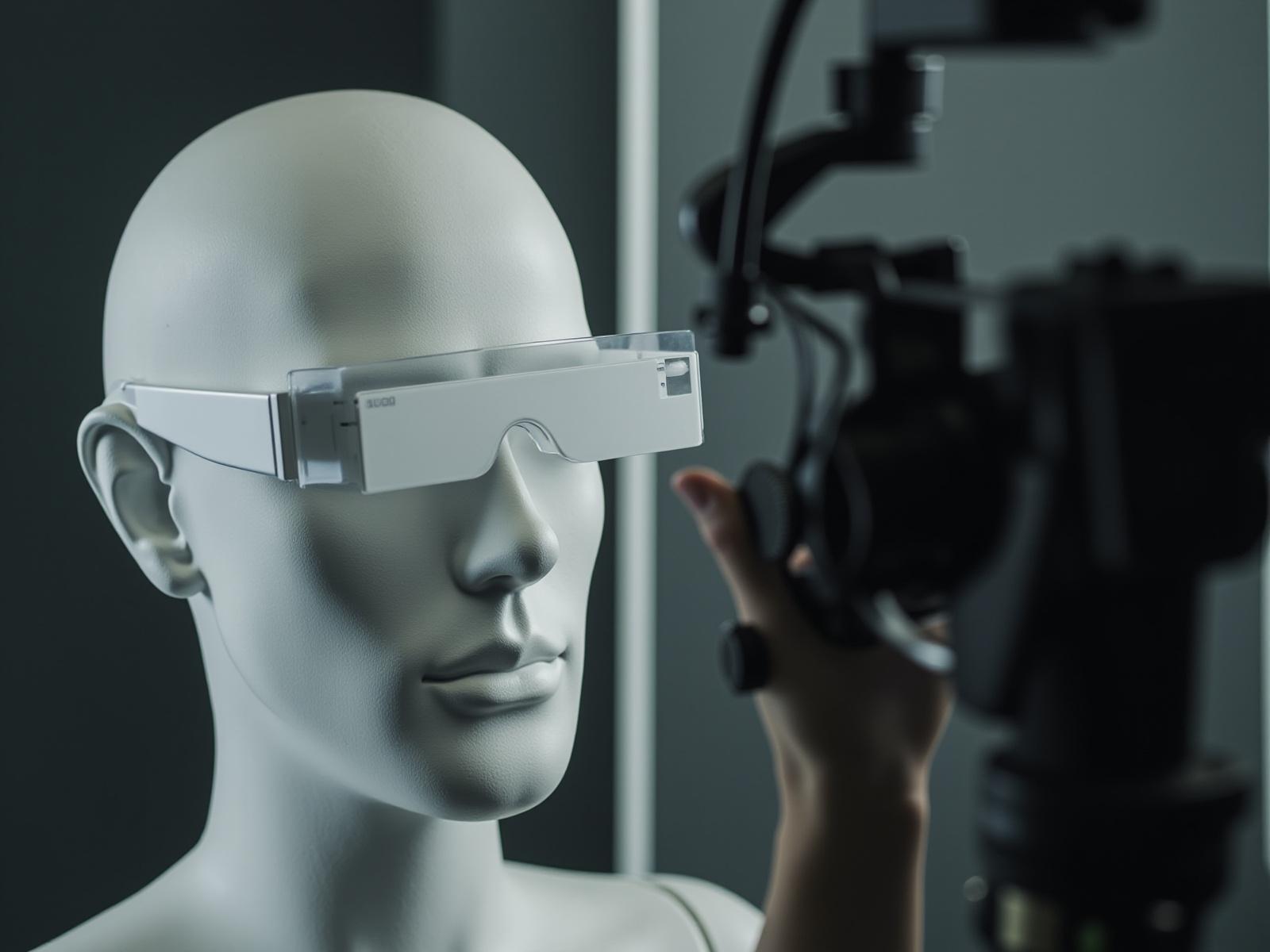
6. Do not convert a perception into an instrument figure. A phone application reading a sound level is not a calibrated instrument, and it is not measuring the right quantity in any case. A pair of calibrated measurement microphones in a coupler fixture is how an acoustic laboratory characterises a device, and even that measures the output rather than the perception. Describe the result in words under stated conditions and label it as a buyer-run evaluation.
7. Run the second-listener leakage check. A second person at a stated distance, with the playback level stated, reports whether anything is audible. If the result is anything other than nothing at all, that belongs in the file and in the care instructions, because a privacy claim that is only approximately true is a claim that will be tested by a customer in a quiet office.
8. Write the result up as an observation, with the conditions attached. Who, where, at what level, at what setting, and what was heard. The bone conduction case study template gives the structure, and the fact it produces is a document, not a number.
The line the protocol must not cross
A sample protocol can produce an observation. It cannot produce a clinical result, a diagnosis, a hearing-improvement claim, or a statement about a population. The distinction is not a matter of careful wording; it is a matter of what the measurement is.
A clinical hearing claim would need a clinical process, a population, an approved method and a different regulatory route entirely. A buyer-run protocol on a named individual under stated conditions is a product evaluation, and it is worth being precise about that in every internal document and in every external use, because the phrase "the tester could hear the source clearly" reads as a clinical finding to a customer and to a reviewer, while "the named wearer could follow the target phrase at the stated setting in the stated environment" is an observation.
The same discipline applies to the listing copy. Words that describe a body part in the context of a benefit — hearing, sight, relief, protection, correction — carry a regulatory weight in this category that the underlying product does not. The mechanism is described under bone conduction audio, and the alternative form factor is covered at open-ear audio.
Where bone conduction programmes go wrong
The result is reported without the baseline and nobody can tell whether it was good. Root cause: the protocol started with the product instead of the subject's unaided hearing. Prevention: make the baseline a required field, not an optional one, and treat a case study without it as incomplete.
The gain setting is not recorded, so the two products cannot be compared. Root cause: the catalogue figure was read as the test condition. Prevention: record the setting used next to the observation, every time.
The person testing the frame removes it and the note says "uncomfortable". Root cause: the reason for removal was not separated from the fact of removal. Prevention: record whether the reason was discomfort or loss of usefulness, because the two have different fixes and different owners.
The listing claims a privacy benefit that was never tested. Root cause: the leakage claim was assumed from the technology rather than measured at a stated distance. Prevention: run the second-listener check on the sample, and publish the distance and the result, or do not publish the claim.
A hearing-related phrase appears in the copy and the product is reclassified. Root cause: the copy was written from the benefit rather than from the regulatory position. Prevention: run the listing copy past someone qualified for the target market, and keep the positioning to personal sound amplification.
The protocol is run once, on a demonstration unit, and never repeated. Root cause: the evaluation was treated as a one-off event rather than as a control. Prevention: keep the approved unit as a reference with its firmware recorded, and compare every later delivery against it, because acoustic behaviour drifts when a component supplier changes and nobody notices.
What a bone conduction programme costs to keep, and the terms that stay fixed
A bone conduction measurement is weak evidence when it rests on one unit and one person, so the sample volume is a commercial line rather than an afterthought. The terms worth negotiating time on:
- Minimum order quantity, and the volume of the evaluation units, which in this category is often two or more per model because a single observation on a single person is weak evidence.
- Packaging and insert design, including the market labels and the language of the documentation pack, which is a low-cost negotiation that carries no tooling implication.
- Delivery splitting against a sample-approval milestone, which is often granted more easily than a price concession because it moves the risk onto the schedule where it belongs.
- The payment sequencing: a deposit when the order is placed, a balance on the inspection result before the goods leave, and a holdback on the documentation.
- The warranty period with a stated response, and in this category the wording of the wear-time guidance, which is a commercial term as much as a product one.
Two cost lines in a bone conduction programme can be quoted but not negotiated. Certification cost and certification lead time follow the process and the testing body rather than your order size. Tooling is often amortised across the first order; the volume it is spread over, and what becomes of the tool if the programme is discontinued, are the two points to pin down. In this category there is a third item that is not negotiable either: the acoustic engineering. A supplier who will not change the transducer, the frame geometry or the firmware tuning is telling you the product is fixed, and the programme should be built around that fact rather than against it.
The document checklist to request before the deposit is: the gain figure with its drive level; the frequency response, with the method and the date; the regulatory positioning statement for each target market; the certificate numbers with the issuing body and validity dates; and the model designation written on the quotation.
The clauses to write into the contract are: the model designation as a line item, with the certificate numbers attached; the acceptance criteria for the sample, referencing the protocol above; a clause on the regulatory positioning per market, with the buyer holding the right to require the copy be amended; and a clause requiring notice before any change of transducer, firmware or frame geometry, because each of those alters the acoustic result without altering the product name.
A site protocol worked through, and the position we can and cannot take
Consider a hypothetical case rather than a real engagement. Assume a brand-side buyer evaluating a bone conduction platform for an industrial channel, where the end user works on a site with machinery noise, wears the product for most of a shift, and cannot remove it to move somewhere quieter.
Step one: the requirement. The target is a specific announcement system at a stated level, not music and not speech, and the environment is continuous low-frequency machinery noise rather than traffic. That single sentence changes the protocol: the target phrase is a machine-safe announcement, the environment is fixed and repeatable, and the question is whether the source remains followable rather than whether the wearer enjoys the product.
Step two: the supplier request. The buyer asks for the gain with its drive level, the response with its method, the pressure the frame applies, the leakage at a stated distance, the microphone pickup figure with the ambient level, and the regulatory positioning for each target market. The supplier answers the gain, the drive level, the positioning and the model designation, and offers to check the rest. The buyer records that the pressure and leakage rows are unanswered, which means the comfort and privacy findings will have to come from the sample rather than from the file.
Step three: the protocol. A named wearer, an unaided baseline recorded in the same spot, the environment stated, the volume setting recorded at which the announcement became followable, the same phrase at the same distance on every run, the second-listener leakage check, and the removal time with the reason. The result is that the announcement becomes followable at a moderate setting in the stated environment, that the second listener hears nothing at arm's length, and that the frame is removed after a couple of hours for comfort rather than for loss of usefulness.
Step four: the decision. The separation of the two removal reasons is what makes the result usable. A comfort-driven removal is a frame and contact-pressure problem, and it is one the buyer can raise as a specification item with a tolerance. A usefulness-driven removal would have been a positioning problem, and the programme would have been wrong for the channel. The comfort finding is converted into an acceptance criterion; the positioning stays as it is.
Step five: the commercial structure. The buyer negotiates the evaluation units as a separate line, splits the first delivery against a sample-approval milestone, and writes the protocol's acceptance criteria and the regulatory positioning into the purchase order along with a notice obligation on any change of transducer or firmware.
Our own position is that we publish the 35 dB gain, the 200 mAh cell, the two-hour charge time, the roughly seven-hour runtime and the Type-C interface because the catalogue states them, and we publish the absent model number and undisclosed customisation capability with the same prominence. We will not present a maximum output as a result, and we will not write a hearing-improvement claim, because a hearing-related description can pull the product into a regulatory framework that a catalogue entry cannot address. We publish no frequency response, no distortion figure, no leakage figure, no microphone pickup distance and no wear-time guidance for this category.
We will also say plainly that this protocol produces a documented, repeatable observation, and not an instrument figure. What we can do is take a completed protocol and tell you which findings are consistent with the published rows for that model and which point at something the product description should say. The specification behind the published rows is in the bone conduction spec sheet explained piece, and the pre-order checks are in how to test before ordering.
What to do next. Give us the target sound, the environment, the wear time and the number of markets, and we will say which fields the protocol needs, which of them our documentation answers, and which have to come from a supplier or from a test on your own units.
Related reading
- The specification behind it — bone conduction spec sheet explained
- The alternative form factor — open-ear audio
Send us a completed protocol and we will tell you which findings are consistent with the published figures for that model.


