

Smart glasses for education: the scenario where the buyer counts rooms
The short answer. An education deployment is not a consumer order multiplied by thirty. It is a room kit, and the room kit is bought in a different unit from the device. A classroom holds a number of rooms, a room holds a number of devices, and the items that make those devices usable — the charging point, the storage tray, the charging case, the wipe, the room quick-start — are counted per room and per term, not per unit. Buyers who specify smart glasses for education as a device-plus-accessory list end up with a kit that is wrong in two places at once: too few charging points, because the count was done per device instead of per room, and too many personal accessories, because a shared device was treated as an issued one. The single question that resolves both is the one an institutional buyer should answer before the quotation rather than after the first delivery: is the device shared across a room, or is it issued to one person for the term?
Who is specifying the pack, and what they are defending. The reader is an institutional buyer, a reseller or integrator building a programme for a school, a training college or a campus, and the decision in front of them is usually not a price comparison. It is a compliance and a plan decision: a written requirement list exists, the quotation is scored against it, and the questions that decide the outcome are which requirements the supplier can meet, which it cannot, and what the school itself has to provide before anything works. What the buyer is defending is the term. A deployment that runs for one academic year has to survive a mid-term failure, an end-of-year asset reconciliation and a renewal decision made by people who were not in the procurement. Those three moments are where a pack specification is either vindicated or ignored.
Why the same device produces very different room kits. The published electrical rows are close together, so the divergence between two education quotations is rarely the battery. It is the charging architecture, because the interface decides whether a room needs a wall socket and a dock, or a case per device that a teacher carries. Our catalogue splits the charging method three ways across the twenty-eight models: seventeen are magnetic, seven publish a Type C interface, and four publish neither a charging method nor a charging port row — the L1 Pro and the CY03, and the MT6 and the CY05, each of which does publish a charging-case capacity. That combination is the awkward one for a classroom, because the case is obviously in the box while the method the teacher uses on it is not published and has to be requested in writing, per model, before the room plan is drawn.
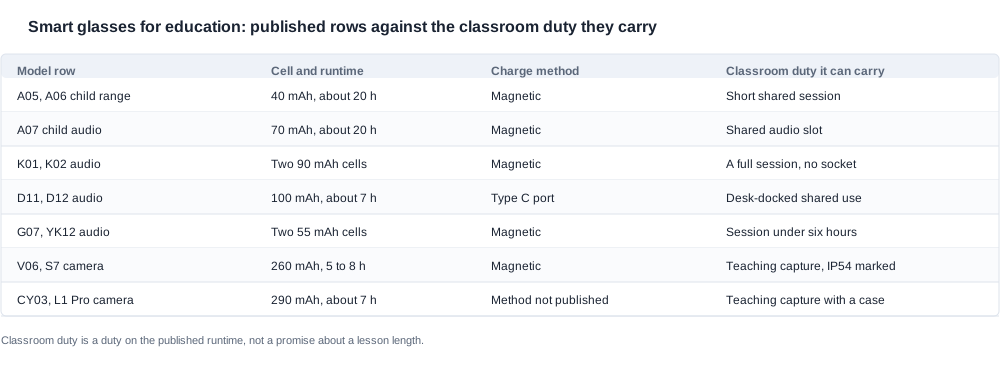
The published rows and the two kits a classroom actually buys
What the published rows mean for a shared classroom set
A classroom set has a duty attached to it, and the duty is a number of hours between opportunities to recharge. That duty is what the published runtime rows have to be tested against, and the catalogue gives enough to do it — provided the buyer does not treat the numbers as more comparable than they are.
The child range publishes the longest runtimes and the least supporting detail. The A05 and the A06 publish a 40 mAh cell, a rated runtime of about twenty hours and magnetic charging; the A07 publishes a 70 mAh cell, the same rated runtime and magnetic charging, and is the only model in that group that publishes a Bluetooth version. Those are the strongest published runtime rows in the catalogue, and they are also the rows where the compliance route matters most, because products for children carry requirements that general electronics does not. That route is a request to make, not an assumption to make, and it is set out at child product. What we will not do is infer a certification scope for a model from a company-level capability, and the catalogue does not carry a per-model certification row at all.
The audio family is the natural choice for a shared room, and the rows split into three groups. The K01 and the K02 publish two 90 mAh cells, a rated runtime of about eight hours and magnetic charging. The D11 and the D12 publish a single 100 mAh cell, about seven hours and a Type C interface. The LC-105 pair, the G07 and the YK12 publish two 55 mAh cells and magnetic charging, with the runtime clustering at six to eight hours — and the two models in that group that publish the lower figure, the G07 and the YK12, are the two that publish ultra-slim or slim detachable temples. A buyer who assumes a uniform eight hours for the 55 mAh group is wrong twice over, once on the runtime and once on the physical part that will not survive a corridor.
The camera family is where the capture duty and the case question meet. The V06 and the S7 publish 260 mAh cells, runtimes of five to eight hours and magnetic charging, and they are the only two models in the entire catalogue carrying an ingress marking. The marking covers splashing water and a dust protection level; it does not cover immersion or a sustained downpour, and no third-party test report is published behind it. The L1 Pro and the CY05, and the CY03 publish 290 mAh cells and about seven hours, and they ship with a 1400 mAh case, which makes them the easiest camera configuration for a shared room because the case is also the storage object. The MT6 publishes 265 mAh, about seven hours and a 1200 mAh folding case, and it is the only model in the catalogue with a published whole-unit weight, 158 g, excluding the case. The digit reading is at IP ratings and the published charging rows are at charging solutions.
The numbers that cannot be compared to each other. The catalogue publishes cells in two forms, a single cell such as the 100 mAh on the D11, the D12 and the ZH12, and a doubled cell such as the 90 mAh times two on the K01 and the K02. A total written as "180 mAh" is a derived figure and has to be labelled as derived wherever it appears, because a buyer who quotes a derived total to a school is quoting something the catalogue does not support. Charge times are published for all twenty-eight models — two hours or less for twenty-six of them, roughly one hour for the D17 and the ZH12 — but no charge time carries a starting state or an end criterion, so it cannot be turned into a usable window for a lesson timetable. No runtime in the range carries a test condition, so a rated eight hours and a measured eight hours are not the same claim. And no camera model publishes a Bluetooth version, which matters for any classroom plan that assumes a managed connection.
The room kit and the personal kit are two different bills of materials
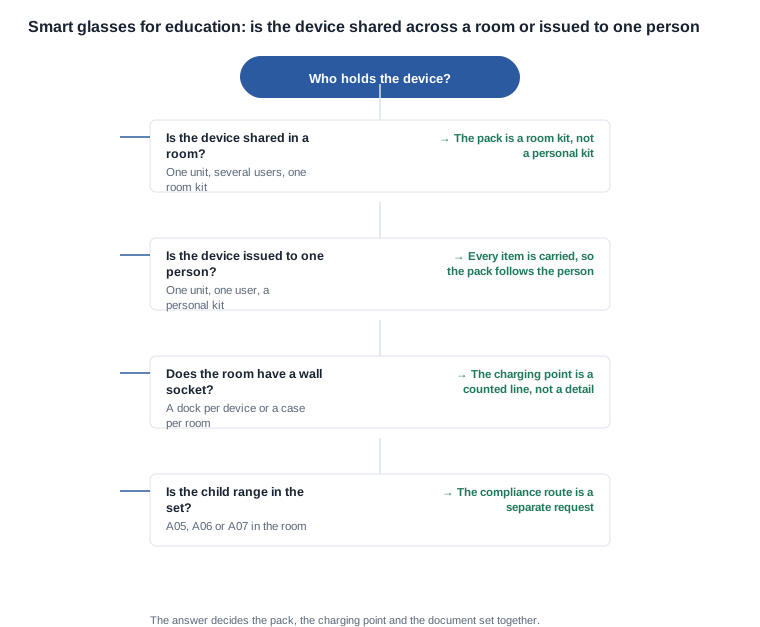
This is the split that most often gets missed, and it is a units problem before it is a content problem. A shared device produces a room kit: a charging point for a group of units, a storage tray that holds the units between sessions, a wipe for the shared surfaces, and one quick-start card for the room. An issued device produces a personal kit: a case, a cable, a personal wipe and a personal instruction. Both kits exist in education, and they have different counts, different suppliers, different minimum order quantities and different replacement rates.
Counting the room kit. The first number a buyer needs is the number of devices per room, and the second is the number of rooms. The third is the number of devices that can charge at once, and that number is set by the interface, not by preference. A magnetic model charges on a contact dock and a dock holds a defined number of units; a Type C model charges from a socket with a cable, and a school with a fixed number of wall points has a hard ceiling on how many devices can be topped up at the end of a session. Neither dock count nor cable count is published for any model, which means the room kit has to be built from a written answer about charging behaviour rather than from a catalogue row. A procurement manager who asks for the dock capacity per model, the charge time with its starting state and the behaviour when a case is plugged in will get a room plan; a buyer who does not will get a room plan built on an assumption.
Counting the personal kit. Where a device is issued to a person for the term, the personal kit becomes the specification that travels with the device, and the case question returns. The published case positions are: five camera models with a published capacity — the CY05 and the L1 Pro, and the CY03 — each at 1400 mAh, the L2 Utral at 900 or 1400 mAh as a configuration choice, and the MT6 at 1200 mAh in a folding case; two more, the KY06 and the MT5, with a case and no published capacity; and four, the V03 Pro and the V06, and the V03 and the S7, with no case row in the catalogue at all, so the room plan has to state what each model carries. The audio and sport models publish no case row either. The consequence for a school is precise: if the chosen model publishes no case row, then a case is either a custom accessory with a different price and a different lead time, or it does not exist, and that decision belongs in the requirement list rather than in the delivery.
The consumables are the cheapest line and the easiest to omit. A wipe for shared surfaces and a printed insert for the room cost a few cents per unit and change nothing else in the operation, which is exactly why they are the first thing dropped when a budget is cut and exactly why they are the line that pays back. A room that shares a device without a wipe accumulates a hygiene complaint; a room without a printed quick-start accumulates a request for a member of staff to demonstrate the device every session.

What the room kit costs in the file rather than in the box. Two things in a deployment cost nothing per unit and everything in administration: the device identity scheme and the end-of-term reconciliation. A school that cannot say which of its four hundred units is in which room cannot write a replacement order, cannot close an insurance claim and cannot answer a parent's question. The catalogue publishes model designations and the model-level rows, but no per-unit serial scheme and no device management path are published, so both have to be requested, written into the requirement list and tested on a sample set at the scale the institution will actually run. That is a procurement task, and it is the one most often left to the supplier's default, which is the worst possible answer for an institutional buyer.
The document set an institutional buyer has to obtain before pricing
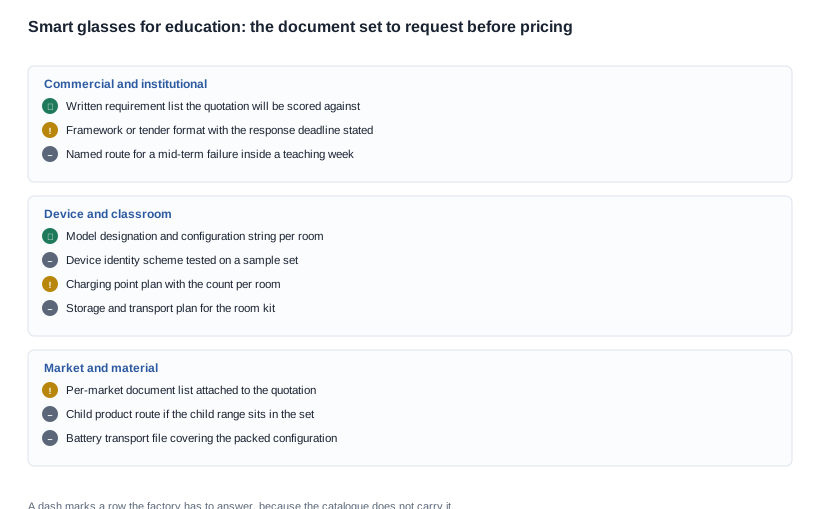
Education buying is specification-led, and the document set is where a programme is won or lost, because a requirement list that is attached to the quotation makes the comparison meaningful and a document set that arrives afterwards makes it meaningless. The verification work here is a request list, and each request has a completion standard.
- The written requirement list, attached to the quotation. The completion standard is a document that the supplier answers item by item, stating which requirements are met, which are not met and which are open. A supplier that answers honestly about an open row is more useful than one that answers every row affirmatively.
- The document set for each destination market, per market. The completion standard is a list, not a single file, because the markets differ and one file cannot cover them. The market requirements for a European deployment are set out at GPSR, and the document set is a per-market commercial decision, because each one is a separate cost with a separate lead time.
- The child product route, where the child range is in the set. The completion standard is written evidence of what the model is and what it is not, and a clear statement of which parts of the requirement set remain open. The requirement list is at certification checklist.
- The battery transport file covering the packed configuration. The completion standard is a document reference naming the model, the case configuration and the cell count, because a classroom set with a case in every room is a different declaration from a set without one. The requirement is at battery transport.
- The charging behaviour answers per model. The completion standard is a written answer for the charging input, the charge-time starting point, the indicator behaviour, the case charge time and whether a case charges the device while plugged in. None of the five is published for any model, and a school timetable cannot be built on a family-level answer.
- The device identity scheme, tested on a sample set. The completion standard is that a unit can be identified, traced and reconciled at the scale the institution will run, demonstrated on the sample rather than described.
- The replacement commitment for a mid-term failure. The completion standard is a named route, a stated response time and a stated cost treatment, because a device that fails in the middle of a teaching week is a pedagogical problem before it is a commercial one.
- The incoming inspection protocol, agreed before production. The completion standard is a written procedure covering the configuration string, the room quick-start, the carton artwork and the accessory count, applied to a stated sample of the production lot. Quality consistency across lots is covered at quality consistency.

Where an education deployment goes wrong after the invoice
The room that ran out of charge points. The count was done per device instead of per room, and by the third week the last units in the room are the ones that get skipped. The control is a charging plan with a count per room, agreed before the order, and a written answer on the charging behaviour that the plan depends on.
The shared device treated as an issued one. Every pupil was issued a personal kit, the consumables disappeared into school bags, and the room ran with nothing to charge from. The control is to state the shared-to-personal ratio as a configuration attribute and to price the two kits separately.
The case that was assumed into the plan. The chosen model publishes no case row, so the room plan that assumed a per-unit case was never executable. The control is to settle the case position per model before the room plan is drawn, and to treat a case on a model that publishes none as a custom request with its own lead time.
The model that a teacher could not set up. The device required an individual pairing per user, and the class model cannot absorb that. The control is to test the set-up path on a sample set, with the number of devices the institution would actually deploy and with the accounts the institution would issue, and to record the time per device as a number, because that time is a staffing cost in the deployment plan.
The cohort that could not be counted at the end of the year. Devices were identified only by a customer name on a platform, so the reconciliation produced a number nobody could act on. The control is to require a device identity scheme as a configuration attribute and to test it on the sample, and to keep the term-end reconciliation as a named deliverable in the contract rather than as an assumption.
The renewal that nobody owned. A deployment ends with a procurement decision made by people who never saw the requirement list and who are given a usage summary instead of a justification. The control is a short handover pack at the end of term: the model mix, the fault rate, the consumable consumption and the open items, written once, so that the next buyer is not starting from zero.

The commercial structure of an education programme
Institutional buying is specification-led, and the commercial consequence is that price is one term among several. The terms that decide the outcome are the document set, the warranty and the replacement route for a failure inside a teaching week, the device identity scheme, and the support commitment. Where a framework agreement or a tender route is used, the quotation is scored against a written requirement list, which means the supplier's ability to state precisely which requirements it meets is itself a commercial advantage.
The compliance cost is per market and per product family, and it is not compressible. That makes the market count a commercial decision: entering three markets is three document sets, three cost lines and three lead times, and the buyer should know the price of each before the market is announced. Where a market is added later, the change route should say what it costs and how long it takes, because a market added without that clause is paid for by the supplier and appears in the next quotation. The same logic applies to tooling and to any mould work, which is normally amortised across an order while certification cost follows the product family; a blended line hides a cost that repeats on every future order next to one that does not.
The term, not the order, is the commercial unit. A one-year deployment of four hundred units produces a different contract shape from four separate purchases of a hundred, because the consumables reorder, the spares sit in a store room, the identity scheme has to survive a year, and the replacement commitment has to hold across a teaching year. Buyers who negotiate the purchase order and ignore the term end up paying for the consumables at a premium and for the spares at a premium, because both are treated as one-off items.
The terms worth putting in the order. The published rows for each model in the set. The configuration string per room, repeated identically on the insert, the carton label and the purchase order. The room kit and the personal kit as separate lines with separate counts. The charging plan with its point count. The device identity scheme and the end-of-term reconciliation as named deliverables. The per-market document list. The battery transport file covering the packed configuration. The incoming inspection criteria and the point in the flow at which they are applied. The warranty period with a stated response, the mid-term replacement route, and the treatment of a unit returned with a missing accessory. The trade-offs between unit price, consumable cost and administrative cost are settled in the quotation rather than after it. The building blocks are at MOQ, lead time, production capacity and contract terms, and a sample order is the cheapest way to settle the set-up and identity questions — the procedure is at samples.
What we publish for an education deployment, and the next step
We publish the rows a buyer can order from, and we will not fill an open row with a typical figure. For this range that means the resolution class, the cell capacities, the charge times, the rated runtimes, the charging method per model where one is published, the structural features that are published, and the case capacities on the models where they are published. For an education deployment that means the table above is offered as a configuration map for the room plan, not as a promise about a lesson length or a term.
What we do not publish, and will not estimate, is the charge-time starting point, the indicator behaviour, the case charge time, the case pass-through behaviour, the runtime test condition, the charging input, the per-model frame weight beyond the single 158 g whole-unit figure for the MT6, the lens material, the coating, the field of view, the video specification, and any device management or identity scheme. We will not state that any model is tested to an ingress rating, because no test report stands behind the two markings that exist, and we will not extend that position to models that publish none. On certification, the catalogue carries a company-level export certification page and no per-model certification row, and its text contains no reference to CE, FCC or RoHS at all, so the certification scope of a model — including the models in the child range — is material a buyer has to request in writing. We will also make no claim about eyesight, eye health or the protective effect of any model, because we publish no evidence for one.
What to send us. Send the institution type, the number of rooms and the number of devices per room, the shared-to-personal ratio, the markets, the term length and the expected volume, and we will return the room kit and the personal kit as separate lines, the published rows that cover each model, the document set that has to be obtained per market, and the four points where a deployment in this category most often fails after the invoice. The channel context is at smart glasses for education, the model families are at kids smart glasses, Bluetooth audio glasses and AI camera glasses, and the selection logic that sits upstream of the kit is at how to choose for education.
Related reading
- The channel situation — smart glasses for education
- The selection sequence — how to choose for education
- The deployment template — education deployment template
- The product options — education product recommendations
Send the room count, the device ratio, the markets and the term, and we will return the room kit and the personal kit as separate quoted lines.


