

A datasheet for an open-ear audio product reads like a specification and behaves like a parts list, and the reason is that the published rows describe the electronic architecture while the acoustic behaviour — the thing the customer is actually buying — is described in words rather than measured. This page is written for the buyer reading a supplier's sheet and needs to know which rows are comparable and which are missing, and it sets out the method, the rows to request and the test that closes the gap.
Our published position across the audio tier makes the pattern visible. The published rows are: Bluetooth 5.3 on the K01 and K02 and 5.4 on the rest; cell configurations at 55 mAh × 2, 90 mAh × 2 and 100 mAh; charge times of two hours or less; runtimes of roughly six to eight hours, with roughly six for the G07 and YK12, roughly seven for the D11 and the D12 and roughly eight for the K01, K02 and the LC-105 pair; magnetic or Type-C charging; no touch row for any model; and features including surround sound and slim detachable temples. On acoustic performance, the published position is that no third-party measurement supports any model.
So open ear audio glasses smart glasses how to read a datasheet is a method for reading a sheet whose most important row is a sentence.
Open ear audio glasses: the sheet sells electronics, the customer buys acoustics
The answer for a buyer who has already read the sheet
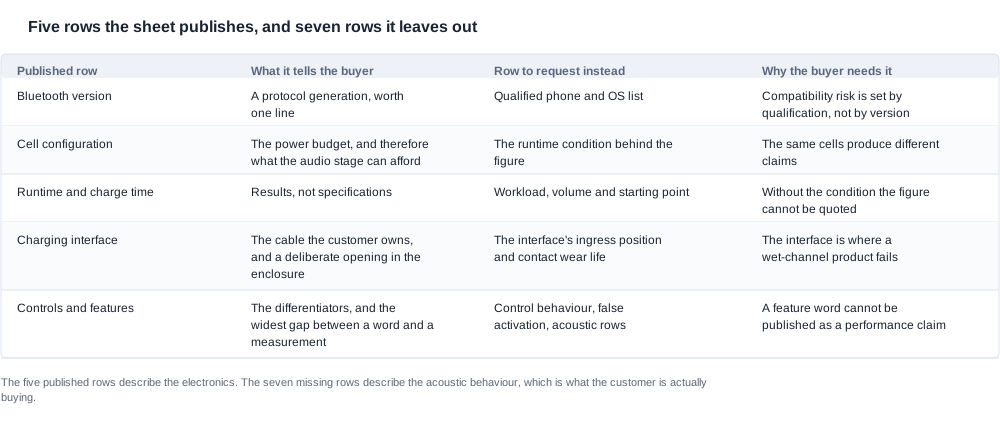
Read the sheet for the five rows it does publish — the radio version, the cell configuration, the runtime and charge time, the charging interface, and the control and feature rows — and then read it for the seven acoustic rows it omits. The published rows tell you what the product is made of; the omitted rows tell you what it sounds like, how loudly it leaks into the next seat, and how well a call works, and those are the rows that decide whether the channel can carry the product. Until those rows exist, the sheet supports a hardware description and nothing else.
Who is reading it and what they are defending
A procurement manager is comparing two audio products on rows that do not include the thing that matters, and needs to know which single question to ask so the comparison stops being about the printed row.
A product manager is building an acoustic proposition and needs to know whether the sheet's feature words can carry it, or whether the words have to be replaced by measurements before any copy exists.
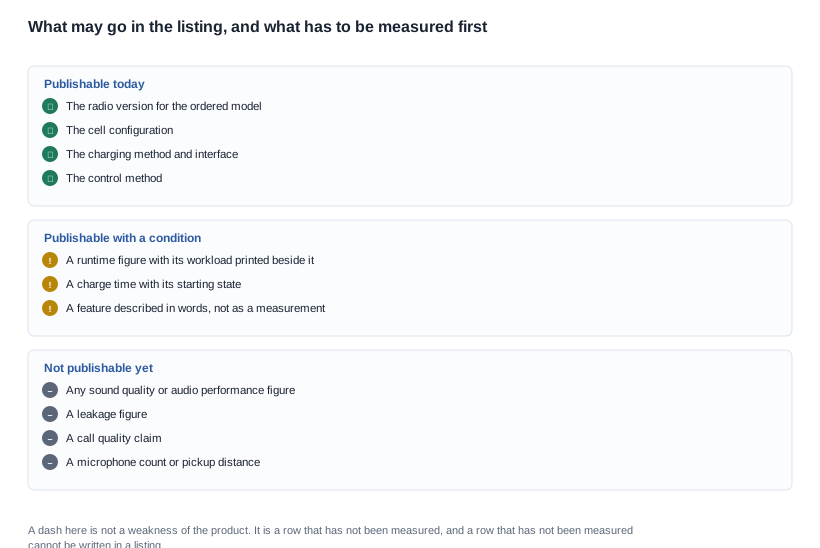
A channel buyer is writing the listing and needs to know which acoustic claims are publishable today, which become publishable after a measurement, and which are not publishable at any price.
Why the electronics rows are the easy part
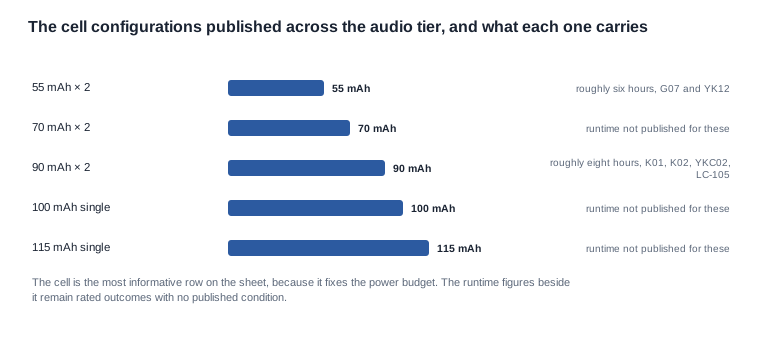
The five published rows are internally consistent and easy to compare, which is exactly what makes them dangerous. A buyer who compares two candidates on cell configuration and runtime will find that the comparison works, that the numbers are legible, and that it settles nothing. The cell does fix the power budget, and the power budget does constrain what the audio stage can afford to do — but a product with more power is not automatically a product that sounds better in the environment the customer is in.
That is the structural reason an open-ear datasheet feels informative and decides nothing. Every row on it is about the box, and the customer is buying what comes out of the box.
The cell configuration is the most informative row on the sheet
This is the row worth reading twice, because it does more work than its position suggests. The published dual-cell arrangements at 55, 70 and 90 mAh per side, and the single 100 mAh and 115 mAh cells, tell you the power architecture of each configuration, and the runtimes map to them closely: roughly six hours for the 55 mAh × 2 models and roughly eight for the 90 mAh × 2 models.
Read it as a budget rather than as an endurance answer, and it stops being circular. Two candidates with different cell arrangements are not competing on the same claim; one of them has more power to spend on the audio stage, and the other has less. That is a real difference and it is worth putting in the comparison table — as a power budget, with the runtime attached as a rated outcome rather than as a specification.
The thresholds that decide whether an acoustic claim can be made
| The row | What it is | What it actually tells you | The threshold or the question |
|---|---|---|---|
| 1. The Bluetooth version | 5.3 on two models, 5.4 across the rest | A protocol generation, worth one line, and in our published data it corresponds to no product difference | The version for the configuration ordered. The Bluetooth audio glasses range page lists the models and their rows |
| 2. The cell configuration | The published dual-cell arrangements at 55, 70 and 90 mAh per side and the single 100 mAh and 115 mAh cells | This is the most informative row on the sheet, because it tells you the power budget and therefore what the audio stage can afford to do | The cell for the configuration ordered, and the runtime condition behind the figure |
| 3. The runtime and the charge time | Roughly six to eight hours and two hours or less, both without stated conditions | Both are results rather than specifications | The test condition, the starting point, and the volume and content in the measurement. The battery life specifications page covers the method |
| 4. The charging interface | Magnetic across the tier, Type-C on some models elsewhere in the range | It determines the customer's cable, and it tells you the enclosure has a deliberate opening | The ingress position of the interface, and the contact's wear life |
| 5. The controls and features | Surround sound, the temple claims, and the absence of a published touch row | These are the product's differentiators and they are where the sheet sounds most confident — and where the gap between the word and the measurement is widest; where nothing is published at all, the gap is the whole row | The control behaviour, the false-activation behaviour, and the acoustic rows behind the sound claim |
The seven rows to request, in one message
The microphone count and the pickup distance. The driver size. The frequency response. The leakage figure with its conditions. The output level. The control behaviour, including what happens on a false activation. The runtime condition.
Seven rows, per model, and each one either exists or does not. A supplier who answers all seven has a measurement habit; one who answers two is telling you something you need to know before the deposit. The open ear audio key specifications page sets out the rows; the microphone specifications to request page covers the input side; the microphone measurement page covers how to close them; and the real world performance page covers what the published figures become in use. The Open ear audio technology reference covers the architecture.
Why a feature word cannot be published as a performance claim
Surround sound, spatial audio, bass enhancement, hi-fi, immersive — these are the words an open-ear sheet uses, and they are the words that create the most risk, because they are specific-sounding and unmeasurable as written. A customer who reads "surround sound" and hears ordinary stereo has been given a claim the product does not support, and the complaint arrives as a description of quality rather than as a description of a feature.
The safe form is descriptive. Describe what the product does — that it leaves the ear canal open, that it carries a temple control surface the catalogue does not describe, that the runtime figure applies to continuous audio playback — and keep the evaluative words for the rows you have measured. Where the catalogue is silent, a temple control surface has to be confirmed with the supplier rather than described from the page. The distinction sounds pedantic until the first listing is pulled.
The leakage figure is the row that decides the channel
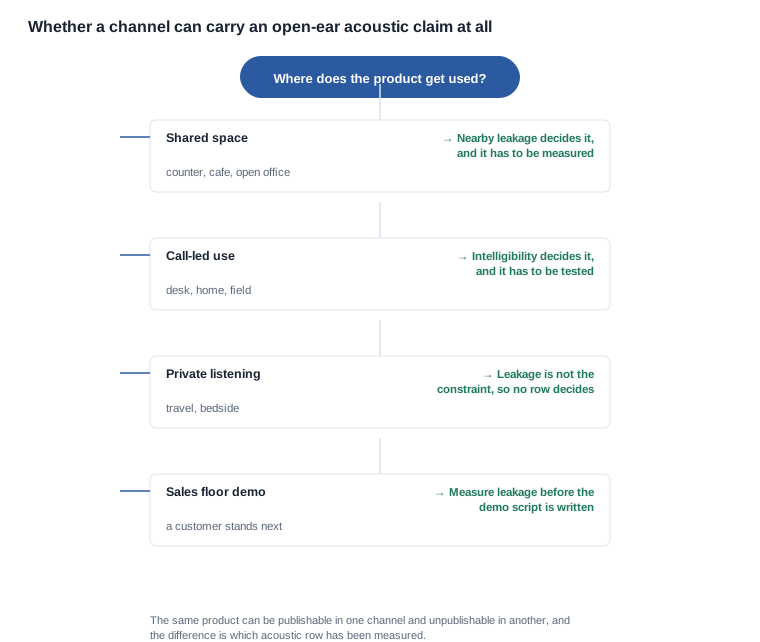
Leakage is how much of the sound reaches a person sitting next to the user, and it is what decides whether an open-ear product can be sold into a shared space at all. A shared-space channel — a counter, a café, an open office — has an acoustic consequence, and if the leakage figure has never been measured, the product has never been qualified for that channel, whatever the sheet says about the driver.
The measurement has to state a distance and a level, because leakage depends on both, and it has to be taken at the output level you intend to ship. A leakage figure quoted at a level the product will never run at is not conservative, it is irrelevant.
The output level is the row that decides the comparison
Two open-ear products at the same volume setting are not at the same output level, and a comparison made on a volume setting is a comparison of the two products' amplifier gains. If the two candidates cannot produce a matched output level, the intelligibility comparison that follows is meaningless, and the buyer has a measurement problem rather than a product problem.
How to choose between two candidates when the sheet is silent
Here is the short answer to the question a buyer actually has, and it is a checklist rather than a number.
How to shortlist. Shortlist on the power budget first, because it is the only published row that describes a capability rather than a result. Then shortlist on the interface, because it determines what the customer has to own and what you ship in the box. Everything else on the sheet is a filter.
What to ask the supplier. Ask the seven acoustic rows in one message, ask the runtime condition, and ask who ran the measurement and on what configuration. The answers tell you more about the supplier than the numbers do.
Which criteria go into the acceptance criteria. Leakage at a stated distance and output level, intelligibility scored at the far end at a matched output level, and the runtime condition. Those three can be written into a purchase order as a pass or a fail, which is the only form of a criterion that can refuse a lot.
What the red flags are. A feature word with no measurement behind it. A runtime with no condition. A frequency response that is clearly a component curve rather than a product curve. A leakage figure with no distance. And a supplier who declines to state an output level, because without it no acoustic comparison is possible.
When to stop comparing and start measuring. Stop comparing sheets when the second candidate's sheet produces the same rows as the first. At that point the remaining differences are acoustic, and acoustic differences are settled on a sample, not on a page.
The total cost view. An open-ear programme carries an accessory minimum order quantity, a packaging slot for whatever ships in the box, and a return exposure that is higher when the acoustic claims are wider than the evidence. Those three costs are usually larger than the unit price difference between two candidates, which is why the right comparison is not the price per unit.
Working through the sheet and then closing the acoustic gap
Mark every figure that has no condition attached. On a good sheet it is a short list. On a poor one it is most of the page, and the length of that list is a faster indicator than any single number.
Ask the acoustic rows in one request, per model. Seven rows, and each one either exists or does not.
Measure the leakage on a sample, at a stated distance, at the level you intend to ship. The open-ear audio page covers why fit changes the result, and it is the row that decides a shared-space channel.
Test the sound at the seating your customer uses. The sound of an open-ear product depends on where the radiators sit relative to the ear canal, which depends on the temple geometry, and the geometry is not published. A product that sounds right on a desk can sound different on a person, and the difference is geometry.
Score intelligibility at the far end, at a matched output level. Volume is not intelligibility, and a listener at the far end is the only one whose opinion matters. The microphone side of the same protocol is covered at how to measure smart glasses microphone quality.
Decide the listing boundary before the copy exists. The radio version, the cell configuration, the runtime figure, the charge time, the charging method, the control method, the surround sound row and the temple description are published. The acoustic figures, the output level, the control behaviour's edge cases and the runtime condition are not.
What this read is worth as a procurement instrument
The output of the read is a two-column sheet. The left column holds the rows the supplier publishes, and the right column holds the rows that have to come from somewhere else — a request, a measurement, or a written confirmation. A buyer who produces that sheet before the first sample order is not being pedantic; they are converting a comparison that looks like a decision into one that is a decision, and they are doing it before the tooling, the artwork and the copy are committed.

Where an open-ear sheet is misread
The runtime was read as a specification. Symptom: a customer expects eight hours and gets six. Root cause: a result with no condition was treated as a guarantee. Prevention: ask for the condition, and print the workload beside the figure.
The cell configuration was treated as a battery-life answer. Symptom: a channel's endurance plan is built on the wrong row. Root cause: the most informative row was read as the only one. Prevention: use the cell to plan the workload, and the condition to state the claim.
The sound claim was taken at face value. Symptom: a listing promises a sound quality no measurement supports. Root cause: "surround sound" was read as an acoustic specification. Prevention: request the acoustic rows, and describe the feature in words.
The interface was read as a sealed product. Symptom: an ingress expectation that the open charging contact does not meet. Root cause: the port was ignored. Prevention: ask for the interface's ingress position, and check the contact's condition on receipt.
The temple description was read as a dimensional claim. Symptom: a fit expectation that a name does not support. Root cause: a catalogue descriptor was read as a measurement. Prevention: measure the temple, and quote nothing you have not measured.
The features were compared and the acoustics were not. Symptom: the chosen product is chosen on a control method, and the call quality is discovered later. Root cause: the readable rows were compared and the missing ones were not requested. Prevention: request the acoustic rows in the same message.
The two candidates were compared at equal volume rather than equal output level. Symptom: a comparison result that reverses when the products are used in a real room. Root cause: a volume setting was treated as an output level. Prevention: match the output, then score intelligibility.
What the acoustic rows are worth commercially
A datasheet you have read properly is a cheaper sample programme, and a cheaper sample programme is a lower return rate. The seven acoustic rows cost one request, and they are the rows that decide whether an audio product can be sold into a call-led channel or a shared-space channel at all. Before you order, the trade-offs worth the negotiation time are the ones that change the total cost: the accessory minimum order quantity, the packaging slot, the return terms and the warranty response time. The common pitfalls in this category are all avoidable at the quotation stage and expensive afterwards — a listing that claims more than the evidence, a channel placement that ignores leakage, and a first shipment with no incoming acoustic check.
The commercial terms that matter in a datasheet-led negotiation are the ones that let you re-judge the acoustic rows yourself, because the assembly consistency behind them is unusually hard to verify from a spec sheet. Those terms are unit price and volume tiers, the accessory and charging set with its minimum order quantities, packaging specification, delivery splitting, payment nodes against inspection, the warranty period with a stated response, the return terms, and the terms of a pilot order. These are the trade-offs worth the negotiation time, and the accessory minimum order quantity is the line that decides whether a dock-based proposition is workable at your volume. Whether the supplier will run the acoustic protocol against production units, and whether they will supply the recordings or transcripts so you can re-judge them, is worth more than a price concession in this category, because the acoustic behaviour is unusually sensitive to assembly consistency.
Two costs in an acoustic programme can be quoted but not negotiated, and they are frequently bundled into a single line that hides which is which. The structural work on the temple and the acoustic fixture that measures leakage are the two lines worth separating out, because a leakage figure produced on a bench rig and a leakage figure produced in the finished temple are different numbers and the quotation rarely says which one you are buying. Below both sits the acoustic design itself: a supplier who will not change the transducer, the radiator geometry or the tuning is telling you the sound character is fixed.
The agreement is where a datasheet becomes a commitment, so it should carry the published rows for the configuration ordered, the acoustic rows once established with their conditions, the runtime condition, the control behaviour, the interface position and the contact's wear life, the leakage figure with its measurement conditions if one exists, and the warranty period with a stated response.
The agreement should equally bound the copy: any acoustic, sound quality or call quality claim that has not been measured on a sample, and any runtime figure without its condition.
A worked scenario: two audio candidates for a shared-space channel
A buyer placing an open-ear product in a place where the next customer can hear it is deciding whether the product belongs in that place at all, and the five steps below are the order in which that decision gets made.
Assume a channel buyer placing an open-ear product in a retail chain where a customer stands next to another customer, and a second placement in a call-led desk channel. The binding constraint is that the previous product in the retail chain generated complaints about sound reaching the next customer.
Step one is the sheet read. Both candidates' sheets carry a radio version, a cell configuration, a runtime, a charge time, an interface and a feature list. The candidates are separated on the cell configuration, which the buyer converts into a power-budget column rather than an endurance column. Neither sheet carries an acoustic row, and the buyer's output is the two-column sheet: five published rows on the left, seven requested rows on the right.
Step two is the request. The seven rows go to both suppliers in one message. One supplier answers with a leakage figure with conditions, an output level, a product-level frequency response and a control behaviour, and declines to give a microphone pickup distance. The other answers with a component curve and a feature description. The buyer records the difference in evidence quality, and draws no performance conclusion from it.
Step three is the sample. The buyer measures leakage on both at a stated distance and a stated output level, and scores intelligibility at the far end at matched output rather than matched volume. The measurement reverses the order the sheet suggested, because the sheet's ordering was about electronics.
Step four is the channel split. The candidate that passes the leakage measurement in the retail placement is not automatically the one for the desk channel, and the buyer places them separately. That is the commercially valuable outcome of the whole exercise: one product, two channels, two claims.
Step five is the copy. The retail listing makes no sound quality claim and states the leakage figure with its conditions. The desk listing states the intelligibility result with the level it was measured at. Neither listing repeats the runtime without its condition.
The decisive measurement was a leakage figure at a stated output level, and it cost an afternoon.
What our audio rows publish and what has to be measured
A datasheet for an open-ear audio product is a parts list, and the rows the customer buys on are the ones it omits. We will not publish a microphone count, a pickup distance, a driver size, a frequency response, a leakage figure or an output level for a model where the manufacturer has not provided one, and we will not present a runtime without its condition or a feature name as a measurement.
On acoustic performance specifically, the published position across the audio tier is that no third-party measurement supports any model, and that is a statement about the absence of evidence rather than a statement about the product.
What we will do is give you the five rows that do exist, the seven to request, and the method for reading each. The Open ear audio technology reference covers the architecture, the Bluetooth audio glasses range page lists the models and their rows, and the battery life specifications page covers the measurement method.
What to do next.
- Mark every figure on the sheet that has no condition attached, and put the runtime and the charge time in that column.
- Request the seven acoustic rows, per model, in one message.
- Measure the leakage on a sample at a stated distance and a stated output level, and test the sound at the real seating with the far end scoring intelligibility.
- Put the acoustic rows, the runtime condition and the return terms in the agreement.
- Write the listing from the rows you have, and say nothing about the ones you do not.
Related reading
- The architecture — Open ear audio technology
- The rows to request — open ear audio key specifications
- The measurement approach — microphone measurement
Tell us the models, the channel and the environment, and we will tell you which rows are documented and which have to be measured.


