

Two audio models sit on adjacent catalogue pages, and the specification block between them disagrees in exactly two places. Page 21 gives the K01 a 90mAh2 cell configuration and Bluetooth V5.3; page 25 gives the LC-105-2 a 55mAh2 configuration and V5.4. The remaining entries read the same on both pages: an approximately eight-hour runtime claim, a charge time of two hours or less, magnetic charging, and no feature line. Everything else a buyer would ask about these two models is answered by a catalogue that does not publish it, so the honest framing is narrow. This is a comparison of two cell notations and one radio version, wrapped in four rows that are identical.
The reason to write it down is that a procurement file does not end at the catalogue page. The model string is what appears on the purchase order, on the carton artwork, on the radio test report, on the spare-parts order for the magnetic dock, and on the warranty line, and every one of those artefacts is keyed to the designation rather than to the published row. Two designations that publish identical rows therefore cost two of everything downstream, while the specification argument that would normally justify that cost is unavailable here, because the specification rows agree.
What follows is built in the order a sourcing team works in. First the two rows that disagree, so the comparison has a defined edge. Then the cell notation, because a paired-cell figure and a single-cell figure are read by a procurement team as different commitments. Then the shared runtime claim, which is the number most likely to reach a listing page and the number with no published test condition behind it. Then the charging and accessory questions, including what the eight audio models leave unsaid as a group. The closing section converts all of it into three decisions and a request list for a specification sheet, and it sets out the criteria a buyer should use to evaluate the pair rather than a verdict we are not in a position to supply.
Two points of scope before the detail. Nothing here compares the two models on price, because the catalogue does not publish prices for any model, and a comparison built on an unpublished number is a comparison of assumptions. And nothing here treats a missing row as an absent feature: the catalogue publishing no charging-case row for the K01 or the LC-105-2 is a gap in the documentation, not a statement that neither product can be supplied with a case. Our position, stated plainly, is that the two rows that differ are the only basis on which a model recommendation can be defended, and we do not read the four matching rows as evidence that the two products are interchangeable in use.
The two models and the two rows that differ
Catalogue page 21 carries the K01 and page 25 carries the LC-105-2, and each page publishes the same five standard rows: Bluetooth version, cell capacity, charge time, stated use time and charging method. Set the two pages next to each other and four of the five agree exactly. The cell configuration does not agree, with 90mAh2 on one page and 55mAh2 on the other, and the radio version does not agree either, with V5.3 on one and V5.4 on the other. There is no third difference hiding in the margin, because neither page carries a feature line.
The feature line is where this catalogue normally records what sets one audio frame apart from another, so its absence on these two pages is itself a published fact worth reading carefully. Across the eight audio models — the LC-105-2 and the LC-105-1, the K01 and the YK12, the K02 and the D12, and the D11 and the G07 — five pages carry no feature line at all and three do. The D11 adds surround sound and a long battery life line, the G07 adds an ultra-thin and detachable temple line, and the YK12 adds surround sound and a slim temple line. The two models in this comparison sit in the group of five where the catalogue publishes nothing beyond the standard rows, so a feature line cannot separate them even indirectly.
The range is also built in pairs, and that is what gives this comparison its shape. The K01 page repeats the K02 rows word for word, and the LC-105-2 page repeats the LC-105-1 rows word for word. Setting the K01 against the LC-105-2 is therefore not a comparison of two individual products with two individual sets of differences; it is a comparison of two pairs that the catalogue has kept interchangeable inside themselves, where the only separation between the pairs is the cell configuration and the radio version.
For a sourcing team the practical consequence arrives before the specification discussion does. The model string on the purchase order determines which artwork runs on the carton, which dock the spare-parts line carries, which serial range the warehouse books against, and which conformity document set sits in the approval file. Because four of the five published entries are identical, there is nothing in the catalogue to justify carrying both strings, and equally nothing in the catalogue that says the two are the same product. That ambiguity is what the rest of this article resolves, and it is also what decides when to split a buying programme and when to hold a single string.
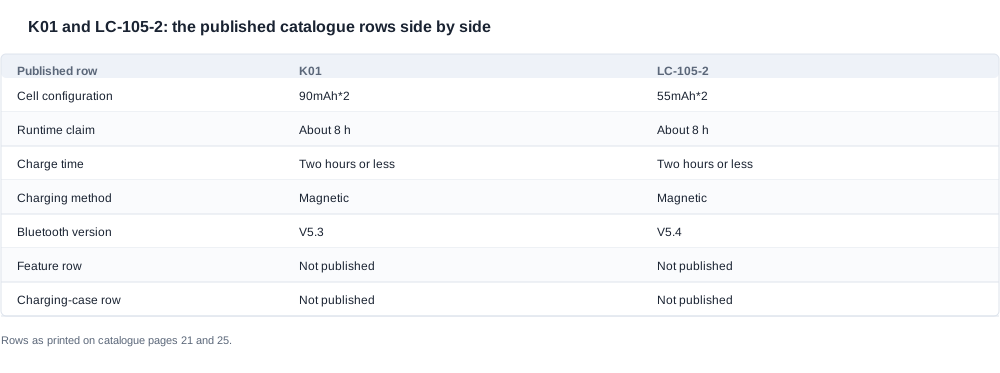
| Published row | K01 | LC-105-2 | What it changes for the buyer |
|---|---|---|---|
| Cell configuration | 90mAh*2 | 55mAh*2 | The per-side value written into the specification sheet |
| Runtime claim | About 8 h | About 8 h | A class label, not a measured shift |
| Charge time | Two hours or less | Two hours or less | One ceiling that applies to both |
| Charging method | Magnetic | Magnetic | One accessory family to qualify |
| Bluetooth version | V5.3 | V5.4 | The one radio fork in the pair |
| Feature row | Not published | Not published | Nothing to merchandise or defend |
| Charging-case row | Not published | Not published | An open question on scope of supply |
Read down that table and the rows divide into two groups. Three rows carry a number you can act on: the cell notation, the radio version and the charge-time ceiling. Four rows carry either a label that is identical on both pages or an absence that is identical on both pages, and those four are where a procurement file stalls. The runtime claim cannot separate the two because it is the same string on both pages. The charging method cannot separate the two because it is the same word. The feature row and the charging-case row cannot separate the two because neither exists. A comparison built only on the rows that agree will end in a circular argument, which is why the two that disagree carry the whole decision. That is also where a shortlist of one model instead of two becomes a negotiating position, and the criteria for carrying both should be written down before the order is placed rather than discovered afterwards.
There is one more commercial consequence in that structure, and it is the reason a catalogue page is not enough to close a sourcing file. Because the model string, not the specification row, keys the carton print, the accessory SKU, the serial range and the warranty route, two designations produce two cost lines even when every published row is identical. Nothing in this comparison changes that arithmetic. What the comparison does change is the question you ask the supplier, and that question is much shorter than the list of rows would suggest. Read as a due diligence exercise, the total cost of a second designation is where the arithmetic lands: two artwork sets, two accessory lines, two serial ranges and two approval files, set against two published rows that differ.

Cell configuration: 90mAh2 against 55mAh2
Both catalogue pages write the cell as a pair, in the notation 90mAh2 and 55mAh2, and a sourcing team should keep that notation rather than convert it. The printed figure is the value of a single cell together with the count of cells; no total is printed on either page. That is a deliberate choice with consequences, because a total is the figure most often carried into a purchase order, and a derived total entered into a specification sheet reads, months later, as though it were a published figure. If you need the total, write it as a total, mark it as derived, and keep the per-side value beside it.
The ratio between the two printed values is roughly three-fifths, and that is the only quantitative statement the catalogue supports about the difference between them. Everything else about these cells is unstated: no chemistry, no nominal voltage, no cycle life, no charge indicator, no statement about whether the two cells are removable, no statement about how the two sides are balanced during discharge, and no environmental limits.
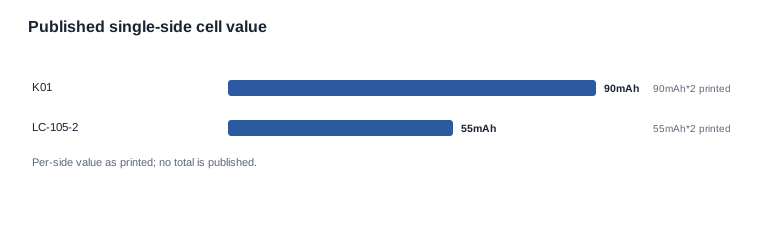
Where the 55mAh2 notation appears four times in the audio group — on the LC-105-1 and the LC-105-2, and the YK12 and the G07 — the runtime attached to it is not one number. The LC-105-1 and the LC-105-2 publish about eight hours, while the G07 and the YK12 publish about six hours on the same paired-cell notation. Read as a tier, the 55mAh2 group therefore covers a six to eight hour band, and neither end of that band carries a test condition. A buyer who treats eight hours as the value of the 55mAh*2 tier will be quoting a figure that the same tier contradicts elsewhere in the catalogue.
The 90mAh2 notation appears twice in the audio group, on the K02 and the K01, and both of those pages publish about eight hours as well. So the two cell notations in this comparison reach the same runtime claim, and the only place in the audio group where two notations receive different runtime figures is the 55mAh2 group itself, where the split runs along the G07 and the YK12 rather than along the cell value. That is a fact about internal consistency rather than about either product, and it is worth raising in writing before anyone concludes that the larger paired cell is the reason for the eight-hour figure.
Two questions settle what the cell notation actually commits you to, and both are answerable in a single line by a supplier. The first is cycle life: how many full charge-discharge cycles the paired cells are specified for, at what depth of discharge, and with what capacity tolerance, because a cell quoted without a cycle count is a cell whose useful life inside a warranty claim is undefined. The second is serviceability: whether the cells are replaceable at all, whether a single-cell failure in a two-cell frame is handled as a unit replacement, and what spare-parts arrangement exists if they are.
The freight file needs a third answer before a purchase order is issued. Transport documentation for lithium cells depends on the state of charge permitted at shipment, and the catalogue does not publish a permitted state of charge for either page. That documentation is filed under the model string, so two strings produce two sets of paperwork for goods that are electrically interchangeable on the published rows — a small line in the logistics file, but one that has stopped shipments before.
None of this makes the K01 or the LC-105-2 harder to buy than the other. It makes the cell row the one entry in the specification that carries real downstream cost and no published detail, and it makes the per-side notation the value a sourcing team has to hold on to, because it is the only version of the number the catalogue supports.

The shared runtime claim and the condition behind it
About eight hours is published on both pages, and neither page attaches a condition to it. Missing from both are the seven elements that would make the figure reproducible: playback volume, the audio source and codec, whether playback is continuous or intermittent, the state of charge at the start, the criterion that ends a run, the ambient temperature, and the number of units sampled. Without those, the figure cannot be converted into a shift length, cannot be sorted against another model, and cannot be reproduced by anyone who buys a sample.
The catalogue's own numbers make the problem visible rather than hypothetical. Six models across the range publish approximately eight hours: the LC-105-2 and the LC-105-1, the YKC02 and the K01, and the K02 and the ZH12. They do it on four different cell notations — 90mAh2, 55mAh2, 70mAh*2 and 100 mAh. If the published cell were what produced the figure, four notations this far apart could not carry the same number. They do, so the figure is a label attached to a measurement whose condition the catalogue does not print, and it cannot be read backwards into a cell capacity. The battery comparison across the audio range sets out how the same label behaves across the wider group.
Within the audio group the picture is a three-band one. Four models publish about eight hours, two publish about seven, and two publish about six. The two seven-hour models are the D11 and the D12, both of which carry a 100 mAh single cell and both of which charge over Type-C, and the only specification entry that separates those two pages is the surround sound line, which the D11 carries and the D12 does not. The published runtime therefore tracks neither the cell notation nor the charging interface in any consistent way inside this group.
What follows from that is a limit on the claims you may make, not a criticism of either product. If a runtime figure appears on your own listing page, you are making the claim in your own name, and the party who will hold you to it is your customer. You have three defensible options: publish the number as a ceiling, publish it as a class label such as a rated figure for approximately eight hours of operation, or obtain the test condition and publish it with the condition attached. The third is the only option that survives a complaint, and it costs one line in a written request.
The request itself is short, and asking it in identical words for both designations keeps the answer comparable. Ask for playback volume, source and codec, continuous or intermittent operation, starting state of charge, the end criterion, ambient temperature, and the number of units measured — for each model string, in the same document, on the same date. A reply that gives the condition for one designation and not the other is itself a finding: it tells you the two models were not measured the same way, and that the shared figure is a coincidence of labelling rather than a shared measurement result.
There is a sampling point a procurement file should record even when the answer is a single figure. A runtime claim is a statement about a population, and a supplier who reports one unit as the figure has given you a data point rather than a specification. The number of units behind a published runtime claim is part of the condition, and asking for it costs nothing on the supplier's side.
The practical result for the K01 and the LC-105-2 is that the shared eight-hour entry is usable as a class label for both and unusable as a comparison between them. Because both pages publish the same label, the label cannot separate the two, and a buyer who needs a separation has to move to the cell notation or the radio version, which are the only entries that differ.

Charging, accessories and what the audio group does not publish
Both pages publish magnetic charging, and that word opens a chain rather than closing a question. Behind it sit the contact geometry, the dock or the cable that ships with the unit, the spare accessory bought to replace it, the packaging line that holds it, the state-of-charge reporting the unit shows, and the return routing that identifies a faulty unit by its serial label. Each of those is keyed to the model string rather than to the charging row, which is why two designations that publish the same word still produce two accessory chains.
Magnetic is also the default for this group, which is useful for accessory planning. Type-C appears on exactly two of the eight audio models, the D11 and the D12, and the other six — the K02 and the LC-105-2, the YK12 and the G07, and the K01 and the LC-105-1 — publish magnetic charging. The interface a buyer is most likely to qualify for the audio range is therefore the interface both models in this comparison need, and neither forces a second interface onto the line. The charging accessory questions for the audio range cover what that qualification involves in general terms.
What the audio group does not publish is where the accessory work sits. The catalogue lists no charging-case row for any of the eight audio models, which means there is no case capacity to plan against, no published indication of whether a dock or a cable is in the box for any of them, and no figure for a spare dock. Read that direction carefully: an absent row is a gap in the catalogue, not a statement that no case or dock exists for these products. The same group also publishes no ingress-protection row, and IP54 appears on the V06 and the S7 only. Neither model in this comparison can be quoted with a protection rating, and neither can be placed in a channel that promises one.
The certification position is the second gap a sourcing file has to close, and it is a documentation gap rather than a product gap. The catalogue text contains no mention of CE, FCC or RoHS for any model, and there is no per-model certification row anywhere in it. The company-level export certification page in the catalogue is images rather than extractable text, and the patents recorded at company level run to ten — eight appearance-design patents and two utility-model patents — which is a statement about the company and not about the conformity status of either model string. The frameworks a request may name are the Radio Equipment Directive (EU) 2014/53/EU and the EMC Directive 2014/32/EU, and the request itself has to name the model string and the destination market.
The remaining rows a buyer expects on a data sheet are absent for both pages: frame weight and dimensions, sensor configuration, storage, unit price, minimum order quantity, lead time, warranty terms and certificate numbers. None of them is published for either designation, and none of them may be borrowed from elsewhere in the range. The one weight figure the catalogue publishes anywhere belongs to the MT6 glasses body and describes a camera model, so it cannot serve as a proxy for either frame in this comparison. The Bluetooth audio glasses range page carries the published rows and nothing more.
The charge time needs the same treatment as the runtime figure. Two hours or less is a ceiling rather than a measured value, and the starting state of charge is not published for either page. That distinction matters for planning, because a ceiling tells you the longest acceptable interruption while a measured average would tell you how long a desk, a bench or a store room actually waits. A ceiling of two hours or less can be planned against and quoted as a ceiling. It cannot be quoted as an average, and it cannot be set against a different model's measured figure.
Every one of these gaps has the same status in a procurement file: open, and answerable in writing. None is a defect to be raised with a quality control team, and none can be closed by inference from another model. What they do mean is that the specification sheet handed to a supplier has to carry the catalogue values and the outstanding questions side by side, because the catalogue alone cannot close the file and the catalogue does not publish prices, price tiers, minimum order quantities or lead times for either designation.
The K01 versus LC-105-2 battery and charging comparison
Pulling the published rows together produces a comparison with an unusual shape: two disagreements, four agreements, and a long list of questions that neither page answers. The matrix below takes each row in turn and states which procurement decision it actually moves, because a row that changes no decision is a row on which negotiating time is wasted.
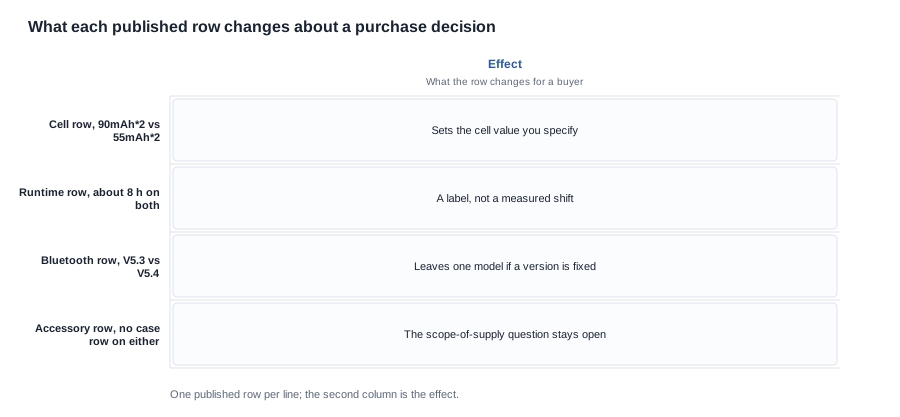
Three questions carry most of the weight, and each one lands on a different line of the file. The first is the cell notation, which is fixed by the catalogue and cannot be negotiated: whichever designation is taken, its per-side value is what goes into the specification sheet, and the only two candidates here are 90mAh2 and 55mAh2. The second is the runtime notation, which is a choice rather than a fact, because a buyer may publish the eight-hour figure as a class label or hold it until a condition arrives. The third is whether the magnetic base counts as an accessory, which decides whether the accessory line, the packaging line and the spare-stock line exist separately from the product line.
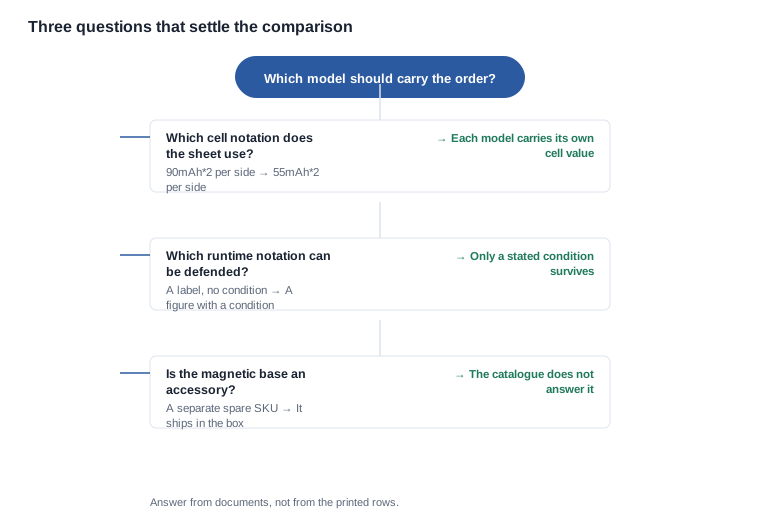
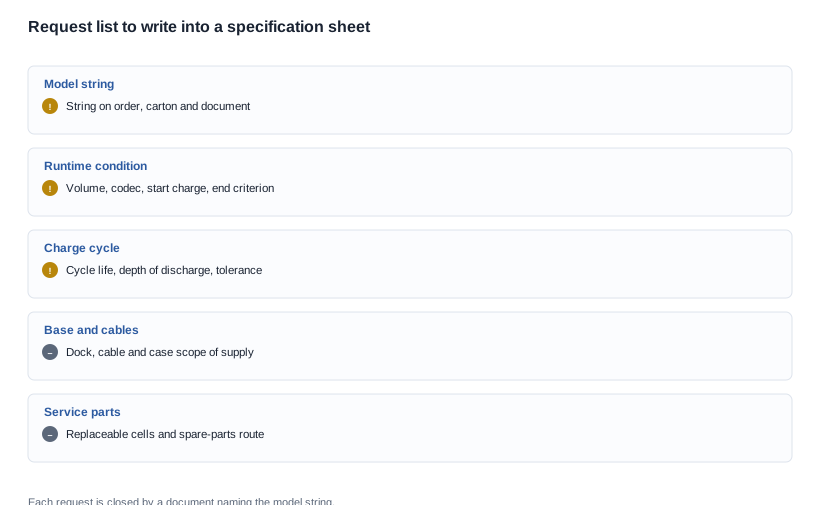
Those three questions are deliberately narrow, because the rows that would otherwise decide the matter are not published. There is no runtime condition to compare, no weight to compare, no case capacity to compare, no price to compare, and no certification row to compare. Where the catalogue is silent, the answer to a procurement question is not an inference drawn from the catalogue; it is a written request to the supplier. If you are still deciding which model to take forward, how to evaluate that request is a separate question from what the catalogue says, and the request list is the only part of this article that can move it. The list below is the shortest version of that request that closes the file, and it is written so that every item can be answered by a document rather than by a conversation.
- The cell notation in writing for each model string: the per-side value and the cell count, with any total marked as a derived figure.
- Cell chemistry and nominal voltage for both designations, together with the cell part number used.
- The rated cycle life for the paired cells, the depth of discharge behind that figure, and the capacity tolerance.
- The test condition behind the eight-hour entry, asked in identical words for both pages: volume, source, codec, continuous or intermittent operation, starting state of charge, end criterion, ambient temperature, and number of units measured.
- Whether the two cells in a frame are replaceable, how a single-cell failure is handled, and what the spare-parts arrangement is.
- The magnetic contact geometry for each designation, and the alignment tolerance to write into the acceptance plan.
- What ships in the box for each string — dock, cable, or both — and whether the cable that charges the dock is included.
- Whether a charging case is available for either designation, and at what capacity, if any.
- The charge-time ceiling stated with its starting point, together with the charge indicator behaviour.
- The permitted state of charge at shipment and the transport documentation profile for each model string.
- The radio identifier and conformity documents for each string, against the RED (EU) 2014/53/EU and EMC 2014/32/EU frameworks, for the destination market being shipped into.
- Frame weight and dimensions measured on samples, and the frame geometry tolerance to accept against.
Two of those twelve items change the commercial shape of the order rather than the technical description of it. Item 7 decides whether one accessory line or two runs through the warehouse, and item 11 decides whether one document set or two sits in the approval file before shipment. Everything else is a specification refinement that a competent supplier can answer without argument, and none of it should be presented as a criticism of either model.
The comparison itself resolves cleanly enough to be stated in one paragraph. The K01 publishes the larger paired-cell notation, roughly three-fifths more per side than the LC-105-2, and it publishes Bluetooth V5.3 where the other publishes V5.4. On everything else the two pages agree: about eight hours of stated operation, a charge time of two hours or less, magnetic charging, no feature line, and no charging-case row, with the same absences around weight, dimensions, certification and commercial terms. If a customer's requirement is written against a radio version, the radio version settles the comparison. If it is written against the published cell value, the cell settles it. If it is written against the runtime figure, neither does, because the figure is the same on both pages and carries no condition.
The honest answer to this comparison is a set of documentation requests rather than a product verdict. Our position is that the shared eight-hour entry is not evidence that the two models are equivalent in use, and we do not present it as such. Two models that publish identical rows are not thereby the same product, and a buyer who wants to treat them as one should ask for the written difference first; a buyer who wants to carry both should be able to say from the request list exactly which line each string creates in the accessory chain, the freight file and the approval file.
Related reading
- the published rows for the K01
- the LC-105-2 against the K01
- how a runtime figure should be read
- the charging questions for the LC-105-2
The K01 and the LC-105-2 differ in two printed entries and agree in four, so the specification sheet you send out should say which of those two entries your customer's requirement is actually written against.


