
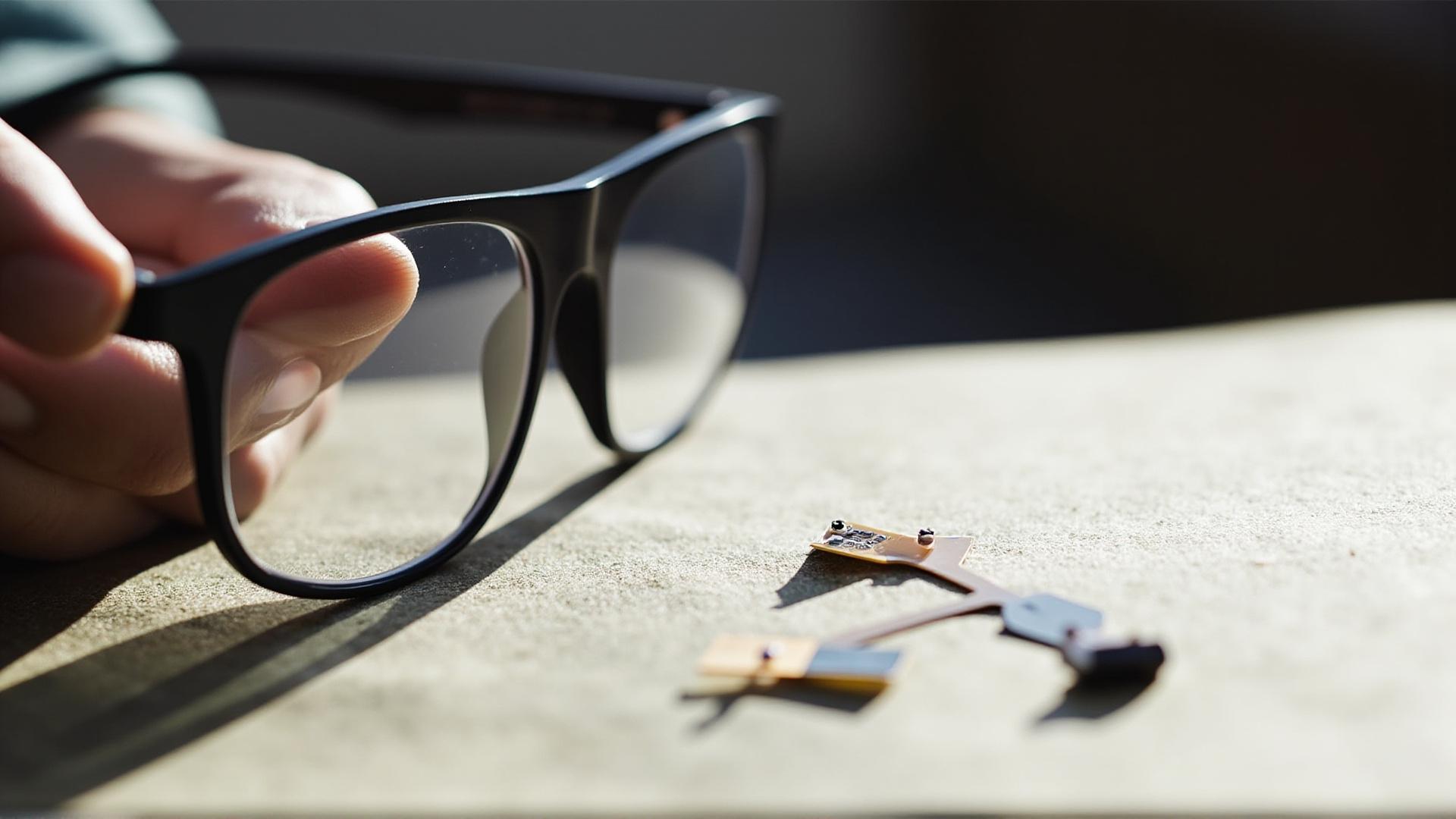
Our catalogue gives the K01 Bluetooth V5.3 and two 90 mAh cells; charging is magnetic, takes no more than two hours, and the rated use is around eight hours. Those five rows are the entire published specification for this model, and there are no feature rows on its page at all. That makes this model unusually clean to read and unusually difficult to buy, because four of the five rows are numbers whose conditions the catalogue does not state, and the fifth is a radio version that raises a question the catalogue does not answer either. This page is written for the buyer who has to decide what to do with four numbers and an open method question, not for the customer who wants to know how long the battery lasts.
K01 smart glasses battery life: the four numbers and the conditions they are missing
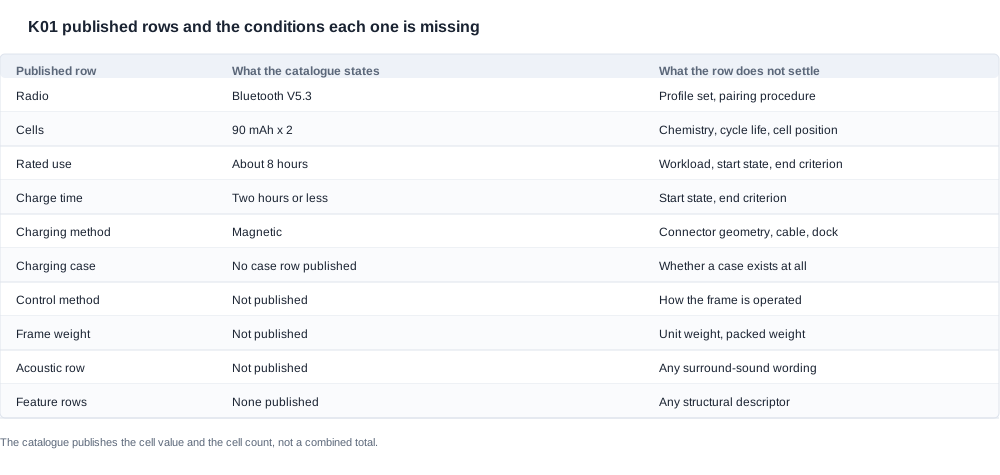
Four of the five published rows on this page are quantitative, and each of them is a statement about a condition the catalogue does not publish. The cell row is 90 mAh × 2. The endurance row is approximately eight hours. The charge-time row is two hours or less. The charging-method row is magnetic. Only the radio version, V5.3, is a fact about the product rather than a fact about a measurement.
That distinction is the whole of the procurement problem, and it is worth stating precisely because the failure mode in this category is to read a published number as a published guarantee. A cell capacity is a fact about the product and is exactly as good as it looks. A rated endurance is a measurement result whose workload, start state, end criterion, ambient conditions and build configuration are not published, and it therefore describes a test rather than a behaviour. A charge time published as a ceiling is a limit rather than a duration, and with neither a start state nor a completion criterion published it cannot be read as an operational interruption at all. The radio version is a fact, and it is a fact about the file rather than about the battery.
So the four conditions a buyer has to add to the four numbers are the same four every time: the workload, the start state, the end criterion and the build configuration of the measured sample. A buyer who requests those four, in writing, for this model, can convert a page of ratings into a specification that a quality team can test and a channel can print. A buyer who does not request them has four numbers and no way to use them in a claim.
There is a fifth condition specific to this product, and it is the one that is easiest to miss because it is not attached to a number at all. No touch row appears in our catalogue for this model or for any other, and the single row anywhere that describes a physical control belongs to a different product. So the method of operating the K01 is not published anywhere, which means the workload behind the eight-hour rating cannot be described without asking, because a workload is defined in terms of what the product was doing. Playback at a stated volume, calls, or both — the three produce three different figures, and the catalogue does not say which one it published.
That is the correct opening position for a buyer, and it is a much stronger one than it looks. A buyer who arrives with the four numbers and the four conditions and the method question is not asking the supplier to do work; the supplier already has the answers. A buyer who arrives asking for "better battery life" is asking for a marketing comparison, and the factory has no way to answer that.
Reading the 90 mAh × 2 row without inventing a total
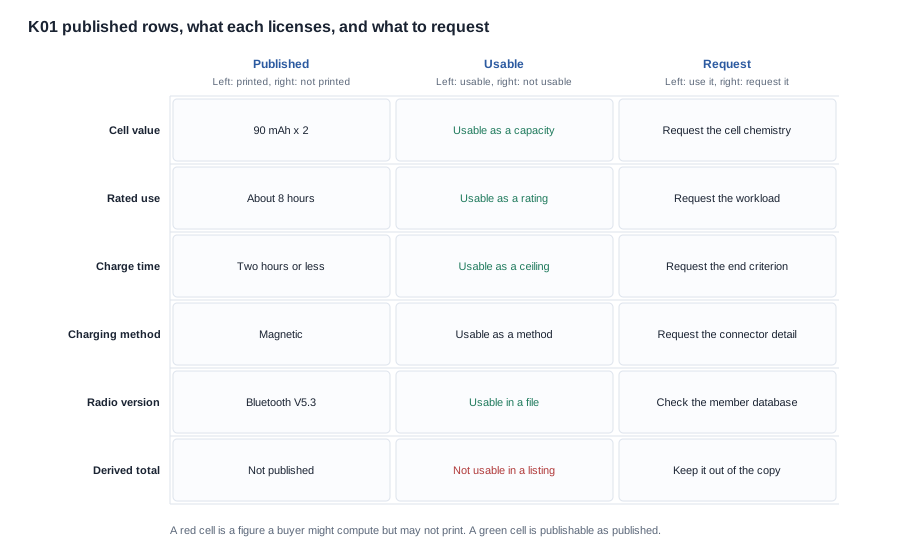
The cell row is printed as a value and a count: 90 mAh × 2. The catalogue publishes the capacity of a cell and the number of cells, and it does not publish a combined figure. That is a deliberate kind of precision, and a buyer who respects it avoids the most common error in this category, which is to write a single total as though the catalogue had published it. Multiplying 90 by two is arithmetic, and arithmetic is legitimate inside an internal capacity comparison provided it is labelled as derived; it is not legitimate in a product listing, where a reader will take the number for a published specification, and it is a number the factory has never confirmed.
The count is doing real work and it is worth understanding why before a buyer compares this model with another. Two cells in a frame divide the weight in a particular way and concentrate the current draw in a particular way, and they change what happens at the end of a discharge, where two cells at a similar state of charge deliver a flatter voltage than one. They also change the transport file, because a package containing two cells is a package containing two cells for the purposes of a consignment declaration, and the documentation has to name both. And they change the service question: a frame with two cells may be serviceable in a way a single-cell frame is not, or may not, and the catalogue does not say.
There is a sharper point in this row, and it is the reason a buyer cannot select on it. The K01 and the K02 publish the same five rows — the same radio version, the same cell configuration, the same charge-time ceiling, the same rated use and the same charging method. Two products, one specification, and no published row on either page separates them. A buyer who chooses between them on the electrical rows is choosing between two indistinguishable entries, and a buyer who quotes the cell row as a reason to prefer one of them is making a claim the catalogue cannot support. The only rows that separate them are rows the catalogue does not publish, which is the practical reason to request the specification file for both before comparing them.
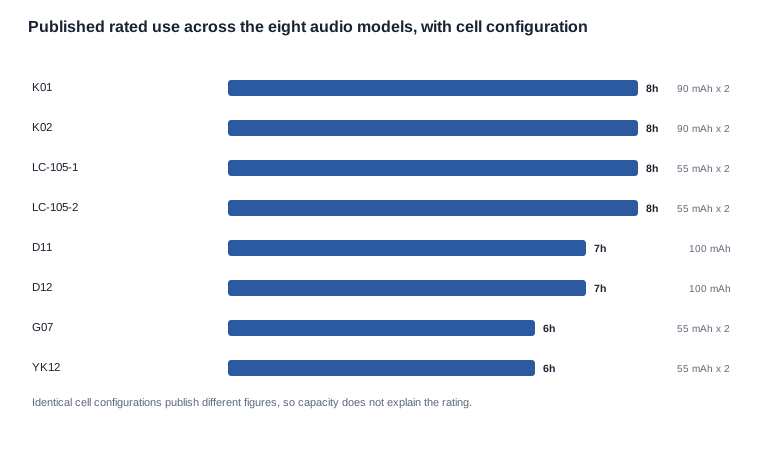
The same pattern appears in the wider audio group, and it is worth putting the whole group on one line because it shows that capacity does not explain endurance. Two models publish two 90 mAh cells and eight hours. Two models publish two 55 mAh cells and eight hours. Two models publish two 55 mAh cells and six hours. Two models publish a single 100 mAh cell and seven hours. Read across and the largest published cells do not produce the longest figure, and the smallest published cells produce both the eight-hour and the six-hour figures. Whatever separates the six-hour models from the eight-hour models inside the 55 mAh × 2 group, it is not on any row the catalogue prints. The catalogue rows behind this model are set out in the catalogue rows behind this model, with everything absent from them noted in the model file.
The eight-hour rating against the range: what the number does not state
The rated use of approximately eight hours is the highest figure published in the audio group, and it is shared with three other models, so it is a leading figure rather than a distinguishing one. The chart below sets the whole group side by side with the cell configuration each one publishes, and it is worth reading as the argument against using an endurance figure as a selection criterion on its own: the ranking and the capacity ranking disagree, and the group contains two pairs with identical cells and different figures.
A rating of approximately eight hours, on a 90 mAh × 2 configuration, over Bluetooth V5.3, is a good number for a category in which a customer expects to get through a full working day on one charge. It is also a number with a workload attached somewhere that the catalogue does not show, and the practical question for a buyer is which workload it is. Three candidates sit behind it: continuous playback at a stated volume, intermittent use with calls broken up by idle time, or a mixed workload that reflects a working day. The first gives the shortest figure, the second the longest, and a buyer who has not asked will not know which of the three the catalogue is quoting.
There is a second published variable that is easy to overlook and that may well be part of the answer, which is the radio version. This model publishes V5.3, and the sibling that shares all of its other rows publishes the same version, while the rest of the audio group publishes V5.4. A radio version is not a battery specification, and it would be wrong to present it as one; but connection behaviour, reconnection attempts and standby draw are all functions of the radio implementation, and a difference in the published version is at least a reason to ask whether the endurance figure was measured on the same stack as the newer models. It is a question worth one line in an enquiry and worth nothing more than that.
The published charge-time ceiling of two hours or less is the third number, and it is a limit rather than a duration. Twenty-six of the twenty-eight models in the catalogue publish that same ceiling, and only two publish a shorter figure of about one hour. A ceiling and a duration are not the same claim, and the difference matters here: a two-hour reading still falls inside what the catalogue permits, so the printed row cannot be restated as a shorter period, and because no start state and no completion criterion are published the published figure cannot be read as an operational interruption window either. For a model whose selling point is an eight-hour day, the charge figure is a background number, and a buyer who prints it as a duration is creating a dispute in the month where somebody needs the product in the afternoon.
The general method for turning a published rating into a number that survives an audit is in the method for reconciling a rating with a measurement, the range positions are in the battery comparison across the camera range, and the selection view across the group is in bluetooth audio glasses which model to pick.

The charge ceiling and the magnetic interface it depends on
Magnetic charging covers the largest group in our catalogue — seventeen of the twenty-eight models — while seven charge over Type-C and four publish no charging method at all. As a data point that tells a buyer where this model sits. As an operating condition it tells a buyer something considerably more useful, because a magnetic interface obliges a routine and an accessory programme that a port-charged product does not.
The routine obligation is a physical attach step. The frame has to be brought to a magnetic interface, held or rested in place while the contacts align, and confirmed before it is returned to service. A magnetic contact finds its own alignment, which takes the fiddliness out of a plug and introduces a step whose success has to be checked rather than assumed, because a contact that looks seated is not necessarily carrying current. The accessory obligation is a specific part: a magnetic end that a customer cannot replace with a standard cable, unless the supplier confirms that it terminates in a standard plug. And the operational obligation is a location, because a magnetic interface only works well when it has a fixed home, which for a team means a defined charging point per group.
That last point is where the endurance figure and the charging method meet commercially. A product with an eight-hour rated use needs a recharge inside a working day if the working day is longer than eight hours, and a magnetic method makes that recharge a scheduled event with a place, a dock and a contact that has to be kept clean. A buyer pricing the deployment should cost the charging point, the accessory line and the contact maintenance as part of the product rather than as an afterthought, and should expect the aftersales kit for a magnetically charged product to carry a spare part that a port-charged one does not.
A case is not part of what the catalogue publishes for this model, so what goes in the box is something the supplier has to confirm. That is worth resolving early for a model with this endurance figure, because a case is the difference between a team that can top up at a desk and a team that has to find a cable. The range-level charging guidance is in the range-level charging interface question and the model-specific version in K01 smart glasses charging options.
The K01 acceptance file: turning four published rows into a checkable number
The supplier requests to make before an order
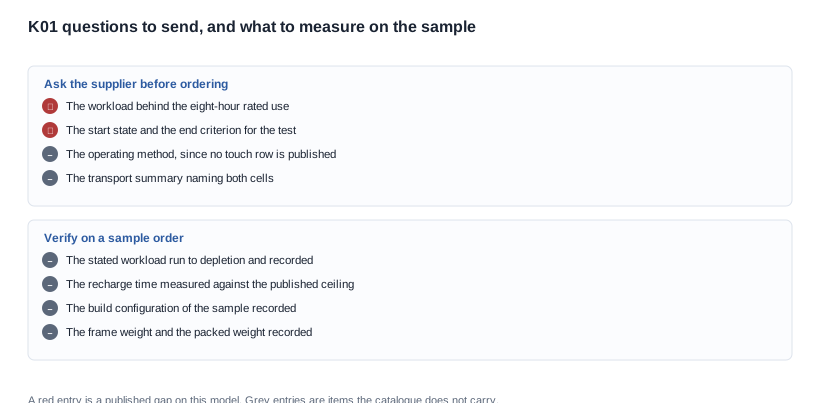
The list is ordered by how much of the buying decision each answer unlocks, and every supplier on the shortlist should be asked the same thing in the same form rather than being given a different question each time. The workload behind the eight-hour rating comes first, because without it the endurance row cannot be used in a listing, a roster or a channel promise. The control method comes second, because a workload is defined in terms of what the product was doing. The cell documentation comes third, because it closes the transport file. Everything else follows.
- The workload behind the approximately eight-hour rated use, with the volume, the connection state and the ambient conditions.
- The start state and the end criterion used in that test.
- The build configuration of the measured sample, including the radio stack and the firmware level.
- The operating method for the frame, since our catalogue publishes no touch row for any model and the control arrangement has to come from the supplier.
- The cell chemistry, the cycle life expectation and the position of the two cells in the frame.
- The transport documentation for the two 90 mAh cells, including a UN 38.3 test summary that names both.
- The charge-time start state and the completion criterion, since the published row is a ceiling.
- The charging interface geometry, whether the magnetic end terminates in a standard plug, and whether a cable or dock is supplied.
- The box contents, including whether a charging case is supplied for this model, given that the catalogue publishes no case row.
- The frame weight as shipped, the packed weight, and the per-model conformity documentation.
The radio version is published, so the radio section of the technical file is the easy part of this model's paperwork: a buyer can state it without asking, and the Bluetooth qualification is a check the buyer runs against the member database as an independent step. The cell documentation is the harder half, because a two-cell configuration has to be covered by a summary that names both cells, and because the transport file for a consignment of this product is built from the cell count rather than from the cell value. Our catalogue states no CE, FCC or RoHS certification for this model, holds no certification line for any single product, and its export-certification page is images rather than extractable text, so a technical file and a declaration of conformity have to be requested from the supplier rather than taken from our pages. In the European market the framework that governs a radio product is the Radio Equipment Directive (EU) 2014/53/EU. A buyer who is asked to compare a supplier against another on documentation is comparing a file that is half-published against one that is not, and that is a difference worth establishing before an order rather than after it.
From the answers to order clauses
A written request is answered with a brochure line, and an acceptance condition has to be met, which is why the conversion step matters more than it usually gets credit for. The four conditions that the catalogue omits become four clauses in the purchase order: the workload, the start state, the end criterion and the build configuration. Each of them is a line a quality team can execute, and each of them removes a category of dispute that would otherwise be settled by whoever is more insistent.
The sample order is where the conditions are tested, and for this model the sample has to be run rather than handled. The published endurance is a rating, and a rating is only demonstrated by repeating the measurement under the stated workload on a unit that matches the production configuration. A sample that has been switched on and looked at has confirmed the radio version and nothing else. The practical sequence is: agree the four conditions in writing, order a sample, run the stated workload to depletion, record the result against the published ceiling and the published rating, and file it with the model record so the following order does not have to reopen the same point.
The pitfall in this category is a well-meant one. A buyer who discovers that the measured figure is below the published rating is often tempted to keep the published number and treat the difference as noise. The correct response is the opposite: a difference between a published rating and a measured result is the most valuable thing the sample order produces, because it converts an open question into a documented one, and a documented difference can be written into the listing. A rating that has been reconciled with a measurement is a rating a channel can print.
What the catalogue settles for this model
Our catalogue prints five specification rows for this product, and none of them is stretched here into a cell chemistry, a cell position, a runtime test method, a control method, a charging-case capacity, a frame weight, a certification claim or a derived total capacity. We also do not rank the K01 against the other models in the audio group on endurance, because the published rows do not support a ranking: the highest published figure in the group is shared with three other models, the largest published cell configuration is shared with one, and the group contains two pairs with identical cells and different figures. A verdict built on that would be a verdict about documentation, not about the product.
What the published rows do support is a strong starting position for a buyer who has a working-day use case. A two-cell 90 mAh configuration, a magnetic interface, an approximately eight-hour rated use and a two-hour-or-less charge ceiling describe a product whose charging cadence can be planned, and the plan is a routine a customer can follow. The model-specific selection argument sits in K01 smart glasses best for, the pre-order checks in the pre-order checks for this model, the comparison with the sibling model in YK12 smart glasses vs K01 spec comparison, the freight consequences in the freight file for a camera-range product and the weight position in bluetooth audio glasses weight comparison.
If the K01 is on your shortlist, send us the quantity band, the hours your customers need the product to cover, the workload their customers will actually put it through, and the listing copy you intend to publish. Send us the copy and we will say, line by line, which of its figures the catalogue supports, which need a measured or a documented answer first, and which are better left out. Send the questions first — the four conditions are the entire difference between a number on a page and a number you can print.


