
Kids eye protection glasses technology: six naming mistakes
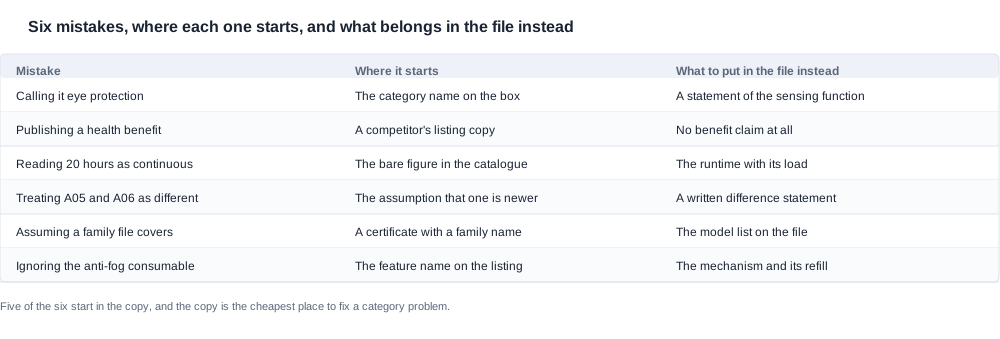
The mistakes in this category are mostly mistakes about what the category claims rather than about what it does, and that is worth saying first because the product itself is simple. Six of them are set out here: three that create regulatory exposure, and three that cost you fit and time.
Three models sit in the children's tier: the A05, the A06 and the A07, publishing roughly twenty hours of runtime each, two hours or less of charging, magnetic charging, 40 mAh on the A05 and the A06, and 70 mAh with Bluetooth 5.4 on the A07. The A05 and the A06 publish the lens-based electronic fogging arrangement and the posture and viewing-distance detection; the A07 publishes neither. The certification status is not published to us for any of the three.
The single rule that resolves four of the six is a sentence long: narrow the claim to what the device does, which is detect and remind, and leave the clinical language out of the listing. The English category label for this tier reads as eye protection, and that reading — not the device — is where most of the exposure starts. A product that detects a position and a distance and reminds a wearer is not a product that changes a child's eyesight, and a listing that implies otherwise is making a claim that the file behind it does not support.
The second rule resolves the remaining two: a published figure with no condition attached is not a specification, and two models that publish identical rows are not two different products until someone writes down how they differ. Both of those are closeable with a measurement and a sentence, and both are cheaper to close than to argue about later.
Why the category label is the root of four of them
Our catalogue names this tier as a children's smart protective glasses line, and in English that name reads as a claim about eyesight. It is not one. The published functions on the two sensing models are a posture and viewing-distance detection with a reminder, and a lens-based electronic fogging arrangement; the third model is listed as a children's audio model with no sensing rows at all.
That gap between what a name implies and what a device does is the origin of most of the mistakes in this article, and it produces three specific errors. It produces listings that describe an outcome rather than a function. It produces packaging copy imported from a competitor because the competitor's listing was faster to copy than the file was to read. And it produces internal product briefs written from the category name, which then flow into the label, the listing and the sales deck without anyone re-reading them against the conformity position.
None of those three is a decision anybody makes. They are the default outcome of writing from the shelf rather than from the file, and the reason they persist is that there is usually no meeting at which a phrase has to be defended. The correction is procedural: put the wording through the same review as the technical file, before the artwork is approved.
What the catalogue actually publishes for this tier
The published rows are worth stating precisely, because most of the trouble in this article comes from a buyer reading them more strongly than they are written.
The A05 and the A06 publish a 40 mAh cell, charging in two hours or less, roughly twenty hours of rated use, magnetic charging, the lens-based electronic fogging arrangement, and the posture and viewing-distance detection. The A07 publishes a 70 mAh cell, charging in two hours or less, roughly twenty hours of rated use, magnetic charging and Bluetooth 5.4, with no sensing rows and no atomiser row.
Everything else a buyer would want — the detection threshold, the delay, the false-positive rate at the default setting, the frame weight, the frame dimensions, the size range covered, the certification status, the ingress marking — is not published for any of the three. A unit weight is published for exactly one model in the whole catalogue, 158 g for the MT6 glasses body, which is not a children's model.
The claim boundary, and the words that cross it
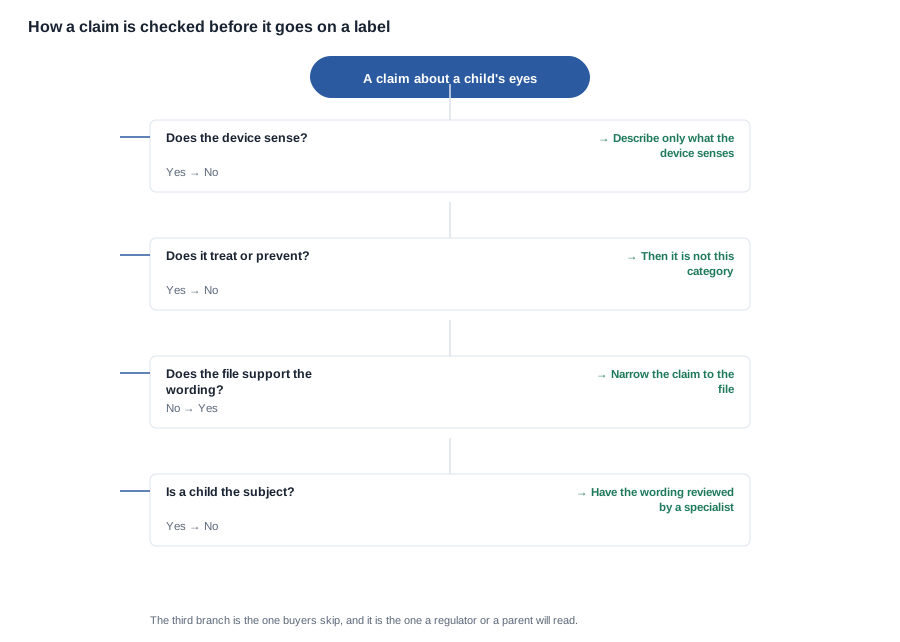
The four branches above are a way to check a claim rather than to argue about it. The first two are about the device and are quick. The third is the one buyers skip, and it is the one a regulator, a retailer or a parent will read: does the file behind the product support the wording used on it? The fourth is about who the claim is about, and a claim whose subject is a child is a claim that has to be reviewed by somebody qualified before it goes live.
The two claims we will not make in any market
A efficacy claim regarding vision, health or eye protection. We make none of these for any of our products, in any market, and we will not write one into a listing, a product brief or a label on request. A device whose function is to detect a position or a distance and to remind is not a clinical device, and the limit of that is not a marketing preference — it is a regulatory line in the jurisdictions where children's products and health claims are both policed.
A hearing-improvement claim. The audio models in this range are audio products, and an audio product that a buyer describes as improving hearing is making a claim we cannot support. The boundary is set out in bone conduction health claims and limits, and it applies to any category where the device sits close enough to the head for the wording to be read as a benefit.
Both of these refusals cost a buyer something commercially, and we would rather they knew that at the start than be surprised at the artwork stage. The commercially safe alternative is not a weaker claim but a different one: a named function, a documented compliance position and a stated set of exclusions is a claim a retailer's technical team can accept, and it is the only kind that survives a review.
The wording to correct before the artwork is approved
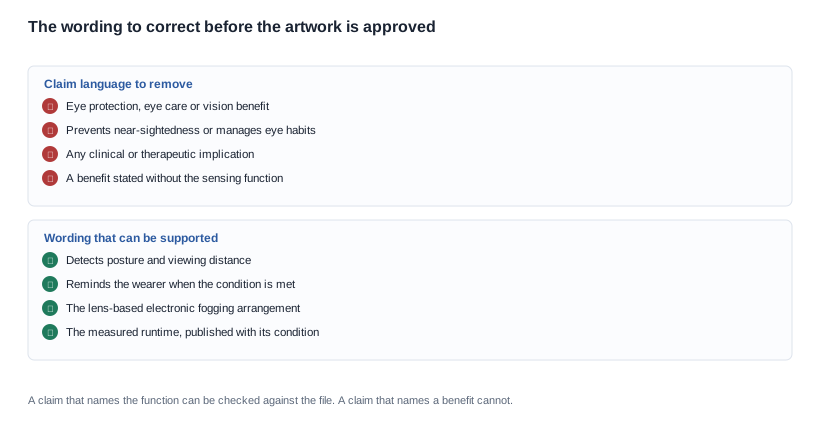
The list above is deliberately literal, because the phrases on it are the ones that appear in real listings in this category. Each of them is a function the device does not have, and each of them is a phrase that a buyer would probably have written without thinking about it.
The replacement column matters as much as the removal column, because a listing that only says what the product does not claim reads as evasive. The supported wording is concrete: the device detects posture and viewing distance, it reminds the wearer when the condition is met, it carries a lens-based electronic fogging arrangement, and its runtime is published with the condition it was measured under. A buyer who writes the four positive sentences and removes the four phrases has a listing that a review can pass and a customer can understand.
Three mistakes that live in the specification rather than the copy
The runtime that is really a duty cycle
Roughly twenty hours is a published figure with no test condition attached, and it describes a use pattern that is not published. A device checking posture and distance continuously is under a different load from one checking periodically, and the difference is not a detail — it is the whole of the claim.
The clue that the figure is duty-cycle dependent is that the same twenty hours appears on a 40 mAh cell and on a 70 mAh cell. A cell that is nearly twice the size producing the same rated runtime implies a different load profile, and the difference has to be somewhere; the reminder frequency is the most likely place, because it is a setting the brand or the parent controls. A household that leaves the reminder on a high setting will reach the end of the day sooner than the figure suggests on a 40 mAh model.
The correction is a measurement you run rather than a figure you request. Run the product at the reminder interval you intend to ship, for a full day, on both cell configurations, and publish the condition next to the number. The methods are covered in how to test kids eye protection glasses.
Two models that publish identical rows
The A05 and the A06 publish the same rows: the same cell, the same charge time, the same runtime, the same charging method, the same fogging arrangement, the same detection functions. The difference between them is not published to us, and a buyer who specifies "the A06 because it is the newer one" is selecting on an assumption.
The assumption is worth testing because it is cheap to test. Ask for the difference in writing, and see whether the answer names something measurable — a firmware default, an enclosure, an app behaviour, a certification scope. An answer that names none of those is probably an answer that says the two are the same product under two designations, which is a perfectly good answer but a different one from the one the buyer assumed. The comparison is set out in A05 versus A06.
The same reasoning applies to the A07, and it is worth being explicit about it because the A07 is not a variant of the other two. It is listed as a children's audio model, with a 70 mAh cell, Bluetooth 5.4, the same quoted runtime, and no published sensing rows at all. A buyer who compares the A07 against the A05 on cell capacity is comparing two different products and will find that neither one answers the other's requirement.
The anti-fogging arrangement as a consumable in disguise
Two models in our range publish a lens-based electronic fogging arrangement, and the published position on its certification is not provided to us. Whatever the arrangement is intended to do, it needs two things established rather than assumed: what it consumes, and what the user sees when it runs out.
The second question is the one that decides whether a feature is an arrangement or a consumable. A feature that consumes a replaceable element has a supply chain, a refill cycle, an end-of-life state and a customer who eventually runs out of it — and if the product does not tell them what happens at that point, the result is a pair of glasses that has quietly stopped doing the thing the listing describes. The lens material question sits alongside it in customisation options and lens materials.
A buyer who has not established whether the arrangement is a consumable should treat it as one until told otherwise, because that assumption is the safe one: it puts the refill and the end-of-life state into the scope of the first order rather than into month two.
The measurement sequence that replaces a published figure
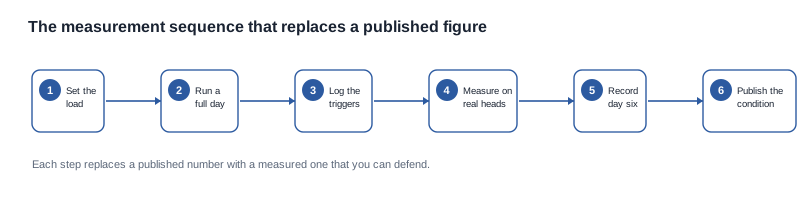
The six steps above are the replacement for a published number, and the order matters because each one depends on the one before it. Setting the load first means the measurement has a stated condition; running a full day means the duty cycle is included; logging the triggers means the false-positive rate has a denominator; measuring on real heads means the fit data is a fit figure rather than an opinion; recording day six means the observation is the one that predicts the return rate; and publishing the condition means the number can be defended.
Applied to this tier, the sequence closes the three specification mistakes above and produces a set of claims the buyer can actually stand behind: a runtime with a reminder interval, a false-positive rate with a number of attempts, and a fit measurement with a size range. None of those is available from a catalogue, and all three are worth more than the published rows they replace.
Where the paperwork fails on the model list
The sixth error in the table is the one that happens furthest from the copy, and it is worth separating from the rest because it has a different owner and a different remedy. A certificate that covers the factory's model or a family of models does not cover a branded unit, and treating similarity as coverage produces a customs query, a marketplace rejection or a school that will not accept delivery.
The remedy is the model list. Ask which designations the file names, compare them character by character against the units you have ordered, and make the exact designation a condition of the purchase order so the answer is binding rather than advisory. And if the position is genuinely unknown, the starting point is in A05 certification status — which is worth reading as a question to ask a supplier rather than as an answer, because the certification position for these three models is not published to us.
How to evaluate a supplier's answers before you sign
The six mistakes above are all visible in a document or a measurement, and every one of them can be caught by a question asked at the right moment. The list of questions is short, and it is worth sending as a list rather than as a paragraph, because a supplier who answers in one message is running a documentation habit and a supplier who answers across three is assembling one.
- Which model designations does the conformity file name? Per market, with the standards and the edition numbers attached.
- What are the detection threshold, the delay, the repeat behaviour and the false-positive rate at the default setting? With units, and with the default setting that ships.
- What is the runtime measured under? The reminder interval and the ambient condition, so the figure can be compared with another supplier's.
- What does the lens-based electronic fogging arrangement consume, and what does the user see when it runs out?
- What are the frame dimensions and the weight of the heaviest unit in this variant, with the measurement method and the sample size?
- What claim wording has already been reviewed against the file, and who reviewed it?
How to evaluate the answers is simple and it is the same test every time. An answer that names a document, a part, a number or a date has closed the row. An answer that describes a quality has not, and no amount of follow-up turns it into one. That is the whole evaluation rule, and applying it consistently is what stops a claim boundary from being crossed one adjective at a time.
The timing matters as much as the list. Before you order is the only point at which these answers are cheap, because after the order they become acceptance criteria, and a criterion that has to be negotiated after the artwork is approved is a criterion somebody will try to soften.
Where the commercial room is in a claims-driven programme
The minimum order quantity is the first number a buyer reaches for and the least valuable lever in this category, because the unit price is the smallest component of the cost. The three numbers that move are the per-model documentation scope, the per-market label scope and the acceptance criteria.
The documentation scope multiplies with the range, and it is the number worth negotiating before the first order rather than after the first variant: three models across four markets with two colourways each is a document set count that is easy to understate and hard to reverse once the first market has been qualified and the second has not. The label scope is a packaging conversation rather than a certification one, and because it carries no tooling implication it is usually the easiest concession a supplier can make. The acceptance criteria are the term that protects the buyer on the failure that costs most, because a criterion written into the purchase order is an acceptance standard and a lot that fails it is a lot the buyer can refuse.
The certification spend itself is not a negotiation variable: it is a fixed cost per model and per market, with the elapsed time set by the test body rather than by the size of the order. Tooling behaves differently — a one-off that is normally amortised over the first order — so the two questions worth asking are what volume it is amortised over, and what happens to it if the programme is discontinued.
The total cost view is what makes these conversations work, and it has to be built from the count of models, the count of markets and the count of variants rather than from the bill of materials. That number is the real size of a children's commitment, and it is the number to carry into the negotiation, because it is the only one the supplier cannot answer from the catalogue.
What to send us before the artwork is approved
The children's range, and the claims we will not make for it
Concretely, we publish the three children's models' rows accurately, including the fact that the A05 and the A06 are identical in their published parameters, and the difference between them is not published to us. We will also be direct that the certification position for this tier is not published to us, and that the frame weight and the frame geometry are not published for any of the three.
We also make no claim about vision, health or eye-protection effects for any of our products, in any market, and we will not write a hearing-improvement or a near-sightedness claim for a device whose function is to detect a position or a distance and to remind. We will not estimate a detection threshold, a false-positive rate or a service life for anything we have not measured, because in a children's product an invented figure becomes a safety statement that a parent will read as a limit on their child.
Send us the copy you are about to publish, before the artwork is approved. We will tell you which phrases we would not put on a children's product and why, and we will say plainly when a claim is one we cannot assess for your market. That review is free and it is much cheaper than a reprint.
Send us the two models and the market list. We will tell you which of the six rows our documentation answers and which have to come from a supplier or from a test on your own units. The background is under kids eye care technology, the measurement method is in how to test kids eye protection glasses, the certification question starts at A05 certification status, and the range is kids smart glasses.
Where the mistake list comes from
Send us the two models and the market list, and we will say which of these six mistakes you are most likely to make.


