
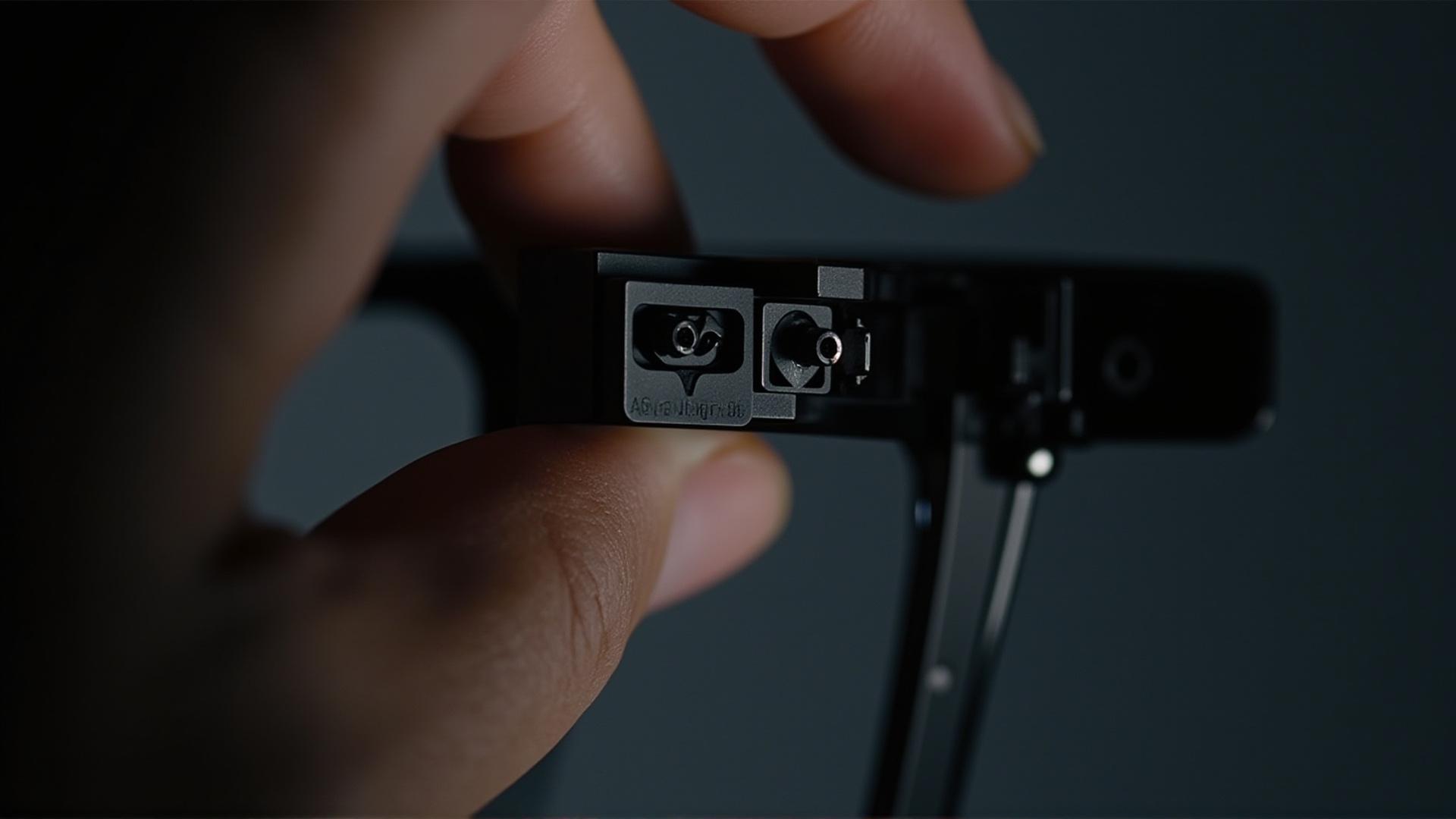
Kids eye protection glasses technology: factors bind sequentially
The five factors in the order they actually bind
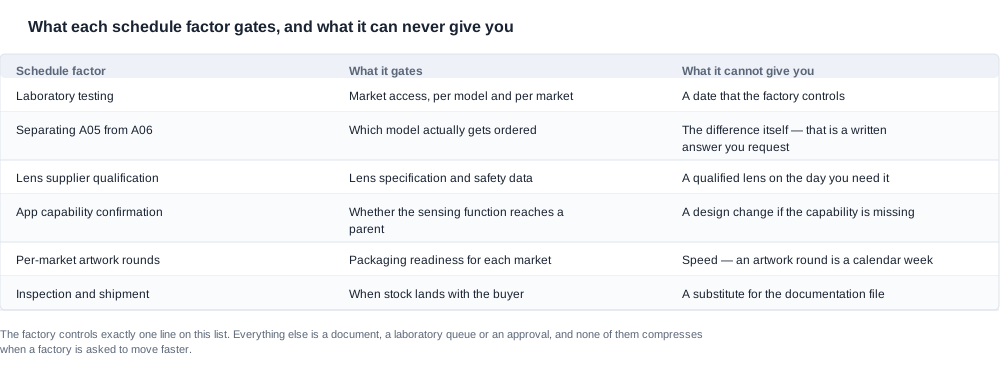
A children's programme runs on five factors, and the mistake is to plan them as if they were parallel. Kids eye protection glasses technology smart glasses lead time factors binds in this order: the compliance position first, because it is the longest and it cannot be compressed; model selection second, because it is either trivial or blocking; the lens third, because a component supplier enters the programme; the app capability fourth, because the central feature needs a delivery route; and the packaging artwork fifth, because that is where each market's requirements become artwork. A schedule built on that order can be planned. A schedule built on a parallel assumption cannot.
Our published position in this tier is small and exact. Three models: the A05, the A06 and the A07. The A05 and the A06 publish a 40 mAh cell, two hours or less of charging, roughly twenty hours of rated use, magnetic charging, three lens options, a lens-type electronic fogging device, and posture and viewing-distance detection. The A07 publishes Bluetooth V5.4, a 70 mAh cell, two hours or less of charging, roughly twenty hours of rated use and magnetic charging.
The one question that can stop a launch outright
The compliance position is the long pole in a children's programme and it is the only factor that can end the project rather than delay it. The frameworks that come into play for products intended for children include EN 71 in the European Union and ASTM F963 with the Consumer Product Safety Improvement Act in the United States, and neither of those is satisfied by a radio approval or by a general declaration of conformity. For our own A05, A06 and A07 models the certification position is not published to us, which means a buyer planning a children's launch cannot start the clock on this factor from our catalogue at all.
That is why the schedule question comes first and not last. A buyer who asks a factory for a first-article date before asking for a laboratory lead time has asked the easiest question and will build a launch date on it. The factory date is real, it is controllable, and it is the only line on the schedule that says nothing about whether the product can be sold.
Why a factory working faster does not fix this schedule
Children's hardware in this tier is small, standard and quick. The cells are 40 mAh and 70 mAh, the charging is magnetic, the electronics are simple, and the tooling footprint is modest. Almost everything that makes a children's programme slow is a document, a laboratory queue, an artwork approval or a written answer that nobody has asked for. None of those responds to a factory being asked to work faster.
This produces a specific and common failure. A buyer sets a launch date from a factory date, then discovers that the compliance work cannot start until the model designation is fixed, that the model designation cannot be fixed until the A05 and the A06 difference is established in writing, and that the difference cannot be established because nobody owned the question. The programme then spends its first month answering a question that should have cost one email in week one.
The hardware in a children's line is the fast part
This is worth stating bluntly because it inverts the usual instinct. Buyers arrive at a smart glasses programme expecting the hardware to be the constraint, and in the children's tier it is not. The published rows describe a low-power product with a short charge time and magnetic charging, built on small cells with modest tooling. Nothing in the published electrical data is hard to schedule.
The consequence is that a buyer who negotiates hard on unit price and delivery terms at the RFQ stage has spent their negotiating capital in the cheapest part of the programme, while the part that actually sets the date is still unowned.
Where the elapsed time actually goes
The lens is a separate supply chain, not a component
A lens-type electronic fogging arrangement brings a lens supplier into the programme, and lens performance figures — transmittance, tint, impact rating and coating — are not published for these models. That means the lens has to be found, qualified and specified, and the qualification is longer than an electronic component's because the lens specification is a safety specification for a product intended for children.
The scheduling mistake here is treating the lens as a cosmetic component and discovering the supplier after the tooling is committed. A lens is not a decoration that can be swapped at the end of the programme; it changes the optical path, the packaging, the claims that can be made about the product, and in a children's line it changes the safety file.
The app capability is a design risk filed as a schedule risk
If the app capability is unconfirmed, the product's central feature has no delivery route. Posture and viewing-distance detection on the A05 and the A06 is published as a function, but how the parent sees the result, whether the alert is visual or audible or both, and whether a parent can disable it are not published. A feature that a parent cannot see is a feature that does not exist commercially, and no amount of schedule compression changes that.
The right classification is therefore a design risk, not a schedule risk, and the right action is to confirm the capability set in writing with a date before the schedule is built. A capability confirmed late is a late product change, and product changes are expensive in a way that delays are not.
Packaging is where a market's requirements become artwork
Every destination market adds labels, warnings, languages, tracking information and age-related instructions, and each addition is an artwork round with an approval owner. The elapsed time here sits in the rounds, not in the printing, and the round count is a function of how early the warning set per market is confirmed. A programme that confirms the warning set after the first artwork round reliably needs a third round.
The children's packaging set is also not the adult packaging set. Small-parts warnings, age grading and the market's own instructions make this a different document set from the one an adult line uses, and reusing an adult packaging set in a children's programme is a common and expensive discovery.
The three factors with no internal owner
Of the five factors, three tend to arrive without a named owner inside the buying organisation: the laboratory relationship, the lens specification and the artwork approval chain. Each of them is usually owned by a different function, and none of them is owned by the person who built the schedule. That is why the schedule slips quietly rather than loudly, and why the schedule request list below asks for an owner against each line rather than only a duration.


Asking a supplier for a schedule that can hold
The schedule request list
This is the request to send. The right-hand column separates a supplier who can hold a date from one who will repeat yours.
| What to ask for | The pass line | What a soft answer sounds like |
|---|---|---|
| The certification position and the laboratory's lead time | Standards, editions, laboratory named, and a duration in weeks | "Certification is extra" |
| The A05 and the A06 difference, and when it will be answered | A written answer and a date attached | "The newer one" |
| The lens supplier, the lens specification and its lead time | The supplier named, and transmittance, tint, impact rating and coating | "Standard lens" |
| The app capability set and its development date | A confirmed capability list and a date | "The app is ready" |
| The firmware and app maintenance commitment | A defined term and a scope | "We maintain it" |
| The packaging artwork route | The number of rounds and the approval owner | "We handle the artwork" |
| The warning set per market | Confirmed before the first round | "We will advise" |
| The first-article date with its dependencies stated | A date, with the artwork freeze and the compliance result named | "Four to six weeks" |
| The model designation for the exact configuration | A published designation, not a series name | A series name only |
Cost-free questions to ask, and when to send them in a children's programme
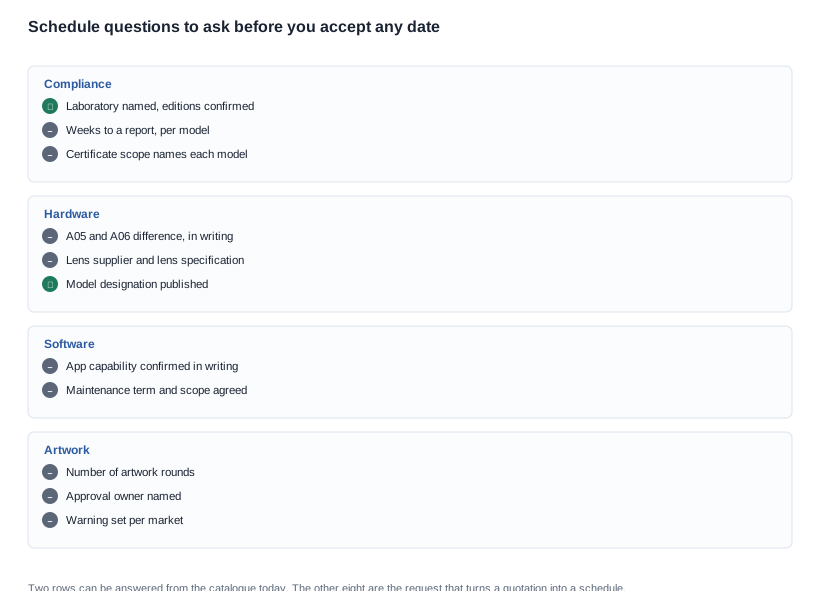
The nine rows above are the ones with a duration attached. Three further questions carry no duration but decide whether the schedule survives contact with the programme, and they are the ones a buyer should send first because they cost nothing and they determine the size of everything else.
The first is a question about scope rather than timing: how many models and how many lens combinations are you quoting for. Every model and every additional lens variant carries its own compliance cost and its own laboratory booking, so the number of models in the shortlist is the single biggest lever on the schedule, and it is a decision the buyer makes before asking anyone for a date.
The second is a question about who is doing the work: which functions are inside the supplier's scope and which sit with the buyer. An artwork round that the supplier runs and the buyer approves moves differently from an artwork round that the buyer drafts. The answer should be written down against each line, because an artwork round with no owner is a calendar week of nothing.
The third is the one most often left until the schedule is built: what happens to the schedule if the model designation changes. A programme that has booked a laboratory for one model and then renames it, or adds a second model after the booking, will find that the booking is the constraint rather than the work. Ask what has to be re-done, and what has to be re-paid for, when the model list changes after the booking is placed.
The trade-offs a buyer can make on a schedule
Three trade-offs exist in a children's launch, and each of them has a cost that is easier to see in advance than afterwards.
The first is between speed and scope. Adding a model or a market lengthens the schedule and lengthens the compliance cost; removing one shortens both. The decision is not really about the schedule at all — it is about which markets the brand can service in the first year, and it should be made before the laboratory booking rather than after.
The second is between speed and certainty. A supplier who offers a shorter duration by using a laboratory the buyer has not audited offers a date that may not survive a customs query or a retailer's technical review. The trade-off is real, and for a school or a regulated channel the slower date is usually the cheaper one, because the cost of a document that does not hold is a withdrawn shipment rather than a late one.
The third is between speed and evidence. A programme can compress the sample stage by accepting the supplier's own test results instead of running a household trial and a fit sample, and it can compress the artwork stage by approving copy without a qualified review. Both compressions are reversible in principle and expensive in practice, because both leave a decision on the product page that nobody has evidence for.
When to add a buffer and when to cut scope instead
The instinct to add time everywhere is not free. A buffer on the factory's own production steps buys nothing, because those steps are the ones the factory controls and the ones with the least variance. A buffer on the artwork rounds and on the sample-to-report loop buys a great deal, because those are the two loops where an unexpected result is most likely and most expensive.
When a schedule cannot be met, the honest options are three: add a buffer, cut scope, or add a model and carry its compliance cost. Cutting a market is usually the cheapest option and the one most often refused for commercial reasons rather than scheduling ones. Adding a model is usually the most expensive and the one most often chosen by default, because it feels like growth rather than delay.
How to test a date that has been offered to you
A date is a real date when it has dependencies attached. Ask what the date depends on and where the dependency sits, then check whether the supplier holds that dependency themselves or is waiting on somebody outside. A first-article date that depends on the artwork freeze and on the compliance result is a real date because it names the things that can move it. A date that depends on nothing is a placeholder, and a placeholder becomes a commitment the moment a buyer repeats it to a customer.
The second test is simpler. Ask for the lead time in weeks rather than in months, and ask which laboratory. A duration without a laboratory is an estimate, and an estimate cannot sit on a critical path, because the critical path is where only the committed durations are allowed.
The third test is the one most buyers skip: ask what the supplier needs from you, and when. A laboratory booking needs a model list and a market list. A lens qualification needs an optical specification. An artwork round needs an approved copy deck. A schedule that names its own inputs is a schedule the buyer can manage; one that does not is a schedule that will absorb the buyer's own lateness.
The steps that need a named owner
Three lines in the request list should be answered with a person's name rather than a department: the artwork approval owner, the laboratory contact and the person who owns the compliance position. Departments do not approve artwork, laboratories do not chase model designations, and a compliance position that sits with a group rather than a person will still be open when the artwork is due to be frozen.

Milestones, buffers, and a launch date built backwards
The milestone chain a launch date depends on
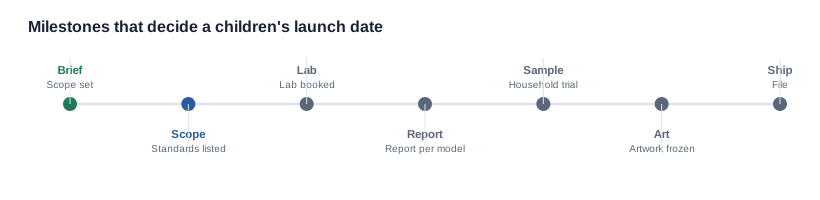
The chain runs from scope through the laboratory booking, the per-model report, the sample and household trial, the artwork freeze, and finally the release against the file. Every one of those is a milestone with a named output, and the launch date is the output of the report milestone rather than an input to it.
Two practical consequences follow. The launch date cannot be set before the compliance lead time is known, because everything downstream is measured from it. And the artwork freeze has to sit after the compliance result, not before it, because the artwork carries the market's warnings and the market's warnings depend on how the product is classified.
Where a buffer actually belongs
Buffers are usually placed where the team feels nervous, which is the wrong criterion. In a children's programme the buffer belongs on the artwork rounds and on the sample-to-report loop, and it does not belong on the factory's own production steps, which are the part of the schedule a factory actually controls.
The artwork buffer is needed because the round count depends on how early the warning set per market is confirmed, and that confirmation tends to arrive late. The sample-to-report buffer is needed because a sample that behaves differently from the expectation generates another round of measurement, and a measurement round that produces a number the team did not expect tends to generate a design conversation.
A worked scenario: a school term as the fixed date
This is a worked case rather than a client project. It is included so order shows.
Assume a brand has committed to a children's line for a school term, and the term date is fixed because the channel is a school procurement cycle rather than a retail cycle. The brand's constraint is that the compliance position for its two destination markets is unknown and the artwork has to be translated for a second language.
The first step is to work backwards from the term date to the date the artwork has to be frozen, and from there to the date the compliance result has to exist, and from there to the date the laboratory booking has to be in place. The result is a laboratory lead time the brand can now go and request, with a laboratory name attached, which is a request that can be answered and a request that cannot.
The second step is the model question. Because the A05 and the A06 publish identical rows, the brand cannot select between them, and the model designation is an input to the laboratory booking. It asks the question in writing with a date, and treats the answer as a schedule item rather than a product decision. The written answer is the single cheapest schedule action available in this tier, and the model question is documented in detail in A05 versus A06.
The third step is the lens. The lens supplier is named and the lens specification is requested with transmittance, tint, impact rating and coating, because a lens specification is a safety specification and a supplier who cannot state the impact rating cannot support a children's product. The lens side of the programme is covered in more detail under customisation options and lens materials.
The fourth step is the app capability, confirmed in writing as a capability list with a date. If the capability turns out not to exist, that is a product change discovered early, which is the cheapest place to discover it.
The fifth step is the artwork: the warning set per market is confirmed before the first round, the approval owner is named, and the round count is capped in the schedule rather than left to emerge.
What the sequence reveals about a supplier
A schedule is the most honest document a supplier produces, and it reveals more than a quotation. A supplier who can name the laboratory, the lens source, the artwork approval owner and the model designation has a production system that has run a children's line before. A supplier who returns a duration without a dependency has a factory date, which is a different thing.
The order in which a supplier answers is also informative. The compliance position and the model question come first because they are the two that can invalidate the plan. A supplier who answers the hardware questions eagerly and the compliance question vaguely is telling you where the programme's risk actually sits.
What we can tell you about a schedule, and what we cannot
Our published position and its limits
We will tell you the compliance scope your destination market requires, and we will not claim that our children's models meet it, because the certification status for the A05, the A06 and the A07 is not published to us. We publish the electrical rows and the published functions, and we publish the absence of the compliance position, the detection parameters and the fit dimensions with the same prominence as the rows we do hold. The position for the A05 is in A05 certification status and the position for the A07 is in A07 certification status.
We will also be plain that in this category the schedule is set by documents rather than by hardware, and that a buyer holding a compliance lead time and an artwork route has a programme, while a buyer holding a factory date does not.
What we cannot do is give you a week count for any of the five factors. Those numbers belong to the laboratory, to the lens supplier, to the artwork approver and to the supplier's own production plan, and quoting our own estimate would be a guess dressed as a schedule. We would rather give you the structure and the request list than a number you cannot defend to a customer.
The four questions that build the schedule
Ask the compliance lead time in weeks with the laboratory named, and treat it as the only date that matters until it is answered. Answer the model question in writing before anything else is scheduled, because the model designation is an input to the laboratory booking. Get the lens supplier named and the lens specification stated, because a lens is a safety specification and a qualification, not a purchase. And build the schedule backwards from the compliance result with a buffer on the artwork rounds.
Send us the launch date you are working back from, the destination markets and the channel, and we will tell you which of the five factors is the long pole for that particular programme and which of them the factory actually controls. The background is under kids eye care technology and the category overview is in kids eye protection glasses technology.
Where the schedule method comes from
Send us the launch date and the market and we will tell you which of the five factors is the long pole.


