
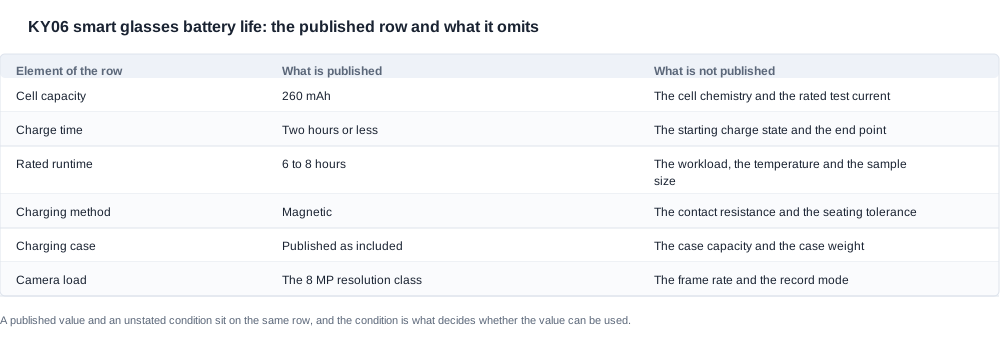
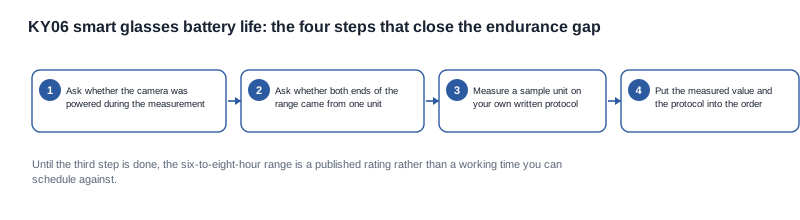
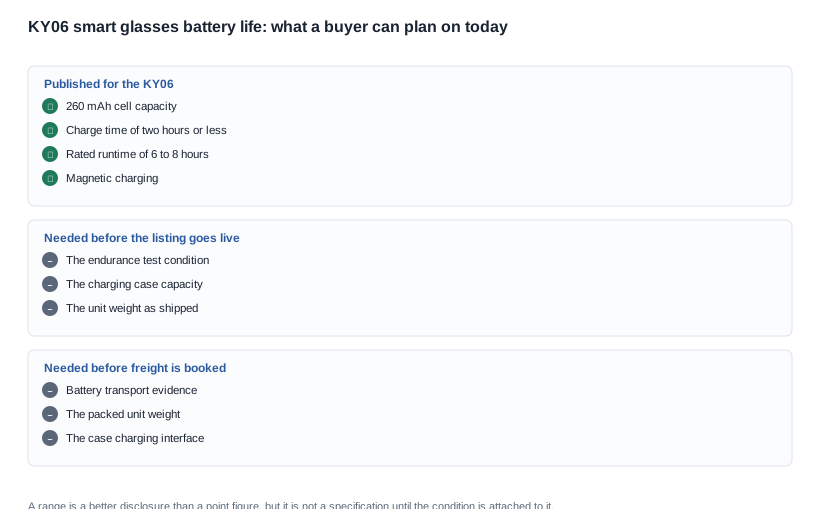
KY06 smart glasses battery life is published as a range of 6 to 8 hours, and reading that range correctly is the whole procurement question on this model. The published rows are a charge time of two hours or less, a 260 mAh cell, magnetic charging, a charging case whose capacity is not published, and an 8-megapixel camera on a frame positioned for photography with a sport emphasis. What is not published is the test condition behind the range, the camera's power behaviour, the case capacity, and the unit weight. Those four gaps are not equally important, and this article sets out which ones decide a purchase, which ones only affect copy, and which ones can be closed by a buyer with a sample and a stopwatch.
The short version is that a range is a better disclosure than a point figure, but it is a rating rather than a working time until the condition is attached to it. Everything below follows from that.
KY06 smart glasses battery life: what a range tells you that a point figure does not
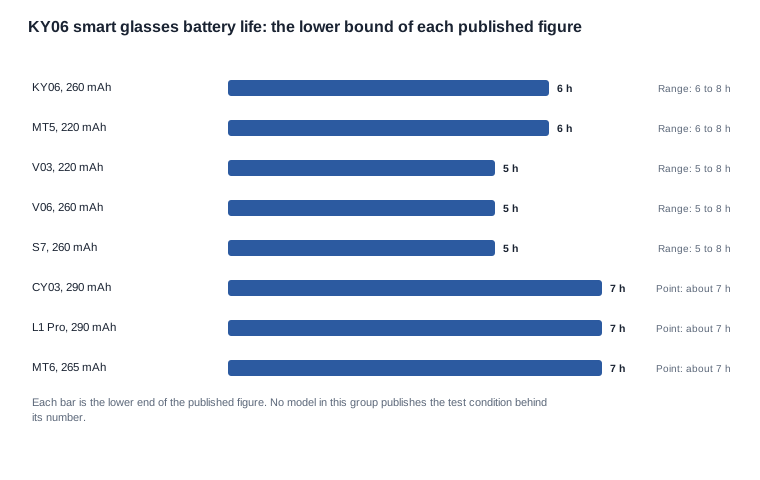
Models in the camera group that publish a single figure — the CY03 and the L2 Utral, the CY05 and the MT6, and the L1 Pro, all at about seven hours — have given you a number that was measured once, under conditions they have not described. The KY06 gives you two numbers instead.
That is a stronger disclosure, and the reason is straightforward: a range is what a supplier publishes when more than one condition was measured and the results differed. It tells you the figure moves with something, and it lets you plan against the bottom of it rather than discover the bottom of it. A six-hour floor and an eight-hour ceiling on a camera product is a reasonable shape. The low end is plausibly the camera working under load; the high end is plausibly lighter usage.
The weakness is identical in both cases, and it is worth stating plainly because the temptation is to treat the range as settled. The condition behind the figure is not published for the KY06, and it is not published for any model in this group. So the range tells you the honest bounds and nothing about which condition produced which bound.
Three questions close that gap, and all three are answerable in a single written request.
- What was the camera doing during the measurement — recording continuously, capturing on demand, or powered down?
- Was the radio link active throughout, and was the device connected to a phone?
- Did the two ends of the range come from one unit under two profiles, or from two different units?
The first question does most of the work. On a camera product the difference between continuous recording and on-demand capture is very large, and it is entirely plausible that the published 6-to-8-hour spread is simply the difference between those two states. If that is the answer, the figure becomes a useful two-profile description rather than a vague range, and a buyer can plan a burst-capture working day against six hours while knowing that a continuous-capture day is shorter.
How to evaluate a runtime figure before you order
The general rule, which is worth stating because this category breaks it constantly, is that a runtime figure is only usable once three things are attached to it: the workload, the starting state and the temperature. If any one of the three is missing, the number is a rating and should be treated as one in the quotation, the specification sheet and the listing. A buyer who applies this rule to three or four suppliers quickly discovers that most published figures are ratings, and that the supplier who attaches the conditions is usually the supplier with the better-controlled product rather than the worse-documented one.
Three practical criteria are worth applying. The first is whether the figure can be reproduced: if you cannot state the protocol you would use to reproduce it, you cannot use it as an acceptance criterion either. The second is whether the figure is stated as a range or a point, because a range tells you that something moved and a point tells you only that someone measured once — and, in a comparison table, a point figure reads as precision that may not exist. The third is whether the supplier will say what happens at the low end under a heavier workload than the one they measured, which is the question that separates a manufacturer from a distributor.
None of that makes the published range unusable. It makes it a rating that has to be converted into a working time by a measurement somebody does, and on this model the cheapest person to do it is the buyer.
The camera is the load, and the load is not characterised
The KY06 carries an 8-megapixel camera, and the published range is the visible consequence of that load. The problem is that nothing is published about the camera's power behaviour: not the sensor model, not the video format, not the frame rate, not whether capture is continuous or triggered, and not what the device does between captures.
That omission matters in a way it would not on an audio product. An audio frame that is idle most of the time draws a predictable average current, and a runtime figure translates into a working day with modest uncertainty. A camera frame that records continuously draws a completely different current from one that captures on demand, and the gap between those two states is probably the gap between the two ends of the published range. Until that behaviour is described, the range is a range and a hope.
There is a second reason the camera load is a procurement issue rather than a curiosity. Storage and file handling consume power and board space, and neither is published for this model — no storage capacity, no file format, no overwrite behaviour. A buyer building a channel around burst capture needs to know what happens when the store fills, and that question is currently unanswerable from our material.
This is also the point at which the resolution tier needs careful handling. The catalogue publishes the 8-megapixel resolution class for the KY06 and nothing further about the imaging — no sensor model, no field of view, no video format, no frame rate, no low-light behaviour. It is a fact about the camera, not a claim about image quality, and it should be described that way in any comparison. The camera imaging notes cover why the sensor and the field of view are the two numbers that decide whether a camera frame suits its purpose.
There are two warning signs a buyer should look for in any camera specification, and both appear in the absence of these rows rather than in what is written. The first is a resolution tier presented as an image quality claim — an 8-megapixel figure quoted next to a competitor's 13-megapixel figure is a comparison of two different sensors, because pixel count alone does not determine what either one produces. The second is a runtime figure that has been separated from the camera load, which is what happens when a camera product's endurance is quoted without stating whether the camera was running. Both red flags are cured by one request: the workload behind the number.
The charging case decides whether the endurance figure is the constraint
The KY06 is published with magnetic charging and a charging case. The case capacity is not published. That single number is a gap with a real commercial consequence, because the case determines the packed weight, the freight class, the battery transport documentation and the customer's weekly routine.
It also determines whether the endurance figure is the constraint at all, and this is the point most buyers skip. A 260 mAh frame with a case is a different product proposition from a 260 mAh frame without one. If the case is large enough to carry several charges, the customer charges weekly rather than nightly, and the published six-to-eight-hour range stops being the thing the customer experiences. If the case is small, the range is the constraint and the product is a short-session product that happens to ship with an accessory.
Across the eleven camera models in the catalogue, the case situation has four distinct states, and the KY06 sits in one of the less convenient ones.
| Case state | Models | What it means for the buyer |
|---|---|---|
| Capacity published | CY03 and CY05, and L1 Pro — each at 1400 mAh; L2 Utral at 900 or 1400 mAh; MT6 at 1200 mAh | The delivered cost and the customer routine can both be modelled |
| Case published, capacity absent | KY06, MT5 | One written question; the number is not derivable from anything else |
| No case row in the catalogue | V06 and S7, and V03 | Not the same as having no case; the row is simply absent |
| Published without a case | V03 Pro | The one model where the absence is stated |
That distinction matters more than it looks, because "no case row" and "published without a case" are different facts and a buyer who treats them as the same will either over-specify a parcel or under-specify a packaging design. The charging case options analysis covers the accessory economics across the group, and the shipping weight breakdown covers the parcel arithmetic that depends on it.
The practical instruction from all of this is short: ask for the case capacity, and ask what the customer's charging rhythm looks like with the case in the loop. A product that charges weekly and a product that charges nightly are different products with the same specification sheet.
There is a total cost consequence here that a buyer should put in the model before the packaging is designed rather than after the first carton arrives. The case affects the packed weight, and the packed weight drives the freight class and the per-unit logistics cost; it affects whether the battery transport documentation has to cover a second cell as well as the fitted one; and it affects the achievable basket value, because a case in the product photograph is the visible reason a customer believes the product lasts a day. All three of those are commercial consequences of one unpublished number, which is why it sits near the top of the request list even though it is a single line of specification.

Why the published figures in this family are not on one measurement basis
At 260 mAh the KY06 shares its cell with the V06 and the S7, and it sits below the 290 mAh of the CY03, the CY05, the L1 Pro and the L2 Utral. Its endurance range of 6 to 8 hours matches the MT5's 6 to 8 hours on a smaller 220 mAh cell, and differs from the V03's 5 to 8 hours and the V06's and S7's 5 to 8 hours on the same 220 and 260 mAh cells respectively.
Read those rows across and a consistent pattern appears: the published endurance figures in this group were not taken under one shared protocol. The models with the largest cells publish a point figure, several models publish ranges of different widths, and the same nominal cell appears against different ranges. A buyer comparing them in a table is comparing measurement conventions rather than measuring products against each other.
The charge-time row has the same character, and it is a row people misread constantly. Every model in the catalogue publishes a charge time. Twenty-six of them publish a ceiling of two hours or less; the two exceptions are the D17 and the ZH12, which publish about one hour. A ceiling of two hours or less permits exactly two hours and permits less. It is a different assertion from "under two hours", and the two must not be used interchangeably in a datasheet, a listing or a comparison table. The distinction is not pedantic — a buyer writing "under two hours" into a contract has tightened the supplier's published obligation without knowing it.
The AI camera glasses battery comparison sets out the full grid across the camera group, and the how to compare battery life method covers the questions to ask instead of comparing figures that were never measured on the same basis.
How to compare figures that were never measured on the same basis is itself a skill, and the trade-off is worth naming. A point figure is compact, easy to publish, and easy to compare — and it is also the figure most likely to have been measured once under conditions nobody will describe. A range is wider, harder to put in a single-cell table, and it is more likely to have been produced by measuring more than one condition. Where a buyer has to choose between a supplier offering a point and a supplier offering a range, the range is usually the more informative offer, provided the supplier will say what the ends represent. Where the choice is between a range with a stated condition and a point with none, there is no real choice to make.
The measurement that closes the endurance question
Some of these gaps can be closed by a buyer, and this is one of them. Endurance is the rare published figure that a buyer can reproduce on a sample, because the buyer can define the protocol and the supplier can simply confirm it.
A workable protocol is short, and it should be written down before the first reading rather than reconstructed afterwards.
- Define the state. Fully charged, and state how you know it is fully charged — a published charge time has no published end point, so the charge indicator behaviour is itself a row to request.
- Define the workload. Be explicit about whether the camera is recording continuously or capturing on demand, and keep that constant across every unit you measure.
- Define the radio state. Connected and idle, or disconnected. Record which.
- Define the ambient condition. Temperature range, because cell behaviour is temperature dependent and the published figures carry no temperature.
- Measure a sample, not a unit. Take at least three units from the same lot, and record the spread rather than the average.
- Record the result as your measurement. The moment it is written down with its protocol, it is your number and it can go into the purchase order as an acceptance criterion.
The value of doing this yourself is that it converts an unanchored rating into a figure you can schedule against and enforce. The risk of doing it without writing the protocol down first is that the resulting number is a description rather than a standard.
One measurement on its own is not enough for a camera product, because the camera's contribution to the drain is unquantified. If the two profiles — continuous and on-demand — produce clearly different results on your own units, you have effectively characterised the camera load without anyone publishing a sensor model, and you can now state the working time for each mode in your own documentation.
The questions to ask before that measurement are worth putting in writing to the supplier first, because two of them change the protocol and a protocol built on the wrong answer is wasted work. Ask whether the charge indicator has a published behaviour, since a ceiling of two hours or less has no published end point and a device that charges indefinitely will not behave like one that stops. Ask whether the battery is removable, because a removable cell changes the logistics plan and the end-of-life handling entirely. And ask what the device does between captures, because an idle state that is not genuinely idle will consume the whole budget before the camera ever switches on.
Once those three answers are in, the measurement is a short afternoon's work and the result is a number that belongs to the buyer rather than to a datasheet. That is the whole argument for measuring instead of comparing.
What we will and will not say about the KY06 runtime
The KY06's six-to-eight-hour range is a more honest publication than a single figure and more useful to a buyer than one, provided the condition is supplied. We will publish the range as a rating, we will not present it as a guaranteed working time, we will not normalise it against the other models' figures, and we will not quote a unit weight, a case capacity or a certificate number that the documentation does not contain. The published KY06 specification list is the honest baseline for this model, and the KY06 certification status covers the market-access side of the same question.
Five questions to close the gaps on this model
- The endurance test condition, and what each end of the published range represents.
- The camera specification: sensor, field of view, video format, frame rate and the storage arrangement.
- The charging case capacity, and the charging rhythm the customer should expect.
- The unit weight as shipped, and the frame dimensions.
- The certification position for this model in each destination market, including the battery transport evidence the fitted cell requires.
Send us the application, the expected daily use and the destination markets, and we will tell you which published figures apply to that use, which ones have to be measured on a sample, and what the customer experience looks like once the case capacity is known.
Related reading
- What is published for this model — KY06 smart glasses specifications and features
- The range-wide battery picture — AI camera glasses battery comparison
- The accessory decision — AI camera glasses charging case options
Send us the application and the expected daily use, and we will tell you which published figures apply and which have to be measured on a sample.


