
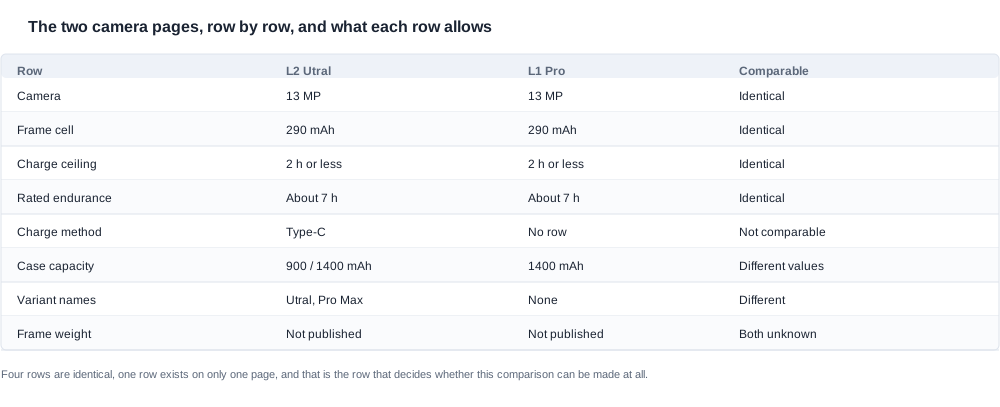
The L2 Utral and the L1 Pro publish identical figures for the frame cell, the charge time and the rated endurance, so the endurance question does not decide between them. What the two catalogue pages actually allow is narrower and more useful than a verdict: four rows are identical, one row exists on only one of the two pages, and the gap between them is a documentation gap rather than a product difference. A buyer who treats that gap as a difference will choose on a feature the catalogue never described.
The row in question is the charging method. The L2 Utral publishes an interface named as Type C. The L1 Pro page carries no charging-method row at all, and in the camera range four models are in that position. A blank row is missing information, not an alternative method, and it cannot be compared against a row that exists. This article sets out what can be compared, what cannot, and the questions that convert the second list into an answer.
L2 Utral smart glasses vs L1 Pro battery and charging: the comparison the pages allow
Four rows that are identical
Both models publish 13 MP, a 290 mAh frame cell, a charge time of two hours or less and a rated endurance of about seven hours. None of those four rows separates them, and none of them can be presented as an advantage for either model, because the values are the same. The endurance figure is a rating on both pages and neither page publishes the condition behind it, which means the two numbers are equally unusable for planning and equally useful for shortlisting.
Two further rows belong to the same group of unpublishable facts: the frame weight is not published for either model, and the sensor model, the field of view, the video format and the frame rate are not published for either. The only weight in the catalogue belongs to a third model, on a different cell with a foldable case, so it cannot be borrowed as a stand-in for either of these.
The row that only one of them publishes
The case row is where the two pages differ, and it differs in a way that is easy to misread. The L2 Utral publishes two values in one row, 900 mAh and 1400 mAh. The L1 Pro publishes one value, 1400 mAh. The obvious reading is that the L1 Pro has the single larger case and the L2 Utral offers a choice, and the reading is not supported, because a page that prints one value does not publish that only one value exists.
What the pages support is narrower and still useful. The L2 Utral publishes a choice of two capacities, and its two variant names sit beside that choice without a published correspondence between the names and the capacities. The L1 Pro publishes one capacity and no variant names at all. So the configuration question is asymmetric: one model has a mapping to establish, and the other has a row to complete.
How to read a comparison page that contains a blank
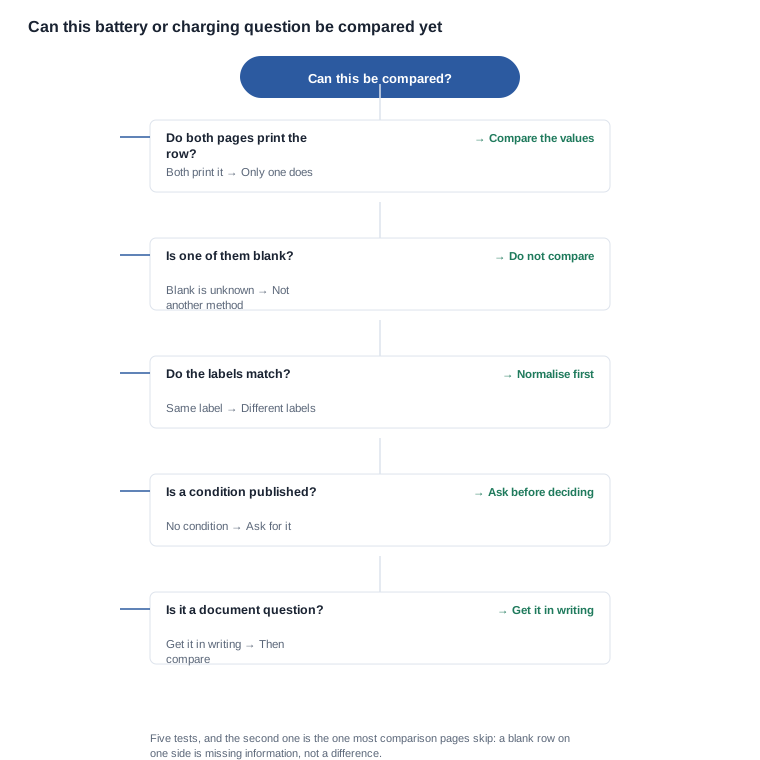
Five tests decide whether any given row can be compared, and the second is the one most comparison pages skip. If both pages print the row, the values can be compared. If only one page prints it, the row cannot be compared at all, and the reason has to be stated rather than filled in. If the labels differ between the pages, they are normalised first — in this range the same kind of row appears under several labels, and the values have to be read before the labels are matched. If no condition is published behind a figure, the figure is quoted with its condition outstanding. And if the question is really a document question, the document is requested before the comparison is made.
Applied here, the second test decides the charging question: one page prints a method and the other prints nothing, so the method is not comparable. What is comparable is the documentation state, and that difference is itself a finding worth having.
Why the charging method cannot be compared yet
A blank row is not another method
It is worth being exact about what the L1 Pro page does and does not say. It carries five rows: the camera, the cell, the charge time, the endurance figure and the case capacity. It carries no charging-method row and no feature line. In the camera range, five models publish magnetic charging, two publish a Type-C interface — the L2 Utral and the V03 Pro — and four publish no charging method at all: the CY03 and the MT6, and the L1 Pro and the CY05.
So the honest statement about the L1 Pro is that its charging method is not published. The statements it does not support are the ones that sound reasonable and turn out to be inventions: that its method is one of the two named elsewhere in the range, that its case is the charging interface, or that it is the same method as the L2 Utral. None of those is on the page, and each of them changes the accessory programme, the carton and the customer routine if it is wrong.
The four models in the same position
It helps to see that this is not a peculiarity of one page. Four camera models publish no charging method, and they include two of the models on the same 290 mAh and seven-hour platform as this one. A buyer who has already worked with one of those pages knows what the gap looks like in practice: the specification annex stops one row short, the accessory list has no basis, and the question has to go to the supplier as a document request rather than as a comparison.
The criteria for asking are the same in all four cases. Which interface the frame uses, whether a cable is required to charge it, whether the case is the charging path or an accessory that sits alongside one, and what a customer needs in the box on the first day. Those four questions are cheap to send and expensive to guess, and the guess is the one that ends up on a carton.
What the two pages do support about charging
What can be said is narrower. The L2 Utral publishes an interface named as Type C, and the L1 Pro publishes nothing to compare it with. The published difference between the two documentation states is one page carrying an interface line and one page not carrying it.
There is a second limit on the L2 Utral row itself, and it applies whether or not the L1 Pro is in the comparison at all. The page names the interface but does not say where it sits: on the frame, on the case, or on both. It does not say whether the case is a power source or a cradle, and it does not publish a case weight, a case charge time or a case interface. So the method row on this model settles that a standard interface is named, and leaves open the two questions that actually decide what travels in the box. The charging case options analysis works through the accessory arithmetic that follows from those two answers, and the shipping weight analysis covers the number that decides the freight class.
The accessory programme, which is where the real difference sits
The commercial difference between the two pages is therefore not a charging method but a documentation workload. One model needs the mapping between its two names and its two capacities established before a purchase order can be written; the other needs its charging method and its case terms supplied as documents before the same purchase order can be written. Both are closed by one written request, and both are closed by nothing at all if they are assumed.

The case row: two values against one
Why one published value does not mean one available value
The L1 Pro publishes 1400 mAh. The catalogue does not publish whether a smaller case exists for that model, and the difference between "the catalogue lists 1400 mAh" and "the only case for this model is 1400 mAh" is exactly the difference between a published fact and an inference. The inference is the more convenient of the two, because it makes the L1 Pro the simpler configuration, and it is the one that lands on a carton.
The criteria for closing it are short: whether a second capacity is available for that model, what its value would be, and whether the two configurations would be produced from the same tooling or from different. How to evaluate what comes back is covered in the certification coverage notes for the document side of the answer, and the model readiness overview sets out how a range is normally assessed before a programme is committed to it.
What the case itself still has to answer
The capacity is the only thing published about either case, and a case is three objects rather than one: a housing, a connector and a cell. None of the other two is described for either model. The case weight and dimensions are not published, so the freight class of the packed unit is open until a packed unit is weighed. The case interface is not published, so the number of cables in the customer's hand is open. And the case charge time is not published, so the routine a customer follows in the first week is open.
There is a fourth question that is not published for any camera model with a case row, and it is the one that belongs in a warranty conversation rather than in a specification: the cycle life of the case cell and the replacement route when it fails. A case that cannot be replaced is a support line for the life of the product, and a case that can be replaced is a spare-parts decision with a stock position attached. Both questions go to the supplier as one line, and neither can be answered from the catalogue.
Why the asymmetry is worth having
The two values on the L2 Utral are worth stating carefully, because a buyer may see them as a complication rather than as an option. Two capacities on one model means two carton specifications, two accessory lists and two configurations to stock, and each of those is a commitment rather than a choice. The cost is real, and whether it is worth paying is a commercial decision about volume, channel mix and packaging rather than a question the documentation can answer.
What the option buys is the ability to serve two different channels from one platform: a configuration with the smaller case for a customer who wants a lighter parcel, and one with the larger case for a customer who wants the box to carry more of the energy. The range guide for choosing across camera models sets out the other criteria that sit alongside it, and the criteria that apply to both models are the same as the ones that apply to one: the freight class, the accessory list, the carton and the stock position.
The naming and configuration questions behind the comparison
Two names on one page, and no mapping
The L2 Utral page prints two names beside the two case capacities: Utral and Pro Max. The page does not say which capacity belongs to which name, which of the two is the base build, or whether they differ in anything other than the case. The L1 Pro page prints one name and no configuration line at all.
That asymmetry has a practical consequence that a comparison table can hide. A purchase order for a single-named model is one line with a case capacity in it. A purchase order for this model has to be written with the confirmed name and the confirmed capacity on the same line, because a document that lists the two names in one block and the two capacities in another has reproduced the ambiguity inside the document that was supposed to remove it. The confirmed strings have to be written out in full, on the model line, and they have to match the carton and the packing list character for character.
The designation has to match three places
Whatever the configuration turns out to be, the designation has to be identical on the supplier's specification sheet, the packaging artwork and the declaration of conformity, and the L1 Pro's single name has to be confirmed in the same way. A designation that differs between those places creates friction at customs and again on every quality claim, and it is much cheaper to resolve in a message than in a shipment. This is a documentation task rather than a technical one, and it is the cheapest item on either list.
What this comparison settles, and what it does not
What both models leave unpublished
Six rows are empty for both of these models, and that is a different kind of fact from the row that exists on one page and not the other. The sensor model, the field of view, the video format and the frame rate are not published for either. The frame weight is not published for either. And an ingress marking is published for only two camera models in the whole range, neither of which is one of these.
The practical value of a gap that both models share is different from the value of a gap that only one has. A shared gap is a task the buyer does once and applies to both: one request for the imaging rows, one weighing session, one question about protection, and the answers apply to whichever of the two is chosen. That is why it is worth separating the two kinds of gap before writing the request list, because the first kind is cheap and shared while the second kind has to be closed separately for each model.
The questions, asked in identical words
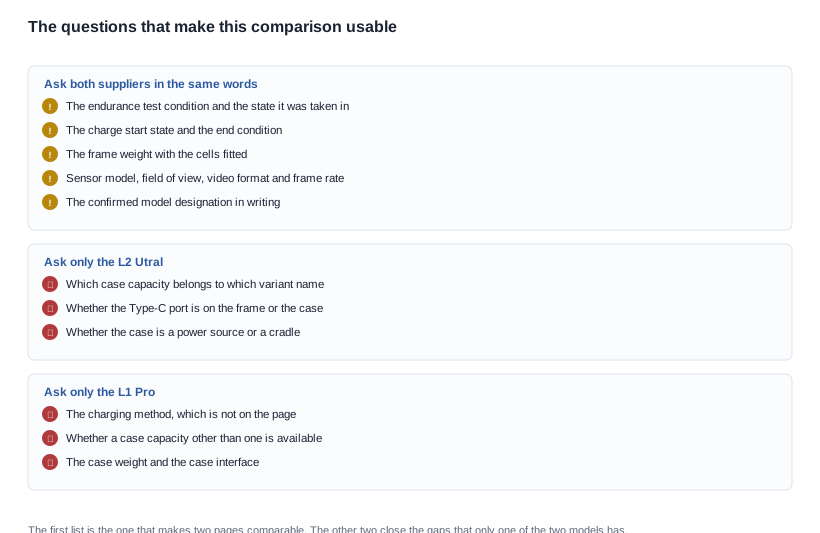
Five questions apply to both models and should be sent with identical wording, because the value of the comparison comes from the answers being comparable. The endurance test condition and the state it was taken in. The charge start state and the end condition behind the two-hour ceiling. The frame weight with the cells fitted. The sensor model, the field of view, the video format and the frame rate. And the confirmed model designation in writing.
Two more questions belong to the L2 Utral alone: which case capacity belongs to which variant name, and whether the Type-C port is on the frame or on the case. Three belong to the L1 Pro alone: the charging method, which is not on its page; whether a second case capacity is available; and the case weight and interface. The L1 Pro battery life analysis covers the runtime side of the same questions, and the method for comparing rated runtime figures explains why the condition matters more than the number.

Turning the comparison into a purchase file
A comparison is only finished when it can be written down, and this one has a specific order. First mark the rows that both pages print and that are identical, because those rows need no further work. Then mark every row that exists on only one of the two pages, because those are the rows that decide the outcome and they are the ones most likely to be assumed rather than asked.
Then write the questions, and send them to both suppliers with the same wording, so that the replies can be placed next to each other. Then record the condition behind every figure that is quoted, so that a number cannot be detached from the test that produced it. Then decide on the configuration rather than on the model name, because the configuration is what the carton, the accessory list and the compliance file all describe.
The last step is the one that most comparisons never reach: writing the confirmed strings into the purchase file. For a single-named model that is one line. For the L2 Utral it is two lines, each carrying a confirmed name and a confirmed capacity, and each matching the carton and the packing list. A comparison that ends before that step has produced an opinion, and an opinion is what arrives back as a claim when a customer opens the box.
Identical figures, and the gap that is not a gap
The published rows do not separate these two models, and the difference between them is a documentation difference rather than a specification difference. We will publish the identical figures as identical, we will not present the seven-hour rating as a reason to prefer either model, we will not state a charging method for the model whose page does not publish one, and we will not describe the single published case capacity as the only capacity available. We will not quote a weight or a sensor model that the catalogue does not contain, and we will not treat a shared set of figures as a shared platform, because the documentation does not describe our platform structure.
The published L2 Utral specification list and the published L1 Pro specification list are the honest baselines for each, and the questions above are what turns them into a decision. Send us the channel, the volume and the markets, and we will tell you which rows are already comparable and which are still waiting on a document.
Related reading
- Choosing across the camera range — AI camera glasses which model to pick
- The accessory trade-off — AI camera glasses charging case options
- The platform structure — OEM ready platforms which models are ready


