

The L2 Utral charges over a Type-C port, charges in two hours or less, and carries a 290 mAh frame cell rated at about seven hours of use. The part that makes this model interesting is the accessory that comes with it: a charging case published in two capacities, 900 mAh and 1400 mAh, on the same model and the same electrical specification. No other model in this catalogue publishes two case capacities, and that single fact turns a charging decision on this model into a product-line decision.
And the catalogue does not tell you which case belongs to which name. The model's page carries two variant names, Utral and Pro Max, printed beside the two case capacities, and it does not publish the mapping between those names and those capacities. So the configuration on this model is genuinely open in two directions at once: you can choose a capacity, and you cannot yet document which name goes with it. Both of those are requests rather than facts, and both of them are cheap to close.
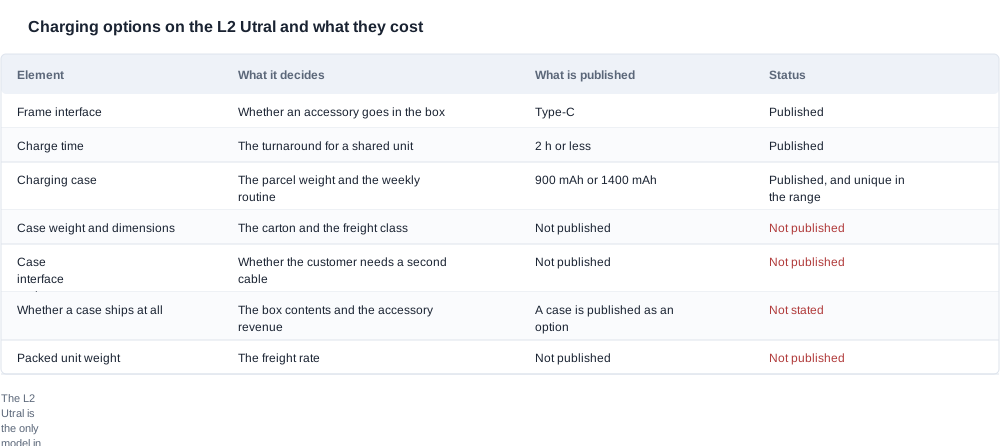
What the L2 Utral's charging setup actually is
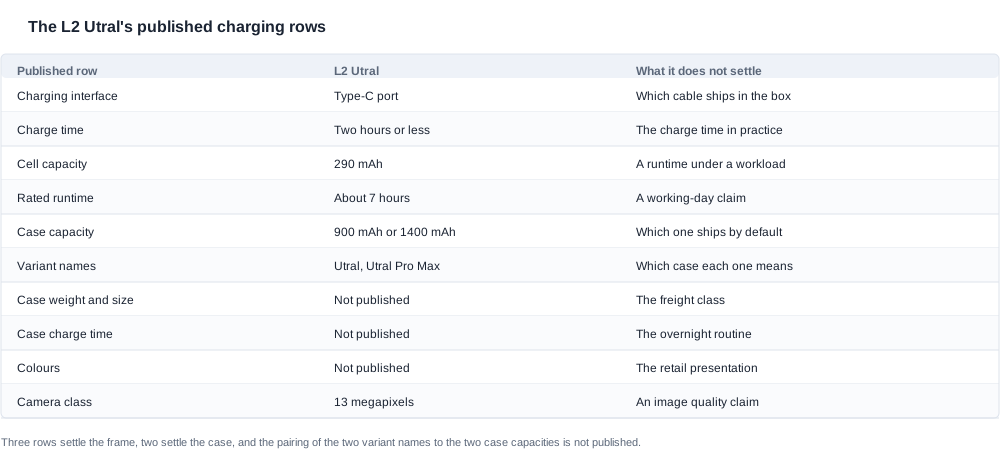
Six published rows describe how this model is charged and what it carries, and the two that concern the case are the ones a buyer will spend the most time on.
| Published row | L2 Utral | What it does not settle |
|---|---|---|
| Charging interface | Type-C port | Which cable ships in the box |
| Charge time | Two hours or less | The charge time in practice |
| Cell capacity | 290 mAh | A runtime under a workload |
| Rated runtime | About 7 hours | A working-day claim |
| Case capacity | 900 mAh or 1400 mAh | Which one ships by default |
| Variant names | Utral and Pro Max | Which case each name means |
| Camera class | 13 megapixels | An image quality claim |
The Type-C interface is more unusual in this category than it looks. Across the eleven camera models, five publish magnetic charging, two publish a Type-C port — the V03 Pro and this one — and four publish no charging method at all. So the L2 Utral is one of only two camera models with a documented Type-C port, and the only one of those two that also publishes a case capacity. and that changes the commercial shape of the case: where the frame charges over a standard cable, the case is an optional value item rather than the thing the customer has to buy in order to charge the product at all.
And the charge ceiling is a ceiling, exactly as it is everywhere else in this catalogue. Two hours or less permits two hours and does not license the tighter phrasing, and the starting state is not published. That is one line in the specification rather than a reason to choose one model over another, and it is worth keeping on the sheet anyway because it is the one figure the case has to work around.
What the catalogue does not publish about the case is the list a buyer actually needs. There is no case weight, no case dimension, no case interface, no case charge time, no statement about whether the case recharges itself, no cycle life, and no indication of whether a case ships at all as standard or only as an option. The colour list is not published either, which matters because a colour is the first thing a buyer puts on a product page, and no colour is published for this model at all.
The two variant names are a documentation task, and the case makes it a documentation task with teeth. Both names appear on the model's page, and the catalogue does not say which is the base and which is the higher one, nor which case capacity each one carries. Until the mapping is confirmed in writing, a listing, a carton and a conformity file can each end up carrying a different string for what the buyer believes is the same product.

Why this model has two case capacities and no other does
Five of the eleven camera models publish a case capacity at all. The CY05 and the L1 Pro, and the CY03 publish 1400 mAh. The L2 Utral publishes 900 mAh or 1400 mAh. The MT6 publishes 1200 mAh in a folding case. Two more models, the KY06 and the MT5, are published as having a case with no capacity attached. Four — the S7 and the V03 Pro, and the V03 and the V06 — carry no case row at all.
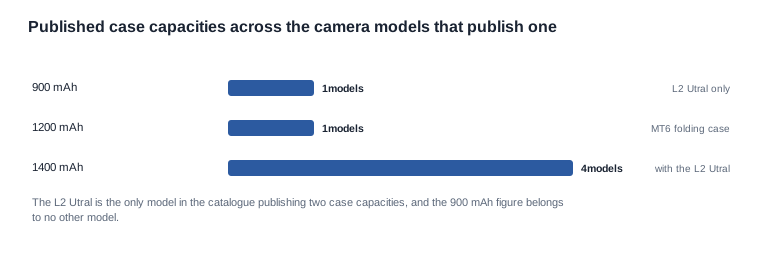
So the L2 Utral is the only model in the catalogue that publishes two capacities for the same accessory. Every other model that publishes a capacity publishes one figure. That is why the case decision here is not the choice between two values of the same thing, the way choosing between a 1400 mAh and a 900 mAh battery inside one product would be. It is the choice between two different products that share an electrical platform, and the consequences run into packaging, freight, merchandising and the accessory list at the same time.
The lower capacity belongs to no other model in the range. The 900 mAh figure appears once in the whole catalogue, on this model, and the only other published case capacity that is not 1400 mAh is the MT6's 1200 mAh folding case, which is a different form factor on a different cell. A buyer who wants the smaller case does not have a second source of it inside this range, which is a supply question as much as a product question.
And the relationship between the two names and the two capacities is unpublished. It is tempting to assume that the higher-sounding name goes with the larger case, because that is how the two usually travel together in this category, and because the 1400 mAh capacity is the one that the other models on the same 290 mAh platform also publish. The catalogue does not say that, and the assumption has a cost: the wrong pairing puts the wrong capacity in the wrong box, and the box is the thing that cannot be reprinted.
What the case choice changes downstream
The parcel is the first thing that changes, and every number in it is unpublished. A case is a second cell, a housing, a connector and a hinge, and the two capacities are not the same object in different sizes — the smaller one is a different tool with a different footprint. The catalogue publishes no weight and no dimension for either case, so the freight class, the carton specification and the warehouse slot count are all open until a packed unit is put on a scale. The shipping weight breakdown covers what that number controls.
On energy, the two capacities are a derived comparison rather than a published one. Taking the published 290 mAh frame cell as the base, the 900 mAh case is roughly 3.1 times it and the 1400 mAh case roughly 4.8 times it — those ratios are arithmetic on published numbers, not figures anyone has published, and the usable fraction is lower than the raw capacity because the conversion losses in a dock and the behaviour under a partly depleted frame are both unknown. The honest way to hold the comparison is stored energy, not additional runtime, and to promise nothing beyond it until a sample is measured.
Then there is what the choice does to your own operation. Two case options mean two carton specifications, two case toolings, two accessory lists, and two smaller production runs per configuration instead of one. That is a real cost, and it is the cost that stops a single-channel brand from taking the two-tier structure even when the platform underneath it would support it perfectly well.
And what the merchandising side gets is the part that is hard to replicate. One platform, one camera class and two case options gives a channel two propositions built on the same product — a full-day configuration and a lighter one — without running two product programmes. The charging case options analysis sets out the economics of that structure, and the what to include in the box piece covers the contents decision that sits underneath it.
One question decides all of it, and it is not published: which capacity ships by default. A case published as an option is not the same as a case in the box. For a retail channel the default is the most visible thing in the product photograph and the thing the customer unboxes; for a distributor it is the largest single line in the delivered cost. It has to be settled before artwork, because the box contents decide the packaging, and the packaging is the one thing in a launch that cannot be changed after the first production run.
The two capacities are two different parcels, and the difference reaches further than the box. The 900 mAh case and the 1400 mAh case are not the same housing in two sizes. They are different tools with different footprints, and each one determines a carton specification, a pallet layer, a shelf position and a freight class — and every one of those four numbers depends on the case weight, which the catalogue does not publish for either capacity. That is why the capacity decision cannot be made apart from the packaging work: the smaller case does not simply ship more cheaply, it may or may not cross into a different freight class once the carton, the insert and the accessories are added, and the only way to find out is to weigh a packed unit of each configuration.
Stocking is where the second-tier decision actually bites. A brand that runs both capacities is holding two configurations of the same model, and the spare-parts question follows from it: a replacement case has to be held in the configuration the customer bought, rather than in whichever capacity is easier to put on a shelf. The frame is the same in both configurations, so either capacity will charge either unit, but the packaging and the shelf space belong to the configuration that was sold, and that is what a spare has to match.
And that is the reason this is a product line and not a parameter. A parameter is a value you set on one product and move on from. A product line is two products that share a frame and a camera class, and that carry two carton specifications, two accessory lists and two spare-parts streams. The catalogue publishes the case in two capacities, and everything downstream of that fact is what turns one model into two sellable configurations. The private label options piece covers how the contents decision interacts with a brand programme.

What the catalogue does not publish about the case
Seven items sit on the list, and they are not equal. Three are answered by a written request, two are answered by a sample unit, and the remaining two are commercial or documentation decisions that the supplier has to make rather than the buyer.
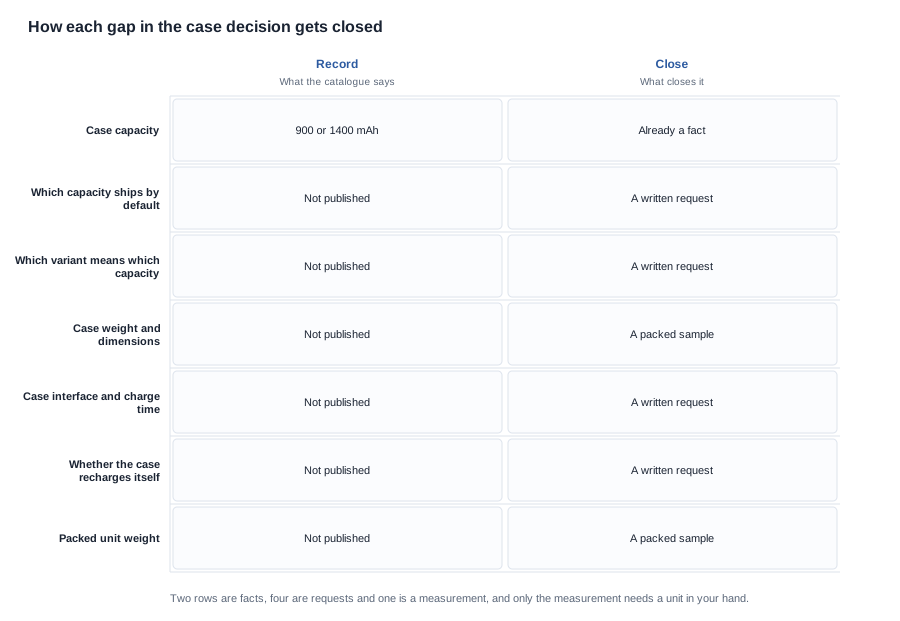
The three requests. Which case capacity ships by default, and at what quantity. Whether the case recharges itself, and how long it takes to charge and by what interface — a case with its own port means two cables and two routines in the customer's hand, and a case charged from the same port as the frame means one accessory. And the mapping between the two variant names and the two capacities, which is a single line on a sheet.
The two measurements. The case weight and dimensions, and the packed unit weight of the whole configuration in its retail carton. Both come from one packed sample on one scale, and both feed the same downstream number, which is the freight class. Nothing else in this list moves the parcel.
The two decisions. Whether a case is included at all at the quantity you are ordering, which is a commercial term and belongs on the quotation rather than on a specification sheet. And the cycle life of the case cell and its replacement path, which is a warranty-cost question before it is a technical one, because a case that is not replaceable is a support line for the life of the product.
One item sits outside the list and still matters more than any of them. There is no per-model certification row for this model or for any other in the range, and the export certification page in the catalogue is a company-level page whose content is presented as images. What can be written down is the regulatory frame a conformity file would be built against — the Radio Equipment Directive (EU) 2014/53/EU and the EMC Directive 2014/32/EU — and the request to make is for a document that names the model string and the case option together. A file that names one capacity and is silent on the other is a file that has to be reissued the first time a customer orders the other one.

How to configure it, and what to ask for
Eight items, and they belong in two lists: one message to the supplier, and one packed sample on a scale. Splitting them that way is what stops a programme from waiting on hardware for information a document could have closed in a day.
- Which case capacity ships by default at my quantity, and is a case included at all or is it a line item?
- Which variant name maps to which case capacity — the two names on the page, confirmed in writing, per capacity.
- The case interface, its own charge time, and whether it recharges itself.
- The case cycle life and the replacement path.
- The colour list, which is not published for this model.
- The measured case weight and dimensions, and the packed unit weight for the configuration you intend to ship.
- The confirmed model designation, identical on the supplier's sheet, the carton, the listing and the conformity file.
- The conformity position for this model and each case option, in each destination market.
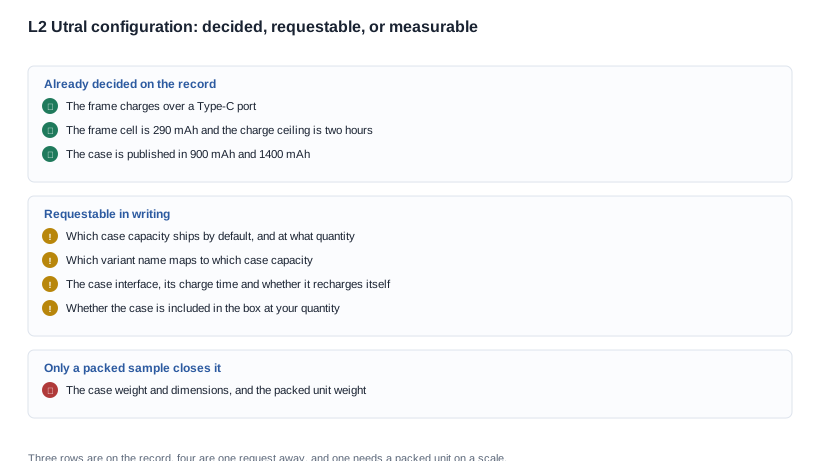
The variant mapping is the part of this that has to be written into the purchase order, because it is the part that is genuinely blank. The catalogue gives two names for the model and two capacities for the case, and it does not say which name goes with which capacity. A purchase order therefore cannot be written as one model line with a case option in brackets. It has to be written as two lines, each naming a model string and a case capacity explicitly, with the pairing the supplier confirms written into both of them — and both lines have to carry the same string, character for character, as the carton and the packing list, because the packing list is the document that decides what is inside the box.
The blank is not a blocker, but it has to be visible on the paperwork. The way to handle it is to write the two confirmed strings in full, to leave the pairing that the catalogue does not publish as an explicit line for the supplier to complete, and to keep the case capacity on the same line as the model string rather than in a separate column that a fulfilment house can read on its own. A purchase order that lists the case capacities in one block and the model names in another has reproduced the ambiguity inside the document that was supposed to remove it.
And the same discipline applies to the colour box and the packing list. Neither the model string nor the case capacity should be abbreviated anywhere on the box, on the packing list or in the warehouse system, because an abbreviation is where two configurations of the same model quietly become interchangeable in the stock system. Where the system cannot hold a case capacity on the model line, it needs a second field, and that is a request to whoever builds the channel's catalogue rather than a formatting decision.
How to evaluate the answers is as much a part of this as the questions are. An answer tied to a model designation and a case option can go onto a specification sheet; an answer that covers the family cannot, and it will look complete on first reading. A case weight given without the configuration it belongs to is a number you cannot use, because the two capacities are two different objects. The red flags are the same across all eight: an answer with no model string, a figure with no configuration attached, and a default that changes with quantity without anybody saying so.
How to compare the two configurations against each other is a shortlist question, and the criteria are known. A brand that runs one capacity is running one carton, one accessory list and one production run, and it is giving up a second merchandising point. A brand that runs both is buying two of everything and getting two propositions out of one platform. The criteria that settle it are the volume split between the two channels, whether the supplier can schedule both configurations together, and whether the packaging artwork can carry two box sizes. When to run one and when to run both is a commercial decision rather than a technical one, and the capability to run both is already on the record. The buyer checklist for this model is short enough to send as it stands: the default capacity, the variant mapping, the case interface, the case charge time, the packed weight and the model string.
And the two lists have different deadlines. The request list should be sent before the packaging artwork is drawn, because the default capacity and the variant mapping both change what goes in the box. The measurement list can follow the first sample shipment, because a case that arrives with the goods is a case you can still weigh — but a carton that has already been printed is a carton you cannot re-specify.
What this configuration does and does not settle
This model publishes more configuration rows than any other camera model in the range, since it is the only one that publishes two case capacities and the only one that carries a variant-name line, and the configuration has to be decided before the artwork, because the case changes the carton, the freight class and the commercial structure at the same time. We will publish the interface, the charge ceiling and the two case capacities because they are documented. We will not quote a case weight, a case dimension, a case charge time, a packed unit weight, a certificate number, a price or a lead time that the source does not contain.
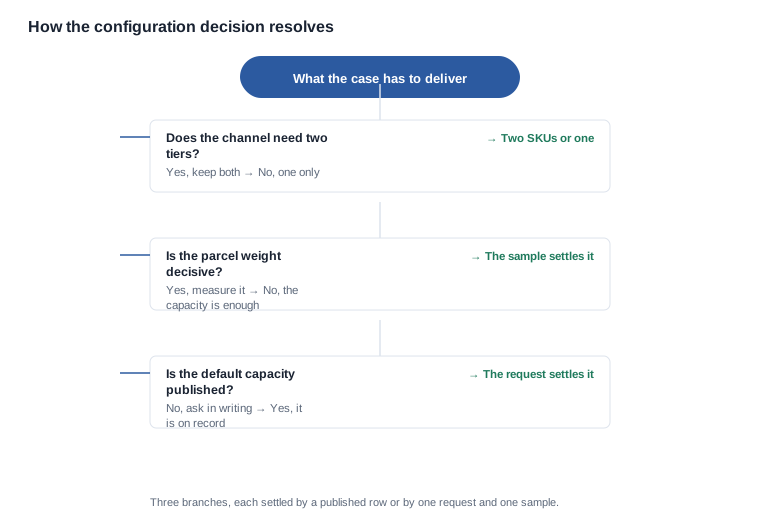
What the published rows settle is the shape of the product, not the shape of your programme. They tell you the frame charges over an interface named as Type C, that the frame cell is 290 mAh, that the charge ceiling is two hours, and that a case exists in two capacities. They do not tell you which capacity is in the box, which name goes with which capacity, what the case weighs, what it costs to ship, or what the file says. Those five are requests and measurements, and the difference between them is the difference between a week and a sample.
What we will not do is assign the variants ourselves. It would be easy to assign the larger case to the more elaborate-sounding name, because that is how two configurations usually travel together in this category and because it would make the page tidier. The catalogue does not publish that mapping, so a buyer who plans a two-tier structure on it is planning on an assumption, and the assumption lands on a carton.
And what we can do is make the decision cheap. One written request covering the default capacity, the variant mapping, the case interface and the case charge time, plus one packed sample on a scale, and the configuration stops being an open question. The published L2 Utral specification list is the honest baseline for the frame, the L2 Utral limitations analysis sets out the full gap list, and the L2 Utral battery life page covers the runtime side of the same configuration.
Related reading
- The specifications this model publishes — L2 Utral smart glasses specifications and features
- The economics of the case choice — AI camera glasses charging case options
- The operating routine that follows a configuration — how to use L2 Utral smart glasses
Two case capacities on one model is a structure you will only find here — tell us which configuration your channel needs and we will tell you which of these eight items still has to be closed before the artwork goes out.


