

When a procurement team asks how the LC-105-1 compares with the K02, the honest starting point is that the published catalogue rows answer very little. Both pages print the same runtime claim, the same charge time, the same charging method and the same empty feature row. Only two entries move between them, the cell configuration and the Bluetooth version, and neither of those is a performance ranking. This comparison therefore sets out the two differences precisely, shows what a buyer can and cannot infer from them, and turns the gaps into a written list of evidence to request from the supplier before a quotation is compared with a quotation.
Two framing points belong at the front of any comparison like this one. First, the catalogue publishes specification rows, not test results, so a runtime figure with no stated condition cannot be decomposed into a capacity claim. Second, the two models here sit inside an audio group whose rows are unusually homogeneous: magnetic charging is the default, Type-C appears on only two models, and five of the eight publish no feature row at all. Whatever separates the LC-105-1 from the K02 therefore has to be settled by your own filters and by documentation, not by reading the specification sheet.
The practical consequence is that this is a shortlist exercise rather than a preference exercise. The right question is not which model is better, because the catalogue does not support a better, but which of the two survives the filters your channel already applies. The K02 positioned against the rest of the published audio range sets out how this pair sits inside that group, and the D11 against K02 comparison works through the same twin-model problem for a different pair.
The two audio models that publish the same runtime
Put the two catalogue pages next to each other and the first thing you notice is how little separates them. The LC-105-1 page carries five standard rows, cell configuration, charge time, runtime claim, charging method and Bluetooth version, and the K02 page carries the same five rows in the same order. Four of the five read identically: a runtime claim of about 8 h, a charge time of two hours or less, magnetic charging, and a Bluetooth line that differs only in the version number. The catalogue prints no feature row on either page.
A shared runtime claim is worth pausing on, because a buyer who has seen one figure used as a differentiator will often treat it as a product fact. Inside the eight-model audio group the published runtime claims are about 8 h, about 7 h and about 6 h, and the figure most often quoted, about 8 h, sits on four of those eight models: the LC-105-1 and the LC-105-2, and the K01 and the K02. It is a group convention rather than a distinguishing specification. If your comparison sheet records runtime as the reason one model was preferred over the other, the entry is carrying no information, and the same applies to the charge time, since two hours or less is the same ceiling on both pages.
The feature-row picture explains why the specification sheets of these two read so thinly. Five of the eight audio models publish no feature row at all: the D12 and the LC-105-2, the LC-105-1 and the K01, and the K02. The remaining three do publish one. The D11 carries a surround sound line and a long battery life line, the G07 publishes an ultra-thin detachable temple line, and the YK12 publishes a surround sound line and a slim temple line. So the rows that would let a buyer compare acoustic description, temple geometry or control behaviour are simply absent for both models in this comparison. That is a gap in what the catalogue publishes, and it is not the same thing as a statement that the frames have no such features.
Charging method is another row that cannot separate this pair. Magnetic charging is the default across the audio side of the catalogue, and Type-C appears within the audio group only on the D11 and the D12. Since both models here publish magnetic charging, an interface filter either passes both or rejects both, and in the second case the audio models with a published Type-C row are the two to look at instead.
Two group-wide absences need the same careful reading. The eight audio models have no charging-case row between them, and they have no IP row either. The catalogue does mark IP54 on the V06 and the S7, two camera models, and on no audio model. Neither silence means that these frames lack a case or lack an ingress rating, only that the catalogue publishes no such line here. The catalogue does contain one explicit absence of that kind, the V03 Pro published without a charging case, which shows the difference between publishing an absence and publishing no row at all. For a supplier discussion, the honest formulation for the audio group is that no charging-case row is published, so the case question has to be closed in writing.
Each model in this comparison also has a published twin, and that is the structural reason the pair is hard to decide. The K01 publishes exactly the same five rows as the K02, and the LC-105-2 publishes exactly the same five rows as the LC-105-1. Two models with identical published rows cannot be separated by a specification sheet, so whatever ends up separating them has to appear on the model string, the quotation, the label and the packaging. A report, a certificate or a quality record written against the twin does not transfer across to the model you actually receive, which is the most common document mismatch we see in audio-glasses sourcing.
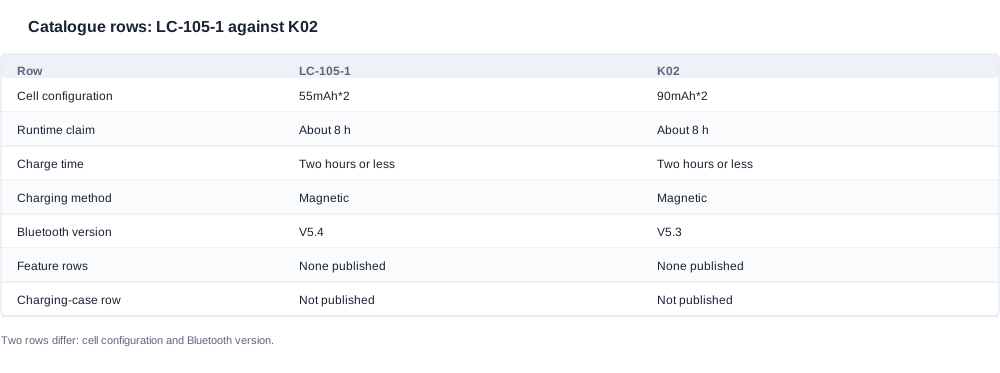
The table above lists the seven rows worth reading side by side, including the two where the catalogue publishes nothing at all. Read it as a filter input rather than as a ranking, because that is what the rows can carry.
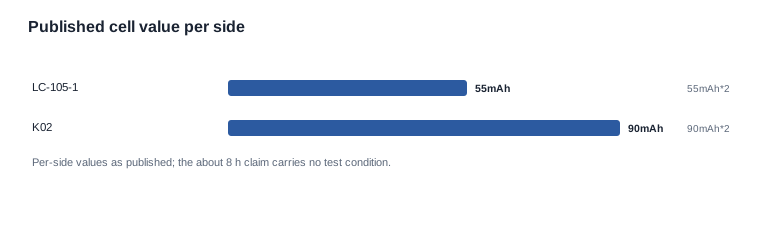
Cell configuration against the identical runtime claim
The cell configuration is the first of the two real differences. The LC-105-1 page publishes 55mAh2 and the K02 page publishes 90mAh2, so the per-cell value published for each side is 55 mAh against 90 mAh, roughly three-fifths in proportion. The catalogue publishes the pair as a cell count and a per-cell value together, which is why any comparison should quote it that way rather than as a single total figure.
That distinction matters because the runtime claim does not move with the cell value. Six models across the catalogue publish the same runtime claim of about 8 h, and they span four different cell configurations.
| Model | Group | Cell configuration | Runtime claim | Catalogue page |
|---|---|---|---|---|
| K01 | Audio | 90mAh*2 | About 8 h | p21 |
| K02 | Audio | 90mAh*2 | About 8 h | p20 |
| LC-105-1 | Audio | 55mAh*2 | About 8 h | p24 |
| LC-105-2 | Audio | 55mAh*2 | About 8 h | p25 |
| YKC02 | Sport | 70mAh*2 | About 8 h | p28 |
| ZH12 | Sport | 100 mAh | About 8 h | p30 |
The two sport models appear in this list because they publish the same runtime figure as the four audio models, not because they belong to the audio group, which holds eight models of its own. None of the six publishes a test condition, so the figure cannot be attached to any of the four configurations with confidence.
The clearest demonstration sits inside the audio group itself, where the same cell configuration appears with two different runtime claims. The 55mAh2 configuration is published by four audio models, and the LC-105-1 and the LC-105-2 claim about 8 h on it while the G07 and the YK12 claim about 6 h. Cell value alone therefore does not determine the published runtime, and the catalogue gives no condition that would explain the split. The reverse case is just as informative: the 90mAh2 configuration is published by the K01 and the K02 with a single runtime claim between them, so there is no published evidence here that a larger cell yields a longer claim, and no published evidence that the smaller configuration yields a shorter one.
This is why the identical runtime claim on the LC-105-1 and the K02 cannot be read as a statement that both perform equally well. It is an unconditioned claim printed on both pages. Any inference that runs from 55 mAh to 90 mAh and lands on endurance is an inference the catalogue does not support, and a sourcing team that lets it stand will end up comparing two unverified figures.
The evidence to request instead is a set of test conditions attached to the runtime claim, in writing, per model string. Ask what state the battery was in at the start of the test, what condition ends it, at what volume level the audio ran, which codec and transport were used, what ambient temperature the test ran at, whether the figure describes a single cell or the pair, and how many units were measured. Ask too whether the claim assumes a particular configuration of the rest of the frame, since a figure printed without its condition can be reproduced under conditions you do not intend to ship.
Battery documentation belongs to the same request list. The catalogue publishes no battery test report number for any model, so the UN38.3 test summary, the cell count behind each model string, the cell supplier and the safety documentation have to come from the supplier as documents with numbers on them. The same applies to certification scope: the catalogue text carries no CE, FCC or RoHS marking and no per-model certification row, so a buyer who needs those marks for a channel must request the scope for the exact model string, including which model the report names, because a report covering the twin does not cover the model in the carton.
The commercial rows are unpublished for both models as well. Unit price, minimum order quantity, lead time, production capacity and warranty terms are not published, so any landed cost comparison has to begin with a quotation rather than with a catalogue sheet, and any freight or packaging assumption has to come from supplier data. Shipping weight is one of those unpublished rows, and the only weight figure printed anywhere in the catalogue belongs to the MT6 glasses body at 158 g, which is a different product and cannot be carried across to either model here. Parcel class, packing specification and therefore freight cost all remain open questions.
When the cell configuration is already fixed by an existing test report, an approved bill of materials or a customer specification, the configuration decides the model and the runtime claim becomes a documentation item rather than a selection criterion. That is the correct way round: the cell value is a hard constraint you can verify, the runtime claim is a number with no stated basis.
Bluetooth version and the two empty feature rows
The second difference is the Bluetooth entry, V5.4 on the LC-105-1 page against V5.3 on the K02 page. Within the audio group, two models publish V5.3, the K01 and the K02, and six publish V5.4. The catalogue publishes no range figure, no codec, no profile and no latency measurement for either model, so the version should be handled as a compatibility input rather than as a capability claim.
That framing decides how much weight the entry can carry. If a customer specification, a platform requirement or a tender document names Bluetooth 5.4, then of these two models only the LC-105-1 carries a matching published row, and the filter is hard. If nothing in your file names a version, then the entry is documentation housekeeping and should not appear as an advantage for either model.
There is also a sourcing consistency angle worth stating plainly rather than as a technical benefit. If your channel already ships a Bluetooth V5.3 product, the K01 already shares the published rows of the K02, so keeping the K02 keeps a single radio baseline inside your existing document set. That is a reason to hold the configuration, not a claim that V5.3 performs better.
The two empty feature rows matter more for what they withhold. Neither page prints a line beyond the five standard rows, so there is no published acoustic descriptor, no published temple geometry claim, no published control method and no published charge indicator for either model. The comparison is easy to read precisely because the other three audio models with feature rows show what a published line looks like: the D11 carries surround sound and long battery life, the G07 publishes an ultra-thin detachable temple, and the YK12 publishes surround sound and a slim temple.
An empty row must not be read as an absent feature, and that distinction is not academic for a procurement file. The catalogue publishes no touch row for any model, so the control method for both the LC-105-1 and the K02 is unknown rather than known to be mechanical or capacitive or gestural. The same applies to the charge indicator, the microphone count, the temple construction and the dimensions of the frame. The honest entry on a comparison sheet is a blank cell labelled not published, and the corresponding action is a question to the supplier, not an inference.
Two of those blanks have direct commercial consequences. A frame weight determines the shipping class and the parcel cost, and no weight is published for either model, so a freight estimate built on a guess carries a real margin of error. A control method determines what a buyer can describe in the retail listing, and with no published line, the listing text has to wait for the supplier answer. Asking whether a temple carries a touch surface, how it is configured, and what the indicator shows is a normal part of due diligence for this pair, not a challenge to the specification.
What the comparison cannot settle from the catalogue
The published surface of the catalogue is narrow and worth naming in full before drawing conclusions from its gaps. It gives model names, cell configurations, charge time ceilings, runtime claims, charging methods and Bluetooth versions for every model, and on some pages it adds a feature row, colour options, an IP54 marking or a charging-case capacity. That is the whole of it.
Everything else in a typical comparison sheet is missing for both models in this pair, and the items below are the ones buyers most often assume are already known:
- Unit price, minimum order quantity and the payment terms attached to either figure.
- Lead time and production capacity for the model string you intend to buy.
- Warranty terms, and what a replacement unit costs under warranty.
- Certificate and test report numbers, and which model string each report names.
- Frame weight and dimensions, and therefore the shipping class and parcel size.
- Control method, charge indicator and microphone configuration.
- Whether a charging case is part of the configuration, and if so what capacity it carries.
- Quality control scope, defect handling and the replacement process after delivery.
The list is identical for the LC-105-1 and the K02, because the catalogue treats them the same way and publishes nothing extra for either. That symmetry is the honest result of this comparison, and it should be stated to the client rather than papered over.
Two kinds of silence have to be kept apart, and the catalogue makes the distinction easy to study. On one side there is the explicit absence, published once: the V03 Pro is written as shipping without a charging case. On the other side there is the empty row, published everywhere else, including across all eight audio models for the charging case and for IP. A supplier statement closes both gaps, but only one of them can be answered from the catalogue, and a comparison sheet that merges them will overstate what is known in either direction.
A second practical limit is worth naming. Even a complete set of published rows for both models would not produce a ranking, because the rows are structure rather than evidence. A comparison sheet built only from catalogue rows can group the two models, describe them and list their filters, and it cannot tell a buyer which one to commit to. The output of a catalogue-only exercise is a set of questions and a shortlist, not a purchase order.
The evaluation method that follows from this is straightforward. Define the filters first, in writing, before any quotation arrives: the Bluetooth version your channel or customer requires, the cell configuration your existing documentation fixes, the charging method your packaging and cable plan supports, and the acceptance criteria you will apply to the runtime claim. Then request the missing rows against the exact model string you intend to receive, and compare quotations on that basis rather than on the catalogue rows, which differ in only two places.
Total cost comparison sits on the same footing. Because unit price, lead time, warranty and certification scope are all unpublished, the only defensible comparison is one where each quotation carries the same rows: model string, cell configuration, Bluetooth version, runtime claim with its test conditions, charging method, packaging scope, warranty terms and the certification documents that name the model. Two quotations that answer different rows cannot be compared, however similar their totals look.
Choosing between the LC-105-1 and the K02
A shortlist for this pair should be built from filters and evidence, in that order, and the decision itself narrows to three questions. Which of them applies first depends on your channel, not on the catalogue.
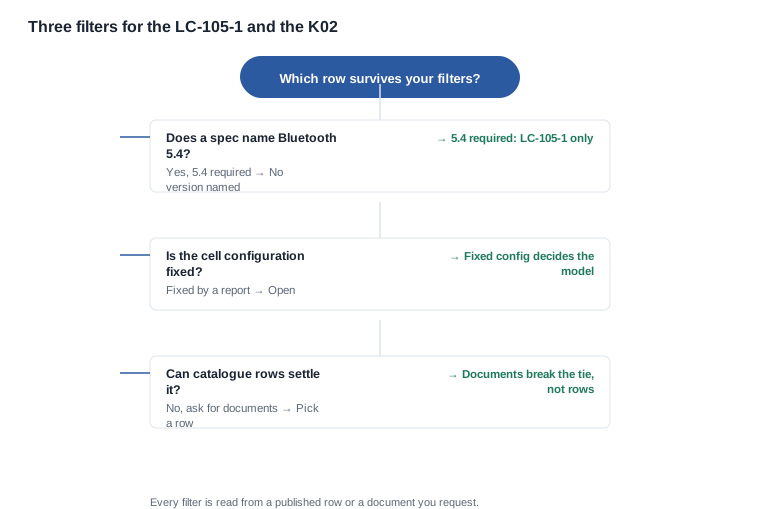
The first question is whether the customer or platform requires Bluetooth 5.4, and it is the easiest to answer because the published row answers it directly. If V5.4 is required, only the LC-105-1 of the two matches, and the K02 drops out of the shortlist regardless of anything else. If no version is named anywhere in your file, the question is moot and the Bluetooth row is documentation housekeeping.
The second question is whether the cell configuration is already fixed, and it carries the larger trade-off. If an existing test report, an approved bill of materials or a customer specification pins the configuration, then that report decides and the runtime claim becomes documentation to request rather than a criterion to weigh. If the configuration is open, the trade-off between the two published configurations and one unconditioned runtime figure cannot be resolved from the catalogue at all, because the same configuration appears elsewhere in the group with a different runtime claim. An open configuration therefore defaults to the one your existing documentation already covers, and where you have no existing documentation, the tie is broken by the evidence you can obtain, not by the cell value.
The third question is the one most comparisons skip. Can the two be decided on catalogue rows alone? They cannot, and the correct conclusion is to close the gap with documents rather than to pick the row that reads better. The rows are two cell configurations and one version number against four identical entries and two pages with no feature line at all.
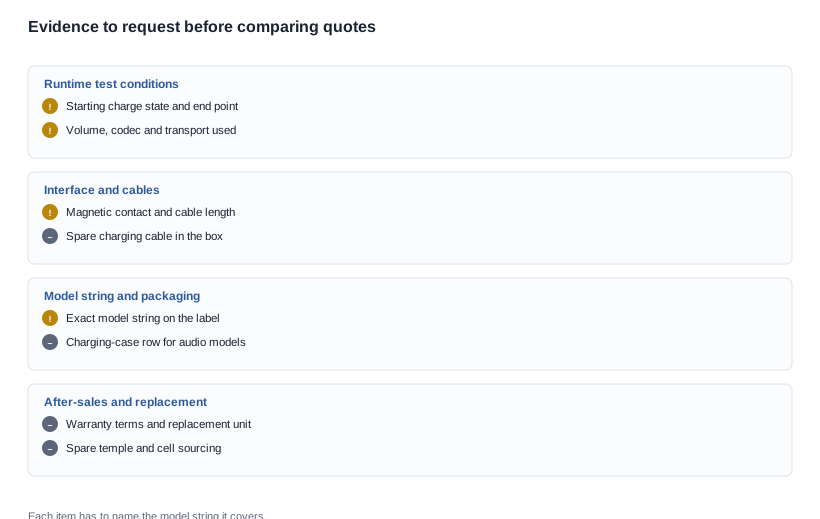
The checklist groups the evidence by what it settles. The runtime test conditions decide whether the claim means anything; the interface and cable questions decide what your packaging and cable plan has to carry; the model string and packaging questions decide whether the documents you receive will match the model you ordered; and the after-sales and replacement parts questions decide what happens when a unit fails inside its warranty period. Each group belongs to a supplier document, and each document should name the model string.
The order of work is what protects a sourcing team from the twin-model trap, because both the K01 and the K02 publish identical rows, and the LC-105-1 and the LC-105-2 publish identical rows too.
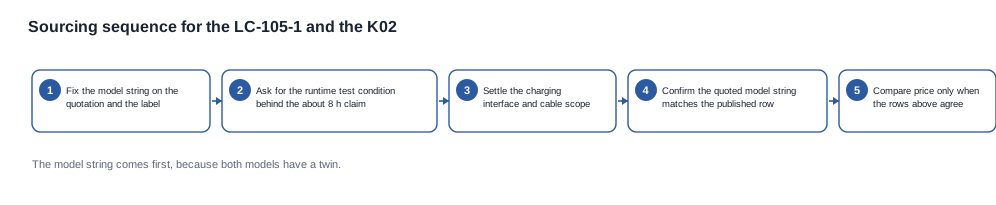
Fixing the model string first is what makes every later request answerable. Once the model string is written down and confirmed, the runtime test condition, the cable scope, the packaging detail and the certification documents can each be requested against it, and a mismatch in the model string becomes visible at the point of the quotation rather than at the point of delivery. The last step, comparing price, is only meaningful once the rows above agree, because a quotation that answers fewer rows is not comparable with one that answers more.
Applied as rules, the shortlist for this pair reads like this:
- If a specification names Bluetooth 5.4, the LC-105-1 is the only one of the two that carries a matching published row.
- If a specification names V5.3, or names no version at all, both remain in the shortlist and the version decides nothing on its own.
- If an existing report or bill of materials fixes the cell configuration, that document decides the model and the runtime claim moves to the documentation list.
- If nothing fixes the configuration, do not let the per-cell value stand in for an endurance argument, because the catalogue contains a counter-example.
- If the charging method must be Type-C for a cable plan or a packaging decision, neither model qualifies, because Type-C in the audio group appears only on the D11 and the D12.
- If a charging case or an ingress rating is decisive for the channel, treat it as an open question for both models, because the catalogue publishes no case row and no IP row for any audio model.
- If the quote is going to carry a certification claim, require the report number and the named model string, since a report covering the twin does not cover the model in the carton.
- If a comparison against the wider range is the real question, the LC-105-1 against the D12 comparison and the K02 specification and features note give you more published rows to work with.
Send us the two filters that actually bind, the Bluetooth version your channel requires and the cell configuration your documentation fixes, along with the model string you intend to order, and we will tell you which of the two catalogue rows that leaves standing and which documents still have to be requested for it.
Related reading
- How the K02 sits against the rest of the published audio range — the K02 in context
- The same twin-model problem for another pair — the D11 against the K02
- Runtime figures across the group — audio glass battery comparison
- Ordering the group as a business — bulk ordering audio glasses


