

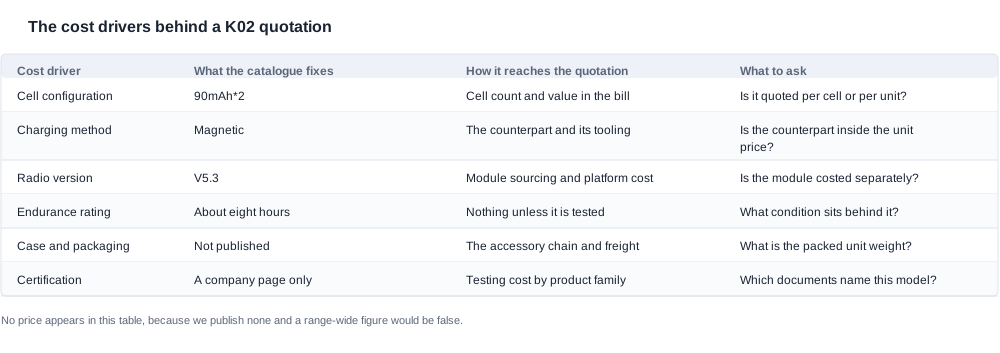
We do not publish a unit price for the K02, and we are not going to tell you the K02 is the best value in the audio range, because a catalogue that publishes no prices and no price tiers cannot support either statement. What it can do is publish the things that actually move a unit cost, and that is more useful to a buyer than a number would be. On that basis the K02's cost position is built on four drivers: a paired-cell configuration that is the largest published in the range, magnetic charging with its own accessory consequence, the older of the two radio generations published in the range, and a complete absence of any published feature line to charge for.
That last point is the one most often missed, and it cuts both ways. A model with no feature line gives a channel nothing to differentiate on except its own brand assets and the specification, which is a cost to the channel rather than a saving from the factory. A model with a documented feature line gives the channel copy that it would otherwise have to write and evidence. So the honest way to evaluate value in this category is to compare the total cost of getting a sellable product, not the unit price of a frame.
What the K02 can be worth when no price is published
Why "value" cannot be read off a catalogue page
Three common readings of "value for money" in this category all fail on the K02 because the catalogue supports none of them.
The first is a price comparison, and it fails because no price is published for the K02 or for any other model. The second is a price-tier judgement — entry, mid-range, premium — and it fails because a tier is a claim about where a product sits relative to its competitors, and the catalogue publishes no competitor set and no price. The third is a specification rank, and it fails because the published rows are too thin to rank on: five rows, three of which are shared with every other audio model, and one endurance rating that the range itself contradicts.
What remains is the part that is actually decidable: which cost drivers are different between the models being compared, and which of those differences the channel has to absorb. That is a smaller claim than a price verdict, and it is one a buyer can act on.
The four drivers that actually move a unit cost
A quotation for an OEM audio product is assembled from layers, and only the top layer is visible on a catalogue page. The published rows fix the configuration. The configuration drives the bill of materials. The bill of materials plus the tooling, the certification and the packaging drives the unit cost, and the packed unit weight plus the destination market drives the freight. Margin and the channel's own costs sit above that.
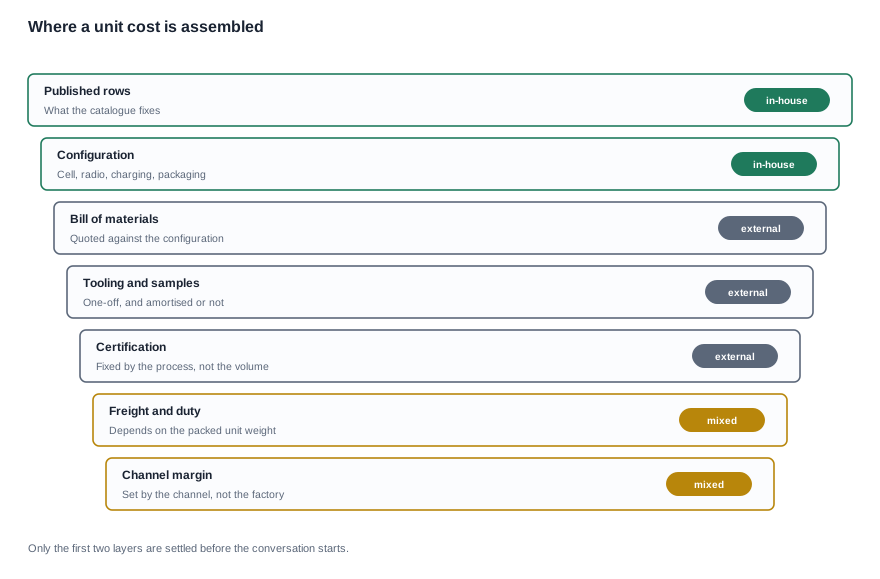
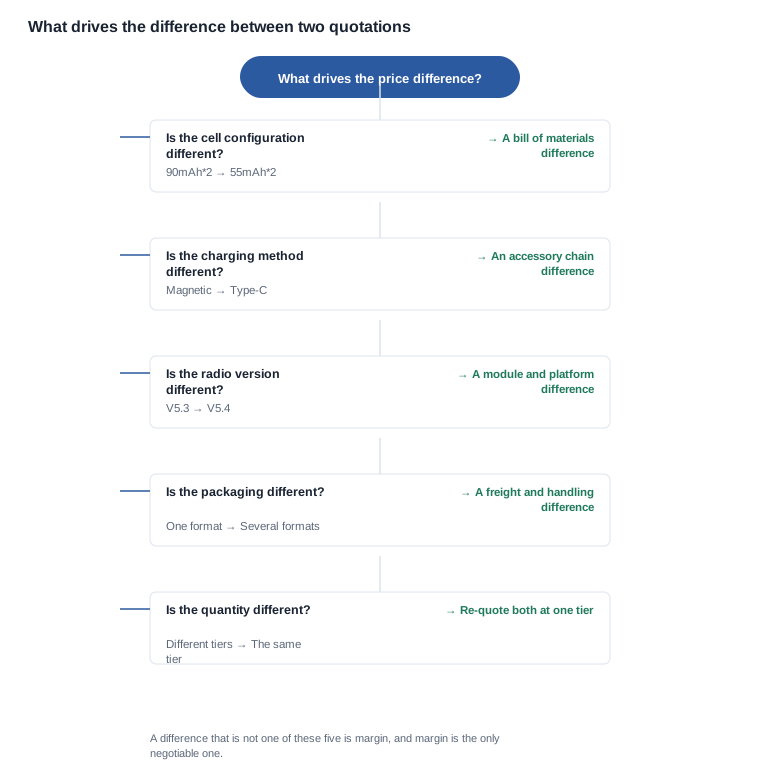
Most of the differences a buyer notices between two quotations are traceable to one of four drivers, and each of them has a published K02 value that lets the buyer ask a precise question about it: the cell configuration, the charging method, the radio version, or the packaging. When the driver is the same on both sides, the difference between the two quotations is margin — and margin is the only part of the conversation a buyer can actually negotiate.

The cost drivers that separate the K02 from the rest of the audio range
Cell configuration and the bill of materials
The K02 publishes 90mAh2, the largest cell configuration published in the audio range. The G07 and the LC-105-1, and the YK12 and the LC-105-2 publish 55mAh2; the D11 and the D12 publish a single 100 mAh cell.
This is the driver most likely to explain a quotation difference that is not a margin difference, and it is the reason the K02 specifications and features article goes into the cell configuration in detail. Cell count and cell value are both cost items, and a buyer comparing a K02 quotation against a quotation for a 55mAh*2 model is comparing a two-cell bill against a two-cell bill of a different size, which is a real difference rather than a premium.
The limit of this reasoning is worth stating. Cell configuration explains part of a cost difference; it does not establish that one configuration is worth paying more for. Whether the additional energy is worth anything to the channel depends on the deployment, and the published endurance rating cannot answer that, because the range contradicts itself on it.
Charging method and the accessory chain
The K02 publishes magnetic charging. In the audio range that puts it alongside the LC-105-1 and the YK12, the G07, the K01 and the LC-105-2, against the Type-C charging published for the D11 and the D12.
The cost consequence is not the connector; it is the counterpart. A magnetic counterpart is a physical item that has to be sourced, stocked, replaced and shipped, and a channel carrying magnetic models carries an accessory line item per model family. It is also a failure mode: a lost or damaged counterpart is a unit that cannot be recharged, not a unit that needs a new cable. The Bluetooth audio glasses charging options page sets out the two approaches, and the customisation path for this platform covers what a packaging programme has to settle about the in-box accessory set.
A buyer comparing two quotations should ask explicitly whether the counterpart is inside the unit price or alongside it. The same question applies to the case, whose capacity the catalogue does not publish for the K02.
Radio version and the platform it plugs into
The K02 publishes V5.3, one of two radio generations across the audio range; the other six models publish V5.4.
For cost, this is a module sourcing question and a platform question. A buyer running several models across a range will want to know whether one module covers the family, because a single supported module means one accessory ecosystem, one certification route and one support script across the whole range. A buyer whose customers run a fixed platform may find the radio row irrelevant to the decision entirely, in which case it cannot be part of a value argument either way.
Why a price tier would be a fiction here
What we do not publish, and what a buyer should do instead
We do not publish unit prices, price tiers, minimum order quantities, lead times, production capacity, warranty periods or certificate numbers for the K02 or for any other model in the catalogue. Every one of those figures is conditional on a quantity, a configuration, a destination market and a date, and a published figure carries none of those conditions.
That is a reason to refuse a tier, not a reason to refuse the question. The substitute is a quotation against a stated configuration and quantity, and the discipline is to normalise two quotations onto the same configuration before comparing them. The two-quotation checklist in the limitations article sets out that normalisation, and the OEM ready pricing tiers page covers how volume tiers are structured as commercial terms rather than as catalogue facts.
The one published weight and the freight line it would unlock
Freight is one of the larger lines in a landed cost, and it is driven by the packed unit weight and the carton dimensions. The catalogue publishes neither for the K02. It publishes one weight anywhere — 158 grams for the MT6's eyewear body, including that camera model's battery and camera and excluding its foldable case — and that belongs to a different model in a different category, so it cannot be carried across. The audio range weight comparison explains why.
So a landed cost for the K02 cannot be calculated from the catalogue at all, and any supplier quote that presents one without a packed unit weight attached has produced a number with no basis. Ask for the measured packed unit weight and the carton dimensions, then treat the freight line as a calculation rather than as a claim.

The commercial terms that carry the value in an OEM quotation
The four terms worth negotiating hardest
Four terms in an OEM audio quotation carry most of the negotiating room, and they are all terms rather than specifications.
The volume tier structure is the first: what the unit price is at the buyer's actual volume, whether the tiers are published in advance or negotiated per order, and whether a first order qualifies for a tier it has not yet reached. The payment nodes are the second: how the invoice schedule follows inspection, how much is held against a defect rate, and what the remedy is when a batch fails. The delivery schedule is the third: whether a single delivery date is realistic against the supplier's production capacity, and whether a split shipment across two dates is available at the same unit price. The warranty period and its response time are the fourth, because a warranty without a response time is an assurance rather than an obligation.
Which terms are structural and cannot be negotiated
Three cost elements behave differently and buyers routinely waste effort on them.
Certification cost follows the testing process rather than the order size, and it is usually assessed per product family rather than per unit. It cannot be negotiated down by ordering more, but it can be amortised across a larger family order, and it is often bundled with tooling into a single line that hides which is which. Ask for the two separately.
Tooling is a one-off cost with its own amortisation question. Whether it is spread across a first order or charged outright changes the effective unit cost of a small order substantially, and the answer is a question rather than a given.
Freight and duty are determined by the packed unit weight, the carton dimensions and the incoterms, not by the factory's willingness. A supplier who quotes a landed cost without the packed weight is quoting a guess.
The evidence set that has to travel with the quotation
A quotation is only as useful as the documents attached to it, and for the K02 there is a specific set. The published rows, quoted as published. The minimum order quantity, the lead time and the production capacity behind the delivery date, stated separately rather than bundled. The tooling cost and the certification cost, separated. The packed unit weight and the carton dimensions, measured. The endurance figure with its test condition, or the explicit statement that no condition is agreed. The certification position naming the model, the standard and the issuing body.
Anything in that list that arrives as a general assurance rather than a number is a gap in the file rather than a term. The K02 limitations analysis works through which of these gaps a buyer can close with a sample and which require a written answer, and the K02 certification status covers the compliance documents in detail.
Four ways a value comparison goes wrong
The tier that was never reached. The symptom is a buyer who planned on a volume price that applied at a volume they had not committed to. The root cause is that a tier structure was read as a quotation. The prevention is to ask for the unit price at the buyer's actual quantity and at the next quantity, in writing, and to treat the difference between them as a negotiation rather than a discount.
The bundled line. The symptom is a quotation where tooling and certification appear as one figure that cannot be amortised or challenged. The root cause is that the supplier's own cost structure was mirrored into the quotation. The prevention is the separation request, made before the first order rather than at the second.
The freight that was never measured. The symptom is a landed cost that turns out to be wrong by a wide margin once the cartons are weighed. The root cause is that no packed unit weight existed to build the calculation from. The prevention is to treat the packed weight as a deliverable, measured on production units rather than on a sample.
The specification that changed after the quotation. The symptom is a delivery that does not match the product that was priced. The root cause is that nothing in the order bound the shipment to the quoted configuration. The prevention is a configuration clause, which is discussed in the K02 specifications and features article alongside the specification annex it belongs to.

Building a like-for-like comparison between two quotations
The six-point normalisation check
Two quotations are comparable only after six points are settled, and the order matters: settle them before comparing, not after a difference has already been explained away.
- The same configuration. Same cell configuration, same charging method, same radio version, same case position.
- The same quantity. A tier quoted at a volume the buyer has not committed to is a different quotation.
- The same destination market. The certification position and the freight basis follow the destination.
- The same accessory scope. State whether the counterpart and the case are inside the unit price.
- The same treatment of tooling and certification. One-off or amortised, per model or per family, stated separately in each quotation.
- The same freight basis. The same incoterms, the same packed unit weight, or a stated reason for the difference.
What a normalised comparison tells a buyer
After normalisation, the remaining difference is either a margin difference or a specification difference the buyer chose not to normalise — and both are useful answers.
A margin difference that survives normalisation is the negotiating space, and it is where a buyer should spend the effort. A specification difference that survived normalisation means the two quotations are for different products, and the right response is to decide whether the difference is worth paying for rather than to argue about the number.
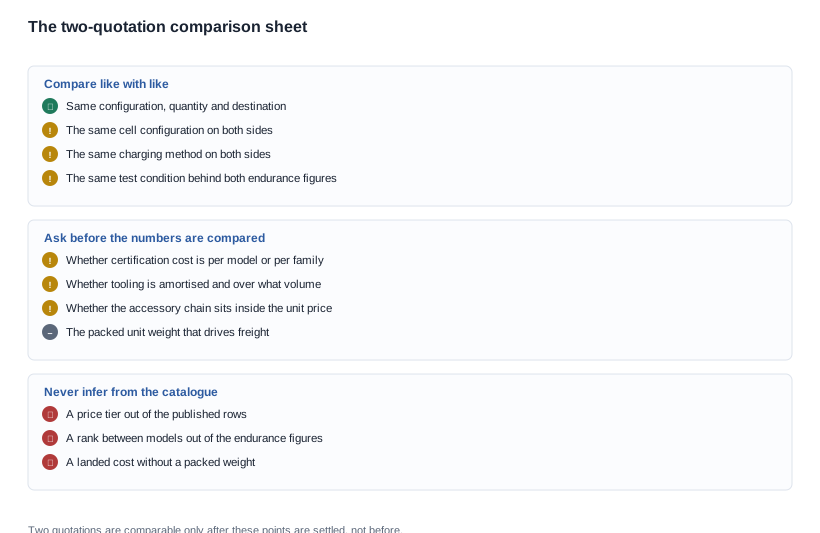
The value of this method is that it produces a decision rather than a number. A buyer who has normalised two quotations knows whether the gap is worth negotiating, and a buyer who has not simply has two numbers and an opinion about which is lower.
A hypothetical comparison, worked end to end
Take a hypothetical buyer who has asked two suppliers to quote one audio model for one destination market at one volume. Nothing in that description identifies a real project or a real order, and no figure below is a price.
The first quotation arrives as a single number per unit with a minimum order quantity attached and a delivery date that is a single date. The second arrives as a unit price with a volume tier structure, a split delivery option, a separate tooling line, a separate certification line and a packed unit weight. On the face of it the two are not comparable, and the gap between them is mostly a gap in documentation.
The six-point normalisation resolves it. Configuration: both are for the same cell configuration, the same charging method and the same radio version, so the bill of materials is comparable. Quantity: the first quotation is tiered at a volume the buyer has not committed to, so the unit price at the buyer's actual volume has to be requested — the gap that opens is the tier discount, which is margin and therefore negotiable. Destination: both are quoted for the same market, so the certification position is comparable once separated from tooling. Accessory scope: the second quotation includes the counterpart in the unit price and the first does not, so the first is adjusted upward before comparison. Freight basis: only the second has a packed unit weight, so the first is asked for one and the freight line is rebuilt rather than accepted.
What survives normalisation is a margin difference on the same product, with a certification position and a tooling position both stated. That is a negotiation with a defined subject, which is the difference between this method and comparing two numbers.
The practical order of operations that follows from the exercise is worth keeping: request the evidence set first, normalise second, negotiate third. A buyer who negotiates before normalising is negotiating against an unknown.
The value position we can defend
A value argument built on unpublished prices is a guess with a table around it, and we are not going to make one. The published rows for the K02 are the cell configuration, the radio version, the charge ceiling, the stated endurance and the charging method, and each of them tells a buyer which cost driver to interrogate when two quotations differ.
We will quote against a stated configuration and quantity, identify the cell configuration, the charging method, the radio version and the packaging in the quotation so the buyer can normalise it against another supplier's, and separate tooling from certification so that neither is hidden inside the other. What we will not do is publish a price, publish a tier, rank the K02 against the rest of the range, or quote a weight that no document supports.
The K02 versus K01 specification comparison covers the closest pair in the range, and the Bluetooth audio glasses which model to pick guide covers range selection where a channel does have to choose.
Related reading
- The five published rows — K02 smart glasses specifications and features
- What the catalogue does not publish — K02 smart glasses limitations
- The closest comparison available — K02 smart glasses versus K01
- The range overview — Bluetooth audio glasses
Send us the quantity, the configuration and the destination market, and we will come back with a quotation you can normalise against any other.


