

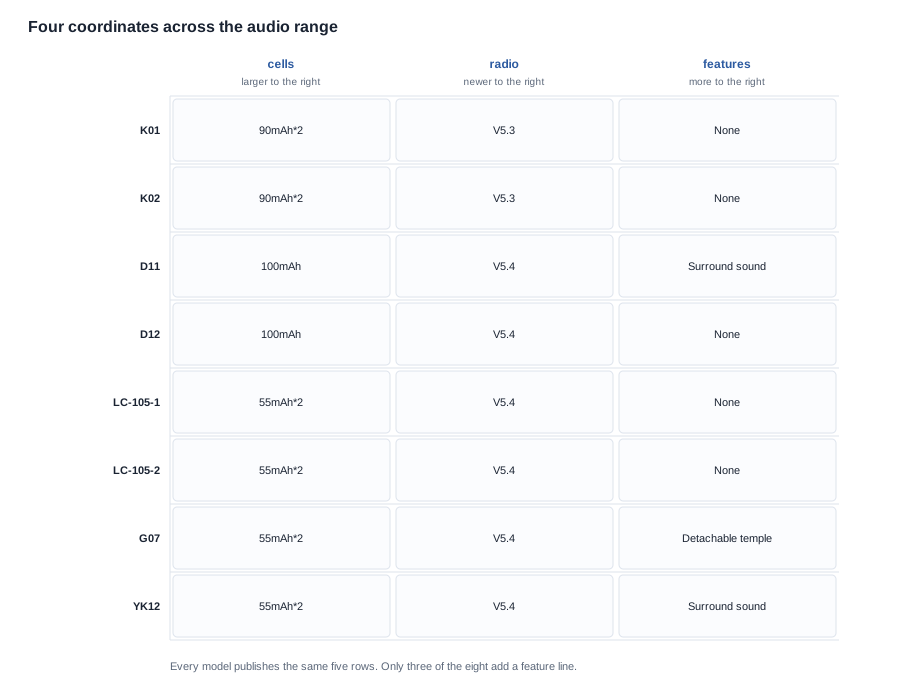
The K02 compares against the eight-model audio range on four coordinates, and only three of them separate anything: published cell configuration, published radio generation, and the presence of a published feature line. Read that way, the K02 is the model with the largest published cell configuration in the range, one of two models on the older radio generation, and one of five audio models whose catalogue page carries no feature line at all. That is the entire published position, and it is enough to place the K02 in a range without inventing a ranking for it.
The comparison is worth doing properly because the range publishes almost nothing else. Every audio model publishes the same five rows. Three of the eight add a feature line. Weight, dimensions, acoustic figures, ingress rating and charging case capacity appear nowhere in the audio range. So the useful question is not which model is best but which published coordinates your channel can actually sell against, and which rows you will have to get answered in writing before the first purchase order goes out.
Reading the K02 against the audio range as four coordinates
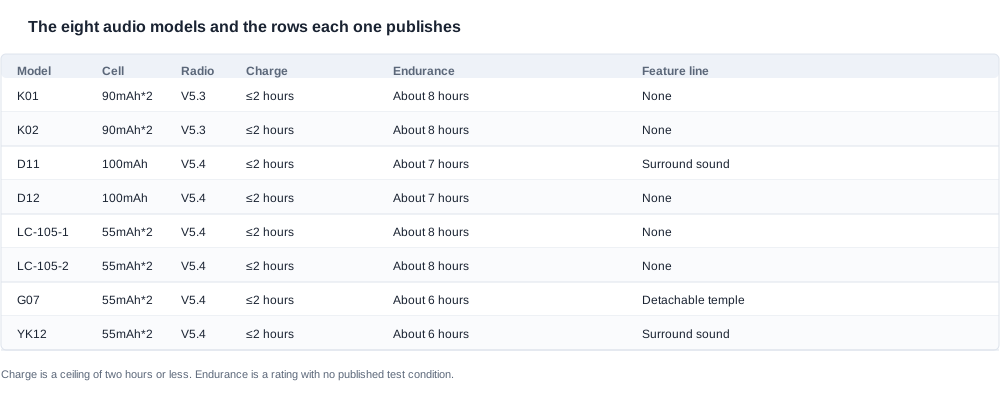
The five rows every audio model publishes
Each of the eight audio models publishes a charge time, a Bluetooth version, a cell configuration, a stated endurance and a charging method. The K02 publishes V5.3, 90mAh2, a charge time of two hours or less, about eight hours of stated endurance, and magnetic charging. The K01 publishes the same five values. The D11 and the D12 publish V5.4, a single 100 mAh cell, the same charge ceiling and about seven hours, with charging over Type-C. The LC-105-1 and the YK12, and the LC-105-2 and the G07 publish V5.4, 55mAh2, the same charge ceiling and magnetic charging.
Because the row set is identical, a comparison is really a comparison of four coordinates: how much cell energy the row publishes, which radio generation the row names, how the unit is recharged, and whether the page adds a feature line. Coordinate one has three values across the range. Coordinate two has two. Coordinate three has two. Coordinate four has three models that publish and five that do not.
Why a range comparison is not a ranking
A ranking requires an ordering, and the catalogue does not publish one. There is no price row, no weight row, no acoustic row and no test condition attached to any endurance figure, so there is no published basis for saying that one audio model sits above another. What the catalogue supports is a structural statement: these models differ in these ways and not in others.
That distinction matters commercially. A channel that stocks two audio models because the catalogue implies a hierarchy is stocking two products with an invented relationship between them, and the shelf, the accessory chain and the return rate all inherit the mistake. A channel that stocks two audio models because the published coordinates genuinely differ has a reason for each, which is the only thing that makes a range legible to a customer.
The cell-configuration coordinate and what 90mAh*2 does and does not tell you
The largest published cell configuration in the audio range
The K02 publishes 90mAh*2, and no other audio model publishes a larger cell figure. That is a real and checkable statement: the K02 and the K01 are the only audio models on ninety milliamp-hour cells, the LC-105 pair, the G07 and the YK12 are on fifty-five, and the D11 and the D12 carry a single hundred milliamp-hour cell.
Two consequences follow for a procurement team. First, the K02 has more published cell energy to spend than any other audio model, which matters for a deployment where the unit has to survive a shift without a dock in reach. Second, the cell count is part of the bill of materials, so the figure also tells a buyer something about what the unit costs to build — which is why it belongs in a quotation conversation and not only in a specification sheet.
Where a derived total stops and a published value begins
Multiplying 90 by two gives 180 milliamp-hours, and it is tempting to treat that as the catalogue's number. It is not. The catalogue publishes a cell value and a cell count, and the total is arithmetic performed by the reader. The distinction is not pedantic: a derived total presented as a published figure ends up in a specification annex, then in a supplier's own marketing, and eventually in a claim nobody can trace back to a source.
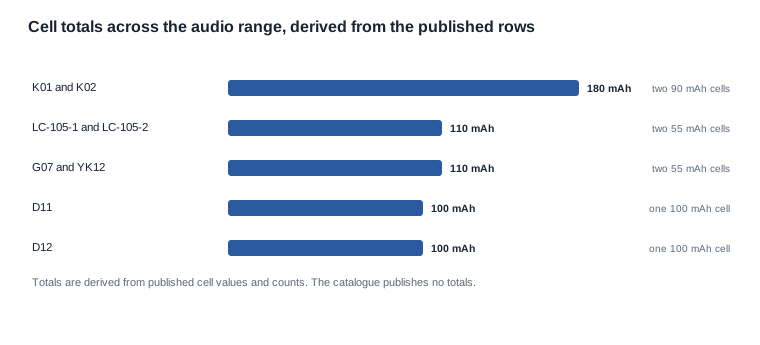
The safe way to write it is in the same sentence as the source. Say that the catalogue publishes 90mAh*2 and that this derives to a 180 milliamp-hour total, and the reader knows which number came from the supplier and which came from the buyer. The published K02 specification list sets out the five rows exactly as the catalogue carries them, and the audio range battery picture shows how cell values and endurance ratings diverge across the wider range.
The K01 comparison is the sharpest illustration of why this discipline matters. The K01 versus K02 comparison finds two models publishing identical rows, so the only way to describe the difference between them is to stop using published values and start using a written request.
The radio coordinate, and why the K02 sits one generation behind its own range
Two models on V5.3 and six on V5.4
The K02 and the K01 publish V5.3. The other six audio models publish V5.4. That is the whole of the radio coordinate in the range, and it puts the K02 on the same footing as one other model rather than in a class of its own.
The radio generation is one of the few published rows that translates directly into a compatibility question, and it is the coordinate most often left out of a comparison. A radio version does not describe how good a product is. It describes which devices it will pair with, which firmware stack it runs, and how much of a supplier's module sourcing and certification work it inherits. A buyer whose customer base runs a newer platform should treat V5.3 as a question to be answered with evidence rather than as a neutral line on a sheet.
What a radio generation decides for a procurement decision
Three things, and none of them is sound quality. It decides the device list the unit is expected to pair with. It decides whether a single radio module covers the range, which affects whether a channel can share one accessory or one support script across the whole audio family. And it decides whether an end customer on an older platform is a supported configuration or a support ticket.
The Bluetooth connectivity guidance covers how the version row should be handled in a technical file, and the how to compare battery life method covers the endurance row, which has its own trap. Neither of those traps is the radio. The radio trap is simpler and more expensive: treating a published version as a resolved compatibility question instead of an open one.
How to select on a radio row without over-reading it
Selection on this coordinate should be a two-step test, and the first step is a filter rather than a preference. Step one asks whether V5.4 appears anywhere in the range the customer actually buys into. If it does not — if the platform is fixed, the account is closed, or the customer base is a single operator on a fixed handset — then the radio generation is not a decision at all and should not appear in the comparison. It is a constant, and a constant that gets compared against another constant produces a false difference.
Step two applies only where the radio row genuinely separates options, and it asks a question the catalogue cannot answer: which generation does the customer's own device run, and has the supplier confirmed pairing against it. The answer converts a published version into a compatibility statement, and it is the only form of that statement worth putting in a technical file. Written that way, the radio row becomes evidence. Written as "V5.3" alone, it is a token in a table, and a buyer who treats tokens as evidence will eventually select on one that was never a difference.

The charging and feature-line coordinates, and the three models that publish one
The magnetic row and the accessory chain it creates
Magnetic charging is published for the YKC02 and the LC-105-2, the LC-105-1 and the YK12, the K02 and the K01, and the G07. Type-C charging is published for the D17 and the D11, the D12 and the ZH12, and the V03 Pro and the L2 Utral and the bone-conduction model. In the audio range the split is six magnetic models against two Type-C models.
The charging row is not only an electrical detail, and this is where the audio range comparison earns its keep. A magnetic dock is a proprietary physical accessory: it has to be sourced, stocked, replaced and shipped as a separate line in a channel's inventory, and it has a failure mode that a cable does not — a dock that is lost or damaged is a dead unit in a customer's hands, not a missing cable. A Type-C frame needs a cable the customer already owns.
So the charging coordinate decides an accessory strategy before it decides anything about the product. For a buyer running a broad channel, that strategy has a carrying cost that appears in the commercial terms rather than in the specification, and it is one of the items most often left out of a first quotation request.
Three models publish a feature line, and the K02 does not
Three audio models add a feature line to their five standard rows. The D11 publishes surround sound and a long-battery-life descriptor. The G07 publishes an ultra-slim, detachable temple. The YK12 publishes surround sound and a slim temple. The LC-105-2 and the LC-105-1, the K02, the K01 and the D12 publish no feature line at all.
This is the coordinate with the largest commercial consequences and the least data behind it. A feature line is what a product page is written from. A model with no feature line gives a channel nothing to differentiate on except the specification rows, and the specification rows are the part of the specification that competitors publish identically. The K02 therefore competes on 90mAh*2, on a radio version it shares with one other model, and on nothing else that the catalogue states.
That is a legitimate position, and for a private-label channel it can be the right one: a frame that arrives without a rival's wording on it and leaves the page to the buyer's own brand assets. It is also a position with a price, because a model that carries no differentiation has to earn its shelf space on cost, on availability and on margin rather than on a claim. The customisation path for this platform shows the kind of programme that fills that gap, and the K02 limitations list sets out what the K02 specifically cannot document.

What a range comparison has to leave to the supplier
The endurance ratings are not comparable to each other
The range publishes four different endurance ratings against three different cell configurations. The LC-105-2 and the K01, and the LC-105-1 and the K02 publish about eight hours. The D11 and the D12 publish about seven hours on a single larger cell. The G07 and the YK12 publish about six hours.
Read those numbers as a simple scale and the scale contradicts itself. The LC-105-1 publishes the same fifty-five milliamp-hour paired-cell configuration as the G07 and the same rating as the K02, while the G07 publishes a figure two hours shorter on an identical published configuration. Two hours of spread on identical published cell values is the signature of a measurement convention rather than a product property, and no test condition is published for any of these models.
So the endurance row cannot separate models in the range, and it cannot be used to plan a shift, price a duty cycle or promise a working day to a customer. It can be used for exactly one thing: establishing that a rating exists. Anything stronger has to be produced by a measurement the buyer runs, or obtained as a documented condition from the supplier.
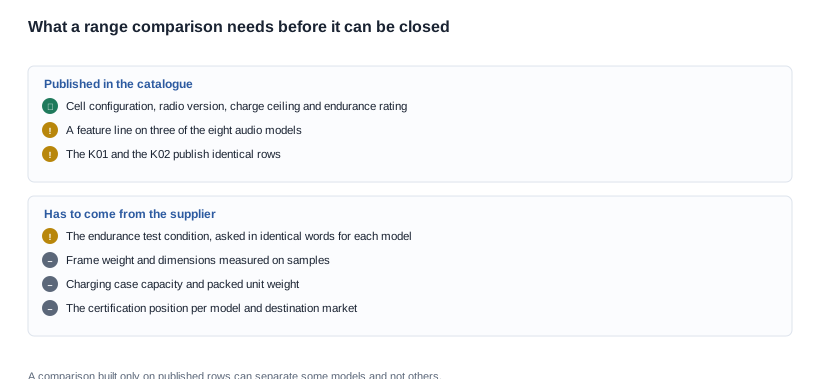
Six rows that no model in the range publishes
Across all eight audio models, six categories are simply absent. Frame weight is absent, and the one weight published anywhere in the catalogue belongs to a different model entirely — the MT6, whose eyewear body including battery and camera weighs 158 grams excluding its foldable case, and which is not an audio frame and cannot stand in for one. Dimensions are absent. Acoustic figures and microphone pickup are absent. Ingress rating is absent. Charging case capacity is absent. Frame weight and case weight together determine a packed unit weight, and that determines freight, which is a line on a landed cost calculation.
The weight comparison across the audio range explains why that single published weight cannot be borrowed. The audio range battery picture covers the endurance side of the same problem.
Building the request list before the comparison starts
A range comparison that begins with quotations tends to compare whatever the supplier happened to send. Building the request list first removes that. Six items, all answerable in one message to a supplier: the endurance test condition for each model, asked in identical words; frame weight and dimensions measured on samples; acoustic figures and microphone pickup in the environment the product will be used in; charging case capacity and packed unit weight; the certification position for each model in each destination market; and the minimum order quantity, lead time and warranty period for each model separately.
The questions to ask, in the order that costs a buyer the least time when an answer is late, are these:
- What test condition sits behind the published endurance figure for each model?
- What does each frame weigh, measured on samples, and what are its packed dimensions?
- What microphone pickup and acoustic figures does each model produce in a representative environment?
- What is the charging case capacity for each model, and what does the packed unit weigh?
- What is the certification position for each model in each destination market, with the certificate numbers and the issuing body?
- What are the minimum order quantity, the lead time and the warranty period for each model, quoted separately rather than as a range?
Ask all six in one message, in these words, against every model. A supplier who answers all six for all eight models has given a buyer a comparison that can be closed. A supplier who answers two of them has given a buyer a price list.
The certification question is the one with the longest lead time and it should be issued first. The catalogue includes a company-level export certification page with image content instead of text content, and there is no per-model certification row anywhere in it. The K02 certification status sets out what that page does and does not establish, and the certification checklist turns the gap into a list of documents to request rather than a list of logos to assume.
What a comparison protocol looks like when one model has no feature line
Three of the eight audio models publish a feature line, and the K02 is not one of them. That makes the K02 the hardest case in the range to compare and the easiest to handle, because there is no qualitative claim to reconcile. A buyer who knows the rules will evaluate the K02 on the three coordinates where it publishes a number, and will treat the absence of a feature line as information about how the channel has to be built rather than as a gap in the product.
The practical protocol has four steps and it is worth writing them down before the first quotation arrives, because the order of the steps decides what gets compared. First, list the coordinates with published values and mark every model where the value is absent rather than where it is weak. Second, separate the coordinates into two groups: the ones a customer can see, which are the cell configuration and the charging method, and the ones only the buyer's own engineering and channel teams can see, which are the radio generation and the accessory chain. Third, for the group the customer cannot see, write the question that would change the decision. Fourth, retire any coordinate where the answer would not change the order.
That last step is the one that saves the most time, and it is where most comparisons quietly fail. A coordinate that cannot change the outcome should not appear in the table at all, because a table with six rows implies that six rows are doing work, and a buyer who later discovers that three of them are inert will distrust the other three. The narrow comparison — three coordinates, one feature line or none, one platform each — is not a thinner answer. It is the answer that survives a quality incident and a finance review.
Closing an audio-range comparison without inventing a ranking
The four-question test that ends a range comparison
Four questions, asked of every model in the range, close a comparison without a scorecard. Which cell configuration does it publish, and what does that derive to in energy across the working day you have in mind? Which radio generation does it publish, and which of your customers' platforms does that generation have to be confirmed against? Which charging method does it publish, and what accessory chain does that commit your channel to stocking? And what feature line does it publish, if any, that a competitor cannot print the same way?
Apply the same four questions to the K02 and the answer is stable and complete. Ninety milliamp-hour cells in a pair. V5.3. Magnetic charging. No published feature line. Everything else about the K02 is a request rather than a published row.
Writing the outcome into a purchase order
A comparison that stops at a table does not survive the first quality incident. The outcome of the comparison belongs in the order, where it can be checked: the exact configuration ordered, referenced to the catalogue page rather than restated in prose; the endurance figure with its test condition once established, or the explicit statement that no condition is agreed and the figure will not differentiate; the charging method and the in-box accessory set; and the per-model certification position for the destination markets in scope.
The remaining rows belong in the same file as evidence rather than as terms. Measured weight and dimensions, a timed charge from a stated starting point, a recorded microphone pickup in a representative environment. A buyer who has these does not need the catalogue to publish them.
What we will publish and what we will not
The published rows are the whole of what we can support, and a comparison that treats them as a ranking is a comparison we cannot stand behind. We will publish the cell configuration, the radio version, the charge ceiling, the stated endurance and the charging method for the K02, and we will publish them again for every other model in the range so the coordinates can be read side by side.
We do not publish a price, a minimum order quantity, a lead time, a warranty period or a certification number for any model, because we do not publish figures a buyer cannot check against a document. What we will do is quote against a specified quantity and configuration, and tell a buyer which configurations exist and which do not. The Bluetooth audio glasses which model to pick guide covers the range selection question, and the D12 how it compares article works through the same four coordinates for a different model.
Related reading
- The published rows for the K02 — K02 smart glasses specifications and features
- The closest comparison available — K02 smart glasses versus K01
- Where the K02 earns its place — K02 smart glasses best-for analysis
- The commercial structure around a range — OEM ready pricing tiers
Send us the models, the quantities and the target market, and we will tell you which configurations exist and which do not.


