

Eight audio models appear in this catalogue and each of them prints the same five specification rows. The LC-105-1 smart glasses are one of those eight: a 55mAh*2 cell, a charge time of two hours or less, about eight hours of stated endurance, magnetic charging and Bluetooth V5.4, with no feature line on the catalogue page at all. A complete five-row specification combined with no published differentiator is an unusual combination, and it turns an LC-105-1 comparison into a procurement exercise rather than a product review. The work is not finding the strongest model; it is building criteria that let a buyer compare eight published rows in the first place, and then a way to evaluate every model against them.
What follows sets out what the LC-105-1 publishes and what it leaves open, places it inside the eight-model audio group, isolates the three rows that actually separate those models, and then works through the comparison model by model. Where the catalogue is silent, the silence is converted into a question for the supplier rather than into an assumption about the product, because a procurement file has to stay defensible in front of the people who sign it.
What the LC-105-1 publishes and what it does not
Five rows are printed for the LC-105-1, and together they are the whole of its published specification. The cell is published as 55mAh*2. The charge time is published as two hours or less, which is an upper bound rather than a measured value. The endurance figure is about eight hours. The charging method is magnetic. The Bluetooth version is V5.4. No further line appears on that catalogue page.
Set against those five rows are four rows a sourcing team will look for and simply will not find. The frame weight is not published. The frame and temple dimensions are not published. The profile under which the eight-hour endurance figure was taken is not published. There is no per-model certification row. Four gaps, and each one has to be closed with a written request rather than an inference.
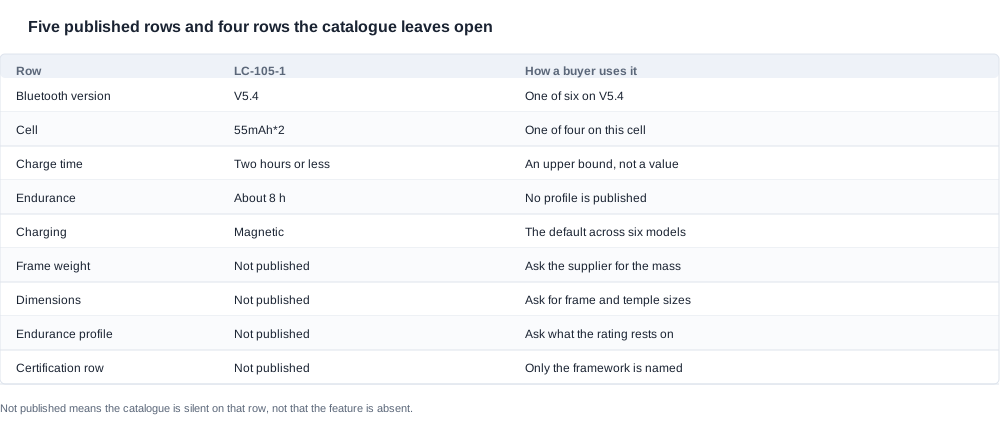
The wording used about those gaps is worth being precise about, because the distinction survives further into a sourcing file than most people expect. "The catalogue does not publish the frame weight" is a true statement about the catalogue. "The LC-105-1 has no weight" is a statement about the product, and the catalogue does not support it. The charging case shows the same split in a way that costs real money: the catalogue prints no charging case row for any of the eight audio models, which is a different thing from printing a row that says no case is offered. A buyer who writes "no case" into a specification because the catalogue is quiet has turned an open question into a false requirement, and that error propagates into the packaging list, the accessory bill of materials and the freight calculation.
Certification needs the same treatment with one extra step. The catalogue mentions CE, FCC and RoHS zero times and prints no certification line for any model. What can be named is the framework rather than the evidence: the radio equipment framework RED (EU) 2014/53/EU together with the EMC framework 2014/32/EU. Those are the two instruments a Bluetooth audio product is built against, and naming them tells a sourcing team what to request — a declaration of conformity, the test report behind it, and the certificate or report number for each destination market — without pretending that any of those documents already exist for this model.
One published weight exists anywhere in the catalogue, and it does not belong to the LC-105-1. The 158 g figure applies to the MT6 frame body, excluding its folding case. It is tempting to carry that number across to an audio frame because the two objects look similar on a desk, but doing so would move another model's published value into this model's file, and a comparison resting on a misattributed weight is worse than one with no weight in it at all. The weight comparison across the audio range sets out what can and cannot be done while the audio rows carry no mass. Until the factory supplies a figure, frame weight for the LC-105-1 is a question, and it is a specific question: the mass of the frame as it ships, not the mass of a sample on a showroom shelf.
The last two catalogue absences follow the same rule. IP54 appears in the catalogue only on the V06 and the S7, so there is no ingress protection row for any audio model, the LC-105-1 included. And the audio group carries no charging case row and no sensor, storage or camera row of any kind, because these are audio products: the whole of the published electrical description of the LC-105-1 is the five rows set out above, and a buyer comparing it against a camera model is comparing two different products against two different row sets.
The audio group on the five published rows
The eight audio models are the YK12 and the D12, the D11 and the LC-105-2, the G07 and the K01, and the K02 and the LC-105-1. Every one of them publishes the same five rows, and that shared row set is what makes an audio comparison possible at all.
| Model | Radio | Cell build | Charge ceiling | Runtime | Interface | Notes |
|---|---|---|---|---|---|---|
| K02 | V5.3 | 90mAh*2 | Two hours or less | About 8 h | Magnetic | No feature row |
| K01 | V5.3 | 90mAh*2 | Two hours or less | About 8 h | Magnetic | No feature row |
| D11 | V5.4 | 100 mAh | Two hours or less | About 7 h | Type-C | Surround sound and long endurance |
| D12 | V5.4 | 100 mAh | Two hours or less | About 7 h | Type-C | No feature row |
| LC-105-1 | V5.4 | 55mAh*2 | Two hours or less | About 8 h | Magnetic | No feature row |
| LC-105-2 | V5.4 | 55mAh*2 | Two hours or less | About 8 h | Magnetic | No feature row |
| G07 | V5.4 | 55mAh*2 | Two hours or less | About 6 h | Magnetic | Ultra-slim with detachable temple |
| YK12 | V5.4 | 55mAh*2 | Two hours or less | About 6 h | Magnetic | Surround sound and slim temple |
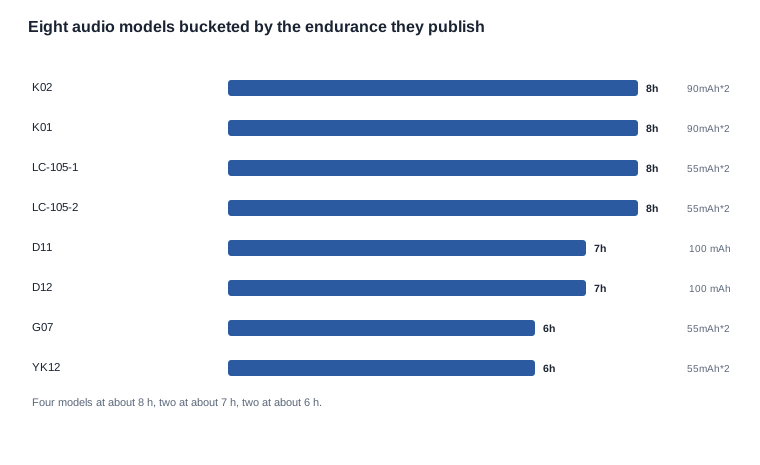
Read the endurance column before anything else in that table, because it is the column buyers reach for first and the column that supports the least, and reading it without a profile is how a sourcing error gets made. Four models publish about eight hours, two publish about seven hours and two publish about six hours. The LC-105-1 sits in the top group on endurance while sitting in the middle group on cell configuration, because the four models that share the 55mAh2 cell are the K02 and the K01 on 90mAh2 and the LC-105 pair on 55mAh*2. In other words the endurance column and the cell column do not move together, and the spread between about eight hours and about six hours inside one identical cell configuration is a difference of measurement convention rather than a difference of capability.
That point gets sharper at catalogue level. Six models in the whole catalogue publish about eight hours — the K01 and the LC-105-2, and the LC-105-1 and the K02, and the two sport models the ZH12 and the YKC02 — and those six span four different cell configurations. Not one of them publishes the profile the rating was taken under. A buyer who treats eight hours as a comparable figure across those six models is comparing six separate conventions and calling the result a ranking, which is why a figure without a profile cannot be used in a quotation, in a category listing or in a tender response.
Three further rows structure the group without appearing in the endurance story. Charging divides cleanly: magnetic on six models including the LC-105-1, Type-C on the D11 and the D12 only, which means a Type-C cable in the box is a real accessory decision on those two and is not one on the other six. The Bluetooth version splits the group once, with the K02 and the K01 on V5.3 and the remaining six on V5.4, so a qualification baseline drawn from one of those pairs does not cover the other. The charge time, meanwhile, is two hours or less on all eight, which makes it the one row in the group that constrains nothing at all, and therefore the one row a buyer never has to select on.

The three rows that separate the audio models
Five of the eight audio models have no feature row on their catalogue page: the D12 and the K01, the LC-105-2 and the LC-105-1, and the K02. Three do, and each of those three publishes something that a buyer can actually act on. The D11 prints surround sound and long endurance. The G07 prints an ultra-slim temple with a detachable temple. The YK12 prints surround sound and a slim temple.
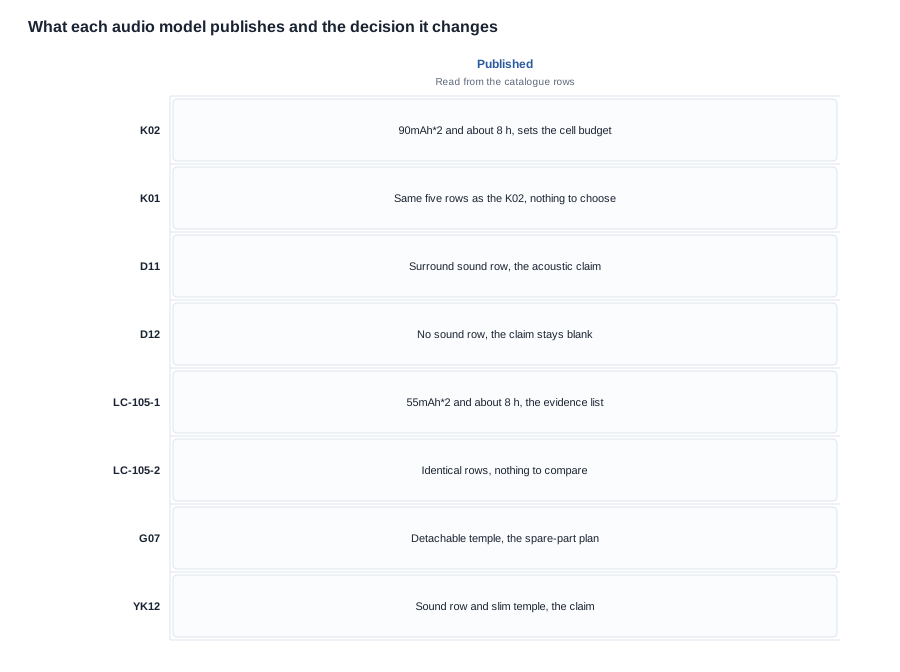
The first separating row is the feature row itself, and it is where the catalogue's own structure becomes visible. Five models give a buyer nothing to differentiate on beyond the five standard rows, and the LC-105-1 is one of them. The second is the surround sound row. The D11 publishes it, the D12 does not, and that is the only published specification difference between those two models — and across the eight audio models the D12 is one of five that publish no feature row of any kind. Two models that share a cell, a charge time, an endurance figure, a charging method and a Bluetooth version are separated by a single acoustic line, which is a strong indication of how much product difference the five standard rows can carry on their own.
The third separating row is the temple, and it appears only inside feature rows. The G07 and the YK12 share all five standard rows exactly, and the only thing that tells them apart is the feature line: the G07 publishes an ultra-slim detachable temple, the YK12 publishes a slim temple together with surround sound. A detachable temple is a serviceability fact, because a spare part can be planned against it, while a slim temple is a design fact. Neither one can be transferred to the LC-105-1, whose page prints no feature line of any kind.
What each published row actually changes in a purchase decision is a separate question from what it says, and the questions to ask the factory follow from the rows rather than from the marketing language. The charging row decides the accessory list and whether a cable is specified in the box. The Bluetooth version row decides the qualification baseline for the connected device list. The surround sound row decides whether an acoustic claim can be written into the listing at all, which is why the D12 and the LC-105-1 sit in the same position on that decision: neither publishes an acoustic descriptor, so neither can carry the claim. The temple row decides the spare-part and repair strategy, and for the LC-105-1 that strategy cannot be planned from the catalogue at all.
One pair deserves a separate note because it is where a comparison would normally start and cannot finish. The LC-105-1 and the LC-105-2 pages are identical, row for row: same Bluetooth version, same cell, same charge time, same endurance figure, same charging method, and no feature line on either page. Any comparison between the two is therefore a comparison between two identical published records, and the difference between them, if there is one, can only come from the factory's own account of the two products. The rows we publish for this model are the baseline that both records share.
What a comparison of the LC-105-1 has to settle
Every figure in this group arrives with a different amount of evidence attached to it, and the four layers below are the right way to organise what a buyer can and cannot conclude. The checklist at the end of this section is the order in which those layers have to be worked through, because each layer only opens once the one above it has been closed.
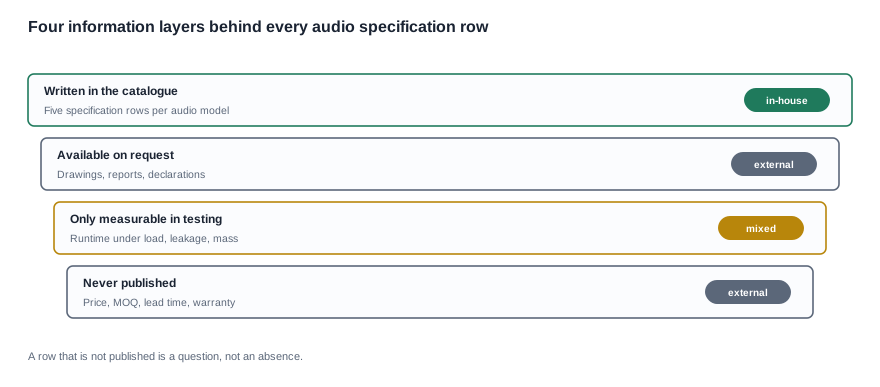
The top layer is written in the catalogue: five specification rows per audio model, and that is all the audio group publishes. The second layer is available on request — drawings, test reports, declarations of conformity, warranty terms, the supplier's own account of what separates the LC-105-1 from the LC-105-2. The third layer can only be reached by measurement: what the endurance figure actually does under a stated profile, what the frame weighs, how much sound leaks, how the microphones behave. The bottom layer is never published: unit price, minimum order quantity, lead time, margin and warranty periods sit outside the catalogue altogether, and asking the catalogue for them will not produce them.
Four things have to be settled before you order, and until they are, an LC-105-1 comparison produces an opinion rather than a decision.
- A common endurance basis. The eight-hour figure needs a profile before it can be compared with the seven-hour and six-hour figures: playback or calls, volume level, codec, ambient temperature and the age of the cell. Until that exists, the tiering in the bars above is a convention and not a ranking, and no quotation should carry it as one. The battery life analysis for this model sets out what the figure does and does not rest on, and the comparison method for battery life rows covers how to ask for the profile instead of assuming it.
- The acoustic position. The LC-105-1 publishes no acoustic descriptor, which leaves two very different possibilities on the table: an architecture simply not written down, or an architecture in line with the D12's silence. Only the factory can close it, and until it does, no acoustic claim can appear in the listing.
- The difference from the LC-105-2. Two identical records cannot be separated on paper, so the question to put to the factory is direct: what differs between the LC-105-1 and the LC-105-2 in build, finish, packaging or supply. This is the red flag that most often goes unnoticed, because a two-model line reads as a deliberate range structure on the shelf while the documentation behind it carries one record twice.
- The certification evidence. With no per-model certification row in the catalogue, the request has to name RED (EU) 2014/53/EU and EMC 2014/32/EU, ask for the declaration and the report numbers behind them for each destination market, and verify that each document names the LC-105-1 itself rather than the family.
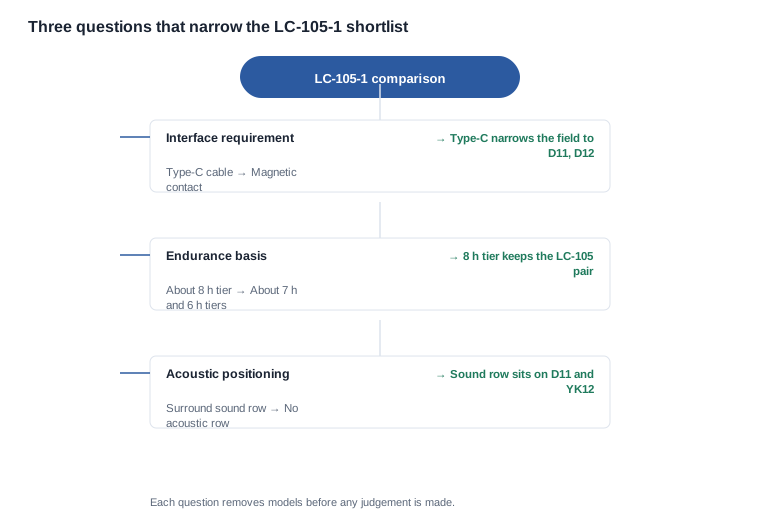
The three questions in the decision chart above are the ones that actually remove models from the shortlist, and they are worth running in that order, because each of them is answered from a published row rather than from a preference. Run them as a checklist and the trade-offs between the models that remain become visible before any sample is ordered, and which model survives each question is written down rather than remembered.
- Interface requirement. A Type-C requirement reduces the field to the D11 and the D12 immediately, because they are the only audio models with that charging row. A magnetic requirement keeps the other six, and the LC-105-1 is inside that group on a published row.
- Endurance basis. A requirement written as about eight hours keeps the LC-105-1 and the K01, and the K02 and the LC-105-2 and removes the D11, the D12, the G07 and the YK12. A requirement written as about six hours does the opposite and keeps the G07 and the YK12, the two models that also publish a feature row.
- Acoustic positioning. A requirement for a published surround sound descriptor keeps the D11 and the YK12 and removes the other six, including the LC-105-1 and the D12. The decision then moves from the catalogue to the factory, because the models that survive this question are the ones where an acoustic claim can be made without inventing it.
The LC-105-1 how it compares, model by model
The K02 publishes the same five rows as the LC-105-1 with two differences: a 90mAh2 cell instead of 55mAh2, and Bluetooth V5.3 instead of V5.4. The endurance figure is the same about eight hours, the charging method is the same magnetic, and no feature row is printed for either. Against the LC-105-1 it is the larger-cell option in the same endurance tier, and it is a candidate for a line that needs a bit more cell headroom without needing a different charger, which is why the criteria for choosing between them belong on the cell row and nowhere else. The K01 against the K02 comparison covers that pair in detail, because their published rows are identical to each other as well.
The K01 stands where the K02 stands, and the catalogue prints the same five rows for it. This is the pair that shows why identical records are a sourcing problem rather than a simplification: a buyer who needs two models in a range has nothing in the published rows to justify the second one.
The D11 is the first model in the group that publishes a feature row, and it publishes two: surround sound and long endurance. It is also the first to break the charging convention, using Type-C instead of magnetic, and it carries a single 100 mAh cell rather than a twin cell. Against the LC-105-1 the comparison is one of positioning rather than of specification: the D11 gives a buyer an acoustic line to work with and a different charging chain to manage.
The D12 shares the D11's cell, its charge time, its endurance figure, its charging method and its Bluetooth version. The single published difference is the surround sound row, which the D11 carries and the D12 does not. That makes the D12 the closest published comparison to the LC-105-1 in structure — a model with no feature row and no acoustic descriptor — with a larger cell, Type-C charging and an endurance figure one hour lower.
The LC-105-2 is the same record as the LC-105-1, line for line, on the same catalogue page format and with the same absence of a feature row. Any difference between the two is a factory matter, and a shortlist that contains both should carry an explicit note that the published evidence cannot separate them.
The G07 shares the LC-105-1's cell, charging method, charge time and Bluetooth version, publishes about six hours instead of about eight, and adds an ultra-slim detachable temple. It is the row-level answer to a requirement about spare parts and repair, and the endurance difference is the price of the feature line.
The YK12 also shares the 55mAh*2 cell, magnetic charging, the same charge time and V5.4, and publishes about six hours. Its feature line combines surround sound with a slim temple, so it is the only audio model that carries both an acoustic descriptor and a design descriptor at once.
The LC-105-1, read against all seven, publishes the highest stated endurance of the group, the smallest cell configuration, and no differentiator whatsoever. The question of how to choose between it and the other seven therefore has to be answered with documents rather than with the catalogue, and that is the due diligence a buyer does on a written record. Before a purchase order is written, four documents are needed, and this is what to ask the factory for.
- The endurance profile behind the eight-hour figure, in the same form as any other figure it will be set next to.
- The factory's account of what separates the LC-105-1 from the LC-105-2.
- The frame weight and the frame and temple measurements, for the freight and packaging calculation.
- The certification evidence for the destination markets, with declaration and report numbers, against RED (EU) 2014/53/EU and EMC 2014/32/EU.
The boundary on this comparison. We do not publish a frame weight, a charging case capacity, an endurance profile or a certificate number for the LC-105-1, and we will not present its eight-hour figure as a ranking against the other seven audio models, because the published rows do not support an order. What the catalogue gives is five rows; what we will not do is fill the empty fields with plausible values, and that boundary is what makes the comparison above usable inside a quotation.
Related reading
- The five published rows in full — LC-105-1 specifications and features
- What the eight-hour figure rests on — LC-105-1 smart glasses battery life
- The complete gap set for this model — LC-105-1 smart glasses limitations
- The detachable temple option in the same group — G07 smart glasses best for
- Where the platforms sit before a model is named — OEM-ready platforms and which models are ready
For an LC-105-1 smart glasses programme, the comparison is finished only when the test profile, the acoustic description and the certification evidence sit on the same page as the five published rows.


