
MT6 smart glasses battery life is published as a single figure of about seven hours, and that single figure is the weakest row on an otherwise unusually complete specification sheet. This model carries the only weight published anywhere in this catalogue, a 1200 mAh case that folds, and a documented portability position. It also publishes a runtime as a bare point with no test condition attached, which makes it harder to plan against than a range would be.
This article reads the battery and power rows properly, explains what the weight figure does and does not include, sets out what the folding case changes, and closes with the questions that turn a published point into a defensible specification.
MT6 smart glasses battery life: the published rows
The cell is 265 mAh. That places the MT6 between the 260 mAh group — the KY06 and the V06, and the S7 — and the 290 mAh group used by the CY03 and the L2 Utral, and the L1 Pro and the CY05. Across the eleven camera models there are four published cell values: 220 mAh, 260 mAh, 265 mAh and 290 mAh. The 265 mAh value appears on this model alone.
The charge time is two hours or less. This is a ceiling rather than a measurement. No starting state of charge and no completion criterion accompany it, so it cannot be used to plan an interruption mid-shift, and it is not a case turnover time. Twenty-six of the twenty-eight models in this catalogue are published on the same ceiling; only two are published at about one hour.
The runtime is about seven hours. A single figure, with no condition, no sample size and no statement of whether the camera was active. Five camera models publish about seven hours: the CY05 and the CY03, the L2 Utral and the L1 Pro, and the MT6.
The charging method is not published. The MT6 has no charging-method row and no charging-interface row. That is a genuine absence of documentation rather than a different method, and it belongs to a group of four camera models — the CY03, the CY05, the MT6 and the L1 Pro — that share this absence. All four of them do publish a case capacity, which is consistent with the case being the charging route, though the documentation does not state it.
The case is 1200 mAh and folds. This is the only folding case published in this catalogue, and one of only five camera models with a printed case capacity at all.
The weight is 158 g, published on the product page alongside the portability and lightness feature rows.
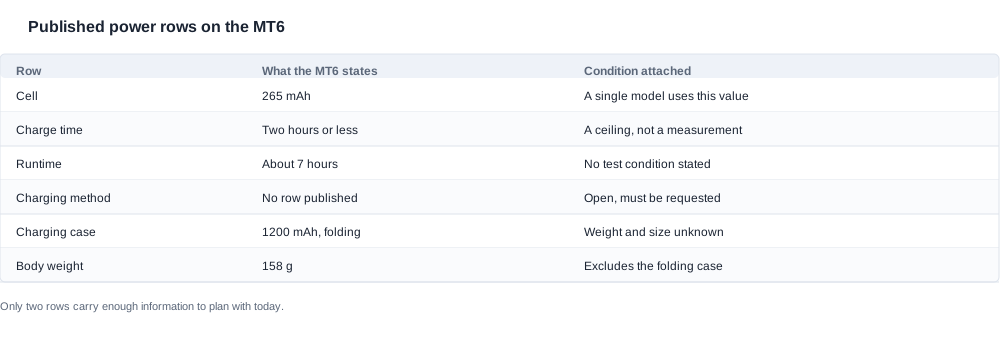
The shape of that list is the finding. This model publishes more operational rows than almost anything else in the camera group — a weight, a case capacity and a fold behaviour — and its weakest row is the one that would matter most to a customer.

The 158 g figure and what it does not include
The weight row needs careful handling, because the number is frequently used for a claim the documentation does not support.
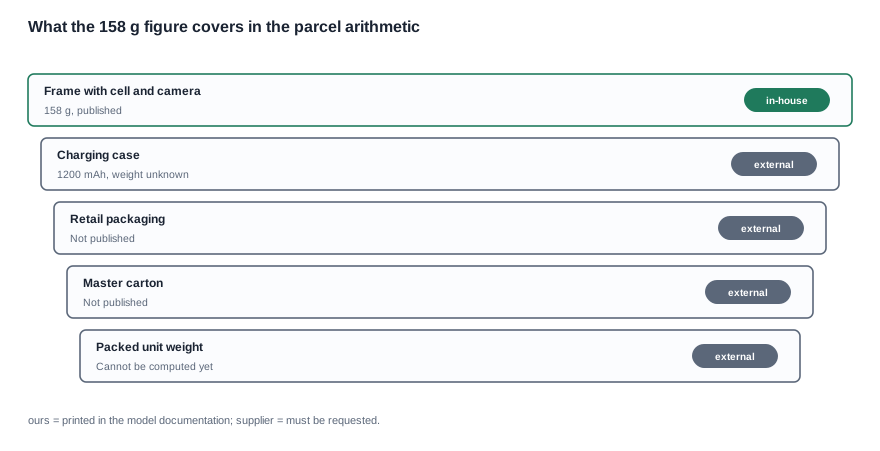
What 158 g is. It is the weight of the glasses body, with the 265 mAh battery and the camera fitted, and it excludes the folding charging case entirely. It is the weight of what the customer carries on their face.
What 158 g is not. It is not the frame weight, because the frame alone is never weighed separately anywhere in this catalogue. It is not the packed unit weight, because the case adds a second cell. It is not the shipped weight, because packaging adds more. And it is not a case weight, because no case weight is published for any model.
The catalogue publishes no bare frame weight for any model at all, so this one figure cannot be borrowed by a neighbouring product that does not publish it. That is a rule worth stating explicitly, because the temptation to transfer a published weight to an adjacent model is common and produces a specification sheet that is wrong in a way nobody catches.
What 158 g supports is a portability statement: the product is documented as lightweight, and the number behind that word is available for a customer to check. What it does not support is any statement about how light the parcel is, how light the shipped unit is, or how the product compares in total mass to another model whose case weight is also unknown.
The AI camera glasses shipping weight analysis covers the arithmetic that follows once a packed unit has been weighed, and that measurement is the only figure worth putting into a freight model. Until it exists for this model, the 1200 mAh case sits in the parcel as an unquantified addition to a frame whose weight is known.

The 1200 mAh folding case and what it changes
The case is the reason this model's specification sheet is more complete than its neighbours', and it is also the reason its battery story is harder to write honestly.
What a printed case capacity buys. A 1200 mAh figure lets a buyer source the accessory against a capacity, describe it against a capacity, and quote it against a capacity. It converts the accessory from an unknown into an input. Five camera models achieve this: the CY05 and the L1 Pro, and the CY03 — each at 1400 mAh, the L2 Utral at 900 and 1400 mAh in a single row, and the MT6 at 1200 mAh.
What the fold changes. A folding case is smaller in the pocket and comparable in the parcel, and it introduces a hinge and a transit failure mode that a rigid case does not have. A fold that holds under pressure, a fold that survives a shipping cycle and a fold that stays closed in a master carton are three separate questions, none of which is answered by the fact that the case folds. The MT6 charging options analysis covers this in detail, and the durability of the fold is worth putting through a shipping cycle on sample units before the first shipment rather than after a complaint.
What the case capacity does not settle. Whether the case recharges the frame or holds a spare cell is not published for any case in this catalogue, and the answer determines whether an endurance claim is available at all. A case that recharges the frame extends the usable day; a case that only holds a cell requires a swap. Both are legitimate designs, and only one supports the kind of statement a product page wants to make.
What remains unquantified on the case. Its weight, its external dimensions, its charge time and whether it carries its own regulatory documentation as a separate lithium cell. The AI camera glasses charging case options analysis works through the accessory economics across the range, and it reaches the same conclusion this article does: the capacity figure is the easy half, while the physical envelope is what decides the carton.

Why this endurance figure is the weakest row
The runtime figure is a single point where the neighbouring models mostly publish ranges, and that difference in shape is more informative than it first appears.
Across the camera group, runtime is published three ways: five to eight hours on four models, six to eight hours on two, and about seven hours on five. A range usually indicates that more than one condition was measured. A point indicates one. On a camera product, the condition that matters most is the camera state, because the imaging subsystem is the dominant load — so a single point produced without stating whether the camera was active describes a product that may not be the one being sold.
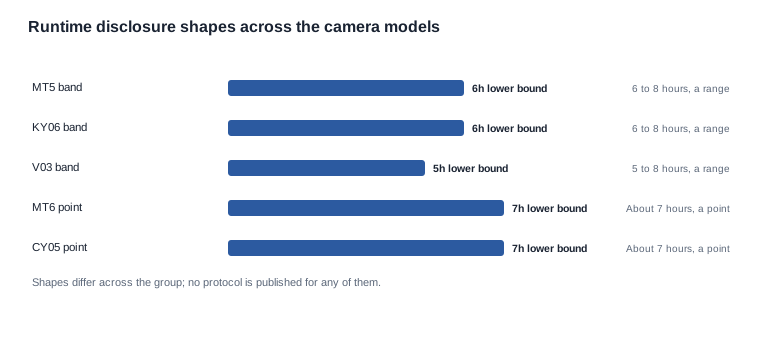
The chart above is worth reading for its shape rather than its height. The numbers plotted are the lower bounds of the published disclosures, and the point is not that one model runs longer than another. The point is that the catalogue contains three different disclosure shapes, which means the measurements behind them were not produced under one protocol. A buyer who compares the heights has taken a number off a chart that was never capable of supporting that comparison.
The honest reading is that this catalogue's endurance figures were not produced under one protocol, and therefore cannot be compared across models. That is a catalogue-wide statement, not a criticism of this model in particular. The AI camera glasses battery comparison sets the full grid out, and the battery life comparison method piece covers the procedure for asking a supplier for a protocol you can actually compare.
Four sub-questions close it for any supplier:
- Was the camera recording during the measurement, and at what resolution and frame rate?
- What were the audio and Bluetooth states during the run?
- What were the starting and ending battery states, and over how many samples?
- Was the figure taken with the case present or absent, and was the case being used at any point?
The fourth question is specific to this model and worth asking, because a model that ships with a case invites an assumption that the figure includes case usage. Nobody publishes that assumption either way, and getting it wrong in the optimistic direction is easy.
The questions that close the battery story
Seven questions, ordered by how much each answer changes the commercial outcome:
- What is the runtime test condition for the MT6? The four sub-questions above, answered in writing rather than inferred from the published figure.
- Does the case recharge the frame or hold a spare cell? This determines whether any endurance claim is available, and it is unpublished for every case in this catalogue.
- What is the case weight and what are its external dimensions? Neither is published, and both are needed before a carton can be finalised.
- What is the case charge time, published as a ceiling or as a measurement? Unpublished for every case in this catalogue.
- What is the packed unit weight with the case in the carton, on a calibrated scale? The only measurement that turns the 158 g figure into a parcel input.
- What charging interface does the frame use? The charging-method row is absent on this page, and the answer affects what else belongs in the box.
- Does the case carry its own regulatory documentation as a separate cell? A second lithium cell in the unit raises transport paperwork questions independently of the frame's compliance position.
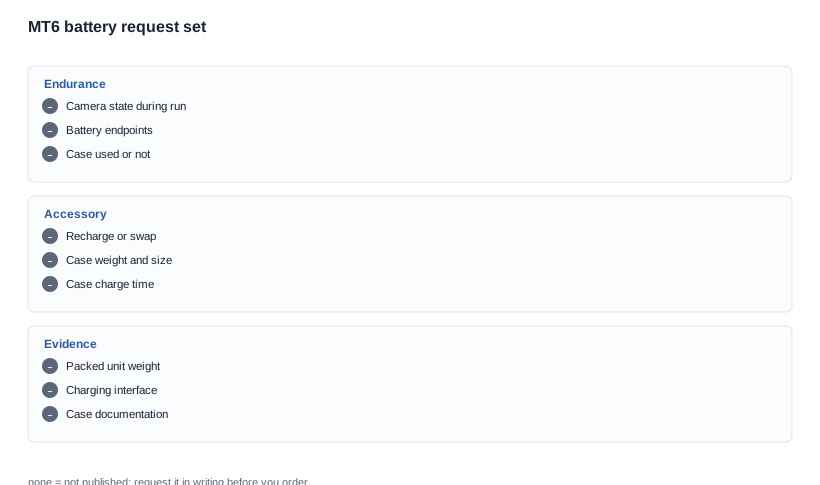
Around those, the commercial set belongs in the same message because none of it is published: minimum order quantity, lead time, sample policy, warranty terms, payment terms, and the quality control regime behind incoming inspection. If a factory is in the supply chain rather than a trading company, asking which operations are in-house determines who signs a warranty commitment and who absorbs a defect claim later, which is a due diligence question that costs nothing to ask.
On compliance, one paragraph covers it. One export certification page in our catalogue holds ten patent certificates — eight of them appearance designs alongside two utility models — and no per-model certification row appears anywhere, with no CE, FCC or RoHS named in the catalogue text. A European Union buyer works against the Radio Equipment Directive (EU) 2014/53/EU, and the electromagnetic compatibility directive, (EU) 2014/32/EU, runs as a separate requirement and the two are routinely confused. Ask for the scope that applies to the model in your purchase order, and check that the model designation on any document matches the order.
Weighing a weak answer before you sign
Replies land in one of four shapes. Only the first of them settles an item: a number, a unit, the condition it was measured under, and a reference to the document it came from. The second gives a number and a unit but leaves the condition out, and it can still be used in a specification if the assumption is printed next to it. The third points somewhere else — a listing, or a different model — and settles nothing. The fourth repeats the question back, and the way out is to ask again with the question narrowed to a single attribute.
On this particular model, two weak forms are especially likely and both are worth refusing. The runtime answer tends to omit the camera state, which invalidates the number on a camera product. And the weight answer tends to arrive as the 158 g figure restated, when what was asked for was the packed unit — the restatement looks like an answer and is not one.
A third weak form belongs to this model specifically: an answer about the case that is really an answer about the frame. Because this model publishes no charging-method row, it is easy for a supplier to reply with a general description of how the product charges and leave the case question unanswered, because the case question and the frame question are easy to conflate when the case is the only charging route anyone has described. Ask the case question explicitly, in a separate line, and require an answer that names the accessory.
How this model's battery story compares with the neighbouring models
Because the MT6 publishes more power-related rows than most of its group, it is worth placing those rows next to the ones it shares a platform class with, so the differences that do exist are visible rather than assumed.
Against the 290 mAh group — the L1 Pro and the L2 Utral, and the CY05 and the CY03 — this model has a smaller cell, a case roughly one-sixth smaller by capacity than the 1400 mAh standard in that group, and a runtime point rather than a range. The 290 mAh group's published case capacity covers three of its four models, which means an accessory strategy can be consolidated there in a way it cannot here.
Against the 260 mAh group — the KY06 and the V06, and the S7 — this model has a slightly larger cell, a printed case capacity where those models publish none, and the only published weight in the catalogue. On the power question alone, this is the better-documented model in either direction, which is the same conclusion reached in the runtime-shape discussion: documentation quality and hardware capability are different axes and should not be merged into one ranking.
Against the 220 mAh group — the MT5 and the V03 Pro, and the V03 — the cell difference is real but modest, and the decisive difference is again the case. Those models either publish no case capacity or publish no case row at all, while this model publishes one. That single row is the strongest published argument this model has, and it is an argument about documentation rather than about power.
The MT6 limitations analysis covers what the same published numbers do not tell you, which is worth pairing with this piece before a purchase order is written.
Writing the claim a buyer can defend
The practical output of this article is a sentence a buyer can use. On the published rows, this model carries a 265 mAh cell, a charge time of two hours or less, an about-seven-hour runtime with no stated condition, a 1200 mAh folding case, and a 158 g body weight excluding that case. That sentence is defensible because every clause maps to a printed row, and it is complete, which is rarer than it should be.
Three claims must be kept out of it. The first is any endurance guarantee or working-day statement, because a point with no condition cannot carry one. The second is any parcel or shipping weight, because the 158 g figure stops at the frame and the case is not weighed. The third is any charging-method statement, because no such row exists on the page.
How to evaluate this model against a shortlist
When this model is one of several under consideration, the criteria for keeping it on the list are worth stating before the specification work starts, because the two decisions are easily confused.
The criteria that keep it on the list are documentation-based and hold regardless of channel. Does your operation need a model with a printed accessory capacity, and does your packaging team need a number rather than a blank? Does your freight model benefit from a documented body weight, even though the case still has to be weighed? Is a folding accessory acceptable to your logistics and to your customer service operation, given that a fold introduces a transit failure mode a rigid case does not have? If the answer to those three is yes, this model has something the majority of the camera group does not.
The criteria that remove it are equally specific. If your channel's product page cannot carry a runtime figure without a test condition, the about-seven-hour point is not usable and no amount of goodwill changes that. If your operation cannot act on an unspecified charging interface before production, the absent method row is a scheduling risk rather than a detail. And if your customer base is concentrated in a market where a folding case's transit durability would generate returns, that risk is real even though it is unpublished.
Before you order, the questions to ask are the seven set out above, asked in one message with the sub-questions kept separate. What to ask for specifically is a number with a unit, a condition that describes the measurement, a document reference, and a model designation that matches your purchase order. A checklist of those four attributes applied to every answer is the fastest way to sort a specification request into the answers that close items and the answers that only appear to.
The trade-off to negotiate deliberately is this: a supplier who will not publish a runtime protocol may still agree to run one on your sample units and supply the result. That single commitment converts the weakest row on this model's sheet into its strongest, because a measured figure with a stated condition is worth more than any published point. It is a smaller ask than a specification change, it costs the supplier one test run, and it is the highest-value item in the whole request list.
Keeping those three out is not a limitation of the marketing; it is what makes the rest of the sentence usable. A specification that overstates by one clause tends to be read as overstating throughout, and a specification that maps cleanly to printed rows survives a challenge from a buyer who has read the same documentation.
The trade-offs worth negotiating here are narrow. A case charge time that is not published can still be written into the contract, and a contracted figure is more useful than a published one because it carries a remedy when it is missed. A packed unit weight that cannot be committed to can usually be given as a tolerance band instead. A runtime with no stated protocol can usually be measured on sample units and reported back. Each of these is a smaller request than a change to published specifications, and each closes the same gap for the buyer who makes it.
What we will publish for this model is the 265 mAh cell, the two-hour-or-less ceiling, the about-seven-hour runtime, the 1200 mAh folding case and the 158 g body weight, each exactly as documented. What we will not publish is an endurance guarantee, a working-day claim, a case weight, a packed unit weight, a charging method that is not printed, or a certificate number the documentation does not contain. The published MT6 specification list is the honest baseline and the MT6 value analysis covers the commercial case around this model.


