

A catalogue page and a brand's product page need different kinds of image, and the reason is worth stating before anything is booked. The catalogue page carries rendered views of a product, which are accurate about shape and general appearance and are not usable as a brand's own material. The brand's page needs a photograph of the unit that will actually arrive in the customer's hand, in the configuration that will actually ship. For this range, that distinction is not a stylistic preference, because the product record states for all twenty-eight models that no product photographs, no video and no detection reports have been supplied. So the image set a brand needs does not exist in a form it can use, and the photography job is not an optimisation of supplied material. It is the production of the only visual evidence a buyer will ever get, and that is why it has to be planned as a specification rather than commissioned as a shoot.
What a shoot needs, and where the input comes from
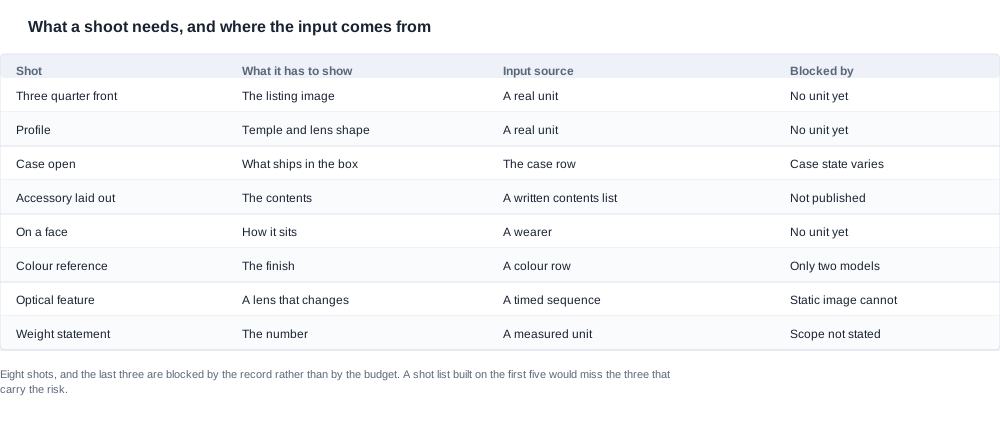
The table below lists the shots a camera or audio product launch normally needs, and for each one, where the input that makes it possible comes from.
| Shot | What it has to show | Input source | Blocked by |
|---|---|---|---|
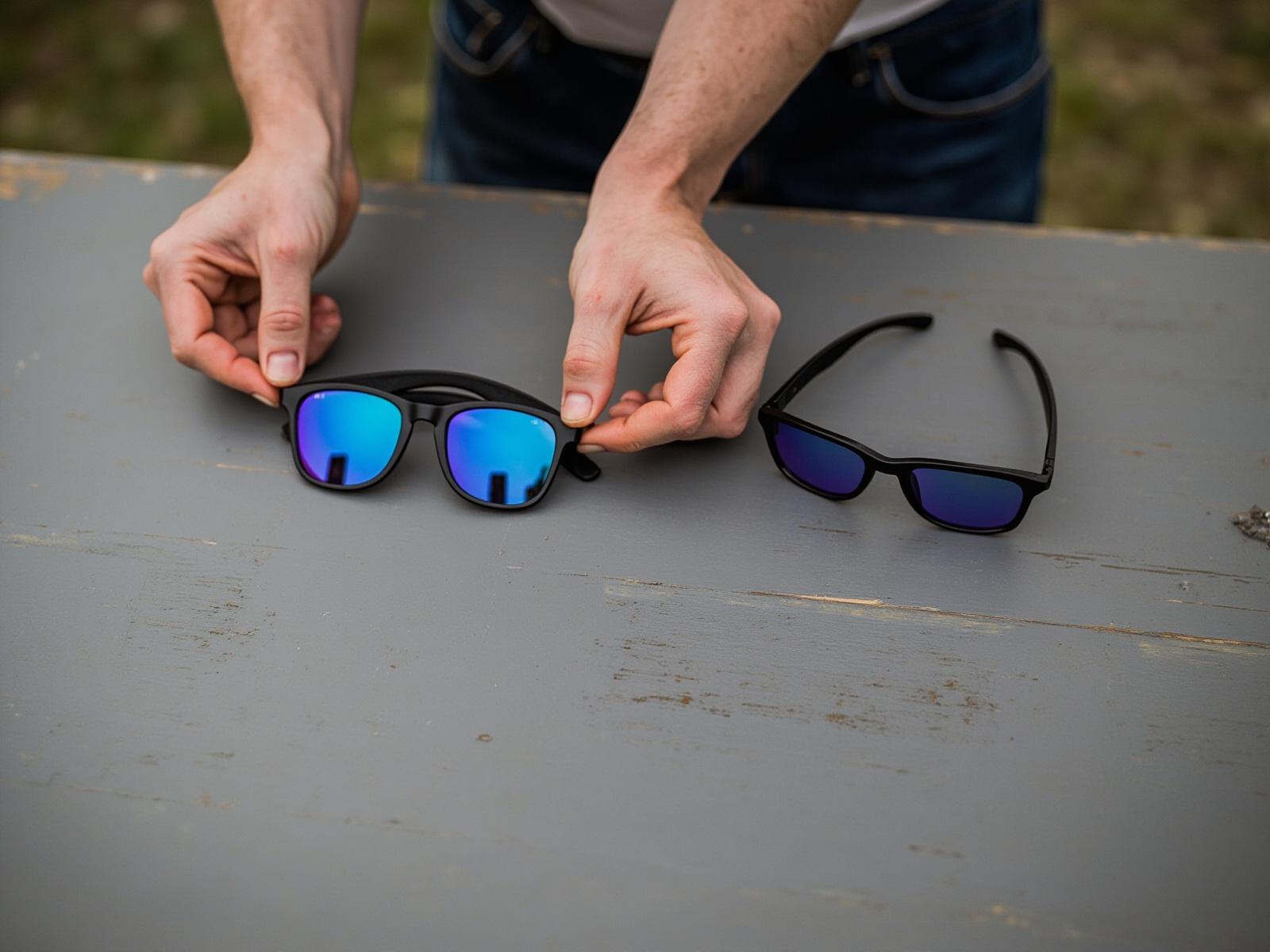
| Three quarter front | The listing image | A real unit | No unit yet |
| Profile | Temple and lens shape | A real unit | No unit yet |
| Case open | What ships in the box | The case row | Case state varies |
| Accessory laid out | The contents | A written contents list | Not published |
| On a face | How it sits | A person | No unit yet |
| Colour reference | The finish | A colour row | Only two models |
| Optical feature | A lens that changes | A timed sequence | Static image cannot |
| Weight statement | The number | A measured unit | Scope not stated |
Three rows in that table are blocked by the record rather than by the budget or the schedule, and they are the three that carry the risk.
The colour reference is the first. The catalogue publishes a colour row on two models only: one lists three colours and one lists four. The other twenty-six entries publish no colour row at all. So for most models in this range there is no published colour reference to shoot against, which means the photograph becomes the only record of the finish, and if the shoot and the production run end up on different finishes, there is nothing to compare them with. The fix is a request rather than a large budget: a colour and surface reference for the unit, agreed before the shoot.
The second is the contents. The camera range gives four different answers to the same question about the charging case, and the accessory set is not published for any model at all. A shot showing a case open, or an accessory set laid out, is therefore a claim about what ships, and the record does not support that claim for any model. It has to be supported by a written contents list for the specific model and configuration, and the two things have to be produced together rather than in parallel.
The third is the optical feature, and it is a category limit rather than a supply problem. One model in the camera range publishes a photochromic lens as a feature, and a photochromic lens is a property that changes with the light. A single frame cannot show it, and a still that appears to show it is a construction rather than an observation. The honest treatment is a timed sequence under a stated lighting change, and the honest alternative is to leave the optical claim to the specification and to photograph the product without pretending a still can demonstrate it.
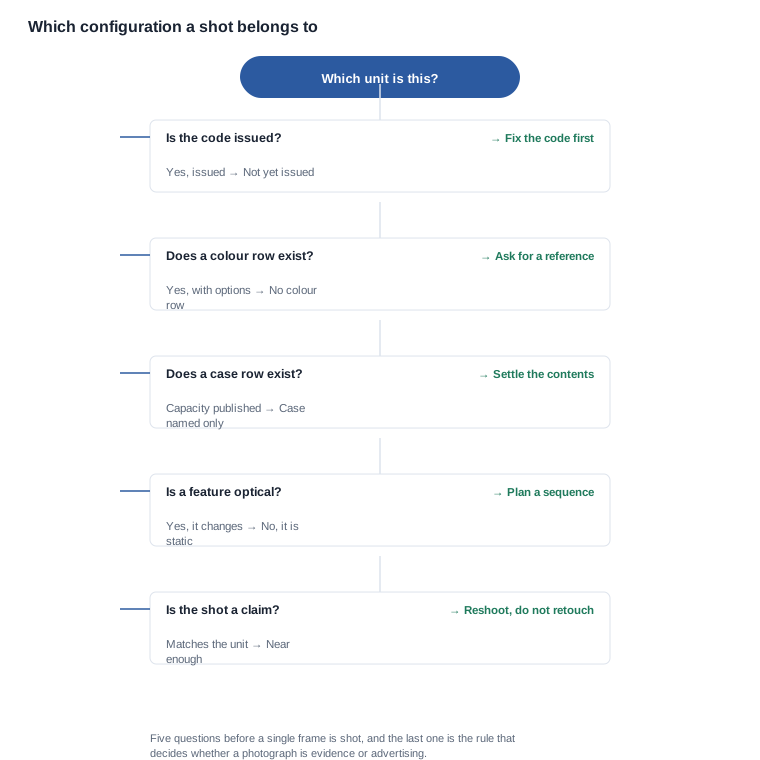
The six OEM ready platforms photography stages, and what each one is for
The first stage is defining the shot list before anything is booked, and the shot list is a specification. Each image has to have a purpose stated in one line, and the set that falls out of that is different from a generic product set. The criteria for building one are these five.
- The listing image. The three-quarter front view, and it exists to be the first thing a customer sees.
- The profile. It exists to show the temple and the lens shape, and it is the shot that tells a customer whether the product matches the shape they had in mind.
- The contents. The case open and the accessory set laid out, and these exist to show what arrives in the box.
- The on-body view. It exists to show how the product sits on a face, and it needs a real person rather than a mannequin.
- The configuration set. Every configuration the channel will stock, each with its own file, because a launch page with three stock lines needs three matching images rather than one.
What is not standard is the eighth row of the table above, and the reason is that the catalogue does not publish the inputs a generic list assumes exist. Two models publish colours, twenty-six do not. The case state differs model by model. So the shot list has to be generated per model from its catalogue page, and it has to record which page each shot came from. A shot list built as a template will produce a set that does not cover the model it was shot for.
The number of images follows from that, and it is worth planning it explicitly rather than discovering it on the day. A model with one configuration and a published colour row needs one set. A model with one configuration and no colour row needs one set plus a colour reference that has to be requested. A model with two published case capacities needs either one set for the configuration that will ship, or two sets if the channel carries both, and the decision on that belongs to the channel rather than to the photographer. A model with two variant names and two capacities whose correspondence is unpublished needs the correspondence settled first, because the number of sets cannot be counted until it is known. And a model with no issued code cannot have a set at all. This is why the shot list is a specification rather than an order form, and why the criteria for it have to be applied per model rather than per programme.
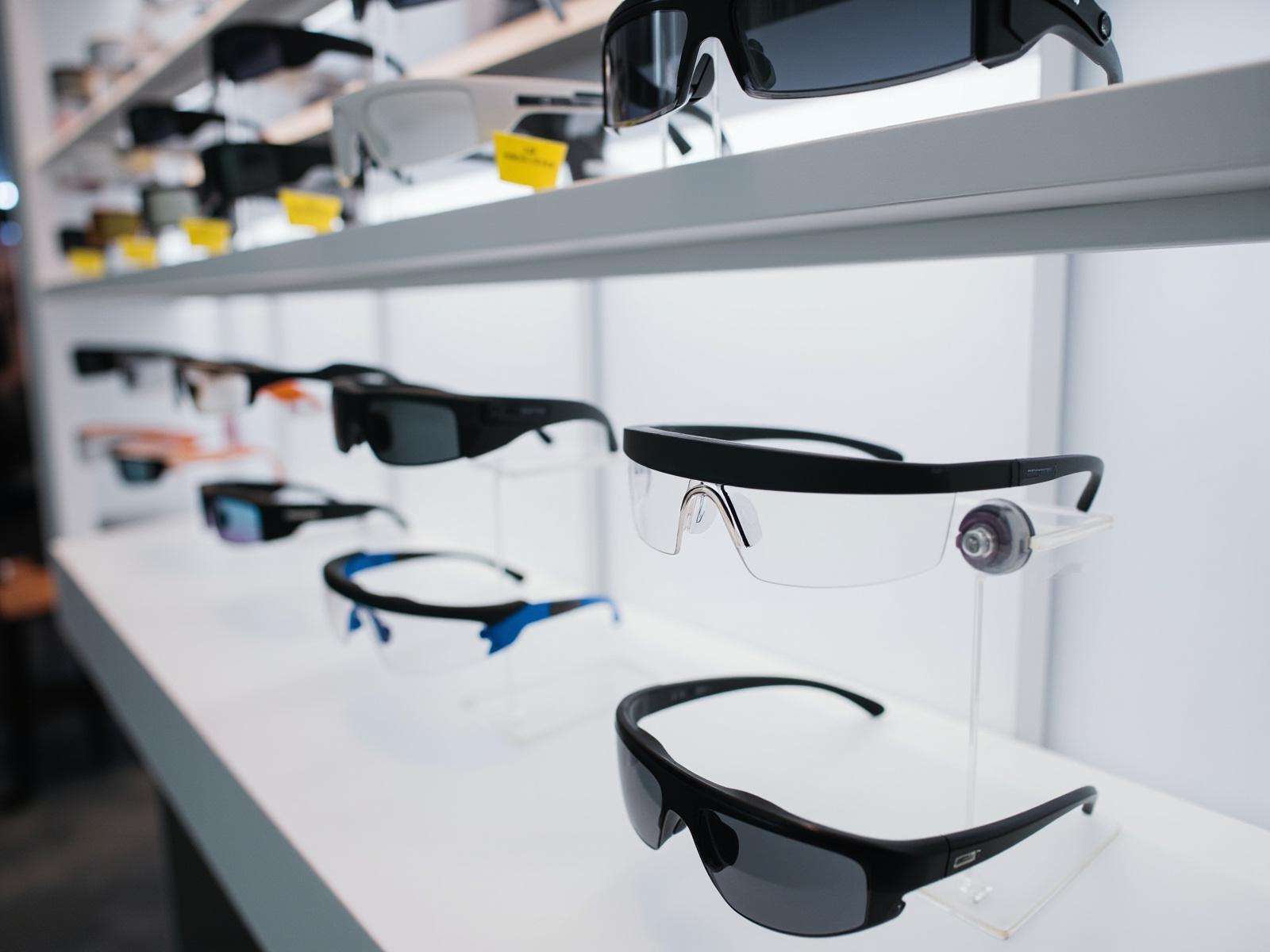
The second stage is shooting the real units in the real configuration, and this is where the gap between a rendered view and a photograph becomes visible. A rendered view shows the design. A photograph shows the unit, and the two differ in the ways that customers notice: surface finish under a light source rather than under a renderer's approximation, the colour of the temple against the colour of the lens, the position of a mark, the way a case sits when closed, the appearance of the interior of a foldable case. The specific model that makes this acute is the one that publishes two variant names and two charging case capacities without stating which name goes with which capacity. If a shoot is booked for one configuration and the production run ships the other, the entire image set describes a product that does not exist, and the discovery happens after the print run rather than before it.
The third stage is correcting the optics, and being honest about it. A product like this is hard to photograph without treatment, and the correction has to stay within what the unit actually is. The test is simple and it is a customer test rather than a photographic one: could someone holding the delivered unit say the photograph is a fair representation of it. A frame lightened until it reads as grey plastic, or a reflection removed that is genuinely on the surface, fails that test even if the corrected version appears better in isolation. The failure mode worth naming is the accumulated one, where each retouch is defensible on its own and the set as a whole no longer matches the goods.
The fourth stage is matching the images to the brand rather than to the other photographs. A set composed for one listing, with its own lighting, background and colour balance, dropped into a different page produces a page with two visual languages on it, and the mismatch is more visible than an imperfect image. Reshooting is normally better than retouching, because retouching a catalogue frame into a brand aesthetic produces something that reads as the factory's product photographed by the brand. The OEM ready platforms listing optimisation notes cover how the image set and the listing copy work together.
The fifth stage is proving every image against the physical unit, side by side, under the same light. Logo position and size, the finish, the colour, the case, the packaging, the accessory contents, the printed markings. A photograph is a claim about the product, and the only way it becomes evidence rather than advertising is by being checked against the goods. The sample before bulk notes cover what to check when the sample arrives, and the quality consistency analysis covers the incoming checks that catch faults worth catching before a carton is sealed.
The sixth stage is archiving the set with the production file, and versioning the images by configuration. The image set, the locked artwork, the proofed sample, the production file and the certification file belong together, because a photograph taken of a pre-production unit is evidence about the wrong product if the production unit later changed.
Where the record blocks the shoot
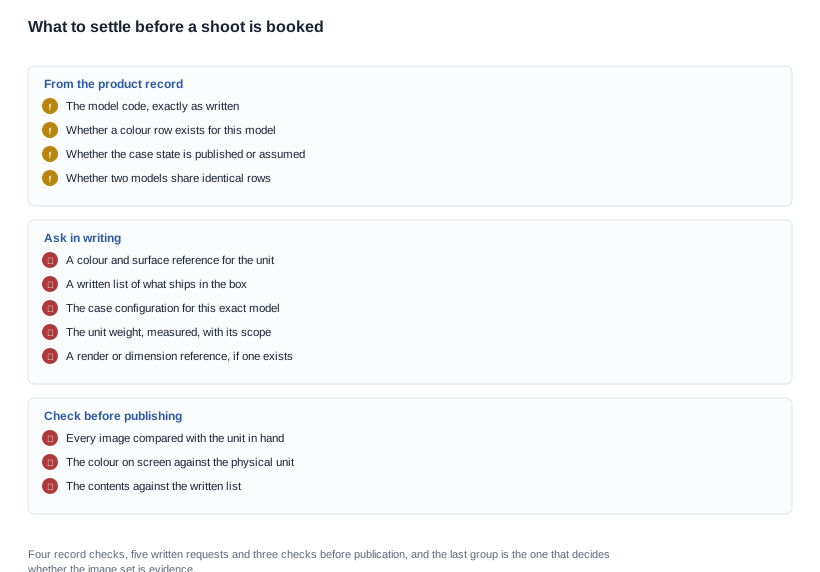
Four entries in the product record create a specific problem for photography, and it is worth naming them because each one produces a different failure.
Two models publish identical specification rows with no stated difference between them. Their photographs will be identical too, because the units are indistinguishable on the record. That is not a photography problem to solve with a different angle; it is a question to settle in writing, because a channel cannot stock two visually identical products under two names and expect the images to do the work of explaining the difference.
One model publishes two variant names and two charging case capacities without stating the correspondence. This one multiplies the shoot rather than blocking it: if the configurations differ visibly, the set has to cover both, and if the correspondence is not known, the number of configurations to be photographed is not known either.
Three entries have no model code issued at all. There is nothing to photograph against in a legally meaningful sense, because the identity of what is being photographed is not established, and the file naming that keeps a set matched to configurations has nothing to key on.
And the single weight figure in the catalogue, one hundred and fifty-eight grams, appears on the same image caption as a foldable charging case, which means the catalogue does not state what it measures. A shoot that includes a weight statement therefore inherits an unresolved scope, and the same applies to any photograph of a unit with a foldable case, since the one published figure cannot be matched to either the glasses or the case.
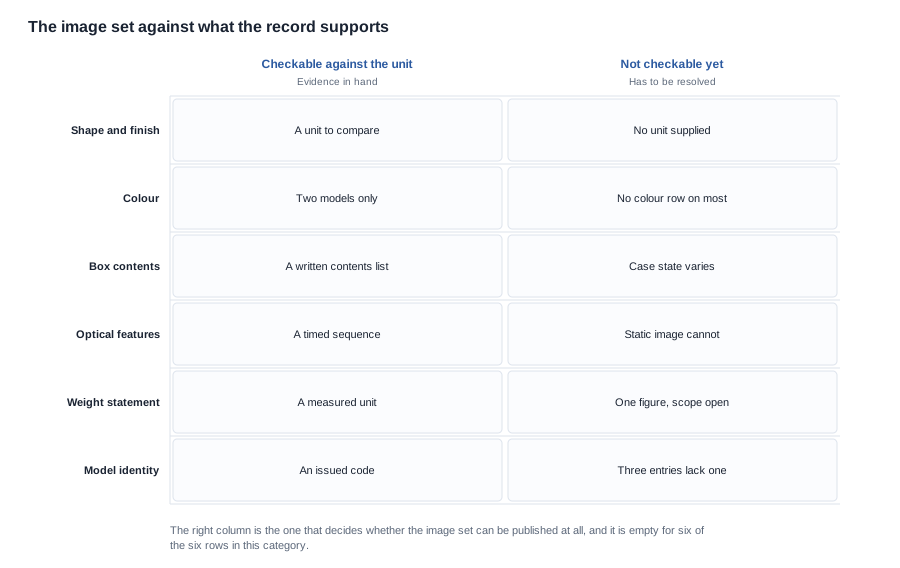
There is a question that sits underneath all of these, and it is the one that decides whether a photography programme is worth running at all for a given model. It is not whether the shoot can be made to appear attractive, because a competent photographer can make almost anything appear attractive. It is whether the images can be made true, and the criterion for that is narrow and checkable: every image has to be comparable against a physical unit that the channel will actually receive. Where the record leaves the identity of the unit unresolved, where the colour has no published reference, where the contents are not stated, and where two models are indistinguishable on paper, the images are not comparable against anything, and a set of beautiful photographs of an object nobody can identify is not evidence of anything.
So the questions worth asking before the shoot is booked are these. What is the model code, and is it issued. Does a colour row exist for this model, and if not, what is the colour reference the shoot will be checked against. What is the written contents list for the configuration that will ship, and does the case state on the catalogue page match it. Which configurations are being stocked, and how many sets does that make. And which of the shots are claims about a physical property that changes, because those need a sequence rather than a frame. None of these five is expensive, all five are answered by a written request, and all five change what the shoot has to contain. A programme that books the shoot first and asks afterwards has already paid for a set that does not cover its own product.
There is one more point about the proofing step that is worth making explicit, because it is where a set of images either becomes evidence or stays advertising. The check is a side-by-side comparison against the unit in hand, under the same light, with each element checked individually: the mark position and size, the finish, the colour, the case, the packaging, the accessory contents and the printed markings. The reason it has to be side by side under the same light is that a photograph and a physical object never match under two different light sources, and a difference that is entirely a lighting artefact will be read as a product defect by a customer and as a photography defect by a factory. Running the comparison once, on one unit, settles the set for that configuration. Running it again on a second unit is what tells you whether the set is a record of the product or a record of one unit, and for the rows where the catalogue publishes nothing at all, the second comparison is the only consistency evidence that exists.
The criteria for deciding whether a configuration is photography-ready are therefore four, and they are worth applying before a shoot is committed rather than after it is delivered. Is the unit identifiable, meaning the code is issued and the row that distinguishes it from a visually similar model is settled. Is its finish identifiable, meaning there is a colour reference to shoot against and it is either published or requested. Is its contents identifiable, meaning a written list exists for the configuration that will ship. And are the claims the images will make checkable, meaning the colour, the shape, the contents and the packaging can each be compared against a unit. A configuration that fails one of the four can still be photographed, and the photographs may still be good, but they will be images of something rather than evidence about something. That is a real distinction for a channel that has to answer a customer who says the delivered product does not look like the picture, because the answer to that complaint has to be a comparison and not an apology.
How to choose between the options when a model fails one of those four is a decision the channel makes rather than one the photographer makes, and the trade-off is worth naming. The three practical options are to hold the launch until the row is settled, to launch the configuration with a reduced claim set, or to launch and accept the risk. Holding is the right answer when the row affects what the customer receives, because a colour with no reference or a contents list that does not match the box is a complaint waiting to happen. A reduced claim set is the right answer when the row affects a detail rather than the product, so that a model with no published ingress marking is photographed and described without that property being asserted, rather than being held. Accepting the risk is the right answer only when the row affects something the channel can verify itself and fix afterwards, and the test for that is whether there is a physical check available. What is not a good answer is launching with the row assumed, because the assumption is invisible on the listing until a customer compares it with the unit, and by then the cost is a return rather than a correction.
The same three options apply to the question of whether to reshoot an existing set or to correct it, and the criteria are the same in both cases. A set that can be compared against a unit can be corrected, with each correction checked against the unit, and the result is legitimate. A set that cannot be compared against anything can only be corrected into an approximation, and an approximation of an unidentified object is a new claim rather than a version of the old one. How to choose between the two is a question about whether the row behind the image is settled, and it is worth deciding before the correction work is commissioned rather than after.
How to read a photography brief against the record
On photography the boundary is firm, and it is worth stating before the brief rather than after the shoot. The rendered views in the catalogue are accurate about shape and appearance, and we will not present them as product photography for a branded programme, because a rendered view is not a photograph of a unit and a customer comparing the two can tell. We will not supply or endorse a product image that is not a photograph of a real unit, and we will say plainly when a configuration has not been photographed, because an image of a similar unit is a claim the customer can disprove on delivery. We will not publish a colour reference for a model whose page publishes no colour row, and we will not substitute a colour from a different model to fill the gap. We will not put a weight statement on a photograph where the scope of the published figure is unconfirmed, and we will not show a static image of an optical property that changes with the light.
What the record does support is a clear division of labour, and it is the same division that runs through the rest of a private-label programme. The catalogue settles the contents question on five camera models and the colour question on two, and it settles them in a form a photographer can plan against. A written request settles the colour reference, the contents list, the case configuration and the measured weight, and each of those is a short request against a named model. The shoot produces the only visual evidence there will be, and the proofing step is what converts it from advertising into evidence. And the archive is what keeps the evidence tied to the goods it describes, so that a change in the production unit is a version event rather than a silent gap.
A brand that treats the shot list as a specification generated from each model's own catalogue page, and that settles the four blocked rows before booking anything, ends up with an image set it can defend to a customer and to a test house. The artwork the images have to match is in OEM ready platforms packaging design, the mapping step that catches a mark or a colour that does not match is in OEM ready platforms brand guidelines, and the proofing step itself is in OEM ready platforms sample before bulk. The commercial side of a branded programme is in OEM ready platforms private label options.
Send us the models you plan to launch, the channels and the deadline, and we will tell you which rows on each model's page have to be settled before the shoot and which ones can be prepared afterwards.


