

The first hour of any battery complaint should be spent on the charging path and the duty cycle rather than on the cell, because those two account for the majority of the reports in this category and neither one requires a return. The published baseline is what makes the triage possible, and it is worth reading carefully rather than approximately. The camera models that publish a figure publish a range: the V03 and the V03 Pro publish five to eight hours and the KY06 publishes six to eight. The MT6 publishes roughly seven. The V06 and the S7 publish five to eight hours, the MT5 publishes six to eight, and the L1 Pro and the CY05, and the L2 Utral and the CY03 publish roughly seven. The audio tier publishes roughly eight hours on the K01, the K02 and the LC-105 pair, roughly six on the G07 and the YK12, and roughly seven on the D11 and the D12. The sport models publish roughly eight hours on the YKC02 and roughly seven on the D17. The bone-conduction entry publishes roughly seven, the children's models publish roughly twenty, and the D17 and the ZH12 publish roughly one hour of charge against a ceiling of two hours or less elsewhere.
None of those figures carries a test condition, and that is the single most important fact on this page. A complaint cannot be evaluated against a rating that does not say what it was measuring.
Smart glasses battery life: why the diagnostic order is itself the fix
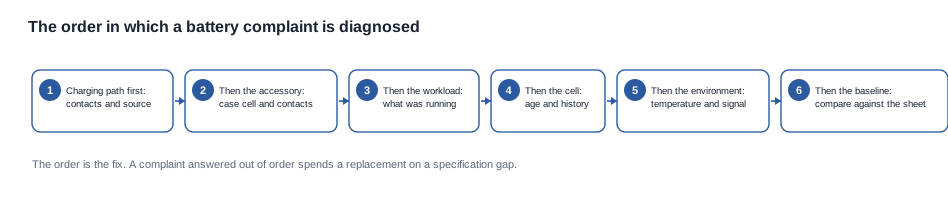
The order above is not a list of possible causes. It is a sequence, and each step assumes the step before it passed. A failure at any step tells you what the later steps would have told you, which is why running them out of order is what makes battery support expensive.
Step one, the charging path. Contacts, source, port, cable. It comes first because it is the cheapest to check, the most common, and the one that produces symptoms indistinguishable from a cell fault. A unit that does not charge correctly also does not discharge correctly, and the customer's description of the two is usually identical.
Step two, the accessory. The case, its own cell, its contacts, its alignment. A case that has lost its charge and a pair of glasses that have lost their charge produce the same sentence from the customer's point of view, and neither is a fault in the glasses.
Step three, the workload. What was running, for how long, in what radio state. This is the step that most often ends the diagnosis, because the complaint is usually a duty cycle the rating never described.
Step four, the cell. Age, history, storage. This is where a genuine fault lives, and it is the step that costs a replacement, so it should not be reached until the first three have passed.
Step five, the environment. Temperature and coverage at the time of the complaint. A seasonal cluster in a cold market is a condition, and a cluster in one batch is a fault, and the environment step is what separates them.
Step six, the baseline. Compare against the reference measurement for that batch. This is the step most programmes cannot complete, because no baseline was created, and it is the step that turns a year-old complaint from an argument into an answer.
The buying task behind this page is a support-process task rather than a sourcing one. The reader is a brand product manager, a channel buyer or an after-sales lead building the process for a product line, and the deliverable is a written diagnostic order plus a baseline sheet. The commercial risk is a warranty budget spent on units that were never faulty, and a customer whose expectation was set by a rating rather than by a workload.

Charging-path symptoms: what to check before anything else
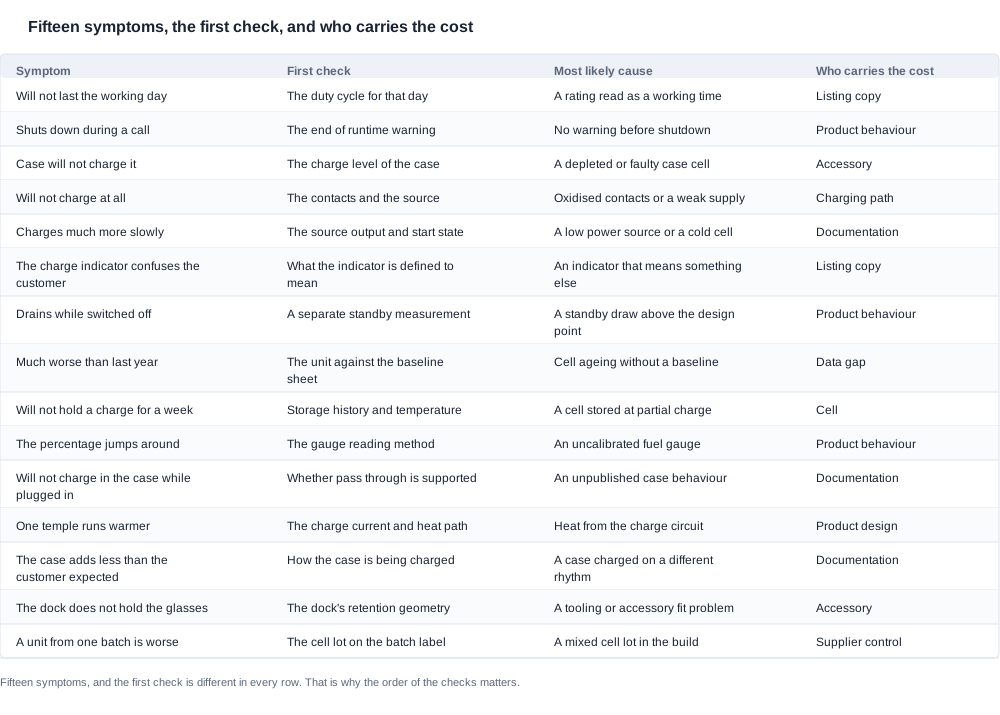
Will not charge at all. The first check is the contact and the source, in that order. A magnetic dock depends on a defined contact geometry, and a contact geometry fails in three ways: it is not aligned, it is contaminated, or it has oxidised. A type C port fails in two: the cable is not delivering data and power correctly, or the port itself is damaged. The D11, the D12, the D17, the ZH12, the V03 Pro and the bone-conduction entry all charge over type C, and in a market where the cable is not in the box, the first question is whether the customer is using one at all. The disposition is a support handling, and the cost sits with support after the contact and source check.
Charges much more slowly than the published figure. The published figure across this range is a charge time of two hours or less for most models and roughly one hour for the D17 and the ZH12, and it is a figure without a start point or a source output. So the first check is the state of charge at the start and the output of the supply. A low-power source produces a longer charge with the same product and the same cell, and a cell that is cold produces a longer charge as well. Neither is a defect. The cost sits with documentation, because the two numbers disagree.
The charge indicator confuses the customer. A percentage that moves in steps, a full reading that falls after the unit is unplugged, and an indicator that means something different from what the customer assumes are three separate problems with one root, which is that the gauge method is not published for any model. The disposition is a product-page and support-script fix, and it is the cheapest item on the list to close.
One temple runs warmer than the other. This is a design and process question rather than a support question, and it should be routed to engineering rather than answered by a script. The heat comes from the charge circuit, and the check is the charge current and the thermal path. If the pattern is consistent across units it is a design characteristic; if it is one unit it is a build fault. The cost sits with product design or with supplier control depending on which.
The unit will not charge in the case while it is plugged in. Whether pass-through charging is supported is not published for any model in this range, and the customer's expectation is entirely reasonable. The check is to ask the factory. The disposition is documentation, and the consequence of leaving it is a support script that answers a question the supplier has to answer.
Runtime and standby symptoms: separating a cell fault from a workload mismatch
Will not last the working day. This is the most common complaint in the category and the least likely to be a fault. The first check is the duty cycle for that specific day: how long each function ran, whether the camera was active, whether the phone was connected. A unit that delivers six hours against a published eight under a mixed load has not failed, because the eight was never a mixed-load number. The cost sits with the listing copy if the copy implied more than the rating, and this is the single most valuable thing a brand can fix in a week.
Shuts down in the middle of a call. The first check is the end-of-runtime behaviour, and the fact that this is not published for any model is the substance of the complaint. A product that warns before shutdown turns this into an inconvenience; a product that does not turns it into a support ticket about a fault. The cost sits with the product, and it is the cheapest of all the product-side fixes in this category because it is a specification line rather than a redesign.
Drains while switched off. The first check is a separate standby measurement, because standby is not the published working rating and the two were never meant to match. If the standby draw is within what the design intends, the complaint is an expectation and the fix is a copy change. If it is not, it is a product fault, and the check that decides it is a measured draw rather than an impression.
The battery percentage jumps around. The first check is the gauge reading method, and the method is not published. A gauge that estimates from recent draw behaves very differently from one that integrates, and the behaviour is visible to the customer as inconsistency. The disposition is a product-behaviour answer, and the practical response is a product page that describes the indicator rather than one that leaves the customer to infer it.
A unit from one batch is worse than a unit from another. The first check is the cell lot recorded against the batch, because a mixed cell lot in one build is a real failure mode and a lot segregation problem is a real supplier control problem. The check that settles it is a runtime measurement on a sample drawn from each batch. The cost sits with supplier control, and it is the only symptom on this list where the supplier's quality file is the decisive document.

Accessory symptoms: the case, the dock and the cable
The case will not charge the glasses. This is the most common misdiagnosis in the category, and it has two causes that produce an identical complaint. The first is that the case itself has no charge, because the case was not charged or because the case's own cell has failed. The second is that the contacts are contaminated or oxidised. Neither is a fault in the glasses, and a support team that jumps straight to replacing the glasses will spend its warranty budget on the wrong component.
The published case data is what makes the accessory check cheap. The CY05 and the CY03, and the L1 Pro carry a 1400 mAh case, the L2 Utral carries a 900 or 1400 mAh case as a configuration choice, and the MT6 carries a foldable 1200 mAh case. The KY06 and the MT5 ship with a case whose capacity is not published, and the V03 and the V03 Pro publish no case at all. The case's own charge time and its own input are not published for any model, so the accessory has to be measured as a separate product rather than assumed to match the glasses.
The case adds less than the customer expected. The first check is how the case is being charged, because a case charged on a different rhythm from the glasses contributes nothing on the day it is needed. The second is the measured recharge count, which nobody publishes and which a customer cannot estimate. The disposition is a routine, which means a product-page change, a card in the box, or a support script line.
The dock does not hold the glasses in place. A contact geometry problem rather than an electrical one, and it is worth separating from the charging fault because the disposition is different. A dock that will not hold is a tooling or accessory problem. A dock that holds and does not charge is a contact or circuit problem.

Ageing complaints: the baseline sheet that makes them answerable
The complaint that is hardest to answer is the one that arrives a year after the product shipped, and the reason it is hard is a missing document rather than a missing measurement technique. A unit in month nine is compared against a rating produced on a new cell, and no evidence exists that the two should match. Without a baseline, the only available answers are to replace the unit or to refuse the claim, and both are expensive.
A baseline sheet is not a difficult document. It is a stated runtime under a stated condition, measured on a sample drawn from the actual production batch, kept for the life of the product. It needs four fields: the model designation, the production batch, the condition, and the result. It needs a decision about where it lives, and it needs to survive the person who created it. A buyer who creates one of these at the start of a production run has a document that answers every ageing complaint for the next three years, and it is the cheapest piece of documentation in this category.
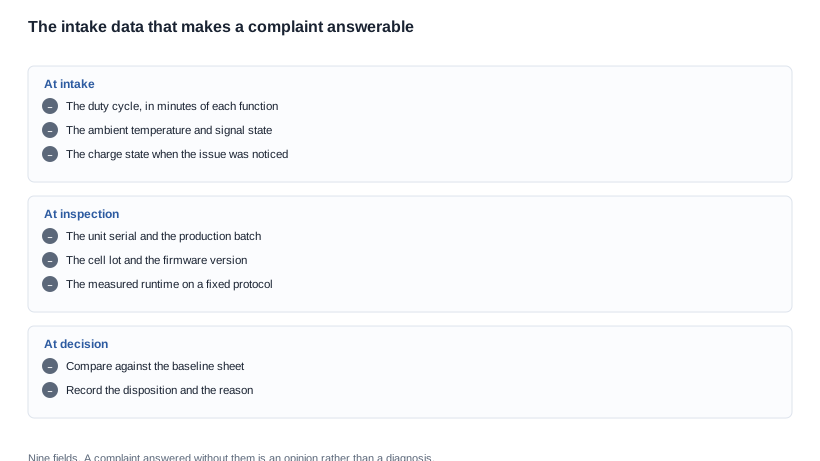
The related intake discipline matters just as much. A complaint that arrives without the duty cycle, the ambient temperature, the signal state and the charge state cannot be diagnosed, because four of the six variables in the runtime chain are unknown. The checklist above is what a support team should collect at first contact, and it is a shorter conversation than it looks because most of it is one question about what the customer was doing.
Much worse than last year. The first check is the unit against the baseline sheet for its batch. If the unit matches the baseline, the complaint is a workload or environment change and the answer is a copy or a routine issue. If the unit falls well below the baseline, it is a cell fault and the disposition is a warranty replacement, and the fact that the baseline exists means the decision can be made in one step rather than one week.
Will not hold a charge for a week. The first check is the storage history and the temperature. A cell stored for months at partial charge behaves differently from one that has been charged and used, and a distributor holding inventory for a season creates exactly that history. The disposition is a cell fault, and the prevention is a storage instruction for the channel rather than a change to the product.
Turning the diagnostic order into a support script and a warranty rule
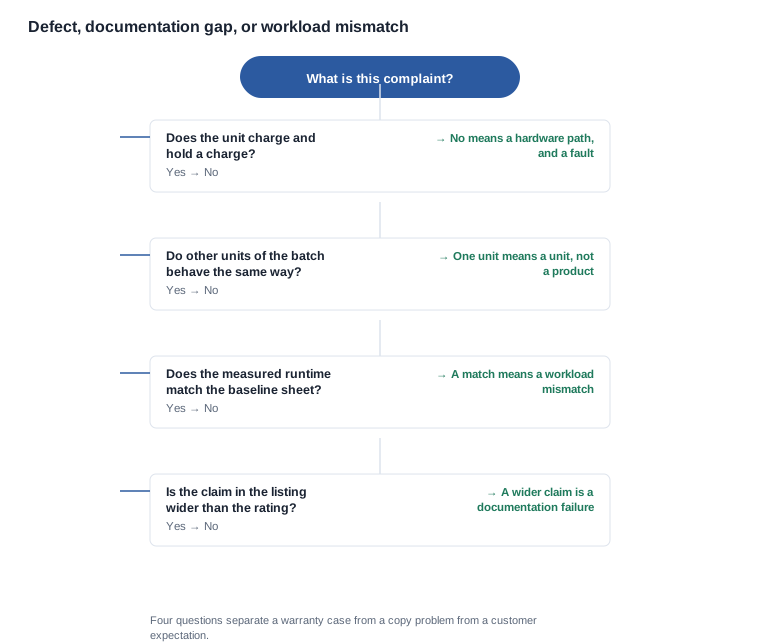
The four questions in the decision chart separate the three dispositions, and the separation is what makes a warranty rule enforceable rather than arbitrary. A unit that does not charge and does not hold a charge is a hardware fault, and the warranty covers it. A unit that behaves as the baseline describes, in a customer whose workload is heavier than the baseline, is a specification and copy issue, and the warranty does not cover it. A unit that behaves badly and consistently within one batch is a supplier control failure, and the agreement has to say who absorbs it.
Two of the three dispositions are cheap to reduce and one is not. The workload mismatch is reduced by a product page that states a condition, and the cost is a rewrite. The documentation gap is reduced by a baseline sheet and a set of published rows, and the cost is a document. The batch fault is not reduced by anything the buyer can do, and it is the one that has to be settled in the agreement, with a definition of what a batch is and a rule for who pays.
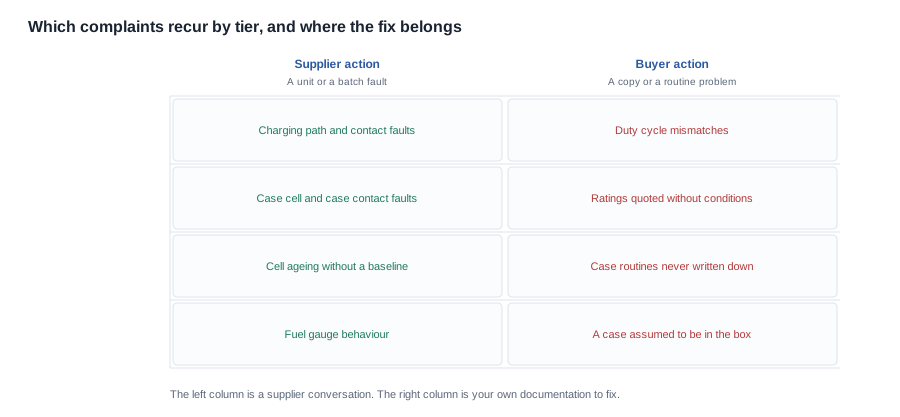
The matrix is the allocation rule. Everything in the left column is a conversation with the factory, and the due diligence behind it is the quality file: the incoming cell report, the process records and the final inspection report with its sample size. Everything in the right column is the buyer's own documentation to fix, and it is the larger share of the complaint volume in a well-run programme.
The questions to ask before the script is written, and before the order is placed
The support script is easier to write once the specification exists, and it is worth being explicit about the order of the two activities. A script written before the specification has nothing to adjudicate against, so every ticket becomes a negotiation with the customer. A script written after it has a reference, and the reference turns a complaint into a lookup.
The questions to ask a supplier, in the same words for every model, are four. What is the runtime under a mixed load that matches our users, and what is the protocol behind it. What happens at the end of the runtime, and does the product warn. What is the measured capacity of the cell in the shipped unit. And what is the rated cycle count, with the capacity you would expect at the end of it.
Three red flags tell a buyer that a supplier's answers will not support a script. A runtime figure with no condition attached. A case capacity offered without a measured recharge count. A cell with no part number on any document. None of the three is fatal, and all three are cheap to close before you order rather than expensive to close after a support queue has been built.
The total cost of getting this right is worth spelling out, because the individual items look small. A workload mismatch that the script catches is a support contact. A workload mismatch the script cannot catch is a return, a replacement, a refund and a review. The difference between those two outcomes across a year of volume is larger than the cost of the measurement and the baseline sheet combined, and the measurement is a few units and an afternoon on two models.
The trade-off that has to be made explicitly is between the size of the baseline sample and the number of units consumed from the first shipment. A large sample gives a tighter result and costs units that could have been sold. A small sample saves units and produces a result that is harder to defend in a batch dispute. The practical answer is to take the baseline from a production run rather than from the sample order, because the production run has more units to draw from and is the batch the customer will actually receive.
What we will do is take the models in your range, the duty cycle your customers create and the support script you intend to use, and tell you which of the fifteen complaints the published rows can already resolve, which one the script still exposes you to, and what has to be established in writing before a purchase order is signed. The published rows are at battery life and power, the comparison across the ranges is at the AI camera battery comparison and the audio battery comparison, the interface options are at charging options, and the question of a user-replaceable cell is addressed at can I swap the battery. The procedures for a buyer-run measurement are at how to test battery life, and the factory-side counterpart to this page is at battery quality control in practice.
Related reading
- The published rows — battery life and power
- Comparing the ranges — AI camera battery comparison
- The interface options — charging options
- The user-replaceable cell question — can I swap the battery
Tell us the models and the duty cycle, and we will say which complaints the published rows can resolve for you.


