

What to ask before ordering in smart glasses certification work is a list of questions whose answers go into the contract rather than into a folder.
The smart glasses certification checklist a buyer actually needs is therefore not a list of documents to collect. It is a list of questions to ask, in an order where each answer enables the next one, with the last answer written into the purchase order so that it can be enforced later.
That is the whole difference between a certification question and a certification document. A document is filed and produces a feeling of completion. A question, answered in writing and attached to the purchase order, produces a position you can enforce. A buyer who receives a conformity assessment for a product line and no written statement of what it covers has received something that looks like an answer and is not one.
Seven questions follow. They are ordered so that each one is answerable once the previous one has been answered, and the last section states plainly which of them our own published catalogue can answer and which it cannot.

What the published catalogue settles, and what it does not
Before the seven questions, it is worth being precise about our own position, because it determines which questions are worth asking us and which are worth asking the supplier whose file actually holds the answers.
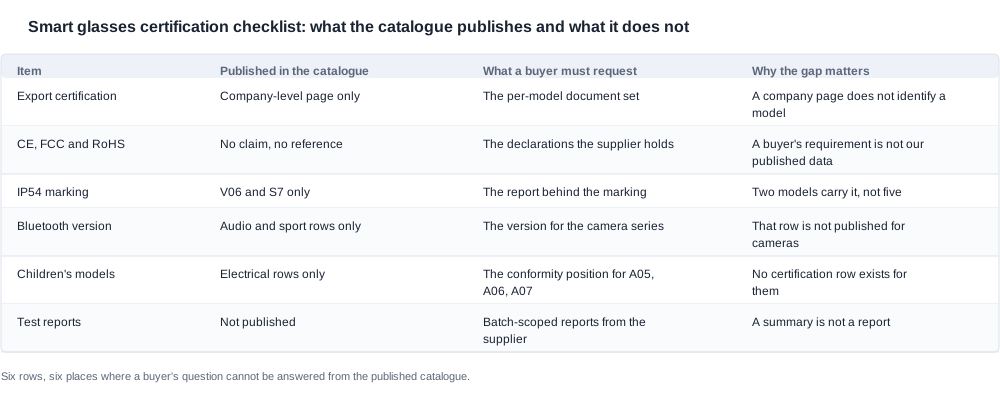
Our product catalogue contains a company-level export certification page. It does not carry a per-model certification row, and the published material contains no CE, FCC or RoHS claim tied to any model string. We are not able to tell you that a given model holds a given conformity assessment, and we are equally not able to tell you that it does not. That question belongs to the supplier's own file, and it is exactly the kind of question a buyer should put to a supplier before ordering.
Two published markings do exist and are worth handling carefully.
The IP54 marking is published on the V06 and the S7, and on no other model in the range. It is a catalogue marking without a third-party report number, so the report behind it is a document to request rather than a fact to rely on. If a supplier offers you an IP54 claim for a model outside those two, the claim is not coming from our published material.
The Bluetooth versions are published per model for the audio and sport rows — V5.3 on the K01 and the K02, V5.4 across most of the rest — and the catalogue publishes no Bluetooth version row for the camera series. That row is simply not published for those models, which is different from a model having no Bluetooth, and a buyer should not accept a version figure for a camera model without a document that names it.
The reader, and the three situations behind the questions
The reader is a brand-side sourcing manager, a channel buyer or an importer, and the situations are three. A retailer has asked for a compliance file that the buyer's own customer will audit, and the buyer does not yet know which documents exist. A destination market has been chosen and the buyer needs to know what has to be true before the goods can move, so they can put it into the schedule rather than discover it later. Or a supplier has asserted that the product is certified and the buyer needs to know how to test that assertion before paying for it.
What is at stake in all three is a shipment that stops at a border, or a product that cannot be sold in the market it was built for. Neither failure announces itself at the factory; both announce themselves at the point where the paperwork is checked against the goods.
The reason this is a procurement question and not a compliance-department question is that the answers have commercial consequences before they have legal ones. A certificate that has to be obtained adds weeks to the schedule, and a schedule is a commercial term. A document that must be reissued for a new configuration adds a cost to the configuration change. So the seven questions below are asked before the deposit for the same reason the MOQ is asked before the deposit: the answer determines the price.

Smart glasses certification checklist: the seven questions, and the document behind each
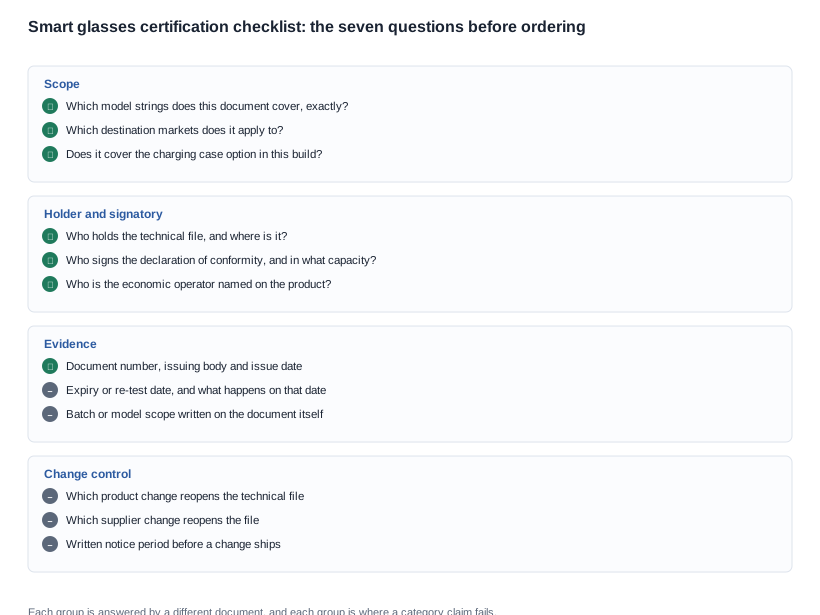
1. Which model strings does this document cover, exactly?
Ask for the model string as it appears on the label, including every suffix, and check it against the string on your purchase order. This is the single highest-value check in the whole list, and it is the one most often skipped because the strings are close together.
The reason it matters so much in this category is that the published catalogue has several near neighbours. The CY05 and the L1 Pro, and the CY03 are different models with different camera modules and different published case options. The K01 and the K02 differ by a feature line. The V03 and the V03 Pro differ by the lens configuration and by whether a charging case is involved at all. A document naming one of a near-neighbour pair proves nothing about the other.
2. Which destination markets does it apply to?
Conformity assessment is market-specific, and a document issued for one market does not transfer to another. In the European Union the framework includes the General Product Safety Regulation (EU) 2023/988, applicable since 13 December 2024, and the Radio Equipment Directive (EU) 2014/53/EU, together with the EN 18031 series of harmonised cybersecurity standards, a mandatory part of the CE mark since 1 August 2025. The United States and the United Kingdom each have their own route, and a supplier who says the product is "certified" without naming the market has not answered the question.
3. Who holds the technical file, and who signs the declaration?
The technical file is the document set behind the declaration. Ask where it is held, who has custody of it, and what the process is for getting a copy. Then ask who signs the declaration of conformity, in what capacity, and whether that party is the entity your contract is with.
This is the question that separates a manufacturer from a reseller. The entity that signs the declaration takes on obligations that the entity that merely distributes the goods does not, and in a supply chain that spans several parties those obligations and the liability attached to them are frequently in different hands. The declaration of conformity responsibility article covers the structure in more detail.
4. Which economic operator is named on the product?
Regulatory frameworks in several markets require a named responsible party to appear on the product or its packaging. Ask who it is, and check that the name is one your own supply chain can work with when a regulator asks. If the named party is a company you have never heard of and cannot contact, that is a finding.
5. What is the document number, the issuing body, the issue date and the expiry date?
Ask for all four, in writing, on the document itself rather than in a covering email. The number and the body make it verifiable by a third party, which is the point. The dates matter because a document with an expiry date is a recurring commercial obligation rather than a one-off, and a buyer who finds the expiry after the reorder has already missed it.
The certificate validity article covers how expiry dates interact with model changes, and the FCC ID checking article covers the verifiability point for radio equipment.
6. Does it cover the charging case option in this build?
This is specific to this product category and it catches a real problem. In this catalogue the charging case is published in several variants: 1400 mAh on the L1 Pro and the CY03, and the CY05, a choice of 900 or 1400 mAh on the L2 Utral, and a 1200 mAh foldable case on the MT6. The catalogue also has three camera models — the V03 and the V06, and the S7 — where no charging-case row is published at all, and one where the catalogue states explicitly that there is no charging case, which is the V03 Pro.
So the question of whether a case is inside the box is not always answerable from the catalogue, and the answer determines whether the case cell is covered by the transport documentation, whether the case changes the declaration scope, and whether the packaging instruction is the right one.
7. Which change to the product or to the supplier reopens the file?
Ask this explicitly, because the answer determines what the buyer has to monitor for the life of the programme. The usual triggers are a component substitution, a change of production site, a change of sub-contractor for an assembly step, and a firmware change that affects the radio or the security profile.
The practical version of this question is a notification commitment: what notice will you receive, how far in advance, and what happens to shipments already in transit when the notice arrives. A supplier that will not commit to notice is telling you that the file will be reopened without warning, and that the shipment in transit will be the shipment that gets held.

The three questions that reveal whether the answers are real
The seven questions above gather information. These three test it, and they are worth more than the seven because a document set can be produced without any of it being true.
Which document changes if we change the case option? A supplier who answers this quickly has a per-configuration view of their own file. A supplier who has to check has a per-model view, and a per-model view means the case option is not covered.
Who is the named economic operator, and have you worked with them before? If the answer is a company you have never heard of, ask what they do. In some supply chains the named operator is a compliance consultancy that signs on behalf of the manufacturer, which is legitimate, and in some it is a trading entity with no technical file of its own, which is not.
Can we see a document for a model you no longer sell? This is a slightly odd question and it works well. A supplier that has produced conformity documentation for two years will have withdrawn a document at some point, and the withdrawal notice shows how the system works when something changes. A supplier who has never withdrawn anything has probably never had anything withdrawn.

The commercial terms this checklist is worth
The certification question is not a technical one at the end of the day; it is a question about who carries the cost of a missing document, and that belongs in the purchase order.
What goes into the agreement is the model strings covered, the destination markets covered, the identity of the technical file holder, the identity of the party signing the declaration, the named economic operator, the document numbers and their expiry dates, the notification commitment for changes that reopen the file, and the remedy when a document is withdrawn or found not to cover the goods. The remedy is the line that matters most, because it is the only line that produces money rather than information.
Two terms are worth resisting. A clause that says the supplier "will provide applicable certification documentation" without naming the models, the markets and the expiry dates, because it commits to nothing that can be checked. And a clause that says documentation will be provided "prior to shipment" without a date, because "prior to shipment" is the point at which the goods have already been made and the schedule is already committed.
The trade-off worth naming is between the certificate cost and the certificate delay. Testing and documentation cost money and take time, and neither is negotiable in the sense that a supplier can absorb it. What is negotiable is which market, which model and which claim, and those three are the buyer's decisions rather than the supplier's.
The questions worth putting in the enquiry, because each one changes either the price or the schedule:
-
Which model strings and which destination markets are covered, by document number?
-
Who holds the technical file, and who signs the declaration of conformity?
-
Which economic operator is named on the product for this market?
-
What are the issue and expiry dates, and what happens on the expiry date?
-
Does the coverage extend to the charging case option in this configuration?
-
Which changes reopen the file, and what notice will we receive?
A buyer who asks all six in the first round is establishing whether the certification route is open, and an answer that is precise on the model strings and vague on the expiry dates is a warning in itself.
The timing, and why it is a schedule question
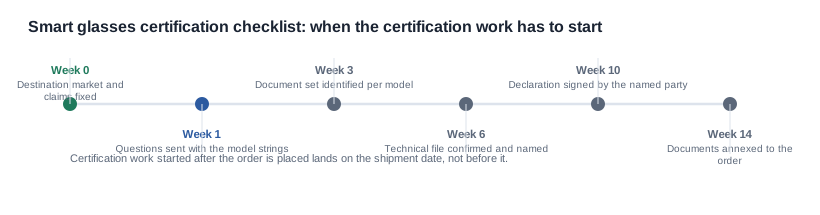
The timeline above is the point that buyers most often miss. Certification work started after the order is placed lands on the shipment date, not before it, because the work itself takes time and the documentation for a configuration that has not been built cannot be produced in advance.
The practical rule is that the certification route has to be confirmed before the configuration is frozen, not after. Freezing first and then discovering that the declaration cannot cover the frozen configuration is an expensive sequence, because the fix is a change to the product or to the claim rather than a delay.
This is also where the certification question meets the sample question and the capacity question, and the three of them have to be answered in the right order. The sample establishes what the product is. The configuration freeze fixes it. The certification route is then confirmed against the frozen configuration. A buyer who confirms the certification route first and freezes second is confirming it against a product that may not yet exist.
The boundary we will state, and what we will and will not supply
Our published position is what makes these questions worth asking. Our product catalogue contains a company-level export certification page and no per-model certification row, and the published material contains no CE, FCC or RoHS claim tied to a model string. We will not produce a plausible-looking reference to fill that gap, because a document that does not identify your model is worse than no document: it is a document that will be relied upon.
What we will do is answer the seven questions about our own operation honestly. We will name the model strings, we will say which configurations exist, we will tell you which published rows apply to your configuration and which are not published at all, and where the certification position for your model and market sits in a file we hold, we will say so and tell you what to ask for.
Where a question cannot be answered from our published material — the per-model conformity documents, the batch-scoped test reports, the Bluetooth version for the camera series, and the conformity position for the A05, the A06 and the A07 — we will say that plainly rather than substitute a plausible answer. The certification checklist for first orders covers the same ground as a working list, the certification myths article deals with the assumptions that get tested, and the certification buyer checklist is the field-level version.
The certification verification section sets out the wider procedure, and the does certification add to lead time article covers the schedule effect in more detail.
A hypothetical order, worked through
This is a worked case rather than a buyer enquiry. What it shows is the order. A channel buyer is opening a camera model with a charging case for a European retail programme, and the supplier has offered a declaration of conformity with the order.
The first question settles more than the buyer expects. The model string on the declaration is the one without the case suffix, and the string on the purchase order is the one with it. That is not a clerical difference — the two are different products with different case configurations, and the declaration covers the first rather than the second. The buyer's decision at this point is not to reject the document but to establish which configuration it actually covers.
The second question, on the technical file holder, produces a name that turns out to be a compliance consultancy rather than the factory. The factory manufactures, the consultancy holds the file and signs, and the buyer now knows that the declaration is signed by a party that has no production line and no relationship with the buyer. That is workable, and it needs to be written down rather than assumed.
The third question, on the charging case, is the one that changes the plan. The declared configuration is the one with the 1400 mAh case, and the buyer was intending to launch with the 900 mAh case because the retailer's packaging was designed around the smaller carton. The declaration does not cover the smaller case, and the declaration for it would need to be obtained. So the launch configuration is the one with the 1400 mAh case, and the packaging gets redrawn.
The commercial outcome is that the supplier's document did not block the order; it changed the configuration, which changed the packaging, which changed the artwork revision, which is a schedule event of about a week. The certification beginner guide is the preparation for that conversation, and the certification myth article covers the assumptions that produce it.
Send the model strings, the destination markets and the claims you intend to make, and we will tell you which configurations exist, what our published material covers, and which parts of the certification question are ours to answer and which are the supplier's to answer in writing.


