
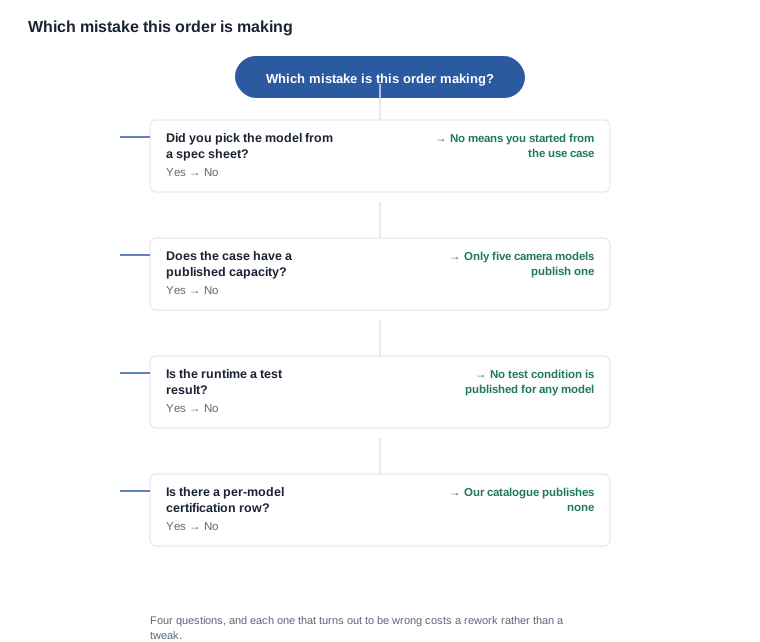
The beginner mistakes in smart glasses for cycling are almost never mistakes about the product. They are mistakes about the sequence: the model is chosen before the task, the case is ordered before the interface, a rated runtime is read as a measured one, and an export certification page is read as a per-model certificate. Each of those four produces a purchase order that looks complete on paper and arrives as a rework. The correction is not more research. It is a different order of operations, and it is short: name the task, take the interface and the case from the published rows, choose the resolution class the task actually needs, then write the claims and cross out the ones with no row behind them.
Who is reading this, and what they are about to spend. The reader is a buyer opening a first programme in this category, a channel buyer with a supplier's catalogue in front of them, or a seller with a competing quotation to beat. They have no reference purchase, which is the real difficulty, because the mistakes below are invisible until the second order. The fear is not a bad unit price. It is discovering in month two that the specification they approved was never the specification the factory built, and that the catalogue they quoted from was never a specification to begin with.
Smart glasses for cycling: the shortcuts a first order should check
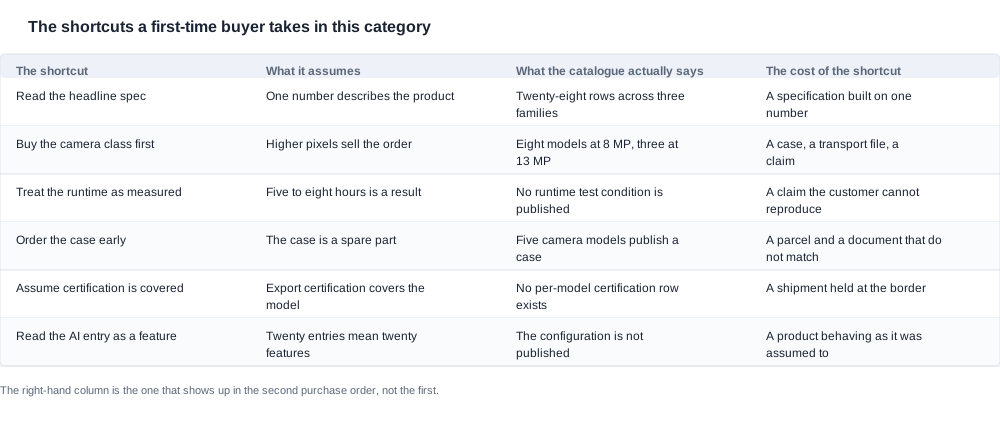
| The shortcut | What it assumes | What the catalogue actually says | The cost of the shortcut |
|---|---|---|---|
| Read the headline spec | One number describes the product | Twenty-eight rows across three families | A specification built on one number |
| Buy the camera family first | Higher pixels sell the order | Eight models at 8 MP, three at 13 MP | A case, a transport file, a claim |
| Treat the runtime as measured | Five to eight hours is a result | No runtime test condition is published | A claim the customer cannot reproduce |
| Order the case early | The case is a spare part | Five camera models publish a case | A parcel and a document that do not match |
| Assume certification is covered | Export certification covers the model | No per-model certification row exists | A shipment held at the border |
| Read the AI entry as a feature | Twenty entries mean twenty features | The configuration is not published | A product behaving as it was assumed to |
The pattern underneath all six is that a published catalogue is not a specification. It is a map of what a factory can build, with the commercial choices still open. A buyer who treats it as a finished specification is not being careless; they are reading a menu as a contract. The categories exist to be selected from, and the selection is the work.

Mistake one: reading the catalogue as a finished specification
The range behind this category contains twenty-eight models across three families — eight audio models, three sport models and eleven camera models. Every one of them publishes a charge time, a cell capacity and a rated runtime, and twenty-four of them publish a charging interface. What none of them publishes in a single place is a finished product: no model has a published lens material, a published coating, a published field of view, a published video specification, a published operating temperature range, a published cycle life rating or a published runtime test condition. Frame weight appears once in the entire catalogue, for the MT6 glasses body at 158 g, and it explicitly excludes the foldable case.
That absence is not a marketing choice; it is what a catalogue looks like before a buyer has selected a configuration. A first-time buyer who writes "the S7" into a specification and sends it to a supplier is asking the supplier to make six decisions. Which of those six the supplier makes for you, and which of them you would have made differently, is where the difference between two quotations comes from — and it is why two quotations for the same model can differ by a wide margin without either supplier behaving badly.
What to do instead. Write the task in one sentence, then let the catalogue answer it. "A ride log for a club, recorded on the rider's own request, viewed after the ride" is a task. "13 MP camera with Bluetooth" is a product description that has already skipped the decisions. The first version constrains the supplier; the second hands over the authority. The selection logic in detail is at how to choose smart glasses for cycling, and the device families are at sport smart glasses and ai camera glasses.
A second trap sits inside the first one. The catalogue has an export certification page, and the page carries images of design patent certificates. It is a company-level statement about the supplier's export capability, not a per-model conformity statement, and the catalogue text contains no CE, FCC or RoHS wording at all. A buyer who reads that page as evidence of per-model certification will not find the missing document, because the document was never the kind of thing the page was. What the buyer is actually looking for is the per-model scope of the Radio Equipment Directive (EU) 2014/53/EU conformity, and that has to be requested in writing and checked in the issuing body's register. The red flags in this category are mostly of this shape: a real document standing in for a different one.
A third trap has the same shape, and it is the one that generates the most excitement. Twenty of the twenty-eight models in the range carry an AI function entry, and a beginner buyer reads that as twenty models that do something clever on their own. The entry states that a capability exists; it does not state the trigger, the language, the conditions or the data handling, and none of those are published. What a buyer can buy is the capability, and what a buyer has to specify is the configuration. The difference is the difference between ordering a function and ordering a behaviour, and it is a letter or two in the configuration document. The capability background is at AI features.
Mistake two: choosing the camera family before choosing the task
The camera models are the most attractive and the most expensive to get wrong, because they carry a physical consequence that the audio and sport models do not. Eight of the eleven camera models publish an 8 MP sensor and three publish 13 MP — the S7 and the L2 Utral, and the L1 Pro. The higher number is not the whole story, because a camera model also brings a case row, a transit file and a set of claims that have to be worded carefully.
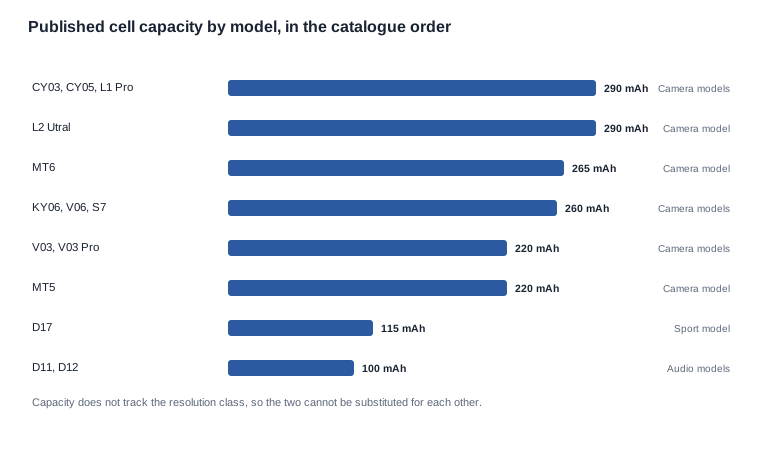
The capacity chart above is the useful part of the comparison, because it shows that the resolution class does not predict the cell. The 290 mAh models are the L1 Pro, the L2 Utral and the CY03, and the CY05, and two of those are 13 MP and two are 8 MP. The 260 mAh group — the KY06 and the V06, and the S7 — contains both 8 MP and 13 MP models. The MT6 is 265 mAh at 8 MP. The V03 Pro and the MT5, and the V03 sit at 220 mAh. So a buyer who assumes the 13 MP models are the heavy ones, or that the 290 mAh models are the long-running ones, is reading a relationship that the catalogue does not contain.
The camera decision that actually matters is whether a camera is needed at all. For a documentation task — a route log a club reviews later, a maintenance walkthrough, a dealer training session — a camera family is a case, a second lithium cell, a battery transport file and a privacy conversation, none of which is required by an audio model. The cost of that decision is not the price difference between two cameras; it is the whole downstream compliance tail attached to the higher-priced option.
The claims burden is the part beginners underestimate. Two camera models, the V06 and the S7, carry an IP54 marking in the catalogue, which covers splashing water and a dust protection level rather than immersion, and no third-party test report is published behind the marking. A product page that says waterproof on the strength of that marking is making a claim the documentation cannot carry, and the rider in a downpour is the customer who tests it. The digit reading is at IP ratings. A beginner buyer should treat an ingress marking as the start of a question rather than the end of one.
Mistake three: treating a rated runtime as a measured one
Every runtime figure in this catalogue is a rated figure, and the catalogue publishes no test condition for any of them. That sounds like a small caveat until a buyer writes it into a product page as a promise. The V03 and the V03 Pro publish a five to eight hour band; the KY06 and the MT5 publish six to eight hours; the L1 Pro and the CY05, and the L2 Utral and the CY03, and the MT6 publish roughly seven hours; the V06 and the S7 publish five to eight hours again. The audio models publish their own bands, with the G07 and the YK12 at roughly six hours against roughly eight hours for the K01, the K02 and the LC-105 pair.
A band of five to eight hours is not a measurement. It is a range without a starting condition, and the number that matters to a rider — the runtime of the device they actually receive, on the day they receive it, at the volume they use it at — sits somewhere inside that band and is not published. A buyer who writes "eight hours of battery" onto a product page has taken the top of a range and called it a figure.
The fix is not to avoid the number. It is to attach the condition. Ask the supplier what the runtime was measured under: the volume level, the signal condition, whether the camera was recording, and whether the case was in use. A supplier who answers that question has done the work, and the answer is what makes the claim defensible. A supplier who cannot answer it has told you something more useful than a number. The measurement background is at battery life, and the planning side of a multi-session day is at how to charge smart glasses for cycling.
The second half of this mistake is to forget what the runtime is for. The charge time is published for every model in the range, and the D17 and the ZH12 publish roughly one hour against two hours or less elsewhere. A model that recharges in an hour is a model that can be topped up between sessions by a rider who has no other equipment; a model that takes two hours is a model that needs a window. The right question is not which model lasts longest, it is which one can be recharged in the time the rider actually has.
Mistake four: ordering the case before ordering the interface
This is the mistake that produces the most expensive rework, and it happens because the case looks like a simple spare part. It is not. A case is a second lithium cell, and the published case capacities are substantial: 1400 mAh for the CY05 and the CY03, and the L1 Pro, 900 or 1400 mAh as a published configuration choice on the L2 Utral, and 1200 mAh in the MT6's foldable case. The KY06 and the MT5 are described with a charging case whose capacity is not published. The catalogue publishes no charging-case row at all for the V03, the V06 or the S7, which is an absence of information rather than an absence of a case, and the V03 Pro has no charging-case row.
The order of operations is the whole lesson. The charging interface comes first, because it decides whether the rider needs a carried cable or a carried dock. Seventeen models charge magnetically and seven use Type-C, and four camera models — the L1 Pro, the CY03 and the CY05, and the MT6 — publish no charging method at all, so their case has to be specified from the supplier rather than inferred. The case comes second, because it follows from the interface and from whether the ride is longer than one session. The artwork and the transit file come third, because they both change when the case configuration changes.
A beginner buyer who orders the case first will get a quotation for a configuration that has to be re-quoted. The case changes the parcel weight, the artwork, the printed insert, the declared battery content and the documentation scope. All five of those are quoted against the configuration, so a case added after the artwork is frozen is a second production slot, not a small addition.

The corrected first order, and where our own catalogue reading stops
What the corrected first order looks like
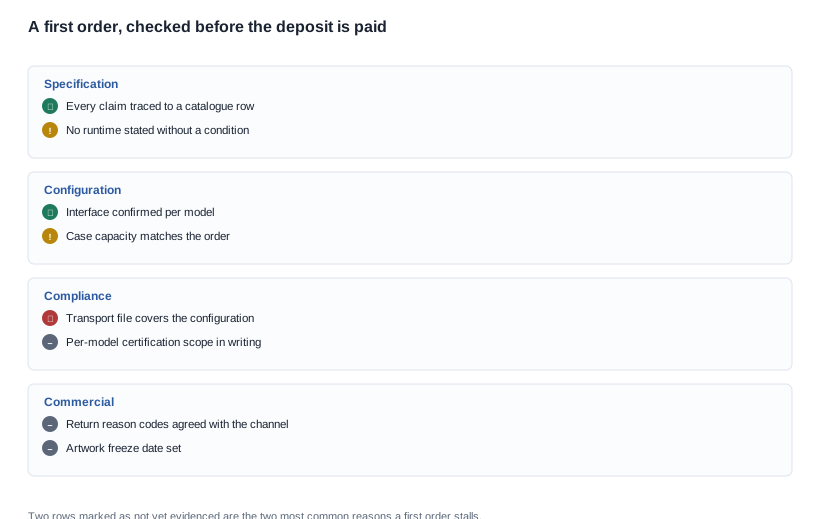
A corrected first order is not more expensive and it is not slower. It is the same purchase with six decisions made in the right order, and the visible output is a one-page configuration document that anyone in the business can read without asking the buyer to explain it.
- One sentence on the task. What the device is for, who uses it, and for how long. Everything downstream is judged against it.
- The model, with the published rows attached. Cell capacity, rated runtime, charge time, charging interface, and the runtime condition asked for in writing.
- The case, or the explicit absence of one. Either the published capacity, or the statement that the catalogue publishes no case row for that model.
- The claims list, with the unsupported ones crossed out. An ingress marking is a marking, not a waterproof claim. A runtime band is a band, not a figure.
- The documentation scope. Which configuration the battery transport file covers, what the per-model conformity position is, and who in the issuing register confirms it. The battery transport requirement is at battery transport and the document list is at certification checklist.
- The commercial frame. Minimum order quantity, tooling, payment milestones and the return reason codes that will let you tell a configuration error from a component fault. The order terms are at MOQ, the commercial structure at pricing, and the clause language at contract terms.
The one thing worth doing twice. Get the sample and then get a production unit, and compare the two against the same configuration document. A sample is built to demonstrate; a production unit is built to the order. The comparison takes an hour and it is the cheapest early-warning system available in this category.
And the one thing worth measuring afterwards. A first order produces a return stream, and the stream is the only evidence that the configuration was right. Ask the channel for reasons rather than counts, because a count cannot tell you whether a returns cluster came from a configuration error or from a component fault, and those two have opposite commercial consequences. The supplier's own incoming criteria and the defect classification behind it are at quality consistency, and the measurement discipline for a deployed programme is at how to measure results smart glasses for cycling. A programme that measures reasons in season one is a programme whose second order is a refinement; a programme that measures only counts is a programme buying the same specification again.
Where our own catalogue reading stops
A catalogue is a menu and a purchase order is a commitment, and the distance between the two is where first orders go wrong. We publish the resolution classes — eight models at 8 MP and three at 13 MP — the cell capacities from 40 mAh on the A05 and A06 up to 290 mAh, the charge times, the rated runtimes, the charging interface per model, the case capacities where they exist, the detachable inner frame on the V06 and the S7, the ultra-slim detachable temple on the G07, the slim temple on the YK12, the flexible temples and the photochromic lens on the V03 Pro, the remote control photo feature on the D17 and the ZH12, and the IP54 marking on the V06 and the S7. The catalogue publishes no touch row for any model, so a temple control surface is a question for the supplier rather than a line you can order from.
What we do not publish, and will not estimate: the lens material, the coating, the frame weight for any model other than the single 158 g figure for the MT6 glasses body, the runtime test condition, the field of view, the video specification, the AI feature configuration, the file storage behaviour, or the per-model certification scope. We will not say a model is tested to IP54, because no test report is published behind that marking.
What we will do is take your task sentence, your market, your volume and your price band, and return the configurations that exist for it, the published rows that cover each one, the claims you could make, and the claims you would have to hold back until you have the paperwork. The scenario entry point is smart glasses for cycling, the measurement discipline for a deployed programme is at how to measure results smart glasses for cycling, and a comparable category write-up for running programmes is at smart glasses for running product recommendations.
What to send us next. Send the task in one sentence and the models you have shortlisted, and we will tell you which of your six decisions the published rows already settle, and which two you have to take to the factory in writing.
Related reading
- The scenario's opening — smart glasses for cycling
- The document pack that closes a first order — smart glasses for cycling buying checklist
- The cost side of the same decision — smart glasses for cycling budget considerations
Send the task in one sentence, and we will tell you which decisions the published rows already settle.


