

A smart glasses for cycling deployment checklist starts where a buying checklist ends. The model is chosen, the order is placed, the documents are signed, and the question changes from what to buy to what has to be true before a rider, a dealer or a club committee touches the device for the first time. That question has six stages — production release, production audit, shipment, receiving, channel handover and the first ninety days — and each one closes on a specific piece of evidence. None of the six closes on a feeling that things went well, and the two that are most often skipped are the production audit and the ninety-day review.
Who runs this list, and when. The reader is a product manager, a channel manager or a buyer who has a confirmed delivery date and a first launch event to get through. The list is run over the delivery window rather than in a single session, because most of the items only become checkable when the goods exist. The failure it prevents is the specific one where a programme launches successfully and then quietly unwinds: a configuration that was never audited, a dock that shipped the failures instead of quarantining them, a channel that was sent a launch email instead of a training card, and a returns figure that arrives as a count rather than as a set of reasons.
Smart glasses for cycling: the deployment stages to check rather than features
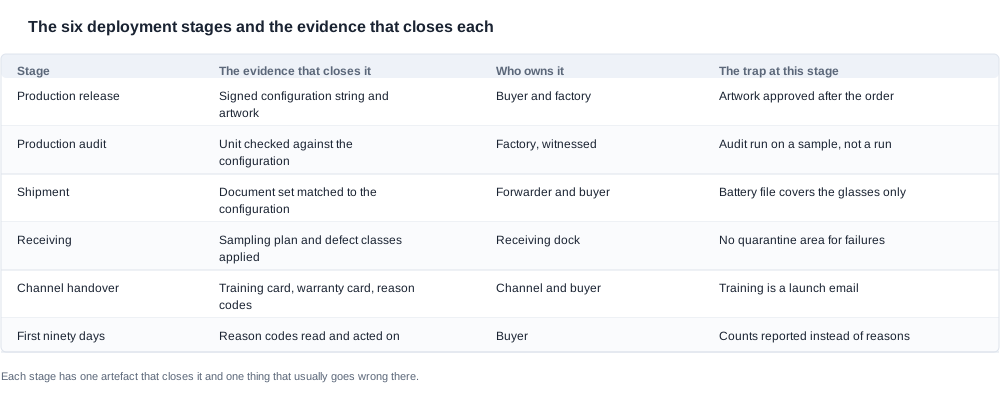
| Stage | The evidence that closes it | Who owns it | The trap at this stage |
|---|---|---|---|
| Production release | Signed configuration string and artwork | Buyer and factory | Artwork approved after the order |
| Production audit | Unit checked against the configuration | Factory, witnessed | Audit run on a sample, not a run |
| Shipment | Document set matched to the configuration | Forwarder and buyer | Battery file covers the glasses only |
| Receiving | Sampling plan and defect classes applied | Receiving dock | No quarantine area for failures |
| Channel handover | Training card, warranty card, reason codes | Channel and buyer | Training is a launch email |
| First ninety days | Reason codes read and acted on | Buyer | Counts reported instead of reasons |
The configuration string is the spine of the whole list. Everything downstream of it is checked against it: the unit that comes off the line, the document set that travels with the carton, the sample taken at the dock, the insert in the box. It is the document that says which model, which interface, which case configuration and which label, and it is the only artefact in the list that all six stages refer back to. A programme that does not have one has not really deployed anything; it has received a shipment.
The trap column is the useful half of the table. Each of those six failures is normal, cheap to prevent and expensive to discover late. Artwork approved after the order is a reprint. An audit run on a sample is an audit of a demonstration unit rather than of a production run. A battery file that covers the glasses but not the case is a document that matches a configuration nobody ordered. A dock with no quarantine area turns a sampling plan into a sorting exercise. A launch email is not training. And a returns count cannot be acted on, only noted.
The two stages a buyer usually cannot skip
The production audit and the ninety-day review are the two that get dropped, and for opposite reasons. The audit is dropped because it appears to be the factory's business, and it is not — the factory knows what it intended to build, and only a buyer with the written configuration can say whether that is what arrived. The ninety-day review is dropped because the launch has gone well and nobody wants to open the returns file, and by then the second order's specification is about to be frozen on the basis of a feeling.

Stage one to three: from production release to the shipment

Production release is a signing, not a message. The artwork, the insert, the configuration string, the label artwork and the case configuration are all confirmed in one signed release, dated, and referenced by the order. The single most expensive habit in this stage is approving artwork in a thread, because a thread cannot be reconciled with a configuration string, and a configuration string that has been amended after the artwork was approved is a reprint with a schedule attached. The brand side of an OEM programme is set out at OEM customisation and the standard route at standard OEM.
The production audit is a unit from the run, against the string. Not the sample, not a display unit, not a photograph of a unit: a unit drawn from the production run, checked against the configuration string line by line. The interface, the case configuration and capacity, the model designation on the housing, the artwork version, the insert, and the language of the printed material. The MT6's published 158 g figure is the only mass in the catalogue and it belongs to the glasses body excluding the foldable case, so a mass check is only possible where the supplier has provided the figure for the model actually being shipped. The quality process behind this is at quality control and the incoming criteria are agreed at quality consistency.
The shipment is where the configuration meets the paperwork. A case in the box is a second lithium cell, and the battery transport document has to cover the configuration as it is packed, not the bare device. Four camera models — the CY03 and the L1 Pro, and the MT6 and the CY05 — publish no charging method at all, and all four publish a case capacity, so the charging interface for those units comes from the supplier rather than from the catalogue. The requirement is at battery transport, the delivery structure at logistics, and the customs and market entry points at EU, UK and US.
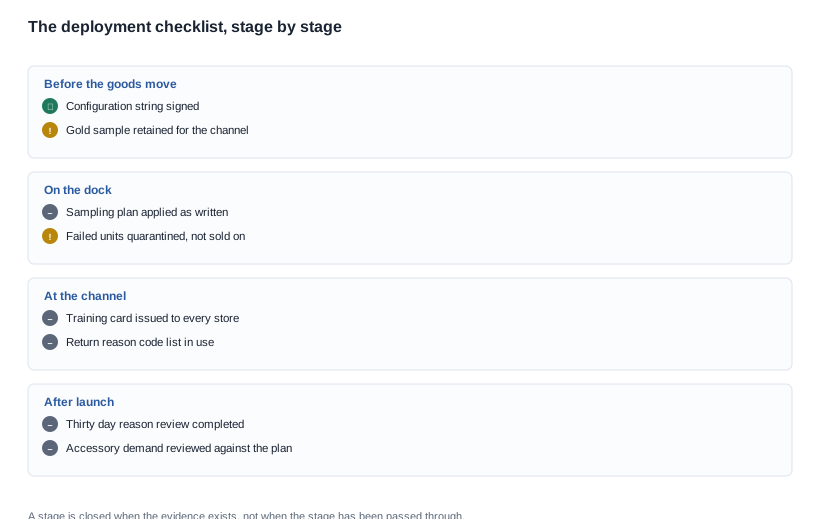
The gold sample is worth more than it looks. One unit from the approved production run, retained by the buyer, is the reference every later question gets answered against: a dealer's question about what is in the box, a club officer's question about the charging method, a returns investigation about whether the unit in front of the inspector matches the one that was approved. A programme that retains no gold sample answers all of those from photographs, and photographs do not settle a configuration dispute.
Stage four to six: from the receiving dock to the first review
Receiving is a sampling exercise, and the criteria have to exist before the container arrives. The sample plan, the defect classes and the action for each class are the incoming inspection criteria, and they were agreed before the order. A dock that receives a shipment without written criteria will do what docks do, which is count the cartons and report a number. The two questions worth writing down in advance are how a unit is quarantined and who is allowed to release it, because the cheapest possible outcome for a channel is a failed unit that was never quarantined and ended up on a shelf. The audit route is at factory audit and the defect classification behind it at quality consistency.
Channel handover is a pack, not an announcement. A training card that says what the device is, how it is charged, what the case capacity is, what the ingress position is and what the rider is told to do with a wet lens. A warranty card that says what happens to a failed unit, in what time, at whose cost. A reason code list that the channel must use, because a channel that reports free text is a channel that reports anecdotes. And the insert itself, which is the part that reaches the rider.
The pack has to be written for the person who will actually hold it. A dealer who stocks forty brands will read a card that answers a question, and will not read a document that explains a product. That means the training card is written as a set of short answers rather than as a description: what it is, how it charges, how long the charge takes, what comes in the box, what the marking does and does not cover, and what to do if it will not charge. The same card carries the three numbers a rider will ask about — the cell capacity, the charge time and the rated runtime — with the note that the runtime is a rated figure and the condition is on the specification sheet. The numbers are published rows: the 290 mAh cell and the roughly seven hour rated runtime on the L1 Pro and the CY03, and the L2 Utral and the CY05, the charge time of two hours or less across the range with the D17 and the ZH12 at roughly one hour, and the 900 or 1400 mAh case on the L2 Utral. A card with three real numbers and a clear boundary is read; a card with a feature list is skipped.
The insert is the last point at which the claim can be controlled. Everything the dealer says and everything the listing says is upstream of the rider, but the insert is the last thing the rider reads before the first ride, and it is the only document that can set the expectation for the things the catalogue does not publish. The lens material and coating are not published for any model, so the insert's handling instruction has to be narrow — the supplied wipe, no solvent, no sleeve — because a permissive instruction is the most common cause of a lens complaint in this category. The charge time and the interface go in the insert too, because a rider who expects magnetic docking on a Type-C model will believe the device is broken. The clause language is at contract terms and the after-sales route at after-sales.
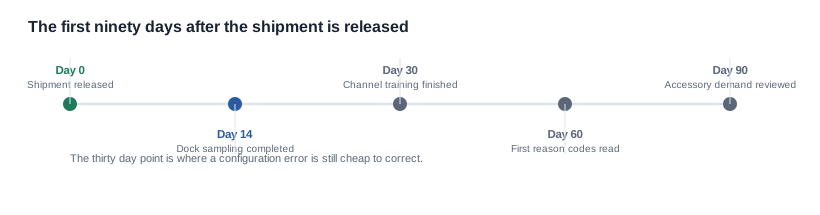
The first ninety days are three reviews, not one. At thirty days, the reason codes from the first returns, read against the configuration string to separate configuration errors from component faults. At sixty days, the defect trend by lot, which is the only way to know whether a cluster came from a production run or from a handling route. At ninety days, the accessory demand, because the accessories a dealer asks for in the first season are the accessory line the next season should carry. The measurement discipline for a deployed programme is at how to measure results smart glasses for cycling, and the accessory line that the ninety-day review feeds is at smart glasses for cycling accessories.
Who owns what in a deployment
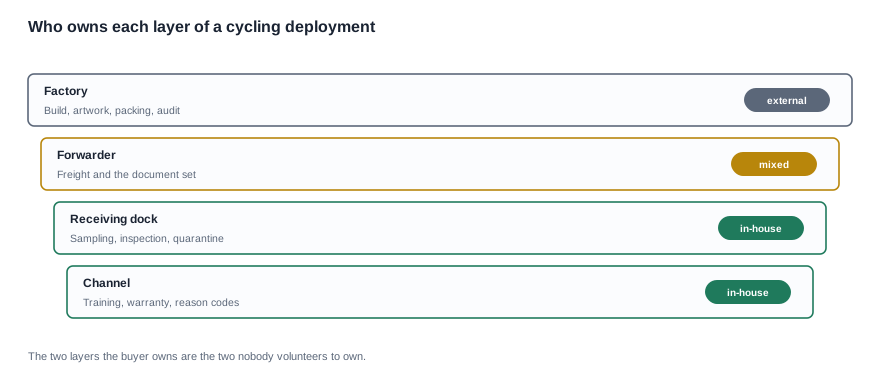
The layering is worth stating explicitly because the two layers the buyer owns are the two nobody volunteers to own. The factory owns the build, the artwork, the packing and the audit. The forwarder owns the freight and the document set, and shares the responsibility for the battery file matching the configuration. The receiving dock and the channel are the buyer's, and they are where a configuration error becomes visible to a customer.
The weather and the season belong in this list too, not only in the product specification. A deployment that starts in autumn and runs into winter changes what the device is asked to survive, and the ingress position is published on only two models in the entire range — the V06 and the S7 — as a catalogue marking that covers splashing water and a dust protection level rather than immersion, with no third-party test report published behind it. A channel that stocks a product in a wet season needs a claim it can defend, and the reading of the digits is at IP ratings while the wider weather question is at sports and outdoor weather considerations.
The one number that is worth watching daily in the first month. Not units shipped and not units sold — the number of units that came back. A cluster in week one is almost always a configuration error, because the units that come back are the ones the channel and the riders misunderstood, and the misunderstanding is a design fault. A cluster in week eight is usually a component or a handling fault, and it is a different conversation with the factory. The two look identical in a returns count and completely different in a reason-coded list, which is the whole reason the reason code list is written before the launch rather than after it.

The four artefacts that actually close a stage
Six stages produce more than six documents, and the useful discipline is to name the small set of artefacts that carry the deployment. Everything else is a form, a report or a meeting.
The configuration string. One page, one version, signed, dated, and referenced from every other artefact. It names the model, the interface, the case configuration and capacity, the label and artwork version, the insert version and the language. A deployment with a configuration string and a deployment without one are not different in quality, they are different in kind: without one, every question of "is this right?" is answered by opinion, and every answer is a new negotiation.
The gold sample. One retained unit from the approved production run, held by the buyer. It is the physical reference for the artwork, the box contents, the insert and the configuration, and it is what makes a returns question answerable. The alternative is a folder of photographs, and photographs cannot be checked for a case capacity or a designation printed in small type.
The incoming inspection criteria. The sample plan, the defect classes and the action for each class, agreed before the goods exist. This is the artefact that turns receiving from a counting exercise into a quality gate, and it is also the artefact that makes the ninety-day review possible, because a defect class is the unit the returns are reported in. A cluster in a class is a finding; a cluster in a count is a rumour.
The reason code list. A closed set of codes the channel is obliged to use, agreed before the launch and printed on the channel's own paperwork. It is a short document and it is the difference between a returns figure that can be acted on and one that can only be reported upward. In a category where a configuration error and a component fault have opposite commercial consequences, the reason code is not an administrative detail; it is the mechanism that keeps them apart.
The four work in sequence. The string is written first, because the gold sample and the criteria are checked against it and the reason codes are chosen to match its failure modes. The gold sample is retained at the production audit, because that is the only moment the artefact exists in the right state. The criteria are agreed before the shipment, and the reason codes are closed before the launch, because a code list agreed after the first returns arrive is a code list agreed by the people who already know what the returns are.
What is not on this list, and why. There is no launch email, because a launch email carries no configuration, no claim boundary and no reason code. There is no acceptance of a pre-shipment photograph, because a photograph cannot establish a case capacity. There is no verbal sign-off at the dock, because a verbal sign-off cannot be audited in month three. And there is no "looks right to the team" stage at all — it sounds harmless because it costs nothing, and it is exactly the stage that lets a wrong configuration reach a shelf and stay there for two seasons.
What we can and cannot close from this side
A deployment is a handover, and a handover is only as good as the configuration string and the gold sample behind it. We publish the rows that both of those are built from: the twenty-eight models across three families, the resolution classes with eight models at 8 MP and three at 13 MP, the cell capacities, the rated runtimes, the charge times with the D17 and the ZH12 at roughly one hour against two hours or less elsewhere, the charging interface per model, the case capacities where they exist with the L2 Utral published at either 900 or 1400 mAh, the detachable inner frame on the V06 and the S7, the slim temple on the YK12, the ultra-slim detachable temple on the G07, the flexible temples and the photochromic lens on the V03 Pro, the remote control photo feature on the D17 and the ZH12, and the IP54 marking on the V06 and the S7. The catalogue publishes no touch row for any model, so the temple control surface has to come from the supplier rather than from the configuration string.
What we do not publish, and cannot close from this side: unit prices, minimum order quantities, lead times, production capacity, defect rates, the lens material and coating, the frame weight for any model other than the single 158 g figure for the MT6 glasses body, the runtime test condition, and the per-model certification scope. The catalogue's export certification page is a company-level page and the catalogue text contains no CE, FCC or RoHS wording at all, so the per-model conformity position against the Radio Equipment Directive (EU) 2014/53/EU is something the deployment has to obtain in writing and check in a register. We will not state that a model is tested to IP54, because no test report is published behind that marking.
What we will do is support the audit. Send the configuration string and the order reference, and we will confirm the published rows that apply to it, supply a unit against the same configuration for comparison, and list the points where the string and the published rows disagree — which is the most useful output a deployment can get before the shipment is released. The scenario entry point is smart glasses for cycling, the device families are at sport smart glasses and ai camera glasses, and the pre-order document set that precedes this list is at smart glasses for cycling buying checklist.
What to send us next. Send the configuration string and the production reference, and we will return the published rows that apply, the items the audit should check, and the points where the string needs to be reconciled with the catalogue.
Related reading
- The scenario's starting point — smart glasses for cycling
- The pre-order document set — smart glasses for cycling buying checklist
- The accessory line the ninety day review feeds — smart glasses for cycling accessories
Send the configuration string and the production reference, and we will return the rows the audit should check.


