What to avoid to know about smart glasses for outdoor smart glasses is a list where six of the eight items are copy and instruction problems rather than product problems, and that ratio is the point. The hardware for the outdoor scenario is largely settled — the sport range exists, it carries an IP54 marking, and two of the models carry a detachable inner frame — and what is missing is mostly the discipline around what the marking means and what the customer has to be told.
The sentence above carries the correction that matters most in this category, and it is worth stating plainly before the list: the IP54 marking is published on two models, the V06 and the S7, and both of them are camera models with a sport positioning. The three sport-positioned models that do not carry a camera — the YKC02, the D17 and the ZH12 — carry no ingress marking at all. Pages that describe five models as IP54, or that describe the sport range as the marked range, are describing a product line that does not exist in our catalogue, and the customer who checks is the customer who returns.
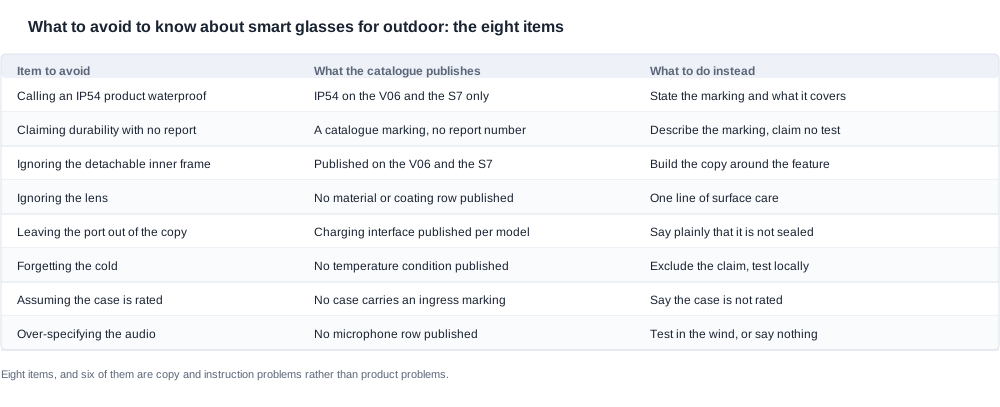
What to avoid to know about smart glasses for outdoor: the eight items
| Item to avoid | What the catalogue publishes | What to do instead |
|---|---|---|
| Calling an IP54 product waterproof | IP54 on the V06 and the S7 only | State the marking and what it covers |
| Claiming durability with no report | A catalogue marking, no report number | Describe the marking, claim no test |
| Ignoring the detachable inner frame | Published on the V06 and the S7 | Build the copy around the feature |
| Ignoring the lens | No material or coating row published | One line of surface care |
| Leaving the port out of the copy | Charging interface published per model | Say plainly that it is not sealed |
| Forgetting the cold | No temperature condition published | Exclude the claim, test locally |
| Assuming the case is rated | No case carries an ingress marking | Say the case is not rated |
| Over-specifying the audio | No microphone row published | Test in the wind, or say nothing |
The ratio, and why it is the useful finding. Six of the eight are copy and instruction problems. That means the outdoor scenario is not primarily a sourcing problem — the models exist, the configurations exist, the marking exists and the case capacities exist. It is a discipline problem: the discipline of writing the marking as a designation rather than an adjective, of putting three instruction lines into the box, and of marking the four rows nobody publishes. A brand that has that discipline can take a good hardware position in this category, and a brand that does not will keep the position and lose the reviews.
The two that are worth a paragraph, because they are the same problem. The waterproof claim and the durability claim are one problem: the customer is asked to believe a protection level that no report supports, and the customer tests it in the rain. The consequence is not a complaint about the product; it is a review that names the brand. The second pair — the detachable inner frame and the lens — is the opposite problem: two real, published facts that a brand leaves on the table while it writes an adjective instead.
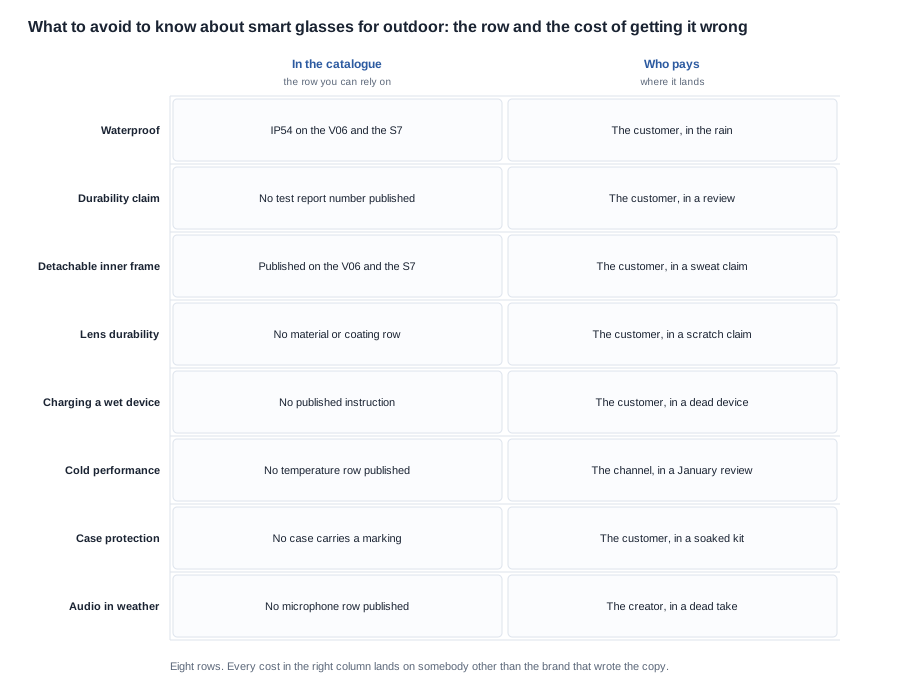
What is published for the sport range, so that the copy can be written from it. The YKC02 publishes a 70 mAh cell across two cells, Bluetooth 5.4, magnetic charging, a charge time of two hours or less, a rated runtime of about 8 h, and surround sound with a long battery life as its feature line. The D17 publishes a 115 mAh cell, Bluetooth 5.4, Type-C charging, a charge time of roughly one hour, a rated runtime of about 7 h, remote control photo capture and surround sound. The ZH12 publishes a 100 mAh cell, Bluetooth 5.4, Type-C charging, a charge time of roughly one hour, a rated runtime of about 8 h, remote photo capture and stereo surround sound. And the V06 and the S7, the two models with a marking, publish an ergonomic frame, a detachable inner frame and the IP54 marking alongside their camera rows.
What is not published, and therefore cannot be claimed. No third-party test report number behind the marking. No lens material, no coating, no surface treatment. No microphone specification. No operating temperature range, and no temperature condition behind any runtime figure. No unit weight for any sport model — the only published weight in the whole catalogue is 158 g for the MT6, a camera model with a foldable case. No hinge specification, no field of view, no cycle life rating. A brand that writes copy from the second list is writing it from a category average.
The marking is on two models, and both of them carry a camera
Calling an IP54 product waterproof is the single most expensive mistake in the outdoor channel, because the claim is what the customer tests — usually in the rain, on a bike, in the wrong season. The published position is narrower and completely usable, provided it is stated as a designation.
What the two digits mean. The second digit is 4, which describes protection against water splashing from any direction. The first digit is a dust protection level. Between them the marking does not cover immersion, does not cover a water jet and does not cover a downpour. It is a catalogue attribute on a page that also carries, on the same two models, an ergonomic frame and a detachable inner frame.
Why the marking and the frame belong in the same sentence. A reader who is told the product carries a detachable inner frame and an IP54 marking is reading about a device that was designed for outdoor conditions. A reader who is told only that it is waterproof is reading a marketing word, and the only thing they will do with it is test it. The design features are the durable part of the story; the adjective is the fragile part.
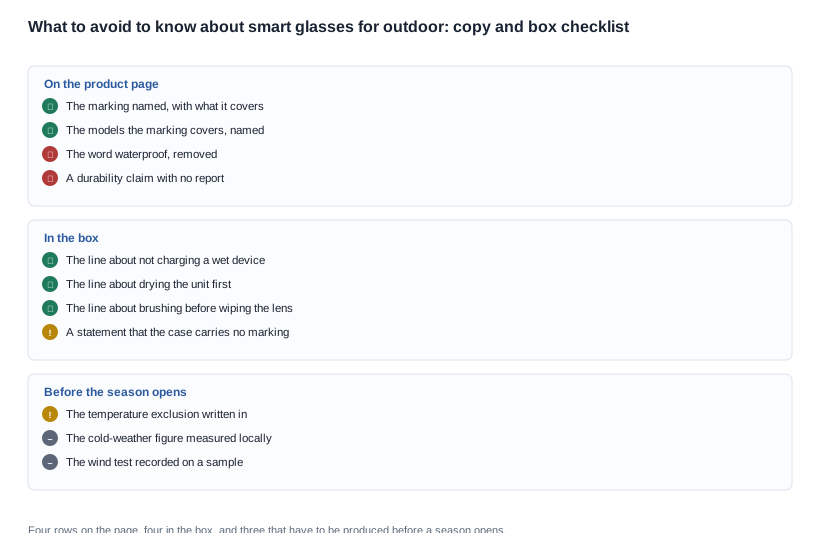
The correction, in one sentence. An IP54 marking on the two models that carry it, describing protection against splashing water and a dust protection level, with no third-party test report published behind the marking. Longer than the adjective, and it converts better, because it tells the reader what the rating means before they have to ask, and it tells a reader who knows the difference not to test the claim in a way the marking cannot survive.
What the two unmarked models need. The YKC02, the D17 and the ZH12 are published with no ingress marking at all, and that is not a gap in the product — it is a gap in the documentation. A page for those models should say so where the page discusses weather, because a customer comparing two sport models will find the marking on one of them and assume the other is the same. Saying "this model carries no ingress marking" is a stronger page than saying nothing, and it is the truth.
What to ask the supplier. Ask for the ingress position in writing per model, and ask whether the marking is a catalogue attribute or a tested result with a report number behind it. If a report exists, the number and the standard belong in the file, and the page can then say so. If it does not, the page says the marking and the marking's meaning, and nothing more. Either answer is workable; the adjective is not.
The detachable inner frame is a design answer, not a claim
Sweat is the everyday agent in the outdoor scenario, and the V06 and the S7 publish a detachable inner frame. Ignoring that and building a copy that says "sweat resistant" instead is using a claim where a design feature was available — and it is worth being precise about why. A design feature is evidence; an adjective is not. A buyer can look at the frame and see the part. A buyer cannot look at a claim.
What a detachable inner frame actually changes. It changes the internal geometry of the frame independently of the outer structure, which means the contact surfaces against the face can be changed without replacing the whole product. That has three consequences for a channel: it is a serviceability story rather than a replacement story, it is a fit story across a range of head shapes, and it is a hygiene story, because a surface that can be removed can be tended separately from the frame that carries the electronics.
Why this is the outdoor equivalent of a claim. "Sweat resistant" is an unsupportable statement for any model in the range, because no material, coating or surface treatment row is published for any model. The detachable inner frame is published, and it is on the two models that also carry the marking. A brand that has those two facts can write a page about being built for outdoor use that is entirely made of published material — and a brand that has neither has to write a page about sweat with an adjective.
The other published structural facts in the same family. The G07 publishes ultra-slim detachable temples, the YK12 publishes slim detachable temples, and the V03 Pro publishes a flexible temple. These are adjustment and serviceability features rather than retention features, and a page should describe them as what they are. A detachable temple is a part that can be replaced and a frame geometry that can be adapted; it is not a claim that the frame will not move on a moving head, and no retention feature is published for any model in the range.
What to ask the supplier. Ask whether spare inner frames or spare temples are available for each model, and at what price and lead time. A brand that does not ask has quietly decided to replace devices rather than parts, and that decision is invisible until the returns arrive. The question is cheap and the answer changes the service model.
The lens, the port and the instruction that carries the channel
Two of the eight items are a single line of copy each, and they are the two lines that most reduce returns in this category. Neither needs a new product, a new supplier or a new tooling commitment. They need to be printed.
The lens. It is plastic and it scratches, and in dust and sand it will. The lens material, the coating and the surface treatment are not published for any model, which means the copy cannot promise a coating, cannot promise scratch resistance and cannot promise a lens that stays clear in sand. What the copy can do is give the care instruction: brush before wiping, no abrasives, no solvent. That one line is worth more than a paragraph about the coating, because it is the only instruction the customer can actually follow. The outdoor lens care article covers the routine in full.
The port. A charging port is a deliberate opening in the frame, and a customer who does not know that will not think twice about charging a wet device. The charging instruction is not a formality in this scenario; it is the line that stops a customer from doing the one thing that turns a damp device into a dead one. It is also the line that no product page can deliver, which is why it belongs in the box rather than in the listing.

The three lines in the box, together. Dry the unit before charging it. Do not charge it while it is damp. Brush the lens before wiping it. Three lines, no cost beyond the artwork, and between them they cover the three failure modes a customer can cause in this scenario. A brand that has these three lines has done more for its outdoor return rate than any amount of listing copy.
Why the box is the right place and not the page. The page is read once, by someone deciding. The box is read at the moment of use, by someone about to do the thing that causes the failure. Instructions attached to a moment that already exists are followed; instructions attached to a manual are not. The sports and outdoor weather considerations article covers the conditions that make each line matter.
The commercial terms of an outdoor line. The minimum order quantity tiers, the bulk order volume, the price tier each configuration lands on, the payment terms and the deposit, the lead time the factory can commit to, and the tooling and new tooling expense for a package with its own instruction artwork. Two of those matter more in this scenario than elsewhere: the artwork cost, because the three instruction lines and the age or configuration markings are what make the package worth its cost, and the lead time, because an outdoor range that misses a season is a range that waits a year.
The cold, and the temperature row nobody publishes
The cell and the lens both behave differently when it is cold, and the published runtimes carry no temperature condition at all. A winter market needs a measured figure at winter temperatures, and the copy needs the exclusion.
What is published, and what is missing. The sport range publishes rated runtimes — about 8 h on the YKC02, about 7 h on the D17, about 8 h on the ZH12 — and every one of those figures is quoted without a test condition, which means without a temperature. The same is true of the charge times: two hours or less across the range, and roughly one hour on the D17 and the ZH12, again without a starting state, an end point or a temperature. The operating temperature range is not published for any model. So a winter listing that quotes the runtime without an exclusion is quoting a figure measured somewhere else under conditions the reader will not have.
What the exclusion has to look like. Not "performance may vary in cold conditions" — that is the version a customer reads as an excuse. A usable exclusion names the situation, says the published figure is a rated figure measured under conditions the catalogue does not state, and says the buyer should expect a local measurement before committing to a winter volume. That is a sentence a procurement lead can accept, and it is a sentence that is true.
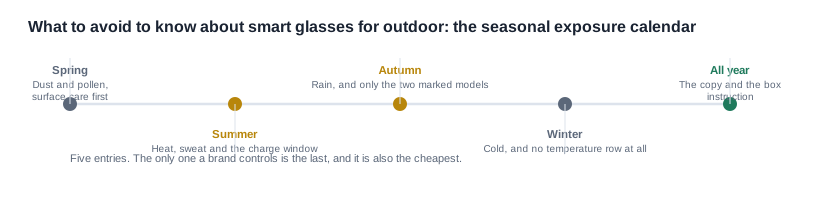
The local measurement, and when to take it. Before a season opens, not during it. A sample, one model, one cold morning, one route, one workload, one measured figure attached to the conditions. The seasonal calendar above places the winter entry as the only one with nothing published behind it, and that is the point: the whole of the outdoor row is publishable except the cold, and the cold is the one that decides whether a winter channel is viable.
What to ask the supplier. Ask for the operating temperature range, and ask for the runtime condition including the ambient temperature at which the rated figure was measured. Two questions, both answerable in writing. Where the answer is that the range is not published, that is the answer — and the buyer then has a measurement to make and a decision to make, rather than an assumption to regret in January.
The case, the microphone and the two claims with nothing behind them
The last two items are both claims of protection or performance, and both are the kind a customer tests without meaning to. They are also the two that a brand is most tempted to make, because they are the two that make a listing feel complete.
Assuming the case is rated. No charging case in our range carries a published ingress rating, and the cases that exist are published with their capacity and their interface rather than with any protection position. A listing that implies the product is protected because it lives in a case is a claim nobody can evidence, and it is exactly the kind of implication a customer tests in the rain — because the customer is the one who assumed the case would help. Where a configuration includes a case, the page should say plainly that the case carries no ingress marking, and it should say it next to the capacity figure, because that is where the customer's mind already is.
Over-specifying the audio. Wind on a microphone is broadband noise and it is not removed by the same processing that handles traffic noise. We publish no microphone specification for any model, so a claim about audio in weather is a claim with nothing behind it. The alternative is either to test it in the wind on a sample and publish the recording, or to say nothing. Between those two, the first is worth doing once per model in a weather-exposed line, because it is the only evidence in this category that a buyer cannot get from a competitor's page.
The published position for the sport range, stated exactly. Three models, and the rows are these: the YKC02 with a 70 mAh cell across two cells, Bluetooth 5.4, magnetic charging, a charge time of two hours or less, a rated runtime of about 8 h, surround sound and a long battery life as its published feature line. The D17 with a 115 mAh cell, Bluetooth 5.4, Type-C charging, a charge time of roughly one hour, a rated runtime of about 7 h, remote control photo capture and surround sound. The ZH12 with a 100 mAh cell, Bluetooth 5.4, Type-C charging, a charge time of roughly one hour, a rated runtime of about 8 h, remote photo capture and stereo surround sound. And the two camera models that carry the marking and the detachable inner frame. Anything else in an outdoor listing is a claim the catalogue does not make.
How to build the page from those rows. Six steps: name the conditions the product is actually used in, pick the models whose published rows fit those conditions, write the page against the marking rather than the adjective, put the three instruction lines into the box artwork, measure the cold and the wind on a local sample, and then re-read the page as a customer who has been caught in a downpour and is holding a device that is still in the box. That last review is the cheapest control in this category, and it catches more than any external audit.
The commercial conditions, in one paragraph. The minimum order quantity tiers, the bulk order volume, the price tier per configuration, the payment terms and the deposit, the lead time the factory can commit to, and the tooling and new tooling expense for the package and its artwork. The term that most deserves negotiation here is the artwork cost, because the three instruction lines are the deliverable that makes the outdoor position defensible, and an instruction insert that has to be re-ordered at every campaign is a recurring cost rather than a one-off one. The term that most deserves attention is the warranty, because a device in this scenario comes back with salt on it and the condition a returned device is expected to be in has to be written down.
How to choose between the three sport models, and the criteria that decide it. The published rows are narrow enough that the decision is short, and it should be made before any sample is ordered:
- The runtime band the route needs — about 8 h on the YKC02 and the ZH12, about 7 h on the D17, all rated figures without a published condition.
- The charge time that fits the gap between uses — two hours or less across the range, and roughly one hour on the D17 and the ZH12.
- The features the use actually needs — surround sound on all three, remote photo capture on the D17 and the ZH12, and no ingress marking on any of the three.
- The interface the team can support — magnetic on the YKC02, Type-C on the D17 and the ZH12, which decides the cable and the dock.
The questions to ask before you order. Five, and all five are answerable in writing: the ingress position per model, and whether the marking is a catalogue attribute or a tested result with a report number; the operating temperature range; the runtime condition including the ambient temperature; the availability and price of spare inner frames and temples; and the certification scope per model for the destination market. A supplier who answers all five has given a buyer a specification that can go into a tender, and a supplier who answers none of them has told the buyer something worth knowing before the deposit.
The red flags. Three, and they are worth watching for rather than waiting to find. A page that claims waterproof. A product page that names a temperature range the catalogue does not publish. And a case in the kit described as protecting the device — no case in our range carries an ingress marking, and the customer's assumption is always the favourable one.
A total cost view of an outdoor line. The unit price is one line in a longer column. The others are the artwork and instruction inserts, the returns that a wet-charging fault creates, the winter stock that a missing temperature row makes unsellable, and the replacement cycle that a lack of spare inner frames forces. A brand that budgets the artwork and the spares as part of the product rather than as an afterthought will price the line correctly, and a brand that does not will discover the difference in the return rate.
Our position, and where it stops. We publish the sport range's configuration, the cell capacities and counts, the charging interfaces, the published feature lines, the charge times, the Bluetooth versions, the rated runtimes, the detachable inner frame on the V06 and the S7, and the IP54 marking on those same two models. We publish no test report number behind the marking, no microphone specification, no lens material or coating, no operating temperature range, no runtime test condition, no ingress position for any case and no unit weight for any sport model. We will not state that any product in our range is tested to IP54, because no test report is published behind that marking, and we will not extend the marking to any model other than the two that carry it. We will not use the word waterproof for a unit whose designation is IP54, and we will not describe a detachable inner frame as a sweat-resistance claim.
What to send us next. Send the conditions your customers actually use the product in, the markets you sell into, the models under consideration and the expected volume, and we will return the published rows that cover each model, the questions that have to be settled in writing before a purchase order, and the claim set an outdoor listing can make without overreaching. The sport smart glasses family is where the configurations are, the outdoor application page carries the wider framework, and the outdoor product recommendations article sets the models against the conditions.
One closing line for the buyer. The eight items on this list are not eight product problems. Six of them are three lines of copy and three lines of box artwork, and the seventh is a sentence that names two models instead of five. That is the cheapest insurance in the outdoor channel, and it is available today.