

Smart glasses for security: the six questions, and why their answers come before the price
Security buyers ask six questions before they ask about price, and the answers to four of them currently end at a gap in the published catalogue. Knowing which is which is worth a procurement cycle, because a buyer who knows that a question has no published answer will ask for a document, while a buyer who does not know that will expect a number and be disappointed later. The more useful framing, though, is the one this article is built on: every one of the six answers is a pair — a published row and a document to request — and the pair has to be assembled before a quotation is accepted, not after a purchase order is raised.
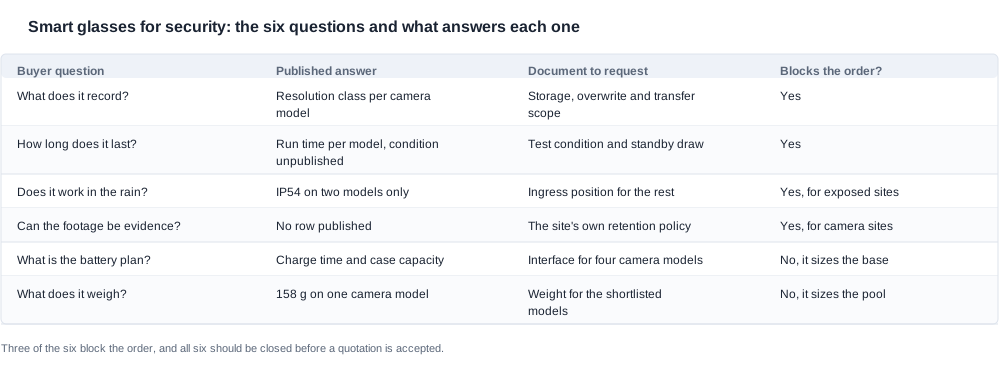
The short version, for a reader who has sixty seconds. What does it record — a resolution class per camera model, with the storage and transfer behaviour unpublished, and that second half blocks a camera deployment. How long does it last on a shift — a rated run time per model, with the test condition unpublished, which blocks any shift longer than the figure unless a spare pool covers the gap. Does it work in the rain — an IP54 marking on two camera models only, so an exposed site has a two-model shortlist until a supplier answer arrives. Can the footage be used as evidence — no published row, and the answer is a site policy, not a catalogue entry. What is the battery plan — published charge times and case capacities per model, with the interface missing on four camera models. What does it weigh — 158 g for one camera model only, and no weight at all for the rest. Three of those six block the order; the other three size the base and the pool.
Who is asking, and what they are actually deciding. A procurement manager, a project lead or an integrator, comparing a camera group, an audio group and a sport group against a site's requirements and a budget. They are not choosing a device for themselves. They are assembling a shortlist they will have to defend to an operations director, and the specific defence they will have to make is: why this model, and what did you do about the things the specification did not say. This article is organised to support that defence.
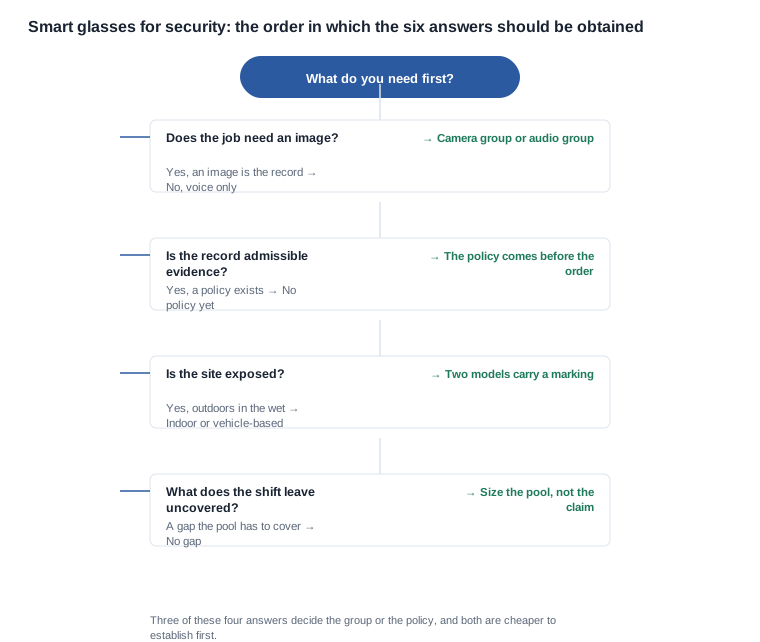
Why the six answers come before the price. The unit price in this category varies with volume, configuration and order size, and it is the number a buyer can obtain most easily. It is also the number that tells them least. The six answers determine which models are even eligible, whether a camera deployment can satisfy a retention policy, and whether the shift arithmetic works — and each of those can remove models from the shortlist entirely. A buyer who negotiates price first is negotiating over a shortlist that has not yet been established. The sequence that works is the one below, and it is the same sequence in every deployment of this type.
The record, the shift and the weight: the three device questions
"What does it actually record?"
The published part. Eleven models in the range carry a camera, and the resolution class is published for each: 8 MP on the KY06 and the CY03, the MT6 and the V03 Pro, and the V06 and the MT5, and the CY05 and the V03, and 13 MP on the S7 and the L2 Utral, and the L1 Pro. That is the whole of the published recording specification. The catalogue also publishes structural features that affect what a deployment can do with the result — a removable inner frame on the V06 and the S7, a foldable charging case on the MT6, a charging case on the KY06 and the MT5 — and a colour-changing lens configuration on the V03 Pro.
The unpublished part, and it is the larger half. There is no published storage capacity for any model, no published overwrite behaviour, no published notification before a limit, and no published route by which a captured file reaches the site's review system. The catalogue publishes no connectivity row for the camera models either, and no Bluetooth version for them. The document to request: a written statement of the storage capacity, the behaviour at the limit, whether a notification is given, and where a file goes after capture. Why it blocks the order: a camera deployment whose retention period is longer than the device's storage, with no warning, produces records that silently disappear, and the site cannot evidence a retention policy it has never checked against the hardware. The product families are at AI camera glasses.
"How long does it last on a shift?"
The published part. Every camera model publishes a run time — five to eight hours on the V03 and the S7, and the V06 and the V03 Pro, six to eight hours on the KY06 and the MT5, and about seven hours on the L1 Pro and the CY05, and the L2 Utral and the CY03, and the MT6. The eight audio models publish between about six and about eight hours, with the G07 and the YK12 at the shorter figure in their tier, and the three sport models publish about seven to about eight hours.
The unpublished part. The test condition behind every one of those figures, and the standby draw for any model — a figure that matters whenever a device sits between patrols rather than on a charge point. The document to request: the test condition, and a standby figure if one exists. Why it blocks the order: a published run time is not a guarantee, it is a report of a measurement, and a buyer who has not seen the condition is comparing a number to a shift without knowing what was measured. The published power rows are at battery life, and the same question in a charging context is at how to charge smart glasses for security.
"What does it weigh?"
The published part. One figure exists in the whole range: the MT6 glasses body at 158 g. Read it precisely, because the number is quoted loosely across the trade. It is the weight of the glasses body, including the 265 mAh battery and the camera, and excluding the foldable charging case; the case capacity is published separately at 1200 mAh and the case's own weight is not published. No bare frame weight is published for any model in the range.
The unpublished part. The weight of every other model, and every frame-only weight. The document to request: the unit weight, stated with its configuration, for each shortlisted model. Why it does not block the order: it sizes the pool and the issue point rather than the decision. It matters more than it appears in two specific cases — a site where the device is carried rather than worn continuously, and a site where a single unit weighs enough to change what an operator will actually do with it. Both are worth asking about, neither is worth blocking a shipment over. A related reading on the long-term behaviour of the device in service is at long-term use.
The rain question, and what the ingress marking settles
"Does it work in the rain?"
The published part. An IP54 marking appears on two models in the entire catalogue — the V06 and the S7. Both are sport camera models, both publish a removable inner frame and a 260 mAh cell, and both charge magnetically. Nothing else in the camera group, the audio group or the sport group carries any ingress marking.
What that marking means, in words that can go on a deployment sheet. A dust protection level, and protection against splashing water. It does not cover immersion, and it does not cover a sustained downpour or a jet of water from a pressure hose — which is worth noting because a surprising number of devices in this category are actually rinsed rather than splashed. No test report behind the marking is published, so the marking can be stated as a catalogue attribute and nothing can be built on top of it.
The document to request: an ingress position, in writing, for every model in the shortlist that will be exposed — including, if the site washes equipment down, a statement about whether it is washable at all. Why it blocks the order at an exposed site: an eleven-model camera shortlist narrows to two on this question alone, and a buyer who has not counted that will discover it after the order rather than before it. The digit reading is at IP ratings, and the deeper treatment of what a marking does and does not settle is at advanced IP considerations.
The evidence question, and the policy it depends on
"Can the footage be used as evidence?"
The published part. Nothing. There is no catalogue row about evidentiary use, about retention, about export, or about the format a file arrives in. The catalogue also contains no reference to CE, FCC or RoHS in its text at all; it carries a company-level export certification page whose content is images rather than text, and there is no per-model certification row anywhere in the range. That means the certification question for a specific model in a specific market is a supplier question to be answered in writing.
Why the answer is a policy and not a specification. Whether a recording can be used as evidence is determined by the jurisdiction's rules and by the site's own procedure, and it has three parts: whether a recording may be made at all in the circumstances, how the file is handled and retained, and who may review it and on what basis. The device cannot answer any of those. What the device can do is determine whether the policy is achievable — which is where the storage answer from the first section comes back in. A retention period, a review cycle, a shift length and a storage capacity have to be compatible, and the buyer cannot demonstrate compatibility until the supplier's answer arrives.
The document to request: the site's own recording, retention and review policy, signed, plus the supplier's written statement of the storage, overwrite, notification and transfer behaviour. Why it blocks the order: the policy has to be signed before the first shipment, and a policy written after the devices are in service is a policy written under pressure, with an obligation already running. The compliance side of the same question is at the certification checklist and the legal framing is at security legal considerations.
The seventh question buyers forget, and why it is the one that decides the order
Between "what does it record" and "what does it cost" there is a seventh question that most procurement conversations skip, and skipping it is what turns a quotation into a negotiation over the wrong thing. The question is not "how much is the unit price" but "what is the total cost of operating this deployment for a year". The published rows make that arithmetic possible, and they make it necessary, because four of the six answers above land in the operating cost rather than in the unit price.
The four that land in operating cost are the base and the pool: the charging hardware implied by the interface row, the spare pool implied by the gap between the shift and the published run time, the consumable rate per device per week, and the replacement rate implied by the inspection results. A fifth lands in staff cost: the recording, retention and review policy, which in a camera deployment creates a role that has to be paid for and a cycle that has to be run. None of these is visible in a unit price, all of them are predictable before the order, and the buyer who assembles them has a defensible total cost rather than a number that a supplier can reduce by shortening a term elsewhere.
This is also why the sequencing matters commercially. A quotation issued against an undefined configuration is not a cheaper quotation; it is an invitation to define the configuration later, under pressure, in response to whatever the buyer has already committed to. The six documents above are what fix the configuration, and a fixed configuration is what makes a price comparable between two suppliers.
The battery plan question, and what it is really asking
"What is the battery replacement plan?"
The question is usually asked as though it were about batteries, and it is not. It is about the charging infrastructure the deployment commits to, and it has two parts that the catalogue answers very differently.
The published part. The charge time is published for every entry in the catalogue: a ceiling of two hours or less for twenty-six of the twenty-eight entries, and about one hour for the D17 and the ZH12. The charging interface is published as magnetic on seventeen models, Type C on seven, and not published at all for four camera models — CY05 and the MT6, and the L1 Pro and CY03. The charging-case position is published with the same three-way structure: a capacity for five camera models (the L1 Pro and CY05, and CY03 — each at 1400 mAh, the L2 Utral at 900 or 1400 mAh, the MT6 as a 1200 mAh foldable case), a case with no capacity published for two more (KY06 and MT5), and no case row at all for the remaining four (S7 and V06, and V03 and V03 Pro), which is an open item rather than a negative answer.
What that means commercially. A magnetic model commits the buyer to a charging point at every location — a fixed asset to be placed, powered, protected, serviced and insured, and a capital line that is usually found after the first invoice because it was never in the product order. A Type C model commits the buyer to a cable, which is a consumable replaced at the base. The four camera models with no published interface cannot be planned for at all until the supplier answers, which is why the interface question belongs in the pre-purchase stage rather than in the base design stage.
The document to request: the charging interface for each shortlisted model, the charging-case status, and the case capacity where one is published. Why it does not block the order but does block the site: it is not a reason to refuse a model, it is a reason to put a question on the list, because the base design cannot be costed without it.
The gap we leave open, and the six documents that close it
The six questions produce six gaps, and the useful output of this article is the list of documents that close them. None of these documents comes from a single source, which is why the answers have to be collected together rather than one at a time.
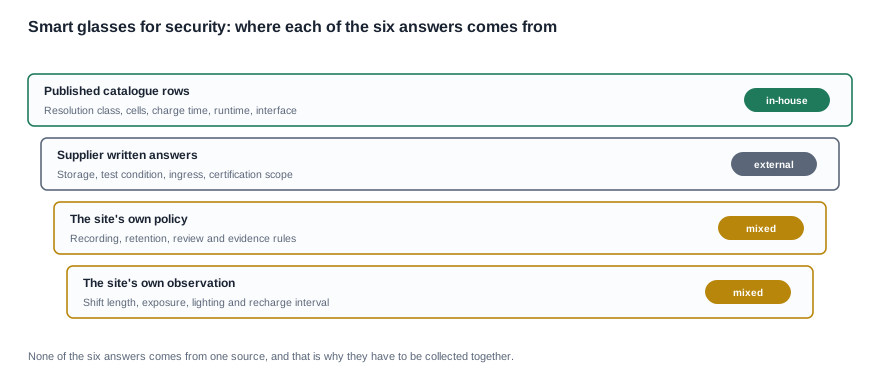
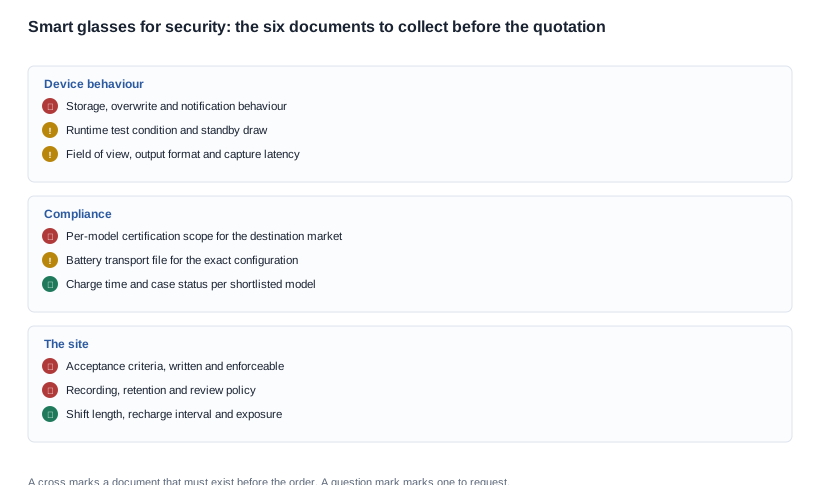
- Storage, overwrite, notification and transfer. From the supplier, in writing, per model. This one document governs whether a camera deployment can satisfy any retention policy at all.
- Runtime test condition and standby draw. From the supplier, in writing, per model. It converts a reported figure into a comparable one.
- Ingress position, test report and the scope of any marking. From the supplier, in writing, for every exposed model. It is what makes the two marked models usable as a shortlist rather than as an exception.
- Per-model certification scope for the destination market. From the supplier, in writing, per model and per market. The catalogue's company-level page is not a substitute and is not a per-model row.
- Acceptance criteria, written and enforceable. From the buyer, before the shipment. A criterion that cannot fail is not a criterion, and this is the document that decides what happens to a unit that does not conform.
- The recording, retention and review policy. From the buyer's own legal and operations functions, signed before the first shipment rather than after the first incident.
A seventh answer is not on anyone's list but decides the order: the unit price, and the total cost behind it — the charging hardware, the spare pool, the consumables per device per week, the replacement rate, and the administrative cost of the policy. A buyer who has the six documents above and prices the total cost is negotiating over a defined configuration. A buyer with only the catalogue is negotiating over a guess.
The boundary we place on what we can answer
We publish the rows a buyer can order from, and we will not fill the gaps with figures borrowed from elsewhere in the industry. For the camera group that means the resolution class, the cell capacities and cell counts, the charge times, the rated run times, the charging interface, the charging-case capacity and case status, and the IP54 marking on the V06 and the S7 stated as a catalogue attribute. For the audio group it means the Bluetooth version, the cell architecture, the charge times, the rated run times, the interface and the published structural features. For the sport group it means the YKC02, the D17 and the ZH12 with their cell architectures, charge times and feature rows.
We do not publish, and will not estimate: the field of view, the video resolution and frame rate, the stabilisation, the low-light behaviour, the storage capacity and overwrite behaviour, the capture latency, the standby draw, the runtime test condition, the thermal behaviour, the operating temperature range, the cycle life rating, the frame and lens material, the coating, the hinge specification, the unit weight of any model other than the MT6 glasses body, or any per-model certification scope. We will not write that a device is tested to IP54, because no test report is published behind that marking, and we make no medical, hearing-aid or corrective-lens claim for any product in the range.
What to send us next. Send the six answers you already have — the job, the shift length, the environment, the recording purpose, the target market and the volume — and we will return the group that can serve it, the models inside it with the published row against each, the six documents listed above with the specific question for each, and the base design the published rows imply. The scenario entry point is smart glasses for security, the model-to-job logic is at security product recommendations, and the operational questions behind these six are at security real-world experience.
Related reading
- The point where the scenario starts — smart glasses for security
- The product family set — AI camera glasses and Bluetooth audio glasses
- The published power rows — battery life
- The ingress reading — IP ratings
Send the job, the shift length and the recording purpose, and we will return the models, the six documents and the questions to put against each.


