

Smart glasses for security: the kit is a records system
A security deployment does not fail at the device. It fails at the record: a shift ends and nobody can say whether the device was running, a lens is too scratched for the footage to be used, a battery is flat at the moment it was needed, and a device does not come back at all. Each of those is a kit decision rather than a product decision, and each of them is invisible in a specification sheet. So the buyer's first question is not what to bring to a test but what has to exist at 06:00 when a device is handed to an officer who was not consulted about the equipment.
Who is buying and what they are deciding. The reader is a brand buyer, a solution architect or a channel buyer specifying a device for a security team, a patrol operation or a serviced site. The decision in front of them is what goes into the box, what is held at the base, what the recording policy is, and which claims the deployment documentation can carry. The fear behind it is specific and expensive: a record that turns out to be unusable, discovered at the point where it matters, with no way to establish whether the equipment or the operator was at fault. That is a contract problem before it is a product problem.
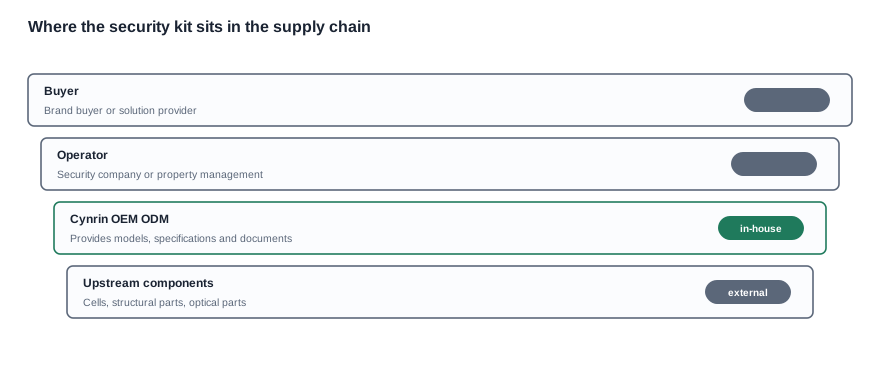
Where the buyer sits, and why the distance matters. The device is bought from a factory, sold by a brand or a channel, issued by an operator, and used by people none of them have met. Every point of that chain is a place where information decays, and the kit is the mechanism that stops the decay: it is how the person issuing the device knows what condition it should be in, how the person using it knows what to do with it, and how the person reviewing the record knows what happened. A kit that omits any one of those three produces a record that cannot be relied on, and no amount of product quality repairs it.
Why two deployments of the same product need different kits. The published position for the camera tier is a resolution class, cell capacities from 220 mAh to 290 mAh, charge times of two hours or less with roughly one hour on the D17 and the ZH12, rated runtimes of five to eight hours, the charging interface per model, colour counts, and case capacities on four models. The audio tier publishes Bluetooth 5.3 on the K01 and the K02 and 5.4 across the rest, cell configurations from 55 mAh × 2 to 90 mAh × 2, rated runtimes of six to eight hours, surround sound and slim detachable temples, and no capacitive touch row, because the catalogue publishes none for any model in the audio tier. Those rows describe the device. What varies between deployments is the interface, the shift length, the environment and the recording purpose — and those four things decide the kit.
What each layer of the kit holds
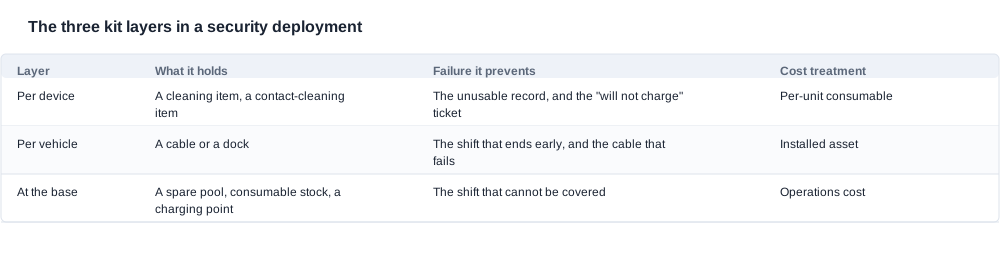
| Layer | What it holds | Failure it prevents | Cost treatment | Who owns it |
|---|---|---|---|---|
| Per device | The device, a cleaning item, a contact-cleaning item | The unusable record, and the "will not charge" ticket | Per-unit consumable | The officer |
| Per vehicle | A cable or dock per device, and a spare or a case | The shift that ends early, and the cable that fails | Installed asset or consumable | The vehicle |
| At the base | Spares or a case pool, consumable stock, a charging point | The shift that cannot be covered | Operations | The base |
The per-device layer carries the two consumables, and they are the cheapest evidence-quality improvement in this category. A scratched lens produces a record that cannot be used, and the lens material and the coating are not published for any model, so the cleaning instruction has to be restrictive rather than permissive — a specified item, a stated prohibition list, one motion. The contact item matters as much, because a device that has been in a vehicle overnight with a dirty contact will not charge, and an officer reports that as a fault rather than a routine. A single-use wipe removes the cross-contamination question that a shared cloth creates across a shift.
The vehicle layer is an installation decision that belongs in the quotation. A magnetic device needs the correct dock at every charging point, which is a fixed asset to be placed, powered, maintained and insured — costs that sit in a different account from the product and are usually found after the first invoice. A Type-C device needs a cable, which is a consumable replaced at the base. The D17 and the ZH12 publish roughly one hour of Type-C charging, which fits a shift break; the rest publish two hours or less, which frequently does not. The charging decisions are at charging solutions, and the published rows are at battery life.
The base layer is where a deployment acquires resilience. Spares or a case pool, consumable stock in a quantity the site can draw from without a purchase order, and one charging point. A site that runs out of consumables on a Tuesday has stopped maintaining its devices, and the symptom appears as a rising rate of "will not charge" reports that nobody connects to the stock. The consumption rate per device per week is the number to negotiate, because it is what the base actually stocks.
The one kit decision that is not a kit decision. Whether a device may record at all, and what happens to the file, is a question the product specification cannot answer. For a security deployment that answer sits in the contract and in the jurisdiction, and the kit has to carry the consequences: a stated recording policy, a defined file-handling route, and a written confirmation in the contract that no claim in the listing characterises the product in a way the documentation cannot support. The deployment thread is at security legal considerations, and the buying-side list is at the security buying checklist.
Smart glasses for security: getting the file set and the numbers in place
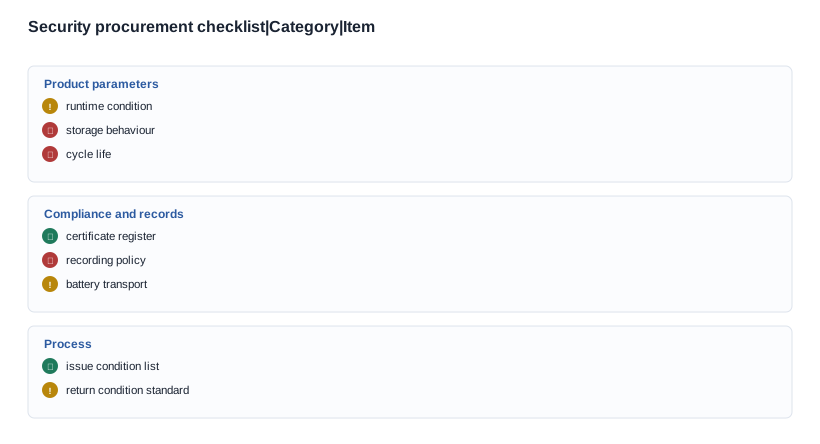
- Ask for the bill of materials by layer, per configuration, in writing. A "what's in the box" answer given verbally is not a bill of materials, and it is the document the issuing point, the freight forwarder and the evidence process all need.
- Ask for the consumable quantities per device per week and the restock interval. "One wipe per device" is not a supply plan; a weekly rate is, and it is what the base stocks against.
- Ask for the storage capacity, the overwrite behaviour and the notification at the limit. Not one of them is published for any model in the range, and all three decide whether a record survives the shift that produced it.
- Ask for the runtime with its test condition, per model, and for the standby draw. A device left idle on a desk between patrols is a standby question, and no standby figure is published.
- Ask for the charging point specification for each vehicle and each base location — power, cable or dock, and the physical protection of the contact.
- Ask for the battery transport documentation for the exact configuration, including the case, at battery transport. A case is a second lithium cell and the requirement is a shipping gate rather than a preference.
- Ask for the ingress position in writing. The IP54 marking on the sport camera models covers splashing water and a dust protection level, not immersion and not a sustained downpour, and no test report behind it is published. The digit reading is at IP ratings. A patrol in the rain is the customer who tests the claim.
- Ask for the frame and lens material and the coating, so the cleaning item and the instruction can be specific rather than generic.
- Look up every certificate number in the issuing body's public register, checking the model on the certificate and the configuration covered, at certification checklist.
- Confirm the model designation on the unit against the paperwork. A security kit has four more things to go wrong in transit than a bare device, and the designation is what makes a loss traceable and an evidence chain intact.
Documents to request before a deposit. The bill of materials by layer with the consumable quantities, the storage and overwrite behaviour, the runtime figures with their conditions, the standby figure, the recording policy position, the charging point specification, the case specification, the battery transport file, the model designation table, the certificate register, and the agreed incoming inspection criteria. For clause language go to contract terms, and for the commercial structure of a first order go to pricing.

Where a security kit goes wrong
A kit planned as two layers instead of three. The device and the consumables get planned, and the vehicle and base layers are improvised on the day, which is when a charging point becomes a cigarette lighter in a car with a flat battery.
A recording policy that is decided after deployment. The device was issued, the record was made, and the question of what may be recorded and what happens to the file has not been answered. It is the most expensive ordering mistake available in this category, and it costs nothing to close before the first shipment.
A condition list that is never written down. Every handover becomes a judgement call made by whoever is least invested in a consistent answer, and the records inherit that inconsistency.
A dock on every vehicle for a magnetic device. The installation and maintenance cost lands outside the product budget and is usually not costed before the order.
Consumables with a quantity but no restock interval. A site that runs out stops maintaining its devices, and the symptom presents as a hardware fault rate.
A permissive cleaning instruction. A rag is what is in a vehicle, and it is abrasive on a coating whose specification is unpublished. The scratch arrives as a soft-image complaint that gets attributed to the camera.
A waterproof claim in the kit card. The marking is published; the report is not, and a patrol in the rain is the customer who tests it.
No count of what went out. A device that does not come back is a device that is bought again, which reads as a repeat sale in the accounts and is a loss in reality. Without a count, the loss rate is invisible and the first sign of it is a budget that does not reconcile.
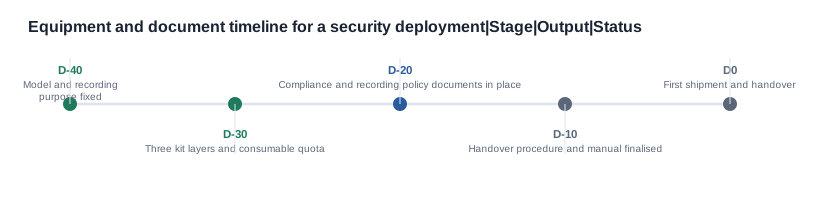
Which parts of the security kit are negotiable
Fixed, and not a negotiation target. The cell configuration, the charging interface, and the three rows they decide: the charge time, the runtime ceiling and the case architecture. The lens material, the coating and the frame material, none of which is published as a row you can order from. Certification cost and lead time. The battery transport documentation. The tooling element, amortised over the first order and quoted apart from the unit price.
Negotiable, in the order the money is. Whether a case is issued per device or held at the base, which is a procurement decision rather than a packaging one. The consumable quantities, the per-unit cost and the restock interval, which together are the highest-return line in the category. Whether the storage behaviour is configurable, which is a real question when the recording purpose is a contract term. Whether a film is included in the shipment, and whether the factory fits it. Whether the supplier supplies the kit template and reviews the handover artwork, and whether they will train a refurbishment partner on the condition list. Minimum order quantity tiers, and whether two models can share a purchase order. Logo, lens tint and packaging. Splitting a first run into two deliveries against a staged payment, which suits a staged team rollout. The units a deployment order stages at pilot tier.
A worked example. Take a security operator running twelve officers across three vehicles, with the record used in weekly incident reviews. The first decision is the recording position, because it determines the documentation and it comes before the equipment. Once that is settled, the interface decision follows: a Type-C configuration is taken — the range publishes it on the D12 and the L2 Utral, the ZH12 and the D11, and the V03 Pro and the D17 — and the D17 and the ZH12's roughly one-hour charging fits a shift break, which moves the charging point from an installed dock to a cable and moves that cost from capital to consumables. The per-device layer is a cleaning item and a contact item in the insert, at a few cents per unit and with no change to the freight weight. The base layer is a spare pool, consumable stock at a stated weekly rate, and one charging point at the depot. The transit file is requested for the configuration with the case in it, because the case is a second lithium cell. The claim set says the IP54 marking covers splashing water and a dust protection level, and does not say waterproof, because no test report is published behind it. The handover count is recorded at every shift change, because without it the loss rate is invisible. The outcome is a kit whose three layers are separately owned, a documentation set that closes the recording question before the first shipment, and a first shipment that produces the returns ratio needed to decide the second year's configuration.
The handover routine, which is where the kit actually lives. The kit list is a document; the handover is the moment it is either used or ignored. It has four steps and each one is a completion standard rather than an intention. The device is charged, checked against the condition list, and confirmed to be recording, and all three are stated at issue rather than assumed. The consumables are replenished, because a kit that runs out is a kit that has stopped being used. The count is updated. The previous shift's issues are returned, and anything that cannot be reissued goes to the refurbishment path rather than back into the pool. A buyer who writes those four steps onto a laminated card at the issue point has converted a per-unit cost into a per-shift routine, and the routine is what makes the consumables worth paying for.
The questions a security buyer should never skip. Four, and they are the ones that look bureaucratic until the first shift. Is the storage and overwrite behaviour published, because a device that silently overwrites the oldest recording produces a gap in the evidence that nobody notices until it matters. Is there a notification before the limit, because a warning and a silent failure are different products. Is the recording position documented, because the kit cannot be specified until it is answered. And is the transit file complete for the configuration with the case, because a case is a second lithium cell and the question is asked at a border.
Smart glasses for security: what we publish, and where we stop
Stated plainly: we publish the rows a buyer can order from and we will not fill the gaps with industry averages. For the security range that means the rated runtimes, the resolution class, the charge times, the charging interface, the cell capacities, the structural features that are published — the removable inner frame on the V06 and the S7, the ultra-slim detachable temples on the G07, the slim detachable temples on the YK12, the remote capture control on the D17 and the ZH12 — the colour counts, the case capacities where they are published, and the IP54 marking on the sport camera models stated as a catalogue attribute.
What we do not publish and will not estimate: the frame material, the lens material, the coating, the hinge specification, the per-model unit weight beyond the single 158 g whole-unit figure for the MT6, the field of view, the video resolution and frame rate, the stabilisation, the low-light behaviour, the storage and overwrite behaviour, the capture latency, the thermal behaviour, the operating temperature range, the cycle life rating, the runtime test condition and the standby draw. We do not put an IP54 test claim on any product in our range, because nothing published behind that marking is a test report, and we do not extend the rating to the camera or audio families where no rating is published at all.
What we will do: take the deployment type, the shift length, the number of devices and vehicles, the recording purpose and the markets, and tell you which models fit, what each kit layer should hold, which published rows apply, and which documents have to be settled in writing before a purchase order. The product families are at AI camera glasses and Bluetooth audio glasses, the charging plan is at charging for security, and the scenario entry point is smart glasses for security.
What to send us next. Send the deployment type, the shift length, the number of devices and vehicles, the recording purpose and the markets, and we will return the three-layer kit with the consumable quantities, the documentation set that has to be settled before the order, and the claims the deployment materials can carry without overreaching. The selection logic is at how to choose smart glasses for security, the field behaviour is at security real-world experience, and the maintenance procedure is at maintaining smart glasses for security.
Related reading
- Where the scenario starts — smart glasses for security
- The families in the range — AI camera glasses and Bluetooth audio glasses
- The buying-side list — security buying checklist
- The recording thread — security legal considerations
Tell us the deployment type, the shift length and the recording purpose, and we will return the three-layer kit.


