
Water resistance is the published row that a smart glasses brand is most likely to over-read and least able to defend once somebody asks a question about it. Two models in our catalogue carry an ingress code — the V06 and the S7 — and in both cases what exists is a catalogue marking with no third-party test report number published behind it. The remaining 26 models carry no ingress row at all, and that is a materially different statement from a negative one: it tells you where the published data stops, not what the hardware does. What follows is written for the procurement team deciding what goes on a product page, into a written specification, and eventually into a purchase agreement.
Three things get conflated around an ingress marking, and separating them is most of the work. The first is what the catalogue marks, and the answer is a code on two model pages out of 28. The second is what an ingress code can be made to carry when no report sits behind it, which is a question about documentation rather than about hardware. The third is what to write, given that the first two may not support the claim a product page wants to make. A buyer who treats those as a single question ends up with either a claim nobody in the retail channel can repeat or a model that has been quietly written out of the range.
One point of scope first, because it decides how the rest of this page should be read: a catalogue marking and a tested result are two different objects, and we do not present one as the other. Where the published evidence stops, this page says that it stops. That is not caution for its own sake: a sport and cycling brand that puts a narrow, defensible protection position in writing spends less time defending it than one that publishes an adjective the evidence does not carry.
What the catalogue marks and what it does not
Across the 28 model pages in the catalogue, an ingress code appears twice. Both occurrences sit on camera model pages, and in both cases the code is printed as one of four short feature lines rather than as a specification row with a value attached to it. The two models are the V06 on page 18 and the S7 on page 19, and they are the only two models anywhere in the range for which any ingress marking is published at all.
The V06 page prints an ergonomic frame, a long battery life, a detachable inner frame and the IP54 code, plus four colour options — orange, white ice blue, black and black ice blue. The S7 page prints an ergonomic frame, a thirteen-megapixel camera, a detachable inner frame and the same code. In both cases the code sits inside a list of product descriptors rather than inside the block of measured specifications, and that placement is itself information for a buyer: the catalogue treats it as a feature it can state, not as a measured value it can cite.
What stands behind those two codes is the part that decides what can be written. The catalogue publishes no test report number for the V06 or the S7, no reference to a test standard, no laboratory, no sample designation, no test date and no statement about whether the units that ship are the units that were tested. A full-text check of the catalogue confirms that the code appears in exactly two places and that no report identifier appears anywhere near either of them. The marking is therefore a catalogue annotation, and we describe it that way: the catalogue marks these two models IP54, with no third-party test report number published.
That distinction carries a commercial consequence which is easy to miss. An annotation can be quoted on a listing; a certification claim cannot be derived from it. If a brand's documentation for a destination market requires a numbered report, then these two models can enter the range with the marking printed, but the compliance file behind it has to be requested separately for the model string and the market in question. A brand budgeting one evidence request per model should note that only two models in this range have a marking to request evidence against, and the other 26 have no published ingress position to request against at all.
The other 26 models need a different sentence, and getting that sentence wrong is the most common error in this category. The catalogue publishes no ingress rating for the nine camera models that do not carry one, for the three models in the sport tier, for the eight audio models, for the three child models, or for the three entries listed without a model number. That is what the catalogue does not publish. It is not a statement that those units are unprotected, and a product page saying so has made a claim the catalogue cannot support — just as a product page saying the V06 and the S7 are waterproof has made a different claim the catalogue equally cannot support.
There is a practical reason to be careful in both directions at once. The omission may be a decision about catalogue space rather than a decision about the hardware, and a buyer who writes "no water resistance" onto a product page has converted an editorial gap into a warranty obligation. A buyer who writes "IP54" onto a product page has converted an annotation into a performance promise. Neither conversion is free, and the reason for writing the sentence the catalogue actually supports is that it can be repeated by a distributor, printed on a carton and defended in a support call without anybody improvising.
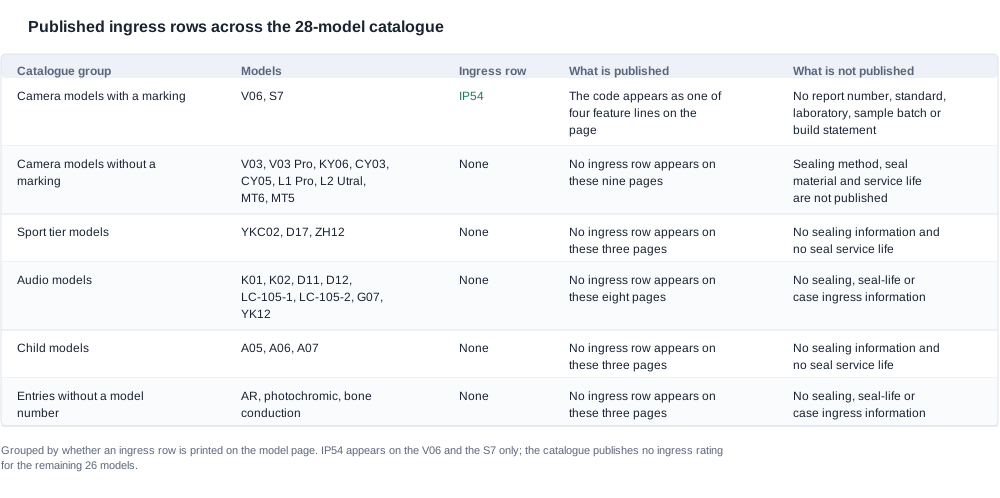
The table below sorts all 28 models by whether an ingress row appears on the page, and records what each group actually published. It is the shortest form of the answer that survives a retailer question.
| Catalogue group | Models | Ingress row | What is published | What is not published |
|---|---|---|---|---|
| Camera models with a marking | V06, S7 | ^IP54 | The code appears as one of four feature lines on the page | No report number, standard, laboratory, sample batch or build statement; no charging-case row |
| Camera models without a marking | L1 Pro and KY06, MT5 and V03 Pro, L2 Utral and MT6, and CY05 and CY03, and V03 | None | No ingress row appears on these nine pages | Sealing method, seal material and service life are not published |
| Sport tier models | YKC02, D17, ZH12 | None | No ingress row appears on these three pages | No sealing information and no seal service life |
| Audio models | YK12 and K02, G07 and LC-105-2, D12 and LC-105-1, and K01 and D11 | None | No ingress row appears on these eight pages | No sealing, seal-life or case ingress information |
| Child models | A05, A06, A07 | None | No ingress row appears on these three pages | No sealing information and no seal service life |
| Entries without a model number | AR, photochromic, bone conduction | None | No ingress row appears on these three pages | No sealing, seal-life or case ingress information |
The distribution is better read as three counts than as one. Among the five sport-related models in the range — the YKC02, the D17 and the ZH12 from the sport tier, plus the V06 and the S7, which the catalogue names as sport camera glasses — two carry a marking and three do not. Among the eleven camera models the same split appears: two carry it, nine do not. Across the remaining fourteen entries, none carries one. Any range plan that assumes an ingress story running through a tier is assuming something the catalogue does not support.
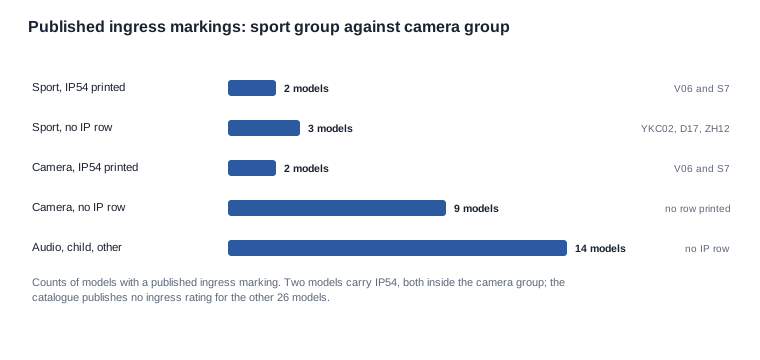
The charts count published markings per group rather than published model names, because the number that matters for a range plan is how many models inside a tier can carry an ingress line at all. Two is a shortlist, not a range.
Reading an IP marking that carries no report number
An ingress code is two digits describing separate exposures, and the first mistake in reading one is to treat it as a single number. On these two models the first digit is a five, which covers the ingress of solid particles into the enclosure, and the second is a four, which covers water splashing against the enclosure from any direction. The code therefore describes neither a seal against a water jet nor a unit that has been under water. That much is general knowledge about the code itself, and it is the part a distributor can be taught in a single sentence.
The second mistake is more expensive, because it happens inside the documentation rather than in the conversation, and it is the more frequent of the two pitfalls. A marking becomes usable evidence only when five further things travel with it: what was tested, against which standard, by which laboratory, on which sample, and whether the production batch matches that sample. None of the five is published for the V06 or the S7, which is why the catalogue page cannot serve as the evidence however the page is formatted. What exists for these two models is a printed code; what a compliance file requires is a numbered report, and the two have different owners and different costs.
For the V06 and the S7 the published position is narrow, and we will state it plainly to any buyer who asks. The catalogue marks these two models IP54, with no third-party test report number published, and we do not present that marking as a certified result or imply that a certification exists. Buyers who need a document for a market-access file are asking a legitimate question, and the answer is that the report has to be requested for the model string rather than inferred from a feature line. We will also say which files we do hold when the question is asked, so that the buyer is not left holding an open item that nobody owns.
The evidence a marking can sit at falls into four levels, and knowing which level a given question occupies tells you how much time the question deserves.
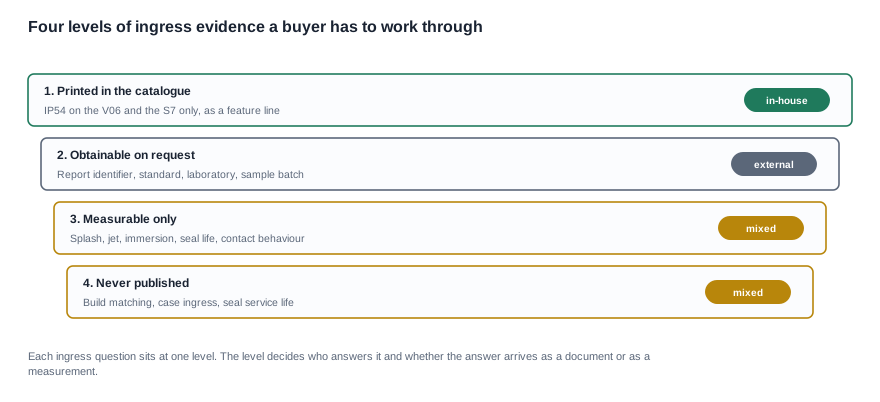
The bottom level is the one that closes fastest and the one most often left undone. The catalogue publishes no sensor model, no field of view, no frame rate, no video format and no storage detail for any camera model, and it publishes no seal material, no service life for the seals and no case ingress status anywhere in the range. Those gaps cannot be closed by reading the pages more carefully; they are measurement tasks, and they belong in a sample protocol with a written observation set rather than in a specification that expects a supplier to supply them from experience.
One further layer runs alongside all of this and is routinely confused with it. An ingress code is a performance characteristic; the documents that permit a product to be sold in a destination market are a separate question with a separate file. The catalogue lists a company-level export certification page whose content is images rather than text, and the written catalogue carries no CE, FCC or RoHS reference. There is no per-model certification row anywhere in the range. The ten images on that page are patent certificates, eight of them appearance designs and two utility models, which document intellectual property rather than market access for a product. A brand therefore cannot infer a conformity file from a marking, and the frameworks a programme can legitimately name — the Radio Equipment Directive (EU) 2014/53/EU and the EMC Directive 2014/32/EU — still require per-model and per-market evidence that has to be requested in writing.

The sport and cycling models the question applies to
A cycling programme and a general sport programme do not draw on the same part of the catalogue, and the ingress question applies to a specific set of models rather than to the range in general. The catalogue's own sport tier is three models — the YKC02, the D17 and the ZH12 — and two further models sit inside the camera section while being named as sport camera glasses: the V06 and the S7. Those five are the models an outdoor brand is actually choosing between, and they fall into two groups with nothing in common on this question.
The two that carry the marking are the V06 and the S7. The V06 publishes 8 MP, a 260 mAh cell, a rated runtime of five to eight hours, a charge time of two hours or less, magnetic charging, an ergonomic frame, a detachable inner frame, four colour options and the IP54 code. The S7 publishes 13 MP, a 260 mAh cell, the same five-to-eight-hour runtime, the same two-hours-or-less charge time, magnetic charging, an ergonomic frame, a detachable inner frame and the same IP54 code. Two further details matter for a protection argument and are easy to miss. Neither page publishes a charging-case row, so the accessory that carries the magnetic contacts is itself unspecified for both of them. And both publish a detachable inner frame, which introduces an interface that is opened every time the unit is put on or taken off.
The three that do not carry a marking are the YKC02, the D17 and the ZH12. The YKC02 publishes Bluetooth 5.4, a pair of 70 mAh cells, a charge time of two hours or less, roughly eight hours of runtime, magnetic charging, surround sound and a long battery life row. The D17 publishes Bluetooth 5.4, a 115 mAh cell, roughly seven hours of runtime, a charge time of about one hour, Type-C charging, a remote control photo row and surround sound. The ZH12 publishes Bluetooth 5.4, a 100 mAh cell, roughly eight hours of runtime, a charge time of about one hour, Type-C charging, a remote photo row and stereo surround sound. The catalogue publishes no ingress rating for any of these three, and the two models that charge fastest in the whole range are also the two that publish no marking at all.
That combination is the structural problem in any outdoor range plan. The remote shutter and the ingress marking sit on different models: the D17 and the ZH12 publish a remote shutter and no marking, while the V06 and the S7 publish a marking and no remote shutter. A range based on the sealed camera models cannot add the remote shutter without a development, and a range based on the remote shutter models carries no ingress line at all. Both are legitimate choices, and neither should be discovered at the artwork stage.
Two configuration questions follow from the published rows, and they are the ones a document and a sample answer between them. The first is the joint. A detachable inner frame introduces a seam that is closed in one configuration and open in another, so a marking written for one configuration does not describe the other. The second is the contact surface. A magnetic charging model presents an exposed mating surface at the temple, which is the most direct path available for water to reach the electronics, and the question of whether the marking was taken with the contacts capped, with the case attached, or with the contacts exposed describes three different products. Where the accessory is unspecified — as it is for both models carrying the marking — the configuration question cannot be closed from the catalogue alone.

Turning the marking into a written condition
A marking becomes usable the moment it is written as a condition with an owner, and a condition has four parts: what is claimed, on which configuration, with which exclusions, and what document is attached to the claim. A page that carries the code and nothing else has written one part of four. That is the practical reason why the wording on a product page, in a specification and in a purchase agreement has to be decided together rather than in sequence.
Three questions decide the wording, and asking them in this order matters because each one narrows what the next one can be.
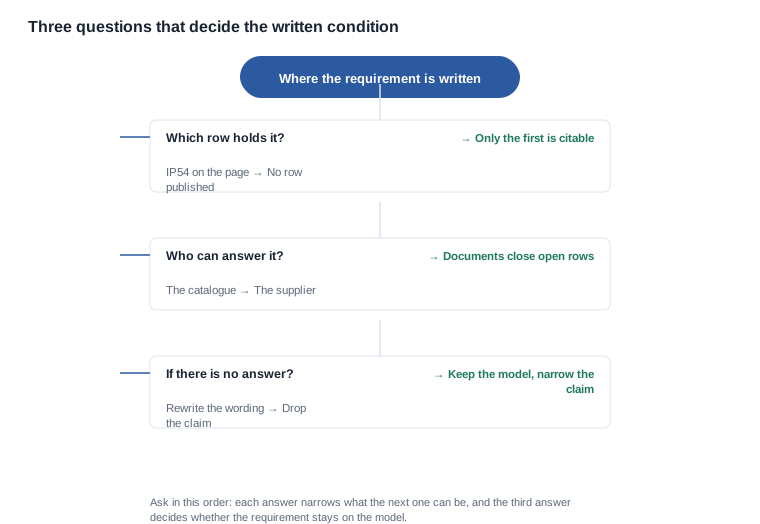
The first question is where the requirement is written. If it lands in a marketing brief rather than in a purchase agreement, the answer is a page and the evidence burden is light. If it lands in an agreement, the answer is a document and the burden is a numbered report. Brands routinely discover that difference at the moment a retailer asks for the paperwork, and the cost of moving a requirement from one place to the other after tooling has started is higher than the cost of deciding it at the beginning.
The second question is who can answer it. A published catalogue row is closed for the models that have it and open for the models that do not. A document closes the open rows, but only for the model string it names and only for the configuration it describes. A measurement closes the remainder, and a measurement is a cost that has to be planned rather than discovered. Assuming the supplier holds every document is what produces the unanswered question at the second order.
The third question is what happens when the answer never arrives. The options are to rewrite the requirement so that it rests only on what can be evidenced, or to remove the requirement from the model that cannot support it and carry it on a different one. Neither outcome is a failure of the programme, and the trade-off between them is deliberate. A narrow requirement that is met is worth more than a broad requirement that is disputed, and a range that survives one question from a distributor is a range that can be extended later without rewriting the paperwork.
The due diligence on this topic is short enough to send in a single request, and it should be sent with the model names and the destination market in the message rather than as a general enquiry.
- The test report behind the marking on the exact model, with its identifier, the standard applied, the laboratory and the sample designation.
- Whether the rating was taken with the inner frame fitted and with the charging contacts capped, exposed, or with the case attached.
- A written statement that the production batch matches the tested sample in housing, seal and accessory configuration.
- What the marking excludes — immersion, water jets, salt water, temperature extremes — and any orientation or duration limit attached to it.
- Whether the result is a single type test or part of a routine production control, and if the latter, how often that control runs.
- Which environment was used: fresh water, salt water, sweat simulant or a neutral spray, and whether the adhesive had cured before the test.
- Whether the case, the remote control or the spare inner frame changes the answer, and which configuration a buyer should quote.
- What happens to the claim if the build changes, since a marking belongs to a build and not to a product name.
A shortlist criterion set for this question is worth writing down before you commit to a range, because the first thing a sample invites judgement on is appearance. Four criteria carry the weight, and each of them can be checked against a published row, a document or a measurement:
- A marking that can be cited with its wording intact, together with the wording of what it excludes.
- A build statement that matches the configuration actually being ordered.
- A warranty position consistent with both of the above and with the exclusions, on the model each claim is written for.
- An evidence request that has a named owner and a date against it.
Anything a supplier cannot answer from a document should not be a criterion at all, because a criterion that cannot be enforced by a second party at incoming inspection is a marketing line.
The sample covers what documents cannot, and it works best as a written protocol rather than as an afternoon with a sink. A useful protocol names the exposure, the duration, the state of the charging contacts, the state of the frame joint and the observation criteria — whether the unit functions afterwards, whether water is visible inside, whether the controls behave and whether the charging contact still works. Five observations repeated across several units give a brand something it owns, and the results belong in the programme file next to the published row rather than in a support inbox. That file is also how to verify the answer against the build that actually arrives, which is the one check no supplier can perform on the buyer's behalf.
The warranty is the line where a narrow claim quietly becomes a broad one. If the terms cover a unit that has been immersed, the claim has been widened whatever the product page says, and eventually the page and the terms contradict each other in front of a customer. Where immersion is excluded, the exclusion belongs in the warranty wording as visibly as the marking appears in the listing. The warranty wording itself is not published on our side either, which means it is negotiated for each programme rather than inherited from any template.
The smart glasses for sports and cycling brands water resistance
Two sentences cover the published position on the V06 and the S7, and they are deliberately narrow. The catalogue marks two models IP54 — the V06 and the S7 — with no third-party test report number published, and it publishes no ingress rating for the other 26 models. We will publish that wording as it stands, we will not extend the marking onto a model it was never printed on, and we will not attach a waterproof or immersion claim to either of the two that carry it. Where a programme needs a document for a destination market, that document has to be requested for the model string and the market, and we will say plainly which files we hold and which we do not.
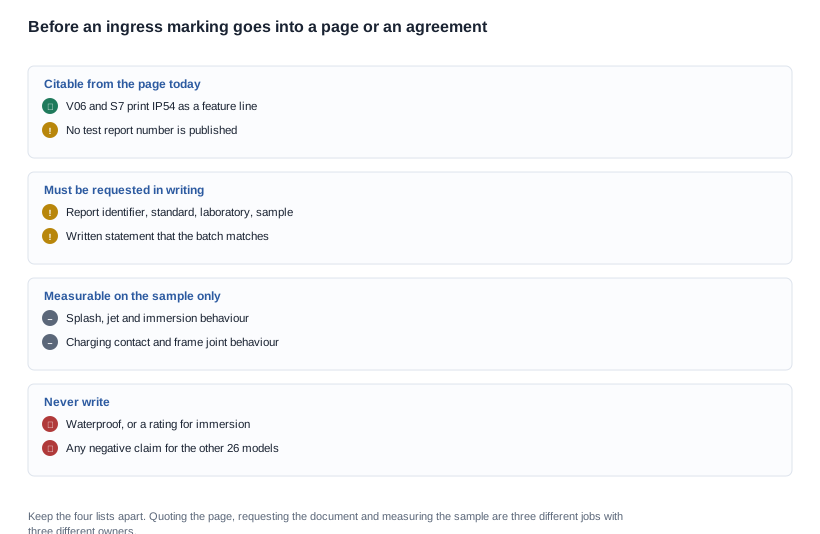
The checklist below separates what a page may quote from what has to be requested, what has to be measured and what must never be written. Keeping the four lists apart is what stops a reasonable question from turning into an unreasonable claim, and it is the shortest version of the whole argument that can be handed to a copywriter, a packaging designer and a distributor at the same time.
Commercially, the terms that usually sit next to this one in a briefing are not published on this site and are confirmed per enquiry: unit price, minimum order quantity, lead time, sample cost and warranty period. A sample order is the right instrument for the questions a specification cannot settle — the behaviour of a wet charging contact, the fogging of a lens at speed, the feel of a joint that is opened on every ride — and it is worth testing the complete retail configuration rather than a bench unit with the accessories set aside. Two hours or less is the published charge-time ceiling on the two marked models and is a ceiling rather than a typical figure, so it should be quoted as a ceiling wherever it appears in a programme document. The wider programme structure for this audience sits under sports and cycling brand solutions, the models in scope are listed on the sport smart glasses range page, and the IP ratings reference sets out what each digit of the code describes.
The last point is about where the requirement is written, because that decides whether the evidence request is worth making at all. A requirement that appears only in a listing has a good chance of being argued on a phone call. A requirement that appears in the specification and in the purchase agreement, with the configuration it belongs to and the document that closes it, is answered once and holds for the life of the programme. That is the difference this page is trying to make: a marking on two models is not much of a range, and the way it is written is what decides whether it becomes a liability or a defensible line.
Related reading
- Verifying an ingress claim with a supplier — IP rating supplier verification
- What a sample can settle that a page cannot — measuring an IP rating
- The sport range and its published rows — sport smart glasses water resistance options
- How the sport tiers divide the range — sport product portfolio
- The paperwork side of the same programme — certification support
Send us the models, the environments they have to survive and the destination markets, and we will say which ingress rows exist, which documents close them and which requirement has to be reworded.


